A Spring Trip to Laojun Mountain in Luoyang during the Qingming Festival 2024
There are several scenic areas called Laojun Mountain in China. It is said that the one located at the main peak of the 800-li Funiu Mountain range in Luanchuan County, Luoyang City, Henan Province, the ancient capital of thirteen dynasties, with Yuhuangding Peak at an altitude of 2,217 meters, has a human history spanning over two thousand years. During the Spring and Autumn period, Laozi (Li Er), the founder of Taoism, came here to retire and practice, making it the "origin of Tao" and "ancestral temple." Laojun Mountain is now a UNESCO Global Geopark, a National 5A-level Tourist Attraction, and is hailed as "the unparalleled sacred land under heaven, the first immortal mountain in the world."
1. Public Transportation to Laojun Mountain
After arriving in Luoyang by train, you can conveniently take direct buses from Luoyang Bus Station, Huadu Bus Station, or other coach stations near the Luoyang Railway Station to Luanchuan and the scenic area. The journey takes about 2.5 hours. Generally, you can visit the main scenic area of Laojun Mountain and return to Luoyang on the same day. If time permits, you can also explore Zhaigou Valley and Zhuimeng Valley. It is recommended to download and follow the "Shendu Chuxing" app on your phone to book tickets for a 7-seat "customized bus" (60 yuan/person) or a 33-seat "regular bus" (38 yuan/person). Get off at Luanchuan Geological Plaza Station, which is the Laojun Mountain Tourist Service Center. Then take two shuttle buses to get near the cable car lower station (shuttle fees: 5 yuan/person + 15 yuan/person).
2. Laojun Mountain Tour Route
The way to reach the summit depends on your interests, physical fitness, and available time. Laojun Mountain has the facility to take cable cars all the way to the top. That is, first take the Yunjing Cable Car / Zhongling Cable Car (first-level cable car) from the foot to Zhongtianmen; then transfer to the Fenglin Cable Car / Sightseeing Cable Car (second-level cable car) from Zhongtianmen to Yuhuangding. Our approach was to take the Yunjing Cable Car to Zhongtianmen (round-trip ticket for the first-level cable car: 130 yuan/person, about 10 minutes); then hike from Zhongtianmen uphill (about 1.5 hours) to Ten-mile Painting Gallery → Mazzong Ridge → Glass Observation Deck → Golden Summit Taoist Complex (it takes about 2 hours to circle the Ten-mile Painting Gallery and reach the Golden Summit Taoist Complex). For the descent, take the Fenglin Cable Car → Zhongtianmen → transfer to the Yunjing Cable Car down. With stops for photos, it took about 6 hours to complete the main scenic area. It is recommended to download the "Laojun Mountain Scenic Area" app for more information, ticket booking, and smart services.
3. Main Scenic Area of Laojun Mountain
The bronze statue of Laozi at the Laojun Mountain Laozi Cultural Garden was listed by Guinness World Records in 2014 as the "Tallest Bronze Statue of Laozi." On the way from the main entrance to the lower station of the Yunjing Cable Car via the shuttle bus, a warmhearted driver kindly stopped briefly, allowing us to take this photo from the bus.
The Yunjing Cable Car / Zhongling Cable Car (first-level cable car) are two parallel cable cars. The tickets are interchangeable. The cable car ride takes about 10 minutes to Zhongtianmen. It is said that if you don't take the first-level cable car and hike up, the 19-km winding road is not only physically demanding but also offers mediocre scenery. In front of the Zhongtianmen archway square, there is a statue of Laozi riding an ox. The couplet on the archway is quite meaningful: The first line: "Laojun Mountain, mountain lord old, mountain old lord never old"; the second line: "Mysterious Gate Tao, gate mysterious Tao, mysterious gate also mysterious." It is said this couplet was jointly created by literati from both sides of the Taiwan Strait.
Take out the walking stick, ready to climb!
From Zhongtianmen, ascend 518 steps to the Jiuku Hall. Originally built in the Tang Dynasty, it was destroyed by fire in the late Qing Dynasty and rebuilt in 2004. It enshrines Taiyi Jiuku Tianzun. The legend of Jiuku Hall originates from the story of the filial son Dong Ping saving his mother.
Guanyin Hall: As a Taoist ancestral temple, Laojun Mountain also houses a Buddhist Guanyin Hall, reflecting the spirit of inclusivity and mutual integration of Confucianism, Taoism, and Buddhism in China—harmonious yet diverse.
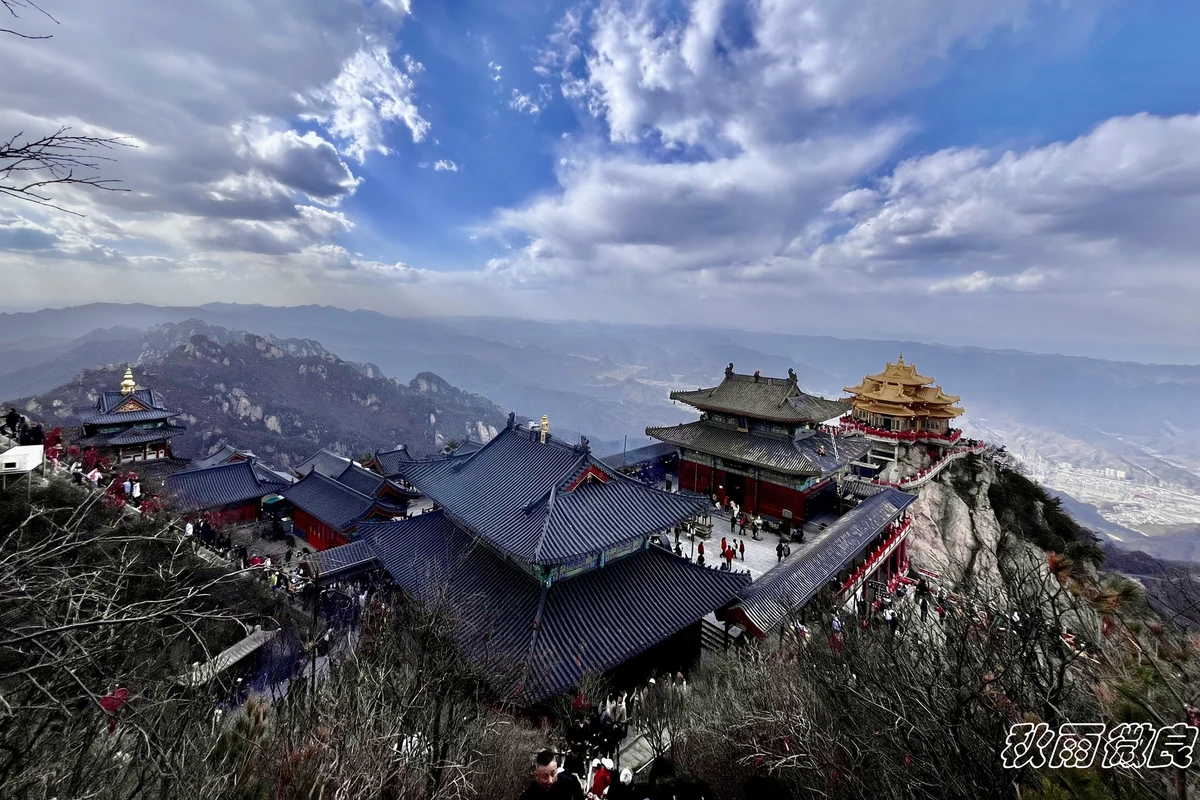
Viewing the Golden Summit Taoist Complex from the Feiyun Plank Road in the distance.
"On the north slope of Junshan, ice has not melted; on the south bank of Yishui, flowers are blooming." This vividly describes the climate of Laojun Mountain. Laojun Mountain is known as Luoyang's "summer resort." The temperature difference between the mountaintop and the base is significant. During Qingming Festival, there is still snow in shaded areas, and even in summer, it's advisable to bring a warm coat.
Walking into the Ten-mile Painting Gallery, look into the distance at the Fenglin Cable Car from Zhongtianmen to the Ten-mile Painting Gallery.
The Laojun Mountain Via Ferrata is built on the majestic, perilous,奇特, and beautiful peaks. Starting at the entrance of the Ten-mile Painting Gallery and ending at Nantianmen, it is about 600 meters long. Standing on the cliff, you can appreciate the scenery similar to Zhangjiajie in the south from a different angle, testing your courage and stamina, and maybe experiencing another thrill.
Entering the stone forest scenic area of the most beautiful "Ten-mile Painting Gallery" on Laojun Mountain.
The prominent scene on the peak at the right side of the image is named "Laozi Preaching."
The large rock in the center of the image is called "Bajie Visiting the Immortal," with what looks like an elephant's head behind it.
The graceful stone figure at the turn of the plank road in the center is named "Fairy Greeting Guests."
The photo shows the "Seclusion and Enlightenment" spot.
"Love Nest"—a popular photo spot.
"Wonderful Steps of Lotus."
To reach the Golden Summit, there was originally a steep path. Fortunately, in June 2023, an escalator with a vertical rise of 80 meters was completed, greatly facilitating the already exhausted climbers, especially the elderly and children, and saving a lot of time. (4 sections of escalator, 40 yuan/person). Taking this convenient route may cause you to miss some scenery.
The Golden Summit Taoist complex on Laojun Mountain, built on the mountaintop, mainly includes the Laojun Temple, Daode Hall, Five Mothers Golden Hall, Liangbaotai, Yuhuangding, Bell and Drum Towers, Nantianmen, Chaoyang Cave, Dadao Courtyard, Shinto Skybridge, and corridors. All adopt the architectural style of Ming and Qing imperial palaces. The creation of the three golden domes—Jindian, Liangbaotai, and Yuhuangding—is the highlight of the Laojun Mountain Taoist Complex.
In the square between Laojun Temple and Daode Hall, a huge dragon-shaped bronze ruyi (scepter) is placed. Tourists come to touch it for auspiciousness.
Daode Hall, originally called Laozi Tower, is one of the core buildings of the Golden Summit complex.
Jindian (Golden Hall) is built on a separate peak called Shairen Mountain north of Laojun Temple. Legend has it that this is where Nüwa dried clay figures when creating humans. Jindian is also called the Five Mothers Golden Hall, enshrining five deities: Tianhuangmu, Dihuangmu, Renhuangmu, Xiwangmu, and Wuji Laomu. They are in charge of the reproduction of heaven, earth, and humanity. The hall is a triple-eave cross-ridge building, with large ornaments and mythical beasts on the ridges, and a gilded gourd-shaped top, magnificent and grand. The couplet by the door reads: "Five Mothers surround the compassionate clouds, heaven and man together look up; Three Pure Ones condense Taoist energy, sun and moon share the brilliance." The small bridge between Jindian and Daode Hall is called Meeting Immortals Bridge.
Liangbaotai, also known as the God of Wealth Hall. The steps leading to Yuhuangding and Liangbaotai are very steep. People have to hold onto the shaky iron chains on both sides as they climb. Due to the large crowd and the strenuous climb, we followed the crowd up to Liangbaotai.
View of Yuhuangding from Liangbaotai. Later, I heard a legend that one peak is for seeking wealth and the other for seeking official positions, and you cannot seek both. Thinking it over, it makes some sense.
Overlooking the Taoist complex from the golden dome of Liangbaotai, feeling very pleasant.
4. Zhaigou Valley Scenic Area
Zhaigou Valley is part of the Laojun Mountain scenic area, located on the east side. A convenient way to enter Zhaigou Valley is to take the shuttle bus from the Geological Plaza Tourist Service Center. Since we were not familiar with the area, we took a taxi directly from the east exit of Laojun Mountain via Zhaigou Reservoir to the ticket checkpoint. During the off-season, there was no shuttle bus at the checkpoint to Zhaigou, so we had to walk about 3 km to reach it. Fortunately, a kind person gave us a ride to the entrance. Of course, self-driving cars can enter with a ticket.
Zhaigou Valley has a 4-km one-way road around the Dongtian River, with about 20 small scenic spots scattered from the Imperial Bamboo Grove to Dongtian Waterfall. The valley has concrete paths and plank roads. Although the Dongtian River had little water during the dry season, its fresh air, babbling water, lush green mountains, blooming wildflowers, gentle paths, and few visitors make it a good place for a leisurely walk. Looking at the inscription of "Dongtian River," I wonder if it is by Mi Fu, the great calligrapher and painter of the Northern Song Dynasty.
As for the 20 scenic spots in Zhaigou Valley, I think most have no distinctive features, but I feel they must have their meanings and allusions. The photo shows the Dongtian River and the Imperial Bamboo Grove.
This is the first time I have seen a tree with yellow flowers. After checking on my phone, I learned it is Cornus officinalis (dogwood).
A statue of Laozi beside Wenfeng Waterfall.
We visited Laojun Mountain rather hurriedly. During the Qingming Festival, there were not many flowers, the leaves of deciduous trees had not fully sprouted, the water flow was not large, and the whole mountain still looked somewhat gray. I missed several scenic spots without knowing how... Although the experience was good, I inevitably felt some regret. Laojun Mountain, we leave our expectations to you—"just to meet you again."


