A Glimpse of Macau (Part 3)
Leaving the Casa Garden, walk along Calle da Praia, Calçada do Carmo, and Rua do Governador Tamagnini Barbosa, and arrive at the world-famous food street—Rua da Cunha. Most of the old city of Macau is built on hillsides; "calçada" seems to refer to steep mountain paths, and the so-called "main roads" wind and undulate unpredictably due to the terrain, often being one-way slopes. Many cobblestone streets appear somewhat narrow, with sidewalks so tight that one can only pass sideways. Yet when strolling along the streets, one finds the roads are clean, businesses never encroach on the pavement, police are rarely seen, and there are no "traffic assistants" or "urban management officers." Pedestrians and vehicles move in an orderly manner, buses run frequently, bicycles are rare, and the few motorcycles weave through alleys. Traffic is congested but not jammed.
The Civil Registration Office of the SAR Government sits across from the Carmo Church.
Interior of the Civil Registration Office
Calçada do Carmo, Taipa
Calçada do Carmo, Taipa
Rua do Governador Tamagnini Barbosa, Taipa, with its narrow sidewalk
Rua do Governador Tamagnini Barbosa, Taipa, where buses flow continuously on the narrow, steep road
Calçada da Barra, a sidewalk wide enough for only one person
Rua da Cunha is a small street about 5 meters wide and 115 meters long, yet it gathers dozens of Chinese and Western eateries, especially restaurants attracting diners with Portuguese cuisine. It brings together culinary delights from the East and West, with aromas filling the air. It's a paradise for food lovers, and being far from the peninsula, there are few tourists, so one can enjoy freely.
Rua da Cunha on Taipa Island is Macau's renowned food street, offering a vast array of Chinese and Western snacks.
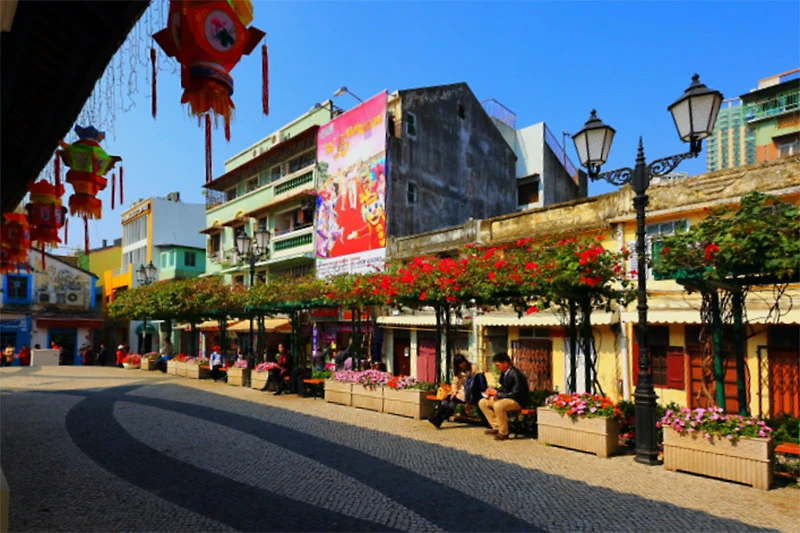
Largo do Edifício dos Bombeiros on Rua do Almirante Sérgio, Taipa Island, adorned with flowers all along the street.
The Commandante Building beside Largo do Edifício dos Bombeiros on Rua do Almirante Sérgio, Taipa Island, home to the famous Puppet Portuguese Restaurant.
Old Macau is built on hillsides, mostly consisting of Portuguese-style buildings of two or three stories, with exteriors painted in yellow, red, green, pink and other colors, decorated with patterns or even murals—vibrant yet not gaudy, full of European exotic charm. Macau has limited land and a dense population. To meet development needs, generations of Macau people have been reclaiming land from the sea for centuries, continuously expanding the territory. The area has gradually increased from 10.28 square kilometers at the end of the 19th century to today's 32.8 square kilometers, with most obtained from land reclamation. The new urban areas built on reclaimed land are filled with high-rise buildings, including skyscrapers for banks, hotels, and commercial firms, as well as row upon row of high-rise apartments—their density exceeding that of high-rise residential areas in central Shanghai. While most residences are Western-style buildings, one can also occasionally see traditional Chinese houses and temples.
Street view and residential buildings at Largo do Edifício dos Bombeiros, Taipa.
High-rise residential buildings on Avenida Panorâmica do Lago Nam Van.
Although most residences in Macau are Western-style buildings, Chinese-style houses can also be seen from time to time.
The I Leng Temple in Taipa, located on Rua do Governador Tamagnini Barbosa, with shrines to the Dragon God and the Earth and Wealth Gods at its entrance.
A gun shop in Macau on Rua da Santa Sancha, with an Earth God shrine at its entrance.
At the entrance of a residence, a shrine to the Earth God is also placed.
Many shops and homes have shrines to the Earth and Wealth Gods at their entrances, with incense burning continuously—a sight rarely seen even in remote rural areas of Mainland China.
At Rua do Almirante Sérgio, I found a bus stop and took bus number 11 to leave Taipa. There are many bus routes between the Macau Peninsula and the outlying islands, with frequent services. However, due to the narrow roads and many one-way streets in Macau, many buses operate on circular routes. On buses, only Macau patacas are accepted, with no change given. The fare in the city is 3.2 patacas per person, 4.2 patacas to Taipa, and 5 patacas to Coloane, so passengers need to prepare small change before boarding. Many orange buttons are installed on handrails and between windows. I learned that if someone wants to get off at a stop, pressing the button alerts the driver to stop and open the door. Riding the bus on narrow, winding roads, jolting up and down with the terrain, weaving through dense buildings and pedestrians, turning and twisting through alleys until one loses all sense of direction—it's a unique experience.
Bus stop on Rua do Almirante Sérgio, Taipa Island.
Bus number 11 heading from Taipa to the Macau Peninsula.


