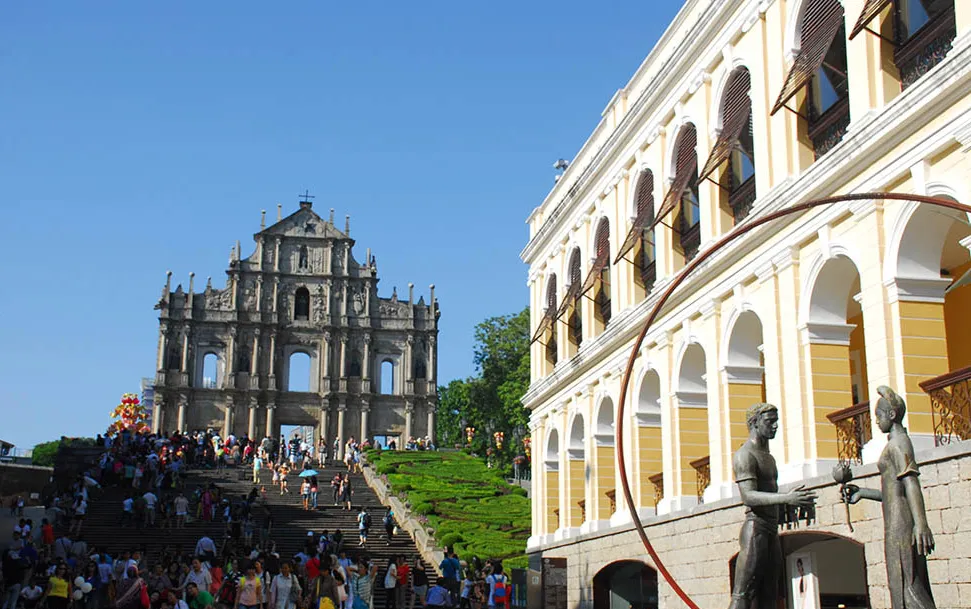
Macau's world-class scenery is captivating, featuring the iconic Ruins of St. Paul's and its oldest temple.
Macau's many world-class attractions are also very appealing, offering a glimpse of Sino-Portuguese cultural fusion. For instance, the UNESCO World Heritage-listed Historic Centre of Macau is a microcosm of Macau's history. Then there's the Cotai hotel district, vibrant day and night, where new hotels or facilities seem to debut almost every year, making each visit feel fresh. Macau World Heritage Sites: Ruins of St. Paul's, A-Ma Temple, Guia Fortress, Lighthouse & Cable Car. Cotai Hotel District: Morpheus Hotel at City of Dreams, Eiffel Tower at The Parisian Macao, Wynn Palace SkyCable Car and Performance Lake, House of Dancing Water at City of Dreams, and the影汇之星 (Star Tower) at Studio City. When you come to Macau, you absolutely must not miss the UNESCO World Heritage Site—the Historic Centre of Macau. Macau's World Heritage sites are concentrated on the Macau Peninsula, featuring a diverse array of historic buildings, including the renowned Ruins of St. Paul's, Macau's oldest temple, the oldest lighthouse in the Far East, a Renaissance church, and traditional Chinese mansions infused with Western craftsmanship. Walking through them is like traveling through time, offering insight into Macau's history of East-West cultural fusion and providing excellent photo opportunities. Ruins of St. Paul's: A must-see landmark in Macau. Originally the facade of the Church of Saint Paul, the church was first built in 1602 with exquisite craftsmanship from China and Japan. After a fire in 1835, only the front facade, part of the foundation, and stone steps remained. Locals call it "大三巴牌坊" (Ruins of St. Paul's) because its appearance resembles a traditional Chinese archway (牌坊). The facade is made of granite in the Baroque style. If you look closely, you can find Chinese characters and chrysanthemum motifs on the wall—a unique East-meets-West feature unparalleled among Catholic churches worldwide. Macau's oldest temple is right here. A-Ma Temple, formerly known as the Temple of the Goddess of the Sea (娘媽廟), Tin Hau Temple, and Hoi Kak Temple, was later officially named A-Ma Temple (媽祖閣), commonly called A-Ma Temple. This was the landing spot for Portuguese sailors and is closely linked to the origin of the name "Macau." Legend has it that when Portuguese sailors asked locals for the name of the place, the locals replied with the temple's name, "媽閣" (A-Ma Temple), leading the Portuguese to adopt the phonetic "Macau" as the name for the area. Guia Fortress and Lighthouse + Guia Cable Car: Ride the shortest cable car to see the oldest modern lighthouse. Guia Fortress and Guia Lighthouse sit atop Guia Hill. You can take the Guia Cable Car from the Flora Garden to reach the summit. Notably, the Guia Cable Car is the world's shortest mountain sightseeing cable car—how short is it? The entire ride takes about one minute. The cable car cabins are small, comfortably fitting two people. During the ride, you can enjoy a bird's-eye view of the entire Guia area. After getting off, it's just a few minutes' walk to Guia Fortress. Built in 1622, the fortress includes a gunpowder magazine, guardhouses, and watchtowers. It also encompasses the Chapel of Our Lady of Guia and the Guia Lighthouse. This lighthouse is the first modern lighthouse along the Chinese coast, and its coordinate location serves as Macau's geographic reference point on the world map. After exploring the World Heritage sites on the Macau Peninsula, let's head to Cotai. I always feel that Cotai is a place vibrant both day and night. The hotel district here boasts not only increasingly impressive architecture but also constantly evolving performances, facilities, and dining—always delivering world-class surprises. Want to experience a side different from the old town's simplicity? Head to Cotai! New hotels and facilities appear almost every year in Cotai, making it incredibly exciting. Amid the dazzling luxury of Macau's Cotai strip, the Morpheus Hotel, opened in June 2018, is a shining star. It is the posthumous work of renowned architect Zaha Hadid, fully embodying her title of "Queen of the Curve." The building's free-form exoskeleton structure presents a fantastically elegant silhouette, while the figure-eight void at its center draws inspiration from Chinese jade ornaments. Inside, the atrium lobby of the Morpheus Hotel soars 35 meters high. Riding the glass elevator offers a breathtaking view of the interior's irregular geometric cladding. The building alone is enough to captivate attention, but the hotel's restaurants and dessert shops are equally impressive. These include a French pastry shop by master Pierre Hermé (Pierre Hermé Lounge), a bar and brasserie by famed chef Alain Ducasse (Alain Ducasse at Morpheus), and a top-tier French restaurant (Ducasse's Restaurant), ensuring the hotel exudes world-class mastery from the inside out.


