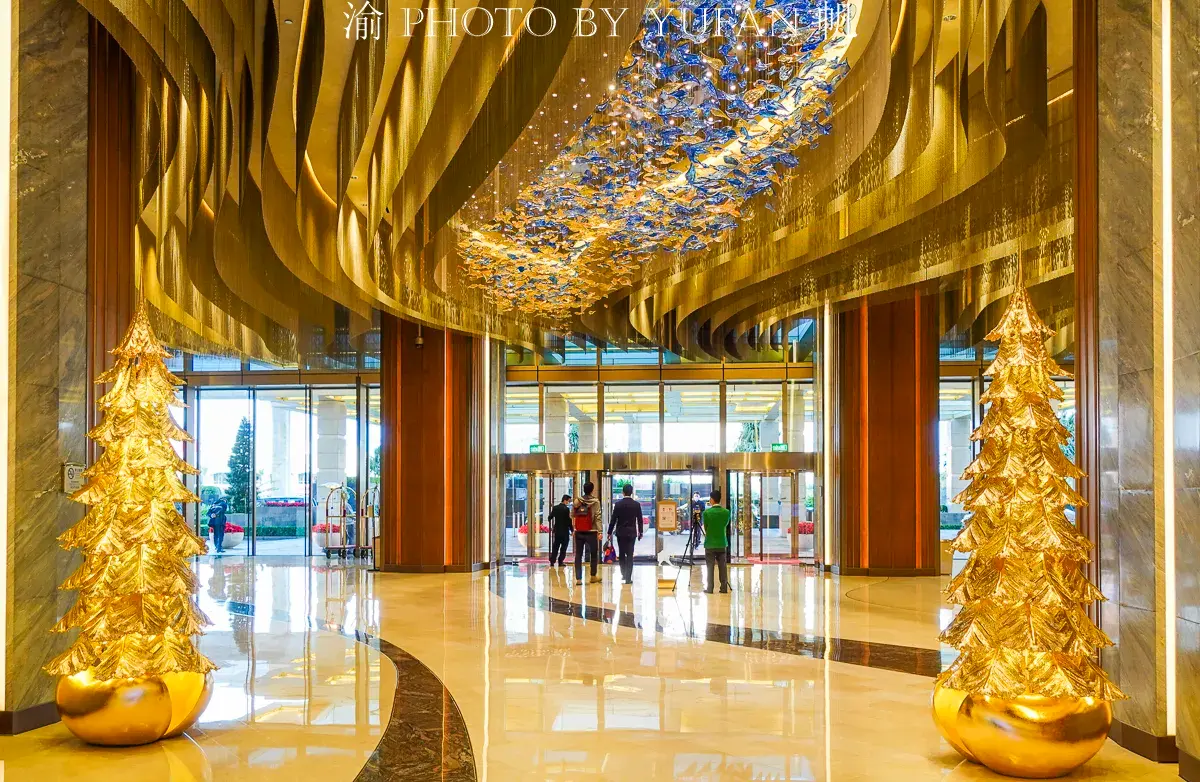
I just went to stay at a hotel, but felt like I visited a museum. These art treasures are truly amazing!
The five-day, four-night trip to Macau in early December was the most in-depth travel I've ever had to Macau. Although I had been there many times before, each trip was only two to three days, sometimes even going in the morning and returning in the afternoon, always in a hurry. I had visited many attractions, but most were just a quick glance, not a true understanding. This time, however, we not only went to some regular tourist spots but also followed local Macau friends to some old streets and shops that only locals know about, with long histories yet little known to outsiders. I discovered many more interesting aspects of Macau, making it a truly rewarding experience.
In addition to the regular attractions and traditional old streets, the hotels I stayed at this time also left a deep impression on me. For example, the Wynn Palace, Grand Lisboa, and Studio City, which I have shared in other articles, each have their own characteristics and selling points, luxurious yet distinctive.
Today, I continue to share another hotel, the MGM Cotai, located opposite the Wynn Palace. This is an international luxury hotel invested by MGM China Holdings Limited and its parent company, MGM Resorts International, with a total investment of up to $3.4 billion.
Similar to the old MGM Macau, the exterior of MGM Cotai is primarily in copper, silver, and gold. The building's design is novel, resembling a pile of sparkling "jewel boxes." The interior decoration is equally magnificent, resplendent, and dazzling.
MGM's logo is a golden lion. At MGM Cotai, besides the 11-meter-high, 38-ton golden lion statue standing at the entrance, there are also cute little lion statues holding a ball, making people feel more affectionate and friendly.
Upon entering the hotel, the first thing that catches the eye is a huge Spectacle, a plaza with creative and dynamic design, blending technology and natural elements. It is understood that the canopy of the Spectacle cost over $37 million to build, with a height of 37 meters. It is a column-free structure using a triangular mesh steel shell system, covering an area of 8,073.1 square meters (equivalent to 30 standard tennis courts). On January 19, 2019, it set a Guinness World Record for Macau, China, being recognized as the world's largest self-supporting mesh steel structure glass roof. It is also the first Guinness World Record in the field of building structures in Macau.
The canopy of the Spectacle uses a precise diagonal grid steel structure with a longitudinal span of 138.5 meters, supported by no columns. It consists of 4,365 beams and 1,531 beam nodes, weighing about 2,000 tons, a rarity in engineering. As a multi-arched building with flowing lines, the canopy cleverly expands the space of the Spectacle through an efficient shell structure system and a large-span single-layer structure, making it visually more grand while reducing obstruction to external views and ensuring flexibility for installation of exhibition suspension points.
Interestingly, when we visited, there was a performance of numerous dolphins swimming in the air in the Spectacle. Silver dolphins seemed to be swimming freely in water or flying happily in the sky. If children came to watch, they would actively interact with visitors, sometimes being cute or nodding, which was very amusing.
However, what impressed us most while strolling through the public areas of MGM Cotai was the artistic atmosphere. It felt as if art was everywhere. According to the staff, MGM Cotai has collected over 300 top-tier art treasures, perfectly integrated with its internal public spaces. While there, one can admire a large number of Qing Dynasty antique carpets, modern and contemporary Asian paintings and sculptures by renowned artists, commissioned works by local and regional emerging artists, and large interactive installations.
In the Qing Dynasty imperial palace, carpets woven with silk, gold, and silver threads were essential decorations in the Forbidden City in Beijing. It is said that only about 300 of these survive globally, collected by museums or super-rich private collectors. In the lobby of MGM Cotai, 28 of these imperial carpets are displayed, all consistent in style, era, and design imagery, forming a unique collection.
During the Kangxi period of the Qing Dynasty, the Forbidden City established an Imperial Workshop, recruiting skilled artisans from across the country to produce imperial utensils and furniture. The carpet workshop wove gold, silver, and copper threads into silk carpets, with weavers skillfully creating patterns of dragons, phoenixes, and various flowers. Among the existing Qing imperial carpets, only 126 retain the names of the palaces they belonged to, mostly pointing to twenty palaces, with the six most common being the Hall of Supreme Harmony, Hall of Central Harmony, Hall of Preserving Harmony, Palace of Heavenly Purity, Palace of Tranquil Longevity, and Palace of Benevolence.
"Nine Dragons" was woven during the Jiaqing period of the Qing Dynasty, over 200 years ago, measuring 246 cm long and 153 cm wide. The number nine is highly valued in ancient Chinese culture, symbolizing heaven, as heaven, earth, and man combine into three, and three times three makes nine. The pronunciation of nine is similar to "long," thus implying infinity.
"Guanyin" was woven during the Qianlong period of the Qing Dynasty, nearly 300 years ago, measuring 210 cm long and 122 cm wide. It is made of cotton warp and weft with silk and copper-plated threads, embroidered with the text "For use in the Palace of Benevolence." It was previously collected by Mike Amber's auction house in San Francisco, USA. In ancient Hinduism, the interwoven warp and weft of carpets is a metaphor for the world, with all beings in the heavenly way connected by threads and knots.
"Dancing Dragon Among Lotuses" was woven during the Daoguang period of the Qing Dynasty, measuring 210 cm long and 122 cm wide. The edge of the wool carpet is embroidered with "For use in the Palace of Heavenly Purity." It was previously collected by the Peter Pap Gallery in San Francisco, USA, and is a masterpiece among Qing imperial wool carpets.
"The Alchemist" is an important work from Cai Guo-Qiang's 2017-2018 solo exhibition "The Spirit of Painting: Cai Guo-Qiang at the Prado." It was one of his last eight exhibition works completed in his temporary studio at the Hall of Realms in the historic palace in Madrid. The work returns to simplicity, using his hands as brushes to rub gunpowder on canvas. The Prado Museum is recognized as housing one of the world's greatest painting collections, and Cai Guo-Qiang became the first artist to create and exhibit on-site at the Prado since its founding in 1819.
This is the work "Eight Scenes of Macau" by local Macau artist Xue Song. He said, "I use burned paper and ashes to construct my works. From destruction to rebirth, it is the cycle of life." The set comprises eight pieces created specifically for Macau, including the Chapel of Our Lady of Penha, the Kun Iam Statue, Macau Tower, A-Ma Temple, Guia Fortress, and Ruins of St. Paul's. From a distance, they appear as scenes, but up close, scenes within scenes reveal details of Macau's streets, cuisine, and culture, forming the brushwork of the paintings, extremely intricate.
The hotel has so many artworks that it is hard to present them all in one article. Much more content needs to be visited and appreciated. I originally thought it was just a hotel, but unexpectedly, it houses more art treasures than many museums. It was truly eye-opening. If you have the chance, you should go and see for yourself.


