Macau Delicacies: A Feast for the Senses in the Bustling City
For me, food is always something that fills me with an overwhelming sense of happiness in life.
Delicious food brings pleasure to the palate and lets me enjoy a feeling of bliss.
Macau is a place with an abundance of culinary delights. Here, you can find everything from street snacks tucked away in alleyways to high-end Michelin-starred cuisine.
Because of the pandemic, it had been a long time since I last visited this city. Upon hearing that the borders had reopened, I immediately wanted to return and once again savor the flavors of this city.
1. A Macau entry permit endorsement is still required. Remember to apply in advance. Endorsements now need to be processed at the counter, so make an appointment.
2. You need to provide a nucleic acid test result obtained within seven days. Remember to get tested at a regular hospital in advance. In Guangdong Province, results can be directly synced to the Yuekang Code. For other regions, please consult local policies.
3. Macau widely accepts Hong Kong dollars and Macanese patacas, but basically Alipay and WeChat Pay are accepted everywhere, and even taxis can use WeChat Pay.
4. For the weather in Macau, just prepare a light jacket.
5. Bring long pants or long skirts; some high-end Michelin restaurants have dress codes.
6. If you cross through the Hengqin checkpoint, you'll need to take a shuttle bus. Prepare some small change (RMB, HKD, or MOP are all accepted at par; no electronic payment).
D1: Rua do Cunha
Traveling from Guangzhou to Macau is still very convenient. I chose the Guangzhou-Zhuhai Intercity Rail as my means of transport to Macau. After getting off at the Zhuhai station, it's just a few hundred meters to the Gongbei Border Gate, making customs clearance very easy.
For my first stop in Macau, I chose Rua do Cunha as the starting point of this trip.
Rua do Cunha is located in Taipa, Macau, and is a famous old street. It has now become a well-known street for souvenirs, attracting many tourists visiting Macau to buy gifts.
The narrow street of Rua do Cunha is lined with many overlapping signs, giving it an antique feel. Especially at night, when the neon lights of the signs illuminate the street, the colorful glow and traditional charm are very captivating.
Besides various souvenirs, there are plenty of authentic street snacks on Rua do Cunha. Eating street snacks in Macau is quite reassuring; generally, the snacks from small roadside shops are of good quality, so there's no need to worry about bad choices.
Simple beef offal is very flavorful, with curry sauce added to enhance the aroma. The milk tea is smooth and rich, with a strong milky and tea flavor that is delicious. The durian ice cream is made with fresh imported durian pulp, giving durian lovers a great satisfaction with every bite.
In addition to snacks, you can also see buildings with strong Portuguese characteristics. The stained glass windows and colorful glass exude a Mediterranean style, with bright colors reminiscent of the passionate and unrestrained Mediterranean sun. This area also has a strong sense of East-meets-West; perhaps next to a Portuguese-style building stands a traditional Mazu Temple or Guandi Temple. This blend of Chinese and Western cultures creates a uniquely moving charm, very distinctive.
In the evening, I checked into the MGM Cotai hotel in Taipa.
Macau has many luxury hotels, and MGM, as a globally renowned luxury hotel brand, naturally has its place here. The design of MGM Cotai is inspired by a jewelry box, with a unique shape full of luxury and fantasy.
This is also an art-themed hotel. Art elements can be seen everywhere in the lobby and public spaces, from exquisite antique carpets to luxurious crystal chandeliers, as well as works by contemporary artists, all with captivating charm.
As a luxury hotel, the rooms here certainly do not disappoint. The suites are spacious, divided into a living room and a bedroom. Whether you want to enjoy a drink on the sofa or have a comfortable sleep, everything is satisfied.
Moreover, all drinks in the minibar fridge at MGM Cotai are provided free of charge, and they are replenished daily by the staff—very considerate.
In the evening, I went to the bar at MGM Cotai. The bar has a Portuguese-style atmosphere, with slightly dim warm lighting that creates a cozy and intoxicating ambiance.
The cocktails here are very unique. Several signature cocktails are named after the hotel's restaurants—such as Chun (the Chinese restaurant), Shu Road (the Sichuan restaurant), etc.—and the cocktails echo the characteristics of those restaurants.
The cocktail "Chun" comes in a very distinctive vessel shaped like a tea cup, with a small mechanism underneath. When you flip it, the liquid flows out into a small cup, making it very convenient. The cocktail is made with tea, honey, and white liquor. The tea gives a refreshing taste, while the white liquor provides richness, creating a very unique flavor.
The "Shu Road" cocktail is made with Sichuan pepper and chili, giving it a subtle numbing and spicy taste, which is quite interesting.
Each cocktail here is paired with accompanying snacks, enriching the cocktail experience in a fun way.
The Grand Lisboa Hotel can be considered a landmark of Macau.
And the Grand Lisboa Palace is even more stylish and glamorous than the Grand Lisboa. More importantly, for gourmands, the Grand Lisboa Palace is a place that can satisfy all expectations about food.
At the Grand Lisboa Palace, there are two three-Michelin-starred restaurants and one one-Michelin-starred restaurant, totaling seven Michelin stars, making it a leader even in Macau, a city with abundant cuisine.
On this visit, I chose the one-Michelin-starred restaurant, The Kitchen.
The Kitchen specializes in steak. Although steak may seem simple, creating a quality steak is quite an art. A good steak has a charred exterior, tender meat, rich juices, and savory fat. To achieve these requirements, both the quality of the steak and the chef's mastery of heat are crucial.
Upon entering The Kitchen, the first thing that catches your eye, besides the luxurious decor, is the refrigerated display case filled with various cuts of beef. Australian sirloin, Japanese Wagyu, and other premium beef are on display for diners to choose directly. Seeing the marbling and the bright red meat is already exciting for any connoisseur.
If you don't eat beef, you can also enjoy various high-quality seafood here. The seafood is "air-freighted," flown in from around the world to ensure quality and freshness.
After selecting the beef, you can order a bottle of fine wine while waiting. The Grand Lisboa Palace houses tens of thousands of bottles of wine; the wine list itself is thicker than a dictionary—for those who love wine, it's a dizzying but also blissful experience!
I ordered my steak medium-rare, which retains plenty of juices and keeps the meat very tender, allowing the best taste of the steak itself.
Here, the steak is not served with heavy sauces; simple yellow mustard and sea salt are all the seasoning needed. Simple seasonings bring out the natural flavor of the beef without masking its freshness, which is most suitable for high-quality steak.
In the afternoon, I chose to stroll through the old town of Macau.
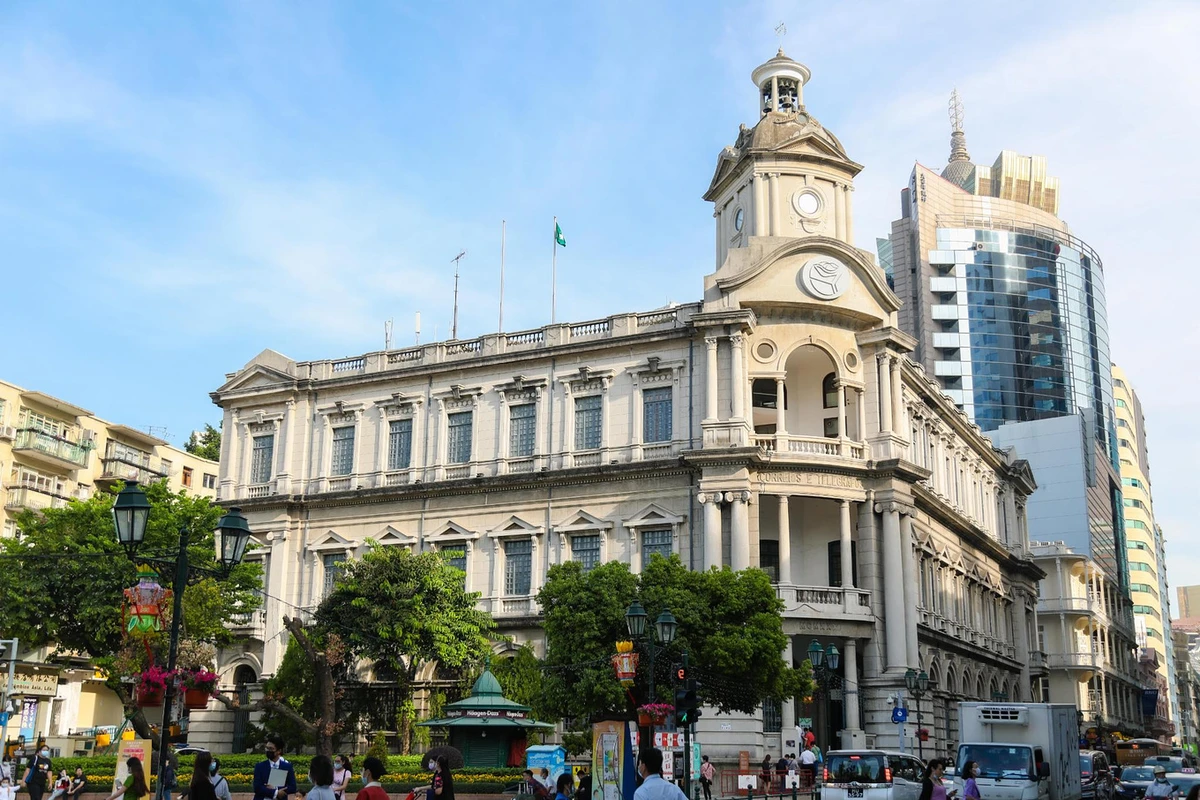
The area around St. Lawrence's Church was once the site of government offices in Macau, and it still retains much of its old-world charm and character.
St. Lawrence's Church, full name Igreja de São Lourenço, is one of the three oldest churches in Macau. It was built over 400 years ago and has undergone several expansions to reach its current size.
The church's main entrance features two impressive stone staircases. The surrounding area is lush with old banyan trees, adding a touch of serene greenery to the church.
The church's architecture exudes a strong Mediterranean style with vibrant colors. Even from the exterior, you can see various exquisite sculptures, which, regardless of faith, convey a sense of solemnity and dignity.
Walking around the St. Lawrence area, you can also see many traditional features of Macau's old town. The shaded streets and old buildings carry the city's memories, making them especially charming.
Returning to the hotel, I chose to dine at the in-house restaurant, "Shu Road."
"Shu Road"—the name suggests it is a restaurant specializing in Sichuan cuisine. Sichuan cuisine emphasizes freshness, aroma, numbing, and spiciness. In Macau, it has been adapted to introduce richer flavors to traditional dishes.
I have always loved the decor at Shu Road. The exterior wall features a large ceramic screen painted in ink wash with scenes of Sichuan. The traditional and imposing screen is very exquisite and unique.
Of course, the dishes at Shu Road do not disappoint either.
One dish left a deep impression on me. Abalone, traditionally considered one of the eight marine treasures, is tender and sweet. Here, it is cooked using a spicy braising method.
The spicy braising broth is made by the chef with over a dozen Chinese herbs, plus Sichuan pepper and chili. The sauce has a subtle medicinal aroma and is very rich. The spicy braising flavor does not overwhelm the natural sweetness of the abalone; instead, it adds complexity.
Lamb ribs are roasted with precise heat control, ensuring they are not too dry. Dipped in chili powder and other seasonings, they are very flavorful.
Beef tenderloin is diced and stir-fried until fragrant. The exterior is crispy, while the inside remains tender and juicy, preserving the natural moisture of the beef—very fresh.
Every dish here meets expectations. Both the presentation and the taste are sufficiently impressive. Traditional Sichuan dishes are refined with more delicate flavors and reinterpreted in a distinctive way.
Here, you can also watch a traditional Sichuan tea art performance. Enjoying delicious food while watching a wonderful performance always adds a multidimensional experience to the meal.
Macau's cuisine always draws me here, but Macau attracts me not only for its food. This city has a unique charm. Coming here, experiencing its prosperity, and tasting its food always makes me feel that life should be like this—life is about enjoyment.
Currently, the pandemic situation in Macau is relatively under control, so tourists can confidently visit Macau for travel and vacation. According to Macau's epidemic prevention measures, mainland tourists can travel to and from Macau without quarantine by presenting a valid negative nucleic acid test result obtained within seven days. For details, refer to the latest guidelines from the Macau Health Bureau.


