A Trip to Guangdong and Macau During the Short Holiday (Part 2)
Today is May 2nd. The plan for today is to first go to a famous tea restaurant for breakfast, then visit the Ruins of St. Paul's, Mount Fortress, and the Macau Museum. Today also happens to be Sunday, so we have a chance to see some churches in Macau.
Macau is composed of three main areas: the Macau Peninsula, Taipa Island, and Coloane Island. The Ruins of St. Paul's, Mount Fortress, and the museum we are visiting today are all on the Macau Peninsula.
Early in the morning, we hailed a taxi at the hotel and went straight to Rua Dez de Agosto (10th of August Street) in the old town of the Macau Peninsula. There stands Nan Ping Yuen Xu (Nam Ping Yuen Xu), a tea restaurant that has been a pioneer of Macau's morning tea scene for over half a century. As its name suggests, it is located on an old street, with a second-floor building, a simple gold-lettered signboard, and a narrow glass door. Outside the door, an elderly man runs a newspaper stand; inside, an 'old accountant' guards the counter. The other staff in the restaurant are also elderly, and they have reportedly worked there for many years. The restaurant's decor still looks like it did about 50 years ago, with simple and worn-out tables and chairs. The customers are also the elderly regulars from back then. In short, this is a nostalgic place. It is a must-visit restaurant for Macau locals every morning, and it has also become a popular check-in spot for modern tourists.
When we woke up early and opened the window, we saw a beautiful sea view outside.
Our order: Nan Ping triple-layer sandwich, egg puff (saa wong), coffee, and almond milk.
Old tables and chairs and the working area.
Leaving Nan Ping Yuen Xu, we walked towards the Ruins of St. Paul's. We saw a church and wanted to go in, but the staff told us a mass was in progress and tourists were not allowed inside. So we just took photos outside and left.
A small street in the old town.
St. Anthony's Church, a Catholic church. Since it was Sunday, a mass was being held, and tourists were not allowed inside, so we took photos outside.
Macau is small in area, and its streets are very narrow. Even in such cramped spaces, many churches have been built. St. Anthony's Church was built in 1638.
Walking along, we came across a community park—Jardim Cidade de Camões (Camões Garden). This was once a Christian cemetery. Robert Morrison, a Protestant missionary who came to China, and his family were buried here. Morrison was the first person to translate the Bible into Chinese and the author of the first Chinese-English dictionary. Now, it is a lush community park where many local residents and elderly people relax, play chess, walk their children, and walk their birds.
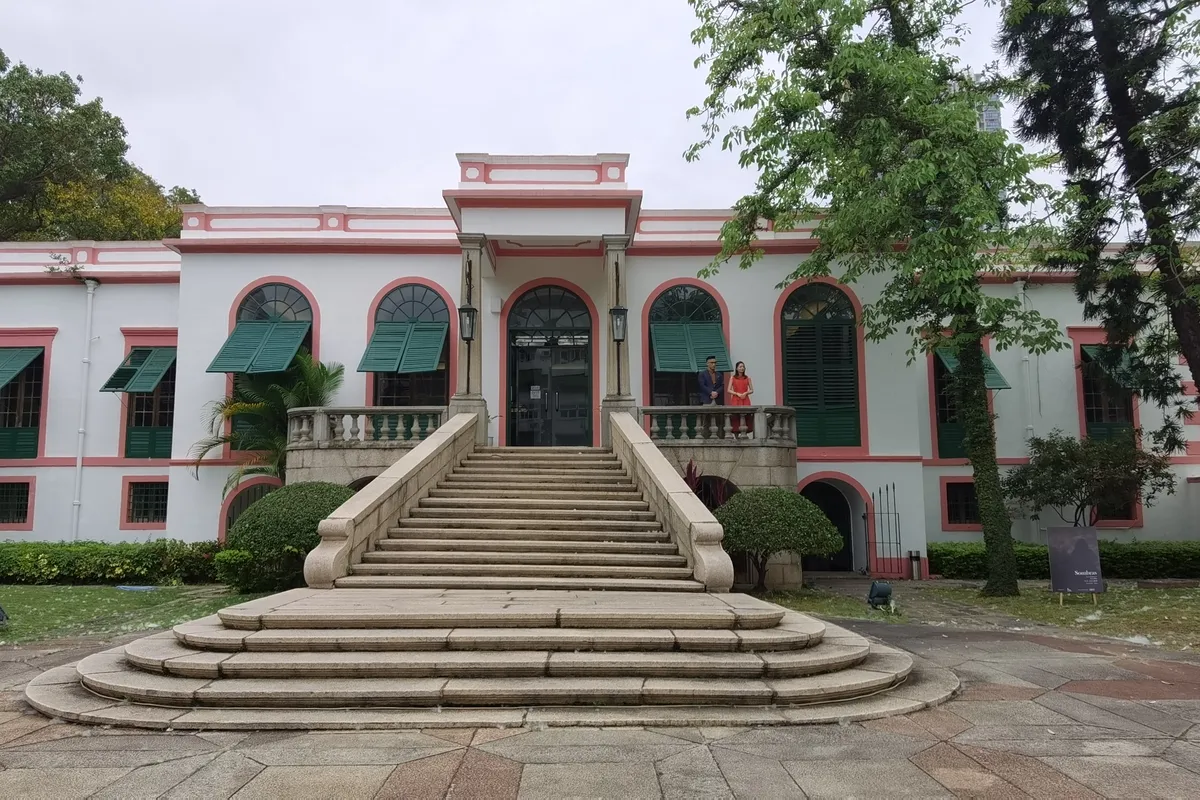
Deep in the community park, there is a white Western-style house. This was once the villa of a wealthy Portuguese merchant, Manuel Pereira. Built in the 1770s, it was later leased to the East India Company and now houses the Orient Foundation. The villa has gardens in front and back, with a fish pond rippling with clear water—a typical example of Macau-style garden villas.
Ordinary red bricks can also pave unique paths.
Leaving the villa, we arrived at the Ruins of St. Paul's. Seeing this structure, I believe many people silently recall the famous song 'Seven Sons of the Earth.'
We commonly call it the Ruins of St. Paul's, but it is actually the front wall of a church. The church was destroyed by a fire in 1835, and only the front wall survived. This regret created Macau's iconic landmark, making it a must-visit attraction for anyone coming to Macau.
The front of the Ruins of St. Paul's.
This is the back of the Ruins of St. Paul's; on the left ground are the former foundations of St. Paul's Church.
The side of St. Paul's Church, with the thick brick wall still standing.
To the left of the Ruins of St. Paul's, there are remaining foundations, which were once a seminary—also the earliest Western-style university in China—destroyed in the great fire of 1835.
Statue of the missionary Matteo Ricci.
To the right of the Ruins of St. Paul's, there are some ruins—the side chapel of the church. Following the path beside the ruins up the hill leads to the Macau Museum.
As soon as we entered the Macau Museum, the exhibition introduced the 'Intersection of Routes,' explaining Macau's value and development path through the exchange of Eastern and Western cultures and economies.
The long corridor lists the development of Eastern and Western cultures during the same period on both sides, illustrating from aspects such as writing, science, and architecture how the East and West learned from each other.
From the lighting pattern on the map, we can clearly see how the ancient Silk Road was formed.
In world trade over 2,000 years ago, Chinese silk, tea, and porcelain were undoubtedly the most popular goods. This plate, a perfect combination of famille rose and blue-and-white, exemplifies the application of Chinese aesthetics in porcelain making.
The arrival of Chinese tea actively promoted the innovation and development of tea sets worldwide.
This stone tablet is inscribed with 'Imperial Edict.'
Religious artworks exhibited in the museum.
The Earth God and Door God placed at the entrance of folk houses.
Young people have never seen a mailbox.
Macau's Portuguese-style buildings mostly feature light green, pink, bright yellow, and other vibrant colors.
Floor tiles with intricate patterns.
A bright yellow corridor.
On the third floor of the museum is a postcard exhibition hall, where you can make a postcard yourself on a computer.
Exiting the museum leads to Mount Fortress.
Looking down from Mount Fortress, you can see the low, old houses of Macau's old town.
Mount Fortress was first built in 1616. Its location was relatively high in Macau at the time, so it faced the sea for defensive purposes. Due to the passage of time, the banyan tree on Mount Fortress has grown so thick that four people together can barely encircle it.
From Mount Fortress, you can clearly see the Grand Lisboa Hotel.
Isn't it funny to take a photo from this angle?
Even though today is May 2nd, the second day of the short holiday, there are still diligent people studying there.
At the entrance of the museum, there is a coffee shop, which is also a popular online spot. After coming down from Mount Fortress, we went directly to this coffee shop.
Our order.
Leaving the coffee shop, we went directly to Travessa da Sé (Cathedral Square) opposite the Ruins of St. Paul's to explore the old town of Macau Island.
This is a small shop selling fresh milk, very famous in Macau, so we also went to try their fresh milk products.
This is the most famous St. Dominic's Church in the old town of Macau Island. However, due to the pandemic, only worshippers attending mass can enter; tourists are not allowed inside. We could only take photos outside.
Another church.
On Rua de São Domingos, there are many snack shops, but only one beef offal shop had a long queue. We joined the crowd.
It was already evening, and the alleys and the Ruins of St. Paul's were lit up. We wanted to see the night view of the old town. This alley is called Love Lane. From its location, you can see people's reverence for the divine. The 'love' here does not refer to the usual romantic love between men and women. Nevertheless, many young people take photos here.
Behind the Ruins of St. Paul's, there is a temple dedicated to Na Zha (Ne Zha), perfectly showcasing the fusion of Eastern and Western cultures.


