Inside Tam Kong Temple on Coloane Island, Macau, a two-meter fishbone dragon boat is the temple’s treasured artifact
Besides the well-known casinos and old town, Macau also has Coloane Island with a fresh rural atmosphere—the least densely populated and highest terrain. Most of Macau’s hiking trails, beaches, and country parks are on the island, making it a retreat from the dazzling hustle. Macau locals used to consider Coloane the countryside, but now they enjoy coming here for rural tourism, vacations, experiencing the local charm, and tracing history.
Coloane Island offers sea, villages, ancient temples, and food, all along the coast near St. Francis Xavier Church. After getting off the bus at President Ennes Square—named after the Portuguese president who first visited Macau—tourists head straight to Lord Stow’s Bakery for the original Macanese Portuguese egg tarts. I, however, was more captivated by visiting temples and other historical sites on the island, capturing the artistic graffiti on the walls of old houses along the streets.
To the left of the Coloane Health Station are two alleys: Shangke Street and Zhong Street. Walking along Zhong Street alley to Shuiquan Gongdi, there is a very small door on the left of a red house—the back entrance of Kun Iam Temple. The main entrance is on the other side, with “Kun Iam Temple” written on the white wall. This small temple was built by local fishermen during the Jiaqing period of the Qing dynasty, with a history of over two hundred years, and is one of Coloane’s four major ancient temples. When I visited, it was under full renovation, so I could only photograph the door; the plaque above it reveals its age.
Exiting the main gate of Kun Iam Temple and turning left, follow Guomin Lane to the Tin Hau Temple on the slope opposite. It is the largest of Coloane’s four ancient temples. From the square in front, you can see the sea between the Hengqin islands. Built in 1763, Tin Hau Temple is the oldest temple on Macau’s outlying islands, still preserving an ancient bell over two hundred years old, a Qing dynasty plaque reading “De Chui Ze Guo,” and three wine boats.
In the courtyard of the temple, beneath the “De Chui Ze Guo” plaque, there is a small square pavilion called the “Worship Pavilion,” which once served as a place for local gentry to make major decisions, similar to a village council. On the left side of the main hall is a wine boat adorned with a statue of Tin Hau and several guards, with a sail inscribed “Divine Blessing, Favorable Weather, Great Profits,” where fishermen once prayed for safe voyages.
Turning left along Chuanpu Street, not far from the sea, stands Tam Kong Temple, the most popular among the four main temples in Coloane. Its treasured artifact is a red dragon boat made from a two-meter-long fishbone placed to the right of the Tam Kong statue, with several equally long whale bones placed beneath it. The temple caretaker said that this century-old dragon boat is also carved from whale bones, with the dragon’s head and tail added later.
Worshippers at Tam Kong Temple believe that touching the dragon boat brings smooth sailing and favorable winds. To protect the whalebone dragon boat, it is coated with red lacquer, and the figures rowing the boat appear to wear Qing dynasty attire. To the right is a shed for hanging incense coils; under a large tree on the left lies a stone carved with the character “Goose” and a small Earth God shrine. Walking around to the slope behind Tam Kong Temple, through the rooftops, you can see Hengqin Island in Zhuhai. I once visited Hengqin Island from Zhuhai, where there used to be bamboo huts on the sea for eating oysters and seafood; now high-rises stand there.
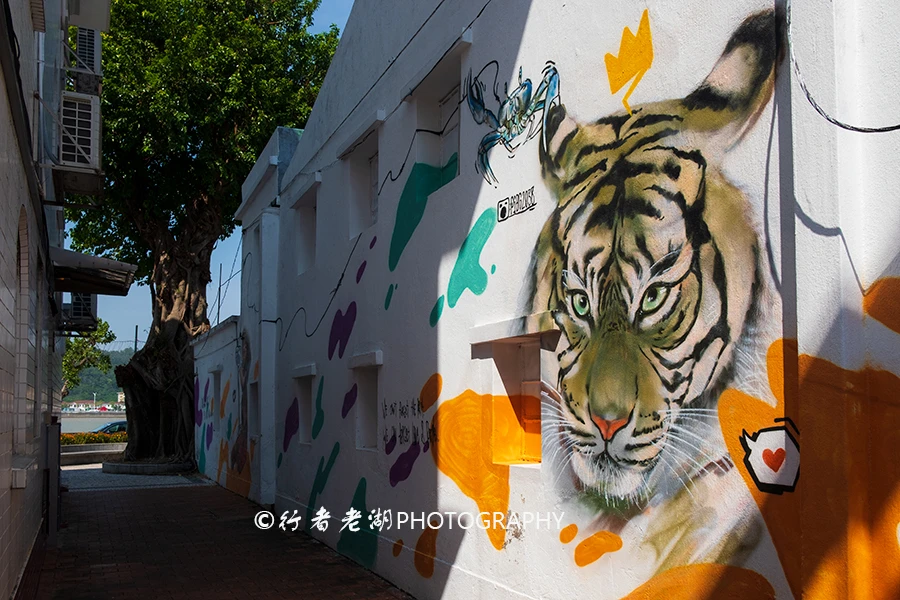
The coastal road in front of the temple is called Rua de Cinco de Outubro. Heading back, turn right at Chuanpu Front Square alley, then right again onto Chuanpu Street. Along the way, most of the old houses have been repainted a romantic light yellow, some with colorful graffiti on the walls. Though they lack the antique simplicity of old dwellings, they radiate the local residents’ vitality and energy.
On the walls outside homes, there are often small incense burners or altars with the inscription “Heavenly Official Bestows Blessings,” where a few incense sticks or even fruits are offered. Many of Coloane’s early residents moved from Guangdong and Fujian provinces, preserving old customs of worshiping the Three Officials (Heaven, Earth, and Water Officials), believing that the Heavenly Official grants blessings, the Earthly Official absolves sins, and the Water Official relieves misfortunes.
Walking along Chuanpu Street to a small building built in 1968 is the Coloane Shipbuilding Branch. Toward the sea from its entrance, on the left stands the old library built in 1911. This light-yellow library is particularly striking, with a porch supported by six Roman columns; it was originally the Coloane Council School.
A few steps along the coast brings you to Largo de Maquis in Macau, a small square with a monument. At the far end is St. Francis Xavier Church, built in 1928. In 1910, eighteen schoolchildren were kidnapped by pirates on the island; Portuguese troops fought for a month and eliminated the pirates, but the local residents also suffered greatly. To commemorate the event, the “Victory over Pirates Monument” was erected. Through the pirate-suppression campaign, the Portuguese achieved effective control over Macau and Coloane.
Over four hundred years ago, Francis Xavier, the first missionary to China, arrived from Japan in Jiangmen, Guangdong, and died on Shangchuan Island. His arm bone bracelet was placed in a silver bone casket and kept at St. Francis Xavier Church in Coloane. Francis Xavier was canonized by the Roman Pope, and more missionaries subsequently entered Macau, gradually integrating Chinese and Western cultures with profound influence. The church caretaker said that during the typhoon season each year, seawater often floods the church to a depth of half a meter, so the bracelet has been moved for safekeeping to St. Joseph’s Seminary in front of St. Augustine’s Square in Macau.
St. Francis Xavier Church is a Baroque-style building in white and light yellow, with a small bell tower and two corridors on each side with arched doors. Giant tree trunks pierce through the corridors. Inside the two corridors are two notable restaurants: Chan Seng Kei, a small eatery that made the 2018 Macao Michelin list, famous for its traditional aged orange peel duck; and across from it, the Ashi Garden Restaurant serving Portuguese cuisine, well-regarded in Macau, known for its signature baked rice with pineapple and seafood.
At Largo do Matadouro, a concrete jetty extends into the sea, resembling an old dock. Egrets glide gracefully, rustling the reeds by the shore. In the distance, sheet-metal huts on stilts over the water represent Macau’s last fishing village. These huts, supported by wooden poles, stand precariously like thin children in the water, supporting generations of lives.
Built in 1865, the Sam Seng Temple stands among them. It houses a bronze bell and ancient bell, and is dedicated to “Three Saints”—Golden Flower Goddess, Guanyin, and Huaguang Master—all enshrined in a single small room with an endless stream of incense. It guards the residents’ wishes for children and silently blesses the safety of young ones.
By the sea, there are many eateries and dried seafood shops. Across from them is the Coloane Pier Noodle Shop, which food critic Chua Lam has visited for its signature shark fin soup noodles; the cuttlefish noodles and “Dong Dou” shredded chicken noodles are also popular. The owner’s father ran a dried seafood shop, and he said that the best shark fin used to be “Tian Jiu Chi,” but now those sharks are protected and cannot be caught or sold. Nevertheless, the various seafood noodles at Coloane Pier Noodle Shop remain a must-try local delicacy. I tried a bowl of signature tossed noodles; the broth was thick, the ingredients authentic, and the flavor of the sea infused into every strand.
Built in 1873, Coloane Pier was once the landing point for boats from the Macau Peninsula to Coloane, with regular routes to mainland China. After the bridge connected Coloane to the peninsula, the pier lost its importance. The fishermen of Coloane fishing village no longer fish; the village has become a symbol of Coloane’s past and a chapter in Macau’s history.
Travel tips for Coloane Island: Buses 15, 25, 26, 50, 21A, and 26A all go to President Ennes Square. The entire coastal fishing village walk takes about 30 minutes.
Part of this travelogue is excerpted from my newly published book “No Work, Go to the Islands: A Blue Romance in the Guangdong-Hong Kong-Macao Greater Bay Area.” Without the consent of myself and the publisher, no one is allowed to republish the text and images of this travelogue (including but not limited to screenshots, screencaps, video conversion, etc.) in any form.


