Seeking Colors and Hot Springs - A Retrospective of My 2018 Autumn Trip to Japan 3: What Do We Mean When We Talk About Eating Broke in Osaka
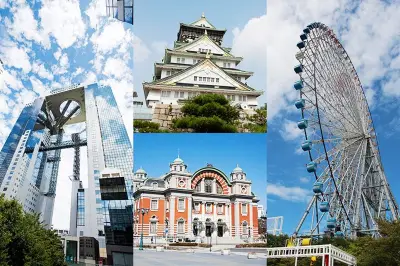
Today we started our free time. The two of us lazily slept until we woke naturally, then slowly ate and drank to our hearts' content before wandering out of the hotel. Actually, we didn't have any specific places we wanted to visit. Since no one was leading us, I had made a minimalist guide in advance—essentially a day tour around the hotel (our hotel was near Namba Station). Not far from the hotel was the famous Dotonbori shopping street, so it wasn't completely without content. For instance, the HIPS building across from our hotel; when I opened the curtains, I could see its large hourglass-shaped pattern. Was there a drop tower in the middle? They say the building is full of various entertainment and dining facilities.
Following the GPS's twisting directions, we stumbled like headless flies into the small alleys beside Dotonbori. While looking around, we surprisingly spotted Shochikuza, Osaka's first Western-style theater, built in 1923. It started as a trendy and avant-garde movie theater, but later mainly hosted kabuki performances. The grand kabuki shows celebrating the New Year are a major event in all of Osaka.
It is said that besides Shochikuza, the Dotonbori area was once a gathering place for many theaters of all sizes. It was a sacred place for traditional drama, home to what was called the "Five Theaters of Naniwa" (Naniwa being the old name for Osaka), including Chuo-za and Kado-za. Additionally, rakugo (similar to stand-up comedy) and other performing arts flourished during that period, making the whole area like a "Broadway." At that time, the biggest pastime for locals was to eat their fill nearby and then enjoy a show. So it's no surprise that the food and drink industry developed alongside, with countless restaurants and izakayas springing up in the surrounding area.
When we arrived, it was around nine in the morning. The ticket office already had a quiet line of a dozen or so elderly people waiting to buy tickets. I wonder if young people today come here to watch these traditional performances; it feels similar to the trends in our country's theater.
Somehow, the GPS led us back to the main street. Since we were just wandering aimlessly, we went with the flow. This was the main branch of Kani Doraku, where we planned to have a big lunch. Since we had seen its branches in many places in Japan, we were curious how delicious it could be. We decided to try it later. It is said there are three Kani Doraku branches on this street, but of course we wanted to go to the main store (called "honten" in Japanese). So I took a photo of its crab sign—that's the one!
We still had our main destination to reach, so we followed the GPS again into the small alleys beside the street.
After walking not too far, we discovered the Kamigata Ukiyoe Museum. I had planned to visit this museum today. The result of not doing proper homework was that we arrived too early and it wasn't open yet. A friendly reminder: the museum opens from 11:00 to 18:00!
Fortunately, right across from the museum was a truly hidden gem—Hozenji Temple. Perhaps because we came too early, there were almost no people in the alley, and just the two of us were in the small temple.
Hozenji Temple enshrines the Mizukake Fudo Myoo (water-sprinkled Fudo deity). The wooden statue is covered in moss. Worshippers first pour water from a small basin nearby over the statue to cleanse their hearts before making wishes for good fortune, love, etc. Over the years, the constant water has made the moss thrive. From a distance, the whole statue looks fuzzy and cute. Actually, when I first saw it, I didn't understand. Just as I was staring blankly, an elderly woman came to pray and "demonstrated" the process for me. So I followed suit. At the time, I only paid my respects without making a wish. When I got back and looked it up, I learned this temple is famous for granting wishes related to love and marriage.
To the left as you enter the temple is a small shop called "Meoto Zenzi" (Husband and Wife Well). This shop, founded in 1883, is a century-old establishment specializing in sweet red bean soup with mochi. In 1940, novelist Osamu Dazai set his famous work "Meoto Zenzi" in the Hozenji Yokocho area of Osaka. Later adapted into a well-received movie and TV drama, the shop became a popular tourist attraction.
They say eating their red bean soup with mochi has a proper method: one serving is divided into two small bowls placed on the same tray, accompanied by a piece of salted kelp to balance the sweetness. Finally, you sip some sencha tea to finish. It is said that married couples who eat it will have a harmonious family, couples in love will marry, and singles will quickly find their soulmate.
After dawdling for a while, we saw that the museum still hadn't opened. So we headed back to Dotonbori to wander around. This photo was taken from Ebisu Bridge over the Dotonbori River. The pink arrow on the left points to the "Ebisu" ferris wheel, said to offer a dazzling night view of Dotonbori. The blue arrow on the right points to another branch of Kani Doraku (the main store is near the end of Ebisu Bridge). Next to it, the yellow arrow indicates Zuboraya, a famous fugu (pufferfish) restaurant in Osaka with a large pufferfish sign outside. As an ultimate challenge for foodies, it's my target for my next visit to Dotonbori!
Ebisu Bridge is roughly the center of the area. The bridge is famous because every time the Japanese national soccer team wins a major tournament, ecstatic fans jump off the bridge into the river.
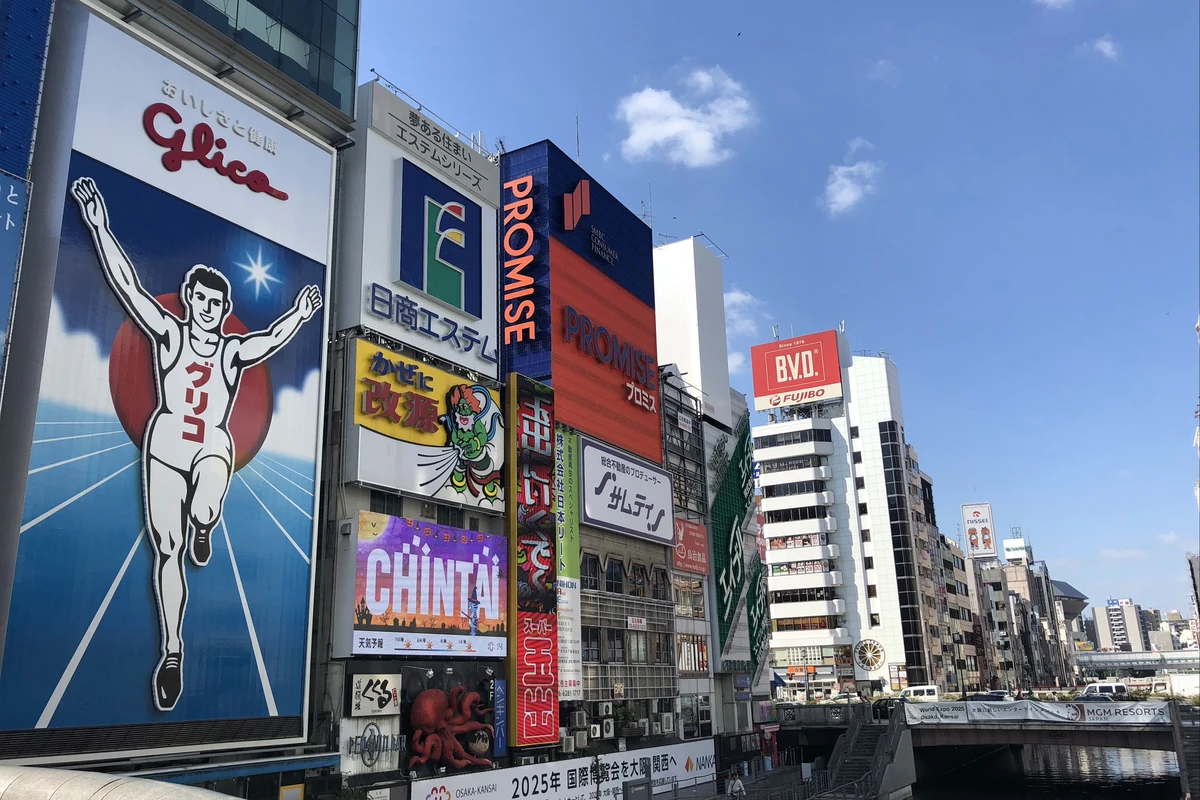
On the other side of Ebisu Bridge stands a massive billboard that has become a permanent landmark of Osaka: the famous Glico Running Man. Since 1935, generations of Glico Running Men (the current one is said to be the sixth) with different styles, outfits, and backgrounds but always the same running pose have been dashing across this 20-meter-tall electronic screen. In 2014, there was even a female runner, the beautiful Haruka Ayase. For many Chinese people, the name "Glico" might not ring a bell, but you've surely eaten or at least seen its products worldwide (see picture below). It is said that the original inspiration for this advertisement came from a nutritional candy called Glico, each piece of which supposedly provided enough energy to run 300 meters. That's why the running man was originally nicknamed the "300-meter runner" when he made his debut on Osaka's busiest shopping street. So when you come to Dotonbori, you have to take a photo with this iconic figure!
By the way, earlier in the morning we had passed by a small but popular shop called "Ju-hachi-ban" (I misread it as "Dai-baku" due to poor eyesight) that specializes in takoyaki (octopus balls). It wasn't open yet; only the staff were busy preparing, and the owner was giving an interview to a TV station, proudly speaking passionately. By now, a long winding queue had formed, and the waiting crowd obscured a funny slogan on the shop front: "One ball enters the soul." I sent K to line up, wanting to experience what it feels like when a takoyaki enters your soul. He came back after a moment, saying that a whole tour group of Chinese tourists had arrived behind him, and it was too noisy, so he gave up.
Across from Ju-hachi-ban was another takoyaki shop. Although it had a sign claiming "XX Award First Place," it had far fewer customers. At a glance, the entire Dotonbori street is filled with various food and drink shops. Huge, dazzling signs blatantly tease visitors' stomachs and eyes. Indeed, as the rumors go, unlike Tokyo's pursuit of fashion and Kyoto's emphasis on traditional taste, Osaka is a paradise for foodies. It feels a bit like my hometown Guangzhou.
P.S.: In Dotonbori, you can try to find the legendary "Kuite Taro" doll, which symbolizes that there are so many delicious things in Osaka that you'll go broke. We didn't specifically look for it, but I heard you have to queue for a photo too.
P.S.: I also recommend a narrow alley called "Ukiyo-no-Koji" (Floating World Alley). It's very close to Hozenji Temple, and its entrance opens onto Dotonbori Street, right next to a shop called Imai Udon. It's easy to miss. The alley is only 1.2 meters wide and less than 50 meters long. It's decorated with bas-relief-like colorful paintings depicting scenes of everyday life in the Showa period, said to be very interesting. There's also a small shrine dedicated to Issun Boshi (the One-Inch Boy) where you can draw fortunes. (Unfortunately, since I didn't do thorough homework, I didn't know about this at the time. I'll definitely go next time!)
Finally, we waited until the museum opened and went inside.
To be honest, I didn't know much about ukiyo-e. When I thought about it, the images that came to mind were women with cross-eyed looks, expressionless pale long faces and black hair, or fierce-looking men. Of course, I also love the big wave by Katsushika Hokusai. Compared to figure paintings, I prefer ukiyo-e landscapes.
The Kamigata Ukiyoe Museum, which opened in 2001, mainly exhibits ukiyo-e works by artists from the Kamigata region (old Kyoto and Osaka). Most of them depict kabuki performances and actors, somewhat like celebrity photos or stage stills. According to the introduction, some were even made specifically for the theaters around Dotonbori, with detailed records of the performance venue, time, and the names of the performers.
The museum regularly plans various series of exhibits, so even regular visitors can enjoy different artworks. The exhibition we caught was the 69th themed exhibition called "Ukiyoe's Light and Shadow." It also had some informational panels (in Japanese) introducing knowledge about ukiyo-e, from which I learned quite a bit.
This artist, Shunkosai Hokushu, was a disciple of Katsushika Hokusai.
The museum is small, and the number of works on display is not large. Perhaps to protect the artworks, the exhibition rooms are quite dim. Fortunately, there were few visitors; during our entire visit, we only saw one young European couple. It was rare to be able to quietly and carefully appreciate the art. On the fourth floor, there was a small hands-on room where you could sign up to learn how to make ukiyo-e. If you want to admire ukiyo-e, I recommend the Sumida Hokusai Museum in Tokyo, but being able to see works of other styles and learn some knowledge made the trip worthwhile nonetheless.
It is said that this main branch of Kani Doraku has a history of over 50 years. Due to the popularity among Chinese tourists, especially for dinner, even reservations can't guarantee a seat. Fortunately, we came at lunchtime, soon after it opened, so there were few diners. In the lobby, crabs in the aquarium were blowing bubbles. The top layer had hairy crabs from Hokkaido, the middle had king crabs from Russia, and the lower layer had snow crabs (zuwai crab) or something—I couldn't quite tell them apart.
After studying the menu for a long time, we couldn't figure out which dishes used which kind of crab. It was all a full crab banquet anyway. We ordered the most expensive kaiseki course meal, but it didn't include all the dishes, so we also ordered a slightly cheaper set to complement.
The photos above show only part of the two course meals: grilled, pan-fried, baked, deep-fried, steamed, boiled, raw crab, sushi, crab soup, tempura, mixed rice... basically every possible cooking method was used. Finally, we had freshly ground matcha ice cream as dessert. After we managed to devour the entire crab banquet, K, who is a chef from Guangdong, said slowly, "But our hairy crab is still better!" I almost spit out blood... But to be fair, when it comes to tender meat and rich roe, sea crabs can't compare to freshwater hairy crabs (some well-known hairy crab restaurants in Shanghai even have groups of Japanese foodies visiting). However, both Hokkaido hairy crabs and king crabs have their unique flavors. Eating them this way was more about the fun experience. Perhaps next time I'll try specialized dishes to truly taste their deliciousness.
I heard that things are very cheap in Osaka, making it the best place for shopping. But I couldn't think of anything I needed besides drugstore items, and we still had a long journey ahead. So I ended up empty-handed, dragging K around aimlessly. When we got tired of walking and wanted to take the subway back to the hotel, we hit the evening rush hour. While hesitating, I noticed many office worker-looking men and women heading into a small side passage next to the subway entrance. My curiosity piqued, I followed them. It turned out that this passage led to a large cluster of small eateries where they were having dinner. So we decided to go with the flow and eat there, passing the time until the subway rush hour passed.
But upon closer inspection, almost every shop had a tiny storefront, and people inside were eating and drinking standing up! This went against everything I know. When I was a child, my family said that only animals like mules and horses stood while eating, to teach kids to sit properly and eat steadily.
I had previously seen those narrow "tachigui" (standing eating) shops in Japan where a long counter serves as a table. People order and pay at a machine by the entrance, then line up in a single row and eat in front of the counter before leaving through the other side—a one-way street. I was astounded! Well, Japan is small and land is expensive, so I could barely understand that. But this time, I saw something even newer: people going specifically to stand and drink, as if it were a cocktail party but cramped. I really couldn't comprehend why they would go to such lengths just to drink. Still, I learned a new Japanese word: "tachinomi" (standing drinking).
We searched the passage for a long time but couldn't find a place with seats. Fortunately, this is Osaka, so no one goes hungry. K grabbed some takoyaki to fill his stomach—this can be eaten standing. If you look closely, you can see a narrow wooden shelf in front of him that serves as a table, with small hooks underneath for customers to hang their bags—quite thoughtful.
Tomorrow, we head off to the next stop. So, see you next time, Osaka!