Japan Travel: Kyoto and Osaka Trip (Photos)
Organized by CNR Urban Voice TOP FM101.8 and Beijing Aiche, the "Sea, Land, and Air Experience Aiche Japan Trip" concluded the Fuji Mountain journey. On the afternoon of December 26, 2011, over a hundred car enthusiasts and listeners drove about four hours from Hakone in Yamanashi Prefecture, arriving in Kyoto around 3:30 PM local time, beginning the final leg of the Kyoto and Osaka tour.
Glimpses of Kyoto Streets (Photo by Feng Ganyong)
Kyoto is located in the Kansai region of Japan, a city with a long history. The Heian-kyo was established in Kyoto in 794 AD, and for over a thousand years until the capital was moved to Tokyo in 1868, Kyoto remained Japan's capital. Since its founding, Kyoto has been Japan's economic and cultural center, with citizens preserving its elegant traditions. At the same time, Kyoto is a city deeply influenced by Chinese culture, with many shop names still bearing traces of Chinese characters.
Kyoto Scenery (Photo by Feng Ganyong)
Luoyang and Chang'an in China were historical capitals of Chinese dynasties. Influenced by China, when Heian-kyo was modeled after Chinese cities, it was divided into east and west sections. The western right capital was modeled after Chang'an, thus called "Chang'an"; the eastern left capital was modeled after Luoyang, thus called "Luoyang." However, the western "Chang'an" area was mostly marshland and could not be fully developed, so the actual urban area was only the eastern "Luoyang." Hence, Kyoto is also called "Luoyang," and areas within the city still retain names like Rakuchu, Rakusai, Rakunan, and Rakuhoku. Going to Kyoto is referred to as "Jōkyō" or "Jōraku."
Arriving at Kinkaku-ji (Photo by Feng Ganyong)
After arriving in Kyoto, the car enthusiasts first visited the famous Kinkaku-ji. The temple's formal name is Rokuon-ji. Because the building is covered in gold leaf, it is also known as the Golden Pavilion. Located in Kyoto, this ancient temple was first completed in 1397 (the fourth year of the Ōei era). Besides being a famous tourist attraction, it is designated as a National Treasure by the Japanese government and was designated a UNESCO World Cultural Heritage Site in 1994.
Kinkaku-ji (Photo by Zhang Baowen)
It is said that the garden centered around the Golden Pavilion represents the Pure Land of Ultimate Bliss. The pond called Kyōko-chi reflects the Golden Pavilion, creating a quintessential Kyoto scene. Especially on clear days, one can enjoy the reflection of the brilliant golden pavilion and the blue sky in Kyōko-chi, like a fine art postcard. Kinkaku-ji also has a unique feature: visitors receive not a regular admission ticket but a paper talisman with blessings. Additionally, beside the Fudō-dō hall, there are fortune slips in Chinese and Korean for divination.
Architecture of Kinkaku-ji (Photo by Feng Ganyong)
The residential-style architecture of Kinkaku-ji, with its Buddhist hall form, is harmonious and elegant. It is a masterpiece of garden architecture, embodying the eclectic taste and refinement of Ashikaga Yoshimitsu. This building, with few pillars and thin walls, evokes a ship's structure, and the green pond below symbolizes the sea. The Golden Pavilion is like a beautiful ship sailing through the sea of time. It is magnificent, unrestrained, and captivating, blending the traditional culture of its era with emerging material culture, representing the Muromachi period.
A Corner of Kinkaku-ji Scenic Area (Photo by Feng Ganyong)
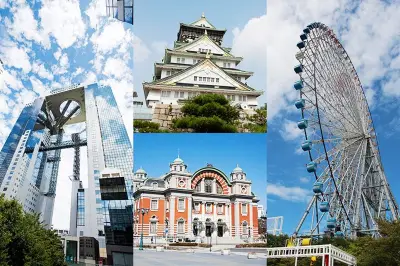
After visiting Kinkaku-ji, the tour bus took about two hours to arrive in Osaka safely by 6:00 PM that evening. Osaka is Japan's second-largest city, historically called Naniwa or Namba, and began to be called Osaka in the 19th century. It is Japan's economic, trade, and cultural center. As a historical and cultural city, Osaka, facing the Seto Inland Sea, has long been the gateway to the ancient capitals of Nara and Kyoto. It is one of the earliest areas for commerce and trade development in Japan, with several Japanese emperors establishing capitals here (313–412 AD, 645–683 AD), so it has many historical sites.
Night View of Kyoto Imperial Palace (Photo by Feng Ganyong)
Osaka's famous historical sites include the ruins of the Nara-era Naniwa Palace, the Heian-era Daifutsu-ji, the Edo-era Tanshu-an, and the Meiji-era Mint Museum's Senkan-kan. The eastern district has Osaka Castle built by Toyotomi Hideyoshi. Osaka's terrain is higher in the east and lower in the west. Taking advantage of the low-lying western area, people have built many canals, making water transport more developed. Water areas account for over 10% of Osaka's total area, earning it the nickname "City of Water," with 1,400 bridges in the city.
Kyoto Night (Photo by Feng Ganyong)
December 27, 2011, was another sunny day—the fifth consecutive clear, bright day since the group arrived in Japan. The car enthusiasts were exceptionally lucky on this sea, land, and air experience trip in Japan. In the morning, they visited Osaka Castle Park. To mention Osaka Castle Park, we should first talk about the historic Osaka Castle, built by Toyotomi Hideyoshi in 1586, constructed with majestic stone walls.
Group Photo at Osaka Castle Park (Photo by Zhao Shuxin)
In the center of Osaka Castle Park stands the main building of Osaka Castle, the Tenshukaku, towering and magnificent, decorated with copper and gold, very impressive. Today, Osaka Castle has been designated a Special Historic Site. The historical museum inside preserves Toyotomi Hideyoshi's wooden statue, weapons, art works, etc. In the Nishi-no-maru Garden, there is a vast lawn and historical sites like the outer moat and Taihei Gate, which were burned down and rebuilt—a good place for a stroll and relaxation.
Visiting Osaka Castle (Photo by Feng Ganyong)
Walking into Osaka Castle Park, visitors can see lush vegetation, flocks of pigeons playing with tourists, sometimes foraging for food on the ground, sometimes soaring into the sky above the park.
Scenery of Osaka Castle Park (Photo by Feng Ganyong)
It is said that during the flower season, it is a great place for cherry blossom and plum viewing, and on the moat banks, families can be seen watching wild birds by the water. It is not only a beloved urban oasis for Osaka citizens but also attracts many international tourists.
Winter Scenery of Osaka Castle Park (Photo by Feng Ganyong)
The area along the outer edges of the north and east outer moats was formerly the Osaka Artillery Arsenal of the Japanese Army, so it was heavily bombed by the US military during World War II. Even today, unexploded bombs are occasionally found during nearby construction. Additionally, the Toyokuni Shrine, originally built on Nakanoshima, was relocated to the park in 1961. The park also has a forest park, Osaka Castle Music Hall, baseball field, and other facilities.
Photo at Tenshukaku (Photo by Ma Feiyue)
The existing Osaka Castle Park was rebuilt in 1931 through private donations, surrounded by moats, with beautiful gardens and pavilions. Strolling along the river, one sees exotic flowers and lush greenery, full of poetic charm. The Sakura-mon Gate inside the castle is quite famous. When Osaka Castle suffered a fire, this gate, made entirely of giant stones, stood unscathed and remains as the only existing relic.
Tenshukaku (Photo by Feng Ganyong)
Tenshukaku is the center of Osaka Castle and a must-visit spot in Osaka. The spacious castle grounds include Hommaru, Ni-no-maru, and Yamazato-maru, with deep double moats and high stone walls preserved. It has important buildings like the Otemon Gate and multiple turrets.
Photo at Osaka Park (Photo by Wang Libao)
The museum inside Tenshukaku has a cinema room, virtual reality devices, and displays introducing Osaka's historical and cultural materials. From the observation deck on the eighth floor, one can take in the entire view of the vast Osaka Castle and the whole city of Osaka.
Reflection in the Lake (Photo by Cui Chunjie)
Osaka Castle Park was the last scenic spot on the Japan tour. Afterward, the car enthusiasts drove to Kobe Port to begin their return journey. After about an hour's drive from Osaka, they arrived in Kobe. Kobe Port is located on the west bank of the Ashiya River estuary in Hyogo Prefecture, southern Honshu, facing the northwest side of Osaka Bay. It is Japan's largest container port and one of the world's top ten container ports.
Beauty of Osaka Castle Park (Photo by Feng Ganyong)
On the afternoon of December 27, around 3:00 PM, the hundred car enthusiasts and listeners of the "Sea, Land, and Air Experience Aiche Japan Trip" boarded the "Yanjing" cruise ship, which would take them back to China. The "Yanjing" belongs to Tianjin Jinshen Passenger Cargo Ship Co., Ltd. This luxury international passenger-cargo liner was built in 1989 at the Onomichi Shipyard in Japan, under the advocacy of former Tianjin Mayor Li Ruihuan and former Kobe Mayor Miyazaki Asao.
Osaka Street Scene (Photo by Feng Ganyong)
The opening of the "Yanjing" route not only built a maritime friendship bridge between the two sister cities but also rewrote Tianjin's history of lacking international passenger ships. The "Yanjing" has a sea speed of 21 knots, making it one of the fastest liners on the China-Japan route. It has operated safely for 20 consecutive years without accidents, significantly contributing to Tianjin's economic development and its construction as an international port metropolis.
Kobe Port Scenery (Photo by Feng Ganyong)
The car enthusiasts would spend three nights and two days on the "Yanjing." After leaving Kobe Port, the cruise ship sailed through the beautiful Seto Inland Sea, with stunning scenery on both sides. From Kobe to Tianjin, the enthusiasts enjoyed views of Kobe's artificial island, the surging Akashi Strait, the Seto Ohashi Bridge connecting six islands in the Inland Sea, the turbulent Kurushima Kaikyo Bridge, the Kanmon Bridge connecting Honshu and Kyushu, passing Jeju Island and the Tsushima Strait, Korean waters, Yantai waters, the Yellow River estuary boundary, the famous Dagu Lighthouse, and finally arriving at Tianjin Xingang.
Kobe Port at Sunset (Photo by Feng Ganyong)
To relieve the boredom of the long voyage, CNR Urban Voice TOP FM101.8 and Beijing Aiche Sunshine and other organizers invited the ship's Political Commissar Hou Guoliang, Captain Song Fengjun, and other leaders to participate in a series of activities, including lectures on navigation knowledge, life-saving drills, visits to the bridge, and a variety show with the crew.
Photo on the Yanjing Cruise Ship (Photo by Ma Feiyue)
Meanwhile, the car enthusiasts enjoyed themselves in the ship's facilities, such as karaoke rooms, bars, mahjong rooms, coffee shops, tea rooms, game rooms, table tennis rooms, and reading rooms. During the eight-day trip, Wang Xiaolei, host of CNR's "Urban Voice" program, connected live daily with CNR TOP FM101.8's "Weekend Drive" show, reporting the group's itinerary in Japan to listeners who were concerned about the trip, receiving enthusiastic responses.
Group Photo on the Yanjing (Photo by Wang Libao)
Wang Xiaolei told reporters that he would produce two special retrospective reports on this Japan tour on January 2-3, 2012. On the morning of December 30, 2011, the "Yanjing" safely docked at Tianjin Xingang, bringing the eight-day "Sea, Land, and Air Experience Aiche Japan Trip" to a successful conclusion. (Text and photos by Feng Ganyong)