Exploring Osaka's History with the 1-Day Enjoy Eco Card!
Merhaba!
I'm Hamza, born in Turkey and raised in Osaka. I lived in Osaka until I was 18, and now I live in Turkey.
I thought I knew a lot about Osaka's history, having lived there for so long, but I actually still have much to learn.
So, I decided to use Osaka Metro's Enjoy Eco Card to explore Osaka and rediscover its history.
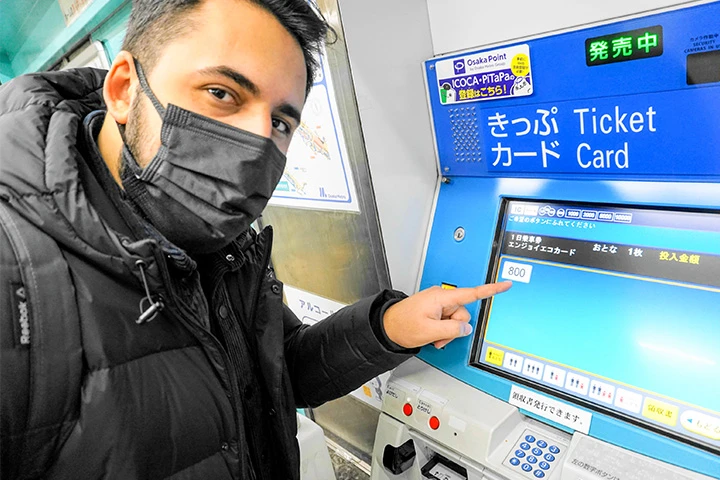
About the Enjoy Eco Card price: 800 yen for adults on weekdays, 600 yen on Saturdays, Sundays, and holidays (children 300 yen), and you also get discounts at sightseeing facilities. The card covers the entire Osaka Metro network and most Osaka City Bus routes. For a day of sightseeing in Osaka, the Enjoy Eco Card is convenient and economical. You can easily buy it at ticket machines in Osaka Metro stations.
Purchasing the ticket and passing through the ticket gate (and adjusting fares)
With my ticket in hand, let's start the Osaka history tour!
First, let's visit the famous Shitennoji Temple, the first officially administered Buddhist temple in Japan. From Namba Station, take the Midosuji Line and the Tanimachi Line to Shitennoji-mae Yuhigaoka Station. A 5-minute walk from the station brings you to the stone torii gate on the west side of Shitennoji. This is said to be the oldest surviving stone torii gate in Japan.
The towering five-story pagoda is truly beautiful. The temple grounds are spacious, and the sky stretches endlessly—so refreshing.
Admission to the central precinct, main garden, and treasure museum requires a ticket, but you can get a discount by showing your Enjoy Eco Card. The regular adult admission to the central precinct and main garden is 300 yen each, but you can get them for 200 yen. The treasure museum's adult admission is reduced from 500 yen to 200 yen. If you visit all three, you save 500 yen in total! That's a great deal.
Shitennoji was founded by Prince Shotoku, a famous politician in Japan, and is an ancient temple with over 1,400 years of history. Even today, it is revered by many people and is a must-see historical site in Osaka. The Kondo (Golden Hall) and Lecture Hall inside the precinct house solemn and beautiful Buddhist statues, but photography is not allowed, so I can't show you pictures—unfortunately.
When I visited the Kondo at 11 o'clock, I happened to witness a Buddhist service called 'Sharishutsu' (relic offering). This ceremony is held daily at 11 a.m., where monks chant sutras and gently touch the heads of worshippers with the Buddha's relics (shari) to pray for guidance.
It felt very solemn and mysterious.
Shitennoji has many other highlights too.
The impressive Niomon gate. The guardian statues are muscular and fierce, really cool.
Osaka's power spot?! Mysterious Seven Wonders of Shitennoji!
It was a cold day, and after walking around, I felt chilly and hungry. So I went to a popular soba restaurant outside Chumon Gate called 'Shitennoji Hayauchi.' The place has a warm, traditional Japanese atmosphere. The buckwheat tea served at the start was hot and warmed my cold body. I ordered my favorite tempura soba! First, I dipped the crispy tempura in a little salt. The big shrimp was perfectly springy and delicious!
The soba noodles were fragrant and elegant, and the broth was gentle, slowly warming my chilled body.
A perfect meal for a cold day. I heard it's always crowded at lunchtime. I was right to go in right as it opened.
● Osaka Museum of History: Experience changes from ancient to modern times
Then I took the Osaka Metro Tanimachi Line to Tanimachi 4-chome Station. A short walk from the station brought me to the Osaka Museum of History.
The building is stylish and cool. The NHK Osaka broadcasting station is right next door.
Here, by showing your Enjoy Eco Card, the regular adult admission of 600 yen is discounted 10% to 540 yen (permanent exhibition only). Let's go in!
Take the elevator to the 10th floor, which represents Osaka in the Nara period (710–784 AD). I time-traveled to the Daigokuden (Great Hall) of Naniwa Palace, the imperial palace of the time. The vermilion-lacquered pillars, reconstructed at actual size, stood tall, and many figurines recreated the scenes of that era.
After the explanatory video about Naniwa Palace, the projection screen opened, revealing the actual Naniwa Palace ruins before me. So this was once the capital—I was deeply impressed. Enjoying the view, I imagined ancient Osaka... So romantic.
On the elevator going down from the 10th to the 9th floor, there is a photo spot of Osaka Castle. The Osaka Museum of History is a little-known great photo spot. You can get a direct frontal view of Osaka Castle from above.
Let me briefly explain each floor. The 9th floor is the medieval and early modern floor. It features exhibits like a detailed model of Ishiyama Hongan-ji, with even the expressions of the figures meticulously crafted.
This area with a bridge represents Osaka in the Edo period (1603–1868). Place names like Hachikenya and Ajigawaguchi are still in use today. So this is what it used to be like—you can feel the vibrant energy of the common people of that time.
Osaka's most famous festival is the Danjiri Matsuri (float festival). Here you can see a Danjiri float up close. It's impressive.
The 8th floor introduces archaeological excavation work. The exhibits are easy to understand, even for children. There are simulated excavation experiences and puzzles for restoration work, but they were canceled due to COVID-19.
The 7th floor is the modern and contemporary floor. It recreates a shopping street from 1940, which feels nostalgic.
Here is the Dotonbori Kadoza theater, where kabuki and rakugo were performed. Today's Dotonbori is a tourist destination known for the Glico running man sign and Kani Doraku, but it used to be a center for theater and film.
It is said that Shinsaibashi Shopping Street was at the forefront of fashion in those days, a place everyone aspired to visit.
This floor has many exhibits that make for fun, retro-looking photos—highly recommended.
After going down to the 1st floor, I found a time capsule buried during the 1970 Osaka Expo!
The Osaka-Kansai Expo will be held again in 2025. I wonder what kind of expo it will be? I'm already looking forward to it.
For the final stop of my history tour, I took the Chuo Line from Tanimachi 4-chome Station to Sakaisuji-hommachi Station. A 5-minute walk from the station brought me to the Osaka Entrepreneurs Museum. This museum displays artifacts and materials related to entrepreneurs with ties to Osaka. As someone aspiring to start my own business, it was a fascinating facility.
Here, by showing your Enjoy Eco Card, the regular adult admission of 300 yen is discounted to 200 yen. Let's go in!
First, watch the prologue video 'The Roots of Osaka Entrepreneurship Spirit' to learn about the Osaka spirit embodied by Toyotomi Hideyoshi, the warlord who built Osaka Castle, and the merchants of the Edo period.
The main exhibition then showcases the footprints and related items of 105 entrepreneurs who contributed greatly to Osaka's industrial development. Names like Matsushita (Panasonic) and Ezaki Glico—even if you don't know the entrepreneurs' names, the company names are famous Japanese corporations. I didn't realize so many entrepreneurs were active in Osaka.
Viewing the panels and materials, you can learn about the entrepreneurs' innovative perspectives, their trials and errors, and the great history of overcoming difficulties to achieve success.
Thanks to the achievements of these entrepreneurs, social and economic development progressed, and people's living standards improved.
Wow! I found my favorite cup noodles! This is ramen loved worldwide.
The exhibit on Momofuku Ando, the founder of Nissin Foods who invented the world's first cup noodles, was also interesting.
Free audio guides (Japanese, English, Chinese, Korean) are available, so I recommend listening to explanations while taking your time. The theater shows videos, and you can browse the entrepreneurs' autobiographies, biographies, and company histories.
Those who started businesses and achieved great success are truly remarkable.
Each entrepreneur held firm to their beliefs, overcame difficulties through creativity and action, and led their companies to greater growth. I'm so impressed. The entrepreneurs' famous quotes resonate in my mind, and just reading them taught me a lot.
I feel that Osaka, where these people thrived, is a city full of energy and strength, and I felt empowered by this museum.
Today, I explored Osaka from ancient times to the modern era, learned about its many facets, and gained a lot of knowledge. I once again realized that Osaka has always been an important political and economic center, a city that made history.
Osaka raised me. I am proud of it.
Thanks to the Enjoy Eco Card, what would have cost 2,720 yen in transportation and admission fees ended up being only 2,140 yen. A great bargain and very satisfying!
Everyone, be sure to get an Enjoy Eco Card and take your own Osaka history tour.
*The facilities mentioned may have viewing restrictions due to COVID-19 prevention measures. Please check their websites for details.
▼ For more information, see the comments below.
Travel Diary Table of Contents
1. ● Start from Shitennoji, Japan's Oldest Official Temple
2. ● Gathering of Famous Osaka Entrepreneurs! Osaka Entrepreneurs Museum
Travel Information
Hotel Index
Strategy Index
Flight Index
Website Navigation
Travel Index
Cruise Index
Corporate Travel Index
Affiliate Cooperation
Distribution Alliance
Friendship Links
Corporate Gift Card Purchasing
Insurance Agent
Agent Cooperation
Hotel Franchise
Destination and Attraction Cooperation
More Cooperation
About Ctrip
About Ctrip
Ctrip Hot Topics
Contact Us
Careers
User Agreement
Privacy Policy
Business License
Security Center
Ctrip Content Center
Intellectual Property
Trip.com Group Algorithm Announcement