Experiencing Tea Ceremony and Calligraphy at a Temple in Hirano, Osaka
Hello everyone! I'm Nas from South Korea, here in Japan on a working holiday. I really like Japan and taught myself Japanese by watching Japanese TV shows on YouTube. I now work at a hotel in Namba.
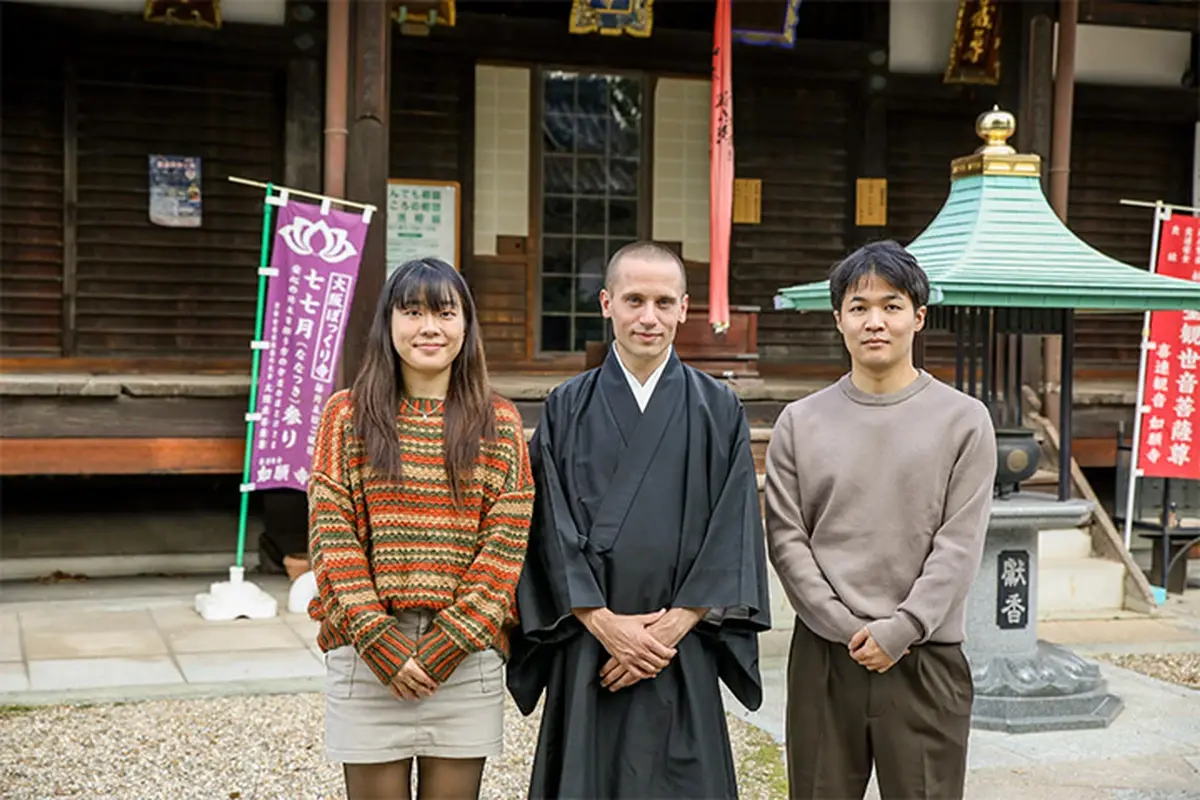
When I'm at the hotel, I often hear tourists say they want to experience something uniquely Japanese. So I decided to try it myself. Together with Ji-Won, also from South Korea and on a working holiday in Japan, I went to a temple where we could experience Japanese tea ceremony and calligraphy.
The station we arrived at was Kire-Uriwari Station on the Osaka Metro Tanimachi Line, a station famous for its difficult-to-read name. After about a 10-minute walk from there, we reached Ruyuan Temple. The vice abbot of this temple is actually Russian♪ Handsome~!!
Because he also moved to Japan from overseas, he felt more approachable to us. Still, his elegant demeanor is very Japanese.
This temple has deep ties with Prince Shotoku and Kobo Daishi, making it a temple with a long history. In addition to temple lodging, you can also experience tea ceremony, sutra copying, Buddha image tracing, calligraphy, and pottery.
This time, we tried out the tea ceremony, which beginners can enjoy, and calligraphy, which is very popular among foreigners!
First, we were led to the study room and started with seiza (kneeling).
The vice abbot speaks Russian, Japanese, and English fluently, and explains in the language the guest prefers. My Japanese is better than my English, and Ji-Won, who is also learning Japanese, wanted the explanation in Japanese.
The vice abbot asked, "Can you do seiza?" Although we weren't confident, we tried our best. If you're not used to seiza, he will prepare a chair, so don't worry.
Tea ceremony is a culture that celebrates the seasons. The scrolls, flowers, and tea bowls in the room all seem to express the four seasons.
Each item has a meaning beyond just decoration.
He explained in great detail, allowing us to understand the concept of "wabi-sabi," which we were hearing for the first time.
"Wabi-sabi" is, simply put, a uniquely Japanese aesthetic sense. For example, appreciating humility, simplicity, tranquility, the beauty that comes with time, and the imperfections of things.
In the tea ceremony, there aren't many words, but there is a heart-to-heart connection between the guests and the host, the vice abbot.
Here, everyone sets aside their status and enjoys tea as equals, using all five senses to fully experience the space—seeing, hearing, smelling, tasting, and feeling the warmth of the tea bowl. This is truly a wonderful culture, worthy of the term "comprehensive art."
Finally, it was time to drink the tea. When the tea was placed in front of me, I brought it forward.
If you drink before the person next to you, you say, "I'll go first," then "I'll have the tea," and turn the tea bowl clockwise twice.
The vice abbot taught us that every action is considerate of others.
The sweet before tea also represents the seasons. Today's sweet was shaped like a cosmos flower, pink and very cute. It was so pretty that I hated to eat it.
Finally, we tried making the tea ourselves. The vice abbot taught us to say in our minds, "Make it delicious!" He also showed a slightly humorous side♪
It was my first time holding a chasen (tea whisk), and I was a bit nervous, but being able to drink tea this way was wonderful. I was so absorbed that when I tried to stand up, ah~ ah~ my legs wouldn't move. It hurt so much.
That was my first experience of numb legs from seiza. Including that, it was truly a wonderful time.
Next, we learned calligraphy from the vice abbot. Ji-Won said she recently started learning calligraphy from a friend's grandmother, but the last time I held a brush was in elementary school. I was worried if I could do well💦
First, the vice abbot taught us the posture and how to hold the brush. We practiced horizontal lines with the teacher. Start sharp, then relax, and press at the end. It's so hard. Am I improving little by little...?
Then we practiced vertical lines and wrote the character "person" (人). Even though it's only two strokes, it contains many elements—it's a kind of ascetic practice.
Ji-Won next to me was clearly getting better, and I did my best too...
Finally, we chose a character we liked and wrote it on a thick paper card. Ji-Won chose the character "奥" (deep), and I chose "勇" (courage). I wrote it with all my heart.
Writing on the thick paper card made me nervous, but although it's a bit embarrassing, it can also be used as decoration, so it's a wonderful memory!
The vice abbot taught me something very important: "If you keep at it, even just a little, you will definitely improve. The emotions in a work written with your heart have the power to convey."
It was a short but very fulfilling and beautiful time. Every day I pass through busy downtown areas, but this experience of calming the mind was also very important.
The tea ceremony experience and calligraphy experience we did this time cost 2,000 yen each (tax included), each taking about an hour. In addition, there are sutra copying, Buddha image tracing, and pottery experiences. If you want to experience Japanese culture, please contact Ruyuan Temple.
You can make a reservation on their website, but it seems to be only in Japanese. If your Japanese isn't good, you can call directly, as they offer English service. Highly recommended for foreign tourists!
After that, we did some shopping and ate delicious udon. Stay tuned for more!
Table of Contents: 1. Vice Abbot is Mr. Volkogonov from Russia 2. Tea ceremony experience! Comprehensive art enjoyed with the five senses 3. Moved by the delicious tea and sweets enjoyed in quiet elegance! 4. Calligraphy experience! Picking up a brush for the first time since elementary school