#Sky over Lake Biwa#: 14-Day Free Travel in Kansai — D8: Amanohashidate, an Amazing Place
May 30, 2025, a sunny day. Today we will visit all the main attractions of Amanohashidate.
Amanohashidate is a scenic spot in the northern part of Kyoto Prefecture. It is a sandbar about 3.6 km long separating the Sea of Japan's Aso Sea from Miyazu Bay. About 8,000 pine trees form a continuous street of trees along it. It is listed as one of the Three Most Scenic Spots of Japan, along with Matsushima (Miyagi Prefecture) and Itsukushima (Hiroshima Prefecture). It is said that its shape looks like a white bridge soaring into the sky, hence the name "Amanohashidate" (Bridge of Heaven).
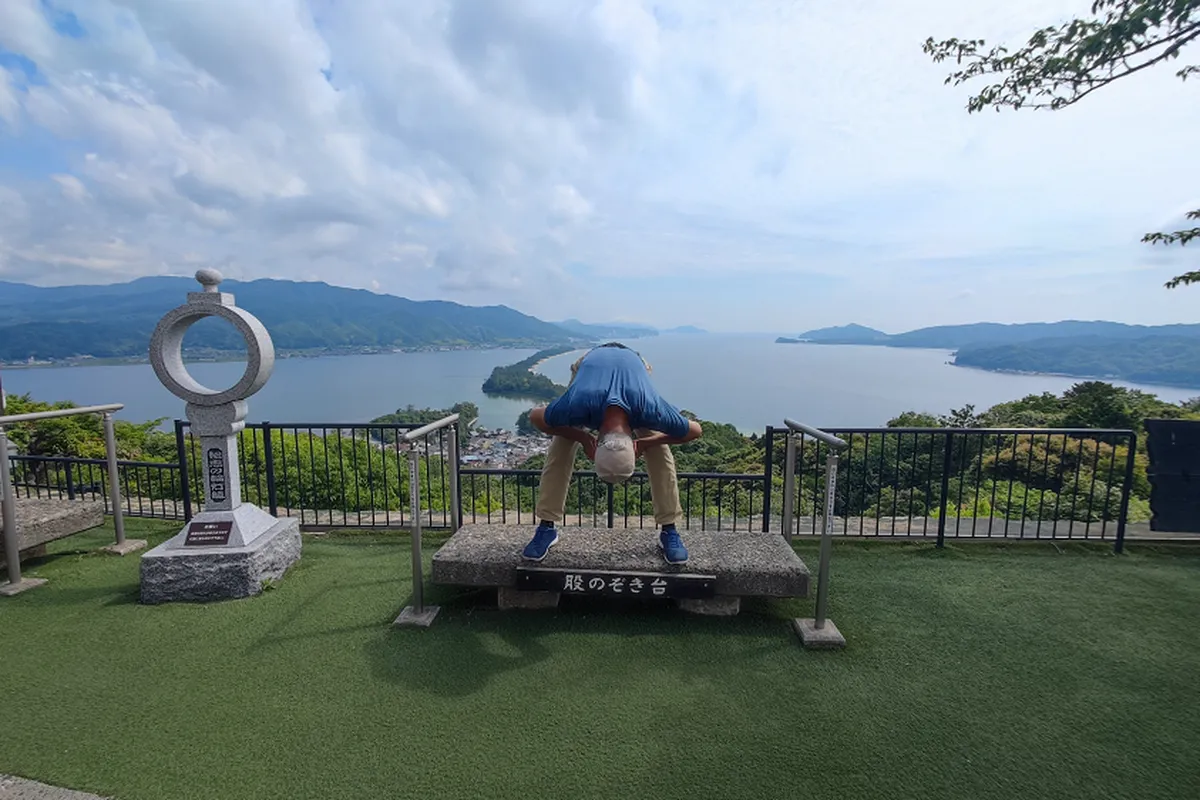
Two legends explain the name. One: if you bend over and look between your legs from the view points at the southern end (Hiryukan) or the northern end (Kasanomatsu Park), the sandbar appears like a bridge extending into the sky, hence the name. The other: the god Izanagi built a great floating bridge in the sky to easily visit the goddess Izanami. One day, Izanami stayed overnight in the human world, and unexpectedly the bridge collapsed and fell to earth, becoming the present Amanohashidate.
In the morning, I opened the curtains and saw the beautiful view of Miyazu Bay outside the window, and I became energetic.
First, I went to the hot spring bath for a soak. The daytime atmosphere is different from night. Last night, the window next to the hot spring pool was dark and I could see nothing. During the day, I could soak while clearly enjoying the sky, mountain view, and sea outside the window—it was simply beautiful (photography and video are prohibited in the hot spring area).
Back in the room, I brewed a pot of tea and tasted small cakes made from pine needles, a specialty of Amanohashidate, and relaxed for a while.
The hotel's Japanese breakfast was exquisite and ceremonial.
After breakfast, I took a look at the hotel lobby. In Japan, if a guest visits someone staying at the hotel, the visitor is not allowed to enter the guest's room; they must meet in the lobby.
At a little past 8 a.m., we set off!
Exiting the hotel, we saw a train of the Kitakinki Tango Railway passing by. Yesterday we had taken the same type of train to Amanohashidate.
First, we took a walk in Amanohashidate Park, which is right next to the hotel.
The building ahead along the walking path is our hotel.
First stop: the Hiryukan observation deck. On the way, we had to cross the railway line; a hundred meters ahead was the platform of Amanohashidate Station.
Soon we arrived at the ropeway station.
It opened at 9 a.m., and round-trip tickets cost 1,000 yen per person.
There were two types of cable cars: a cabin type and a chairlift type. The cabin cars ran every 20 minutes, while the chairlift was available anytime. We chose the chairlift for a better experience.
Soon we reached the top of the mountain. Let's take a photo!
This is the Hiryukan observation deck.
These platforms are for tourists to stand on, with their bottoms facing the sky, and look backwards upside down.
A poster shows how to see a different view.
The image below clearly shows the geography of Amanohashidate: a north-south sandbar separating the Aso Sea from Miyazu Bay.
This is such a beautiful photo spot, of course we had to take a picture.
A distant view of the beautiful city of Miyazu.
At the top, besides sightseeing, there were also entertainment facilities like a small Ferris wheel, pedal-powered rail cars, and shooting games.
The Hiryukan corridor is absolutely not to be missed—it's stunning.
Before going down, I took a panoramic photo.
On the way, I saw the cabin cable car.
Second stop: taking a sightseeing boat.
On the way to the pier, we passed by Chionji Temple.
We bought round-trip tickets at the sightseeing boat pier, 1,300 yen per person.
I went up to the top deck, struck a pose, and showed off.
The sightseeing boat sailed from the Aso Sea side toward the Shoryukan. Many seagulls and eagles flew around, either circling above people's heads or following the wake behind the boat.
The bold ones would fly over and snatch shrimp crackers from tourists' hands (shrimp crackers were sold at the pier for 100 yen per pack).
I captured several close-up shots of the seagulls—they looked silly and cute.
I also caught a photo of several eagles together in the frame.
After landing, we walked toward Kasanomatsu Park.
At Fuchu Station, we took the ropeway up the mountain. Round-trip tickets were 800 yen per person.
Again we chose the chairlift. The cabin cable car here was under maintenance. First-time chairlift riders could check this picture for instructions.
The Shoryukan observation deck is slightly lower than Hiryukan.
Another upside-down pose.
I saw the effect of the dragon ascending to heaven.
At the top park, there was a piano; those who can play could show off their skills. My wife pretended to be cool.
There was also a terrace suitable for small weddings or proposals—very romantic.
On the return trip, it was already noon. There were almost no seagulls or eagles; perhaps they had already eaten. I couldn't sell my shrimp crackers, so I just ate them myself.
This photo of the Kasanomatsu Park Shoryukan ropeway was taken from the boat.
We had lunch on the shopping street near the pier.
We still had some time, so we rented two bicycles (500 yen each) and rode across the Amanohashidate sandbar.
The 2.6 km ride was full of beautiful scenery.
Perfect! Round trip plus taking photos took less than 1.5 hours, and we actually cycled across the Amanohashidate sandbar easily.
Of course, there is another way: take a boat to the opposite shore and walk back. But bicycles can only be returned where they are rented; you cannot do a one-way ride.
Due to time constraints, we couldn't visit farther attractions, such as Ine Bay to see the Ine boathouses or the sea train experience.
At 3 p.m., we returned to the hotel to pick up our stored luggage. By the seaside, I saw a creature that looked like a jellyfish swimming.
Leaving the hotel, we boarded the Limited Express train to Kyoto at 15:51.
This reserved seat ticket was obtained last night from the staff at Amanohashidate Station (there were no self-service machines at Amanohashidate Station).
There was a small incident on this Kyoto-bound trip. After boarding, I found seat 16B according to the number. Strangely, the seat was not turned to the normal direction (according to common sense, I had booked the last row, and the seat back could hold luggage behind it). Now it was reversed, row 16 was the first row. I was puzzled, but the train started. I had to push my luggage to seat 1 (since that seat happened to be unoccupied). After about ten minutes, the train turned at a junction, and our row 16 really became the first row (no wonder the seat wasn't turned). I asked the conductor to switch to seat 1, but he said it was not possible because one of the seats had been sold and a passenger would board at an intermediate stop. He told me to put my luggage in the space by the door, but I thought it was inconvenient—passengers would come and go, making it easy to lose.
After another ten minutes or so, the conductor asked me to move my luggage to the second row of another car (maybe he checked that those seats were unsold). Seeing my worried expression, he said "No problem." In our perception, putting luggage in another car is really unsafe—would you go check it every time the train stops? Although it was a Limited Express, there were six or seven stops; having to watch your luggage every time is inconvenient. But in the Japanese conductor's view, he thought it was fine because in Japan, no one takes someone else's luggage.
So I moved my luggage to the other car. At first I was still a bit uneasy, but later I let it go. Different countries, different perceptions. This is truly worth complimenting.
We arrived at Kyoto Station smoothly at 18:07. We retrieved our luggage and exited the station. The JR Rail Pass had fulfilled its mission—in five days, we had traveled to many places and definitely got our money's worth. Rough estimate: five Limited Express trains (Shirahama to Kii-Katsuura, Shingu to Osaka, Osaka to Tottori, Tottori to Toyooka, Amanohashidate to Kyoto) and three local trains (Wakayama to Shirahama, Kii-Katsuura to Shingu, Toyooka to Amanohashidate) would have cost more than 24,000 yen. Using the JR Pass was about half price.
Our hotel was in Kyoto Shijo, just two subway stops away.
We found the hotel and checked in. We would stay here for four consecutive nights.
The room had two windows.