Time on the Road: A Road Trip Through Ottawa, Montreal, and Quebec City
A week after returning from Iceland during the National Day holiday, I immediately flew to Canada. After attending my daughter's grand graduation ceremony, we set off together once again on a road trip through eastern Canada.
This trip was different from last year's Canadian journey. Last year focused on maple leaf viewing, while this year centered on cities. So we wandered through cities, stopping here and there, observing the diverse urban landscapes, the ancient churches and buildings of various forms, the flowing traffic, and the uncrowded streets.
There is no noise here, no crowding—only beautiful scenery accompanied by quiet time gently flowing through the river of years...
November 1st happened to be Halloween. On the streets of a small English-style town near Waterloo, we experienced the Halloween atmosphere. Every household displayed not only pumpkins of different shapes but also all kinds of peculiar ghosts and monsters. Celebrating a festival for ghosts—something we Chinese could hardly imagine.
After soaking in the Halloween atmosphere in Waterloo, we began a new leg of our eastern Canada trip.
The route for this self-driving tour of eastern Canada was basically set: Waterloo—Ottawa—Montreal—Quebec City—Kingston—Waterloo. We drove leisurely, lingering in the deep autumn of eastern Canada, staying in various distinctive guesthouses and inns, and wandering among ancient buildings...
The next morning, we took a stroll around the neighborhood near our accommodation. In the stillness, the only sounds were leaves rustling in the gentle breeze and the crunch of my own footsteps on fallen leaves. The colorful maple leaves brightened the otherwise desolate ground, enlivening the quiet autumn.
The attractions in downtown Ottawa, Canada's capital, are mostly concentrated on Parliament Hill.
The Parliament buildings consist mainly of three Gothic-style structures.
Entering the interior of Parliament Hill, I thought we might run into Canada's handsome Prime Minister in the hallway, but he went to Toronto without even saying goodbye—haha!
The library inside the Parliament building looked exquisite, but it is not open to everyone; only staff members can enter and use it. We could only glimpse the interior of the national library from outside.
From the observation deck on Parliament Hill, we could see the Notre-Dame Cathedral Basilica on the opposite shore. All the stars on the cathedral's ceiling are made of pure gold, giving a sense of luxury.
In front of the National Gallery of Canada, across from the cathedral, stands a steel spider sculpture that looks abstract and embodies a sense of linear beauty.
After visiting the desolate Chinatown, we set off for Montreal.
The drive from Ottawa to Montreal takes about one and a half to two hours. Since it was already early November, most maple leaves had fallen along the roadside; only a few trees still retained some leaves, but just a glimpse was no longer impressive.
Montreal is located in the southwestern part of Quebec Province, covering an area of about 4,200 square kilometers. It is the largest city in Quebec and the second-largest city in Canada. The city's central landmark is Mount Royal, from which you can see a panoramic view of Montreal.
Due to various political reasons, Montreal is now the second-largest French-speaking city in the world after Paris, France.
On a sunny morning, we began our exploration of Montreal.
From the fresh-air Mount Royal Park to the stunning Notre-Dame Basilica (the largest church in North America), and then to St. Joseph's Oratory, we encountered all kinds of people and strongly felt the city's inclusiveness. It is said that people from over 80 countries live here, with French being the most common, making it the second-largest French-speaking area after Paris.
In the old town, relaxed and leisurely tourists strolled in small groups, and various quirky outfits drew no judgment, as if everything naturally blended into the city. By the St. Lawrence River next to Habitat 67, the city's landmark building, surfers repeatedly paddled out and fell into the huge waves. I couldn't understand why they kept tumbling in the waves—perhaps that's part of the joy surfers seek.
At night, Montreal under countless hazy lights added a touch of allure to this romantic city.
After visiting the magnificent and exquisite cathedral, we headed to the old town. Despite many shops, there was no overwhelming commercial atmosphere. It still felt quiet and laid-back—tourists lazy, horse-drawn carriages lazy, even the buildings seemed lazy. Everything was languid and comfortable.
After exploring the old town, we went to St. Joseph's Oratory. This church was built by Brother André, starting in 1924 and completed in 1965. It is said that only the dome of St. Peter's Basilica in Vatican City is larger than this church's dome.
The next morning, after breakfast, we were to head to Quebec City. At that time, Montreal was drizzling lightly, with a cool breeze carrying the city's lazy atmosphere.
To have an authentic brunch, we waited over an hour to get a table. Unfortunately, our Chinese stomachs, used to simple fare, still struggled to adapt to the seemingly delicious food.
The distance from Montreal to Quebec City is about 250 kilometers, taking roughly 2.5 hours by car. We arrived in Quebec City in the afternoon, still with light rain, so we directly checked into our guesthouse to rest.
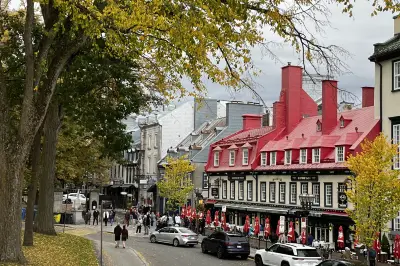
Quebec City's old town was built in 1829 and is listed as a UNESCO World Heritage site.
The Fairmont Le Château Frontenac in Quebec City is a landmark building, located on a hillside along the St. Lawrence River.
It opened in 1893 and became world-famous after Winston Churchill and Franklin D. Roosevelt stayed there during World War II.
The castle gained even more fame after being featured in the drama "Goblin." Its fairytale-like exterior and opulent interior captivated visitors.
The next day, we went to Rue du Petit-Champlain. This street is in the lower town of Quebec City and is considered the birthplace of the old city. It claims to be the oldest commercial street in North America. Honestly, I didn't feel a sense of historical depth here, but I did sense romance, warmth, and leisure.
The most distinctive feature of Rue du Petit-Champlain is the variety of doors and windows, each with a unique style.
Most attractions in Quebec City are clustered around the Château Frontenac. The oldest street in North America, Rue du Petit-Champlain, exudes the unique romantic charm of the French. The ancient buildings in both the upper and lower towns also reveal a touch of weathered grace.
The City Hall building, set against the statues in front, appeared solemn.
The cannons still present in the Plains of Abraham Park hint that this place once witnessed the trials of war.
Walking slowly through these exotic streets, hearing the clip-clop of horse hooves and unfamiliar languages, I felt as if I had traveled back to the Middle Ages.
Quebec City—a different city, a different memory.
After seeing this medieval city, it was time to leave.
Farewell, the World Heritage site of Quebec City's old town
Farewell, the romantic land of goblins
Farewell, Quebec City where ancient and modern civilizations merge
Farewell, the colorful deep autumn of Quebec City with falling petals.
Leaving the romantic goblin land of Quebec City, we drove back to Waterloo. But since it would take nearly ten hours to return, we decided to stop in Kingston for a day of sightseeing before continuing to Waterloo.
That night in Kingston, we stayed in a house even older than me—nearly 70 years old, witnessing countless joys and sorrows of human life.
Early in the morning, while my daughter was still asleep, I took a walk alone in the nearby residential area.
The fresh air was filled with profound tranquility.
Occasionally I saw a resident walking a dog,
Occasionally a father sending his child to the school bus,
Occasionally a woman jogging,
Occasionally a man raking leaves,
Occasionally falling autumn leaves slowly drifting to the ground. Stepping on the fallen leaves was the sound of autumn, and also the cry of leaves.
The houses along the road were either adorned with small charms or surrounded by colorful autumn hues—all looked so warm, reflecting a love for home and for a beautiful life.
Rain began to drizzle, carrying the chill of deep autumn. I returned to our accommodation, Room 827, and felt a room full of warmth.
Kingston, this ancient city, was once the capital of Canada in 1841.
Canada's first Prime Minister, Sir John A. Macdonald, once lived here.
His former residence and grave are still well preserved. Unfortunately, it was closed today, so I could only see the exterior of his house. The most regrettable part is that today's quiet Kingston gives no hint of its past prosperity.
Queen's University, established in 1841, now occupies about one-third of Kingston's urban area. Its old campus buildings show no signs of decay; instead, they exude a sense of historical depth in their simplicity.
The City Hall building looks more like a church, while the abandoned steam locomotive has become a notable landmark in Kingston.
Perhaps the most astonishing is the prison museum. Every brick and stone of the museum was built by prisoners themselves. No wonder—the Kingston Penitentiary, once Canada's largest prison, must have housed an enormous number of inmates, so building a prison museum was a trivial task.
We spent the remaining time shopping with my daughter, visited Niagara Falls, and went to a well-known ice wine winery nearby.
Time is like an ancient time machine, sending people off and welcoming them as minutes and seconds slip away. In a blur, a year passes as Santa arrives. Half of life's journey is over, and the search for life's meaning has long dissipated with a mature self.
Having traveled far and wide, having seen the world's splendor, I only wish for a peaceful life and a warm existence.
Canada is world-famous for its ice wine, and the main producing regions are in Ontario. We drove to a winery near Niagara. The grapes were still on the vines, not to be harvested until February or March of the following year. Each vine typically yields only one bottle of ice wine, so it is not cheap.
By now, we had spent over ten days in Canada and were deeply missing Chinese food. So we feasted at the "Small Jianghu" restaurant in Waterloo, which serves Northeastern braised dishes and barbecue, as well as spicy Sichuan skewers—a real relief for our longing for hometown flavors.
After seeing beautiful scenery and enjoying delicious food, it was time to return home.
What ends is the journey; what remains is the memory. Each trip, each recollection, will be eternal in my life.