Canada RV Trip: East Route Maple Chase – What to Check In and How to Play in Ottawa, Montreal, Quebec?
Heading east from Algonquin Park, you take Highway 60, one of the famous Maple Leaf Roads. October autumn is the most beautiful season in Canada. For hundreds of kilometers, forests and lakes line the roads, with maple leaves turning fiery red and golden yellow. Since cars cannot stop arbitrarily, you can only appreciate the scenery with your eyes.
From Algonquin Park to Ottawa is about 260 kilometers, about 2.5 hours drive. As the capital of Canada, the Parliament Building on Parliament Hill is a symbol of Ottawa and all of Canada, and is also the seat of the Canadian government and Senate. Unfortunately, we couldn't enter to visit, so we could only take photos in the square.
Tips: When at Parliament Hill, be sure to see the "Centennial Flame". It's on the square. From a distance, it appears as a black burning sphere. Up close, you can see something like a rotating ball in a pool, spinning continuously with the water flow. This is an eternal flame platform commemorating Canada's centennial. It was ignited on July 1, 1967 and has been burning ever since. The fire burns brightly on the water surface, and the water flowing out from the fire is warm all year round.
This is a must-check-in spot on Parliament Hill Square. After all, it has been burning for a century without extinguishing. Can a person have a century? When we visited, we didn't carefully research. Only after leaving did we realize we missed it. On the way back, we deliberately detoured to check in, costing an extra half day.
About parking in Ottawa: There are no RV parking spots near Parliament Hill. You must find temporary street parking in the blocks near Parliament Hill and park there, then walk over. There are parking payment machines by the spots where you can select parking time, accept cash and credit cards. Then place the payment receipt on the front windshield.
About Rideau Canal: The historic Rideau Canal was built between 1826 and 1832, stretching 202 kilometers, with 7.8 kilometers passing through downtown Ottawa. No parking is allowed along the entire route, so to catch a glimpse, you have to park in a distant block and walk over.
There are no RV campsites near downtown Ottawa, so we could only drive around the city briefly and then continue east.
RV campsite: Between leaving Ottawa and heading to Montreal, we found one directly by following road signs. One night cost 59 CAD, with water, electricity, sewage dump, and WiFi.
Montreal is one of the oldest cities in North America. We headed straight to Notre-Dame Basilica.
The great bell on the west tower of Montreal's Notre-Dame Basilica is one of the largest in North America, and its chimes can be heard far away at the hour. The basilica was built in 1829 and is a Neo-Gothic Catholic church.
The stained glass windows of Montreal's Notre-Dame Basilica depict colorful Bible stories and over 350 years of parish history. Inside, there is also a religious museum displaying religious art, vestments, etc. Among the collections, exquisite silverware is most dazzling. People speak in hushed tones and walk quietly in the church, creating a solemn atmosphere.
The small chapel behind the church is even more resplendent, nicknamed the "Wedding Chapel" by locals. The famous Canadian singer Celine Dion held her wedding here.
📝Note tips:
Parking: There are many parking lots near the church, but they can only accommodate small cars, not RVs like ours.
So we had to drive about ten minutes' walk away from the church, where street parking was available. You need to enter the spot number to pay, maximum two hours, 8 CAD.
📝Note tips: Notre-Dame Basilica requires tickets to enter. You can scan a QR code to buy online, but it's all in French and we couldn't understand.
Fortunately, there is also an on-site ticket window, but it only accepts Visa, Mastercard, and debit cards.
Note: Visa cards with UnionPay logo are also not accepted. Ticket price $15, no cash. We queued three times and tried three cards before getting tickets.
Upon entering, you'll see introductory booklets in various languages. Find the one with a Chinese flag for Chinese. This is very thoughtful; otherwise without explanations, we wouldn't know what to look at.
We happened to arrive during Mass time. The organ music made the atmosphere even more solemn. Many people sat quietly meditating or praying. There was no noise, and after each piece, everyone applauded.
What to see inside the church? 1. Altar and altar carvings; 2. Pulpit; 3. Organ composed of 7,000 pipes; 4. Eucharistic Chapel; 5. Sacred Heart Chapel; 6. Stained glass windows.
It is recommended to stay overnight in this old city if you have time. Unfortunately, we had no place to park our RV, so we had to leave regretfully.
About RV campsite: That night we still found a campsite along the way, one night 51.74 CAD. It was run by a couple. It provided water, electricity, sewage dump, and WiFi for only one person; adding another person costs one more dollar. Shower also required extra fee. Heading north from Montreal, locals speak French. At the campsite, only the husband spoke simple English, so communication was difficult.
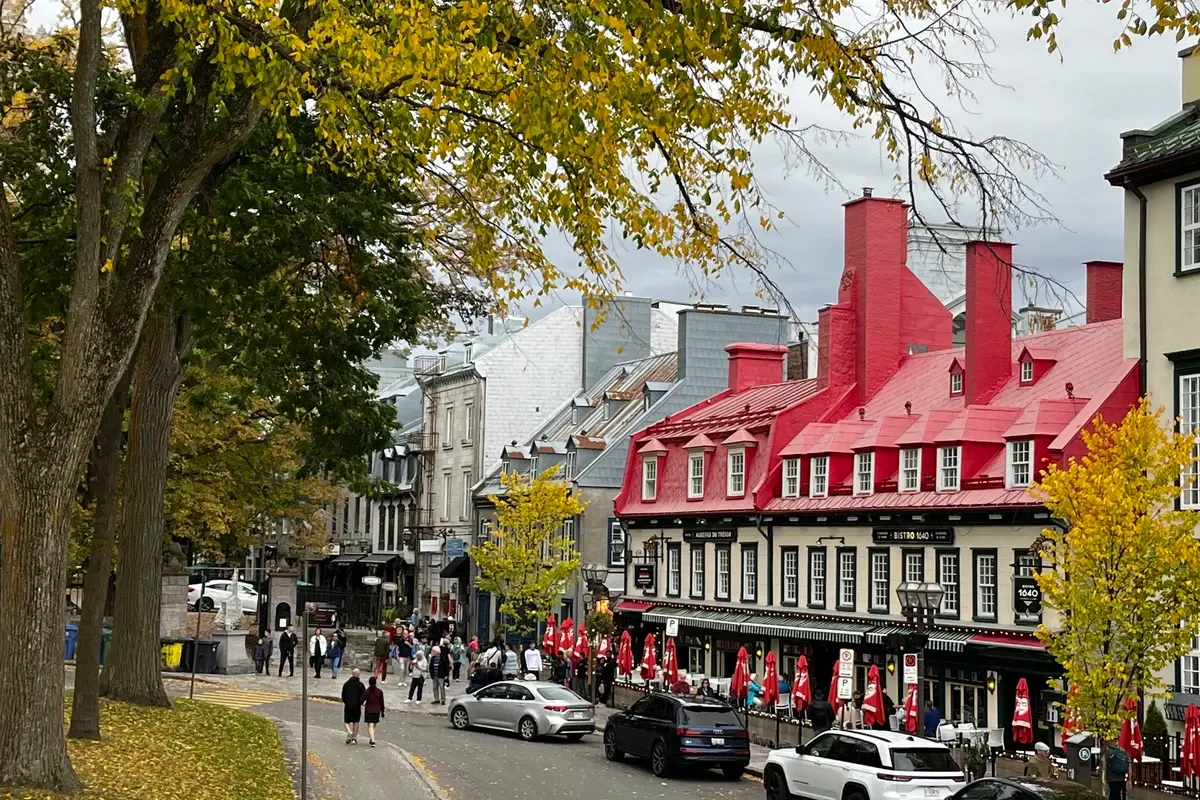
Quebec Province is located in southeastern Canada. It was the last city we arrived at on this trip. It was founded in the early 17th century by French explorer Samuel de Champlain. Quebec is a city with preserved city walls and fortifications. It is a small town full of history and culture, with abundant tourism resources.
📝Note tips: Directly navigate from the RV campsite to Old Quebec (Vieux-Québec). Throughout Canada, we used the Google Maps navigation system on iPhone. It is recommended to note down the English names of places you want to visit in advance for easy search. We usually enter the destination while we have internet, so that even without network we can still use navigation offline.
We parked at a roadside parking area by a park that was a 20-minute walk from the old town, costing $10 for 4 hours. Later we found that there is also parking in the park north of Fairmont Le Château Frontenac, with one hour free.
For those with mobility issues or who don't like walking, taking a sightseeing bus is the best choice to tour the old town. Ticket price per person including tax: $51.5.
It is recommended to take a double-decker bus when it's not raining. Be sure to sit on the open top deck. You can listen to commentary, look, and take photos at the same time.
The best part is that the buses have commentary in 10 languages. Each person gets a headset upon boarding. At each location, the audio guide provides commentary. After a full loop, you can get a general understanding of the old city.
You can also get off at stops with your headphones, visit, and then use your ticket to board the next bus. It allows unlimited re-boarding, so you can get off at each stop, visit, and then take the next bus.
🌟Highlights:
There are many photo-worthy spots, which are best captured on foot.
📝Note tips:
On holidays, there are many tourists, and restaurants have long lines. Photo spots are also crowded; it's impossible to get a solo photo. So try to avoid holidays.
Fairmont Le Château Frontenac is a landmark building. It is recommended to check in inside the hotel. The castle's high protective walls are built along the St. Lawrence River. Outside the walls is a leisure promenade. Walking back along the promenade is a good choice, avoiding the crowds on the main streets.
Here you can visit the "Citadelle of Quebec" (Star-shaped fortress), located on Cape Diamond. It is a well-known fortress in North America. We only passed by by bus and looked up at it from below.
In the afternoon, we went to Montmorency Falls. The falls are located west of Quebec Province, formed by the Montmorency River flowing into the St. Lawrence River. The drop is 83 meters, 1.5 times that of Niagara Falls. A large volume of water plunges down a steep cliff, producing a thunderous roar. Perhaps due to a refinery upstream, the water quality is yellowish with black streaks, and the river below the falls looks black, making it unappealing to view.
At the entrance, there was a maple forest, but due to too many tourists, the viewing experience was poor. On one side of the suspension bridge over the falls, the maple leaves were just turning yellow, but again too many tourists made it impossible to take photos.
Regret 1: There is no RV campsite in the old city, so we couldn't stay overnight to fully experience the local customs and culture of the old city.
Regret 2: We didn't go to Canyon Sainte-Anne, which is a 30-minute drive from Quebec City. On the second day in the old city, it rained heavily. Knowing the canyon trails would be difficult, we had to give up.
We only spent one day in each of the three cities on the east route. Actually, all three cities are suitable for staying one night to fully appreciate the local atmosphere. If I come again, I will definitely not rent an RV. I will rent a car and stay in a B&B for a few days.
Travel Diary Index: 1. D14 Ottawa; 2. D15 Montreal; 3. D16 Quebec. Tourism Information, Hotel Index, Strategy Index, Ticket Index, Website Navigation, Tourism Index, Cruise Index, Corporate Travel Index, Franchise Cooperation, Distribution Alliance, Friendship Links, Corporate Gift Card Procurement, Insurance Agency, Agency Cooperation, Hotel Franchise, Destination and Scenic Area Cooperation, More Franchise Cooperation, About Ctrip, About Ctrip, Ctrip Hot Topics, Contact Us, Career Opportunities, User Agreement, Privacy Policy, Business License, Security Center, Ctrip Content Center, Intellectual Property, Trip.com Group Algorithm Disclosure