Glimpses of Eastern Europe
The Eastern Europe trip started from Hangzhou (June 6, 2017), via Amsterdam to Warsaw, visiting the cityscape, the Holy Cross Church housing the heart of the poet of the piano, Frédéric Chopin, and the Łazienki (also known as Chopin) Park; on the 7th, we traveled by bus to Kraków, the Wieliczka Salt Mine, the Polish Royal Palace, the Kazimierz district; on the 9th, we traveled to Brno, stopping on the way to visit the Auschwitz concentration camp; on the 10th, we visited the town of Kutná Hora, the Sedlec Ossuary, then headed to Prague; on the 11th, we explored the Old Town, Charles Bridge, Old Town Square, Powder Tower, the Castle District, St. Vitus Cathedral, the Old Royal Palace, with a boat lunch at noon; on the 12th, we visited the Czech spa town of Karlovy Vary, then headed to České Budějovice; on the 13th, we visited Hluboká Castle and Český Krumlov; on the 14th, we traveled to Vienna, visiting Schönbrunn Palace; on the 15th, we had a city tour; on the 16th, we went to Bratislava, then to Pannonhalma Abbey, and Lake Balaton, enjoying grilled trout; on the 17th, we passed through Pécs to Budapest; on the 18th, we had a city tour, visiting Fisherman's Bastion, Matthias Church, Heroes' Square, and the Parliament Building; on the 19th, we flew from Budapest to Amsterdam and back to Hangzhou. A total of 15 days, visiting five countries.
I have completed nine travel essays: "The Homeland of the Poet of the Piano", "Purgatory Auschwitz", "The Bone Church", "The Underground Salt City", "Charles Bridge in Prague", "Schönbrunn Palace and Empress Sisi", "Fisherman's Bastion", "Pannonhalma Abbey", and "The Spa Town of Karlovy Vary". This "Glimpses" covers the main attractions of the itinerary, focusing on images to provide more visual experience.
Poland, located at the crossroads of Central Europe, has no natural defenses and has been repeatedly trampled by forces from east and west, having been wiped off the map and revived several times—an ancient yet much-suffering nation.
Warsaw's city center square.
The garden behind the square.
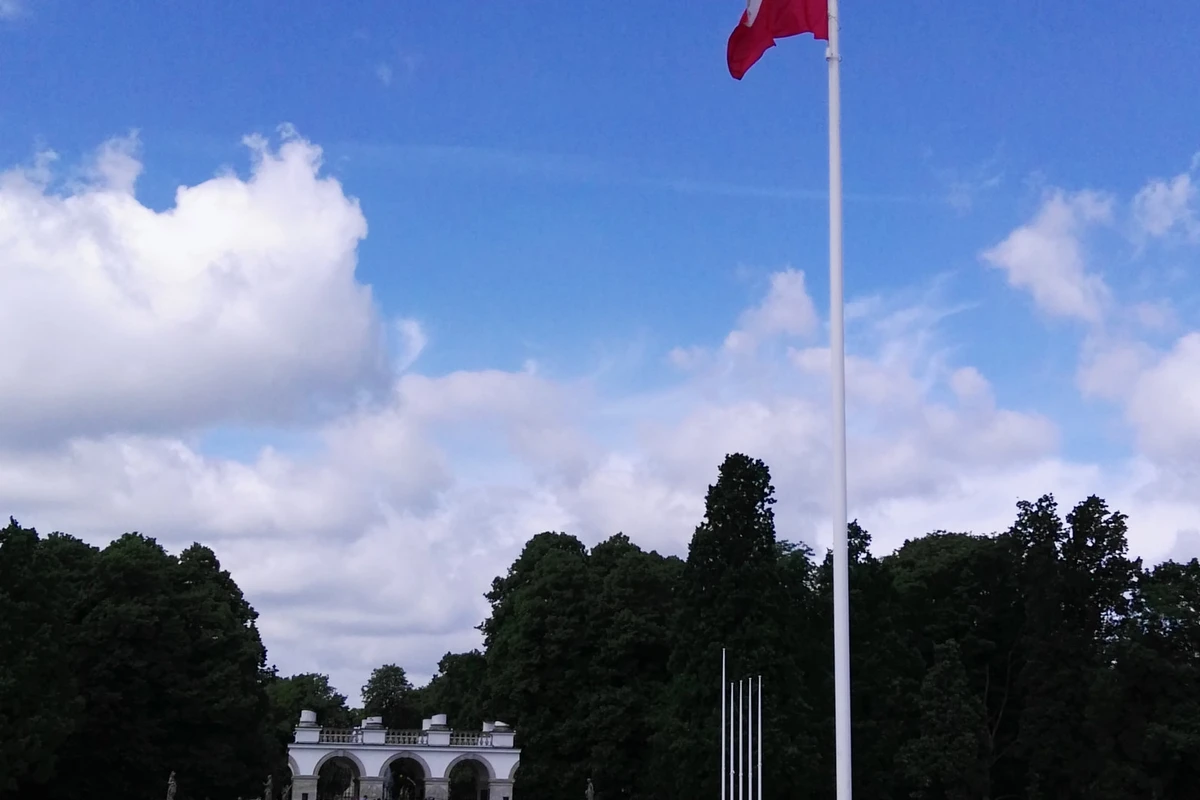
The incomplete Tomb of the Unknown Soldier. The missing parts were destroyed in World War II.
The guards keeping vigil.
The origin of the name Warsaw, according to folk legend: a fisherman named Wars fell in love with and married a mermaid named Sawa from the Vistula River, and the city was named by combining their names. At the center of the Old Town Square, you see the famous "Warsaw Mermaid"—perhaps the fish spirit who fell for the fisherman. This story is quite similar to "The Legend of the White Snake"; which version do you prefer? But even as a mermaid, she is a fighting fish wielding a sword and shield, embodying the Polish national character.
A group of schoolchildren taking photos in front of the mermaid statue.
Tourists resting inside the Royal Castle.
Kraków street.
A ticket seller wearing a mask at the theater entrance.
Kindergarten children crossing the street.
A street-performing child and his dog.
These cloth dolls are so Polish!
Speaking of Poland, one must mention Chopin, the famous poet of the piano. Chopin was a musical prodigy, composing at age 7, performing at 8, and gaining fame by 20. He spent the latter half of his life in France and unfortunately died young at 39. According to his will, his heart was buried in a pillar inside the Holy Cross Church in Warsaw. His works express a deep love for his homeland. Today, many public places in Poland are named after the pianist, and Chopin has become one with his country.
The entrance to the Holy Cross Church.
Chopin's heart is buried inside this pillar.
Chopin Park. By the pond is a statue of Chopin.
The English word "salary" derives from the Latin "salarium" (salt). In ancient Rome, soldiers were paid in salt. Excellent soldiers were said to be "worth their salt"! This shows the importance of salt for survival at that time. The salt mine, needless to say, was a goldmine. The Wieliczka Salt Mine in Poland was once such a goldmine. Who would have thought that an abandoned mine could become such a remarkable tourist attraction? It is worth exploring.
A relief of "The Last Supper".
A view of the underground hall from above.
A giant chandelier made of salt crystals.
Polish dumplings. The taste... well... hmm...
The German Nazi regime committed countless heinous crimes. Seeing the railway leading to Auschwitz—a one-way track! Barbed wire everywhere, surrounded by trenches and bunkers... The crematorium was blown up by the Nazis before they fled; all that remains is collapsed concrete and brick rubble. Strangely, the closer I got, the more a sense of eerie horror crept over me. Even under the bright sky, chills ran down my spine. So many souls! Hundreds of thousands of souls! War, massacre—who is the greatest demon of humanity?
The Sedlec Ossuary, another creepy place. The church's decorations are all made of human bones, reportedly using over 500,000 bones. The Black Death in the 14th century and wars in the 15th century caused the small cemetery next to the church, originally about 3,000 square meters, to suddenly accumulate tens of thousands of graves, leaving no room for later burials. The cemetery next to the church was the preferred burial site for believers, as lying there brought them closer to the Almighty, and with prayers from monks and priests, it was a doubly blessed place. So, hanging old bones in the church doesn't seem entirely inappropriate. There is also a bone church in Portugal, but not as famous as this one. Hallelujah!
A distant view of Auschwitz.
Many Jews come here to pay tribute every year.
The train cars that once transported Jews.
Restored prison cells. All buildings were burned by the Nazis before they fled.
The crematorium. What a sin!
The exterior of the Sedlec Ossuary.
Scary, isn't it? Frightening, isn't it?
Charles Bridge in Prague is one of the most popular attractions in Europe. Besides the bridge's antique charm, the key is the 30 lifelike statues on it. The eighth statue on the north railing is of St. John of Nepomuk (Jan Nepomucký, 1345-1393). Due to a religious dispute with King Wenceslaus IV, he was beaten to death by the king and thrown from Charles Bridge into the Vltava River. Tyranny and oppression are always despised by the people. According to folklore, after being thrown into the river, St. John became the patron saint of the river—in Chinese terms, the river god of the Vltava. The base of the statue features a relief depicting his throwing into the river. A cross was erected at the spot where he was thrown, as a memorial. The statue and the cross are polished to a shine by tourists' touches. It is said that those who touch them will have a chance to revisit Prague. At least it's a nice wish.
Praying for a chance to return.
The spot where he was thrown into the river.
Many lover's padlocks are also on the bridge railings!
The characteristic of Eastern European tourism is many churches, many old town squares, and even more castles. The attraction of Prague's Old Town Square is the astronomical clock tower on the church. The clock face features the sun, moon, and zodiac signs, rotating on a track once a year. Below the astronomical clock is a calendar clock; at each hour, a small window opens and a rooster crows. At noon, it's impressive! The small doors open, and 12 apostles appear in succession! The clock was built in the 14th century. Pretty impressive! Thumbs up!
People in medieval costumes at tourist attractions.
Scenery of Kutná Hora.
A street shot in Prague.
In my opinion, the Czech spa town of Karlovy Vary is the most distinctive attraction in Eastern Europe. Nestled in the mountains, it is quiet and peaceful, but the buildings in the town are quite upscale. Most street-front buildings are the fashionable terraces (high-end row houses) seen in European cities. Hotels and guesthouses even have black Rolls-Royce royal luxury cars. This is because the spring waters here are extraordinary: they can be used for both bathing and drinking, and have different temperatures and tastes. One of the tourist activities is to taste the different waters from different springs. I didn't follow the group but wandered off on my own, enjoying the scenery, and ended up getting lost. Fortunately, I found a police station, only to realize I had wandered quite far from the town center. The police officer's English was rather poor, but luckily I had a map, and finally found my group having lunch. They had already ordered a grilled lamb chop for me. Karlovy Vary is far from being a hidden gem; it is famous, with many celebrities and politicians having vacationed here, including the once-prominent Empress Sisi of the Austro-Hungarian Empire.
The spa town hidden in greenery.
A hotel in the town.
The black Rolls-Royce.
Town scenery—any snapshot is like a postcard.
The charm of the spa town is breathtakingly beautiful. A cup of coffee, a glass of beer—just daydream!
In Vienna, the city of music, we first visited the highly esteemed Golden Hall (Musikverein) in China. Outside the venue, there were many touts selling tickets—probably not scalpers, just promoters. The tour guide explained that the Golden Hall became famous in China after a certain singer spent 600,000 euros to hold a concert there, essentially buying the gig, which then attracted a swarm of Chinese stars wanting to bask in the golden brand effect. In fact, the Golden Hall is just one of four performance venues of the Austrian Music Society. Truly top-notch performances must be at the State Opera House to count. Moreover, you can't just pay to get on stage there; they evaluate your program and performance level before issuing an invitation. Unfortunately, we couldn't enter the State Opera House. But on the street, we saw groups of people carrying various instruments to perform somewhere. In the city of music, you could probably find a few random people to hold a small concert.
The Eastern European plains.
Ivy covering an entire wall.
The Vienna State Opera.
Statue of Johann Strauss.
Schönbrunn Palace is the top attraction in Vienna. It has a royal air, elegant and dignified, similar to the Palace of Versailles in Paris, with a symmetrical layout. In particular, the back garden, with several huge flower beds, the Neptune Fountain statue group, exquisite statues of Greek mythological deities, and the Gloriette on the hilltop—all are masterfully designed. Empress Sisi, who disliked being constrained, used to gallop through the garden on horseback. That scene must have been charming and romantic.
Pannonhalma Abbey, the oldest monastery in Hungary, ranks second in the world, holding 360,000 books. At first glance, hundreds of thousands may not seem many, but many are unique copies, and it preserves the first archive written in Hungarian from 1055. The abbey is built on a hilltop, with thick, high walls. Originally, it was likely a multi-purpose place—defense against invasion, worship, prayer, and theological study. From the ramparts, one can overlook the surrounding countryside. The library inside is solemn and elegant, with heavy, ancient parchment books that inspire reverence. Several statues look very scholarly, as if teaching visitors the true meaning of "Good good study, day day up!"
The entrance square of Schönbrunn Palace.
This is where the spring was discovered.
The Gloriette on the hillside.
Ancient Greek deity statues in the back garden.
The last stop of the trip was Budapest. Fisherman's Bastion, the Parliament Building, and Matthias Church were must-see attractions. The hotel we stayed at was right on the Danube River. From the window, we could enjoy the scenery on both banks and the cruise ships passing by. River cruise ships are very different from ocean liners, not only in size but also in docking points. Ocean liners sail for days without seeing land, while river boats stop frequently, much like buses. Some group members who had taken river cruises said they simply rented bicycles and rode to the next stop. Sounds fun.
A monument shaped like two half-rings.
Bullet holes left from a famous event.
The library of Pannonhalma Abbey.
Overlooking the surrounding countryside from the abbey.
Bronze statue of Stephen I.
Scenery on the opposite bank.
A girl taking a selfie.
The Danube flows through nine countries and can be called the mother river of Europe. Especially the piece "The Blue Danube" by Johann Strauss II, with its beautiful melody, romantic tune, majestic chords, and the image of morning mist on the river clearing under the rising sun, deeply flows into the hearts of every listener, stirring deep and melodious ripples...
A cruise ship on the Danube.
Dusk on the Danube.


