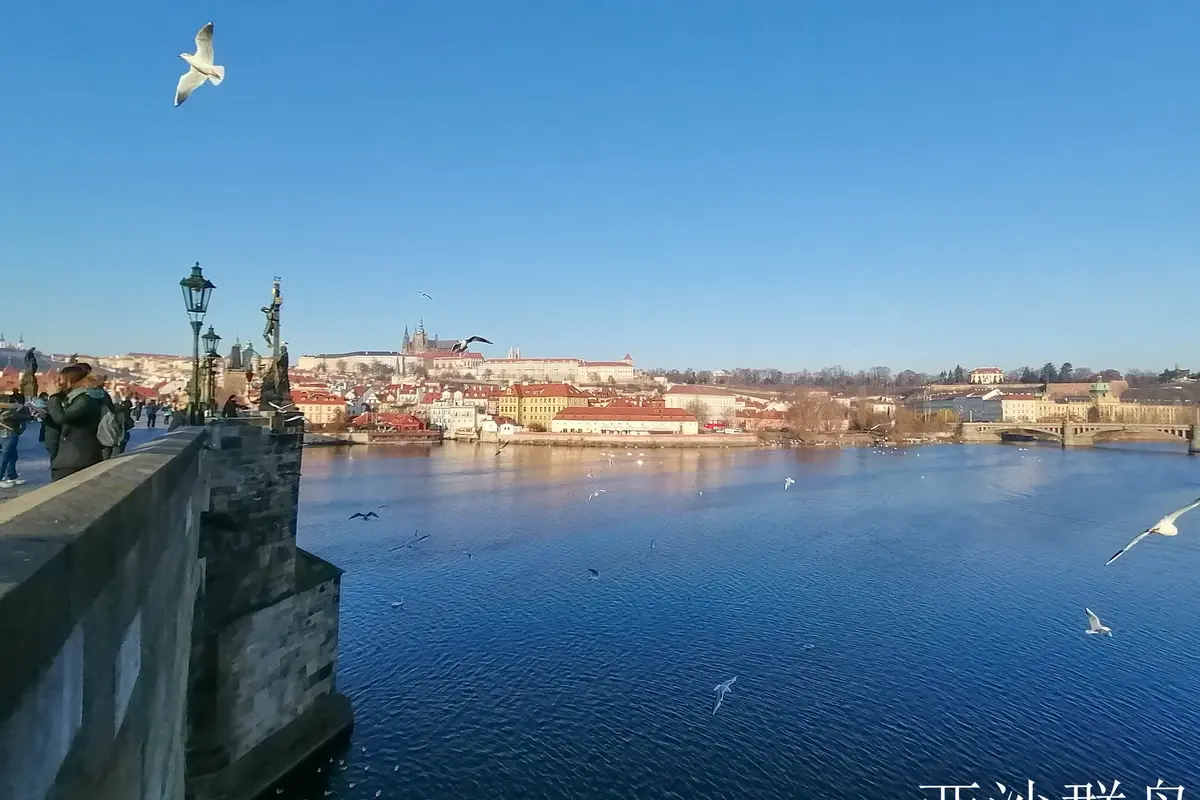
Prague Castle Through a Millennium – Part 3 of a Free-and-Easy Trip in the Former Austro-Hungarian Czech Lands
Enchanting medieval castle, once a Bohemian royal residence.
Prague Castle Through a Millennium – Part 3 of a Free-and-Easy Trip in the Former Austro-Hungarian Czech Lands
On the second day, the early morning of 24 November, still adjusting to the time difference on our second day in the Czech Republic, we made an early start to see Prague Castle.
Prague Castle sits on a hill on the west bank of the Vltava River. It is the largest ancient castle in the world, stretching 570 metres long and averaging about 130 metres wide. Originally a fortress built by the Bohemian Duke around AD 880, it then served as the seat of Bohemian royalty for centuries.
In the mid‑14th century, under the reign of Bohemian King Charles IV – who also became Holy Roman Emperor – the castle reached unprecedented splendour when Charles ordered the rebuilding of St. Vitus Cathedral.
In the mid‑16th century, the Habsburg Ferdinand I took the Bohemian throne. Successive Habsburg rulers enlarged the castle, making it ever more magnificent.
After the early 19th century, under the Austro-Hungarian Empire, the castle was neglected by the Habsburg royals.
Over the centuries it has been expanded many times, and today it still houses many grand buildings and historical treasures. Remarkably, it remains the official residence of the Czech president.
Exiting the Malá Strana metro station, we climbed a long uphill path along the Old Castle Steps, admiring the colourful old town of Prague on our left, until we reached the castle security checkpoint.
Standing at the east‑gate entrance, we enjoyed a sweeping view of the entire city, with both banks of the Vltava stretching before us.
Entering the freely accessible castle courtyard, we noticed a shiny male statue in front of the Toy Museum – it seemed quite popular with female visitors.
Walking on along the gently sloping street, passing St. George’s Square, we arrived at the Third Courtyard.
A Christmas market had already set up shop and was welcoming visitors.
Seeing sausages grilling like that made our mouths water.
The square is framed by St. Vitus Cathedral. Weathered to a brownish‑yellow, its Gothic black pinnacles pierce the sky. It’s hard to count all the spires – layer upon layer, they create a breathtakingly elaborate and exquisite building.
Opposite the cathedral stands the brightly coloured Presidential Office.
Beside it, the old Royal Palace with its ancient charm.
We headed first to the ticket office.
Two years ago I had visited St. Vitus Cathedral inside the castle. On this return trip, we chose to buy a 250‑CZK ticket from the self‑service machine (there are options A, B and C). Some of the photos below are from my previous visit to the cathedral.
St. Vitus Cathedral is the most important landmark of Prague Castle and the largest and most significant church building in Prague. Besides religious services, it has hosted the coronations of Czech kings and queens. Many of Bohemia’s patron saints, monarchs, nobles and archbishops are buried here.
St. Vitus is one of the Fourteen Holy Helpers in Christian legend. In AD 303, while preaching in northern Italy, he was martyred under the persecution of a Roman emperor.
In 925, the German king Henry I presented a surviving bone of St. Vitus to the Bohemian Duke Wenceslas I. From then on, the relic became a treasured possession handed down among Prague’s rulers, and Wenceslas I founded the earliest Romanesque St. Vitus Cathedral around it. In 1344, Charles IV initiated a massive rebuilding. Over the centuries, the cathedral underwent many renovations, gradually incorporating Baroque and Renaissance elements.
St. Vitus Cathedral is like a textbook of architectural history, encompassing almost every medieval style. Its present external appearance is predominantly Gothic, and it is acclaimed as the “architectural treasure” of the Czech Republic.
The interior has an east‑west cruciform layout. The south‑facing Golden Gate was originally the cathedral’s main entrance; it is now closed, with the west door used for entry and exit instead.
The mosaic “The Last Judgment” above the Golden Gate dates from 1370 and is composed of 40,000 pieces of mosaic.
The “Golden Gate” consists of three arches. Above the arches, in the central panel, are Jesus and six saints. Below, against a blue background, on the left is the founding king Wenceslas and on the right his fourth wife, Queen Elizabeth.
On the left arch, the scene shows the Virgin Mary and six apostles, depicting righteous souls being led into heaven by angels, while people climbing out of coffins follow the angels upward. On the right arch is John the Baptist and six apostles, showing the archangel Michael with a sword herding sinners bound with ropes into hell.
On the high tower wall to the left of the Golden Gate, there are two clocks. The upper clock has an hour dial; the lower clock is marked in quarter‑hours. Beneath the large clock is a stunning golden window.
Below the golden window are three coats of arms: on the left, the Bohemian double‑tailed lion; in the middle, the fire eagle of St. Wenceslas (an early Bohemian emblem); on the right, the shield of the Archbishop of Prague.
Of the ten long‑transmitted treasures of St. Vitus Cathedral, we saw two here; one more is at the west door, the others are inside.
From the ticket office, we faced the cathedral’s west‑facing bronze door. A little beauty walking into the frame was right in front of the entrance.
The bronze door is decorated with reliefs depicting the history of the cathedral: stories of St. Wenceslas and St. Adalbert, who brought Christianity to the Bohemian people along with St. Wenceslas. The lunette above the door shows scenes of the Passion, the Disputation at the Robe of Christ, and the Lamentation.
The rose window above the portal was built in 1927 and is said to be made of 27,000 pieces of coloured glass.
From outside, the rose window appears dark brown, but from inside the cathedral the colours are incredibly beautiful. The window illustrates stories from the Book of Genesis.
The main highlights inside the cathedral include 20th‑century stained‑glass windows, the tomb of St. John of Nepomuk, and the St. Wenceslas Chapel.
Stepping into the nave, the hall is 33 metres high, 124 metres long and up to 60 metres wide. The typical Gothic ribbed vault and soaring colonnades make the space feel vast and grand; standing inside, one feels tiny, filled with awe for God’s greatness.
An indispensable pipe organ.
A royal tomb in front of the presbytery.
This tomb belongs to the Habsburg Emperor Ferdinand I (died 1564), his wife and his son, Emperor Maximilian II. The sculptures on the sarcophagus were completed in 1589 by Alexander Colin and a Dutch sculptor. Many more royals, including Charles IV who built the cathedral and his four wives, are buried in the crypt beneath the church. It’s said that the crypt still holds remains of an earlier circular church and a later rectangular basilica.
In a side aisle is the tomb of St. John of Nepomuk.
St. John is the subject of the famous eighth statue on Charles Bridge. A 14th‑century Cardinal of Prague under the Luxembourg dynasty, he refused to reveal the queen’s confession and was thrown into the Vltava from Charles Bridge by the enraged King Wenceslas IV, where he drowned. He was later canonised.
This lavish tomb, built in the mid‑18th century, is made of pure silver and consumed 20 tonnes of the metal.
Above the tomb, four angels gently hold a crimson canopy, symbolising protection so that St. John may no longer be harmed.
The sarcophagus bears a kneeling St. John holding a cross, his expression and gesture incredibly lifelike; underneath are exquisitely detailed angels and guardian figures.
In the New Archbishop’s Chapel, the large stained‑glass window was created in the early 20th century by Alfons Mucha on the theme “Jesus Blessing the Slavs”. It depicts the origins of Catholicism in Bohemia: in the centre, Methodius baptises Bořivoj I, with Cyril standing beside; below sits Bořivoj’s wife Ludmila, and on her lap kneels her grandson Wenceslas, dressed in red. The main scene is flanked by depictions of the lives of Cyril and Methodius.
In fact, all the other stained‑glass windows in the church are also splendid works of art.
I always enjoy the stained‑glass windows most when visiting a Catholic cathedral.
Along one side of the wall are several chapels, the most famous being the St. Wenceslas Chapel.
The outer walls of St. Vitus Cathedral are also adorned with many sculptures.
Walking through the Christmas market, the oldest church within the castle complex is St. George’s Basilica. It was founded in AD 920 by Vratislaus I (father of Wenceslas I). In 973, the Benedictine St. George’s Convent was added. After a great fire in 1142, the basilica was severely damaged. Through successive reconstructions and repairs, by the late 17th century the façade acquired Baroque features.
High on the façade, above the triangular area, a vivid relief depicts St. George slaying the dragon. Behind rises the Romanesque choir tower.
Today, St. George’s Basilica is more often used as a concert hall. During the Prague Spring music festival, concerts are frequently held here.
The large Spanish Hall in the Old Royal Palace is where the president now holds investiture ceremonies and state banquets.
The Vladislav Hall in the Old Palace is the venue for presidential inaugurations and other major political events.
It is 62 metres long and 16 metres wide, with five rib‑vaulted compartments each 13 metres high, and two rows of large Renaissance rectangular windows. The ceiling is a Gothic fan‑vault; the flowing, interlaced lines on the vaulted roof evoke a touch of Art Nouveau.
The hall was used for banquets, assemblies and coronations. Intriguingly, it also served as an indoor jousting arena; the Knight’s Staircase on the north side was designed specifically to allow mounted knights to enter the hall.
In the former council chamber, the crown, sceptre and throne of King Charles IV are on display. Unfortunately, the famous “Golden Bull” of Charles IV and other items are copies.
Upstairs, the state archives hold old land deeds, property records, case files of the highest judicial body, etc. The walls are painted with the coats of arms of judges and judicial officials according to their rank. The seals and emblems of Bohemia were derived from these very seals.
Following the flow of visitors past St. George’s Basilica, we reached a tiny lane lined with fairytale‑like houses: the famous Golden Lane inside Prague Castle.
Golden Lane is a little street where handicrafts are sold. In the 16th century, during the Roman Empire period, many goldsmiths lived here; later the cobbled lane became known as Golden Lane.
Everything is miniature here, every building small and brightly coloured, like the dwellings of sprites in a storybook kingdom.
At No. 22 Golden Lane, a pale blue house was once home to Franz Kafka a hundred years ago. It’s now a small bookshop.
There was a constant stream of visitors. Not wanting to jostle with the crowd, we went upstairs to a second‑floor medieval armour exhibition.
The long gallery displays a variety of medieval armour and weaponry.
It seems the Roman imperial and medieval knight armour confirms that the props in the TV series “Rome” were quite realistic.
At the end of Golden Lane stands the base of Dalibor Tower.
The tower was originally a place for holding prisoners; instruments of torture from that period are on display.
Right at the entrance to the dungeon, we saw this spine‑chilling torture device.
Climbing a narrow staircase, we reached the large viewing platform next to Dalibor Tower.
Through the gaps in the castle wall, we gazed out across the city. The lovely panorama of Prague, the city of a hundred spires, lay spread before us in its entirety.
Leaving the castle, we strolled into the castle gardens to relax for a while.
The Czech capital, Prague, is a poetic “city of a hundred spires”. Nearly the whole city centre consists of ancient architecture dating from the 13th century onwards – Romanesque, Gothic, Baroque, Renaissance… rich and dazzling in colour. The sparkling Vltava River flows through the city.
With its long history and architectural artistry, Charles Bridge is one of Prague’s most famous monuments. The bridge towers and 30 ancient statues are of exceptional artistic value, earning it the nickname “open‑air Baroque art gallery”…
Next chapter: “Charles Bridge”
Travel journal index:
1. Itinerary
2. Highlights
3. Travel diary
Travel information
Hotel index
Guide index
Flight ticket index
Website navigation
Travel index
Cruise index
Corporate travel index
Cooperation & partnership
Distribution alliances
Friendly links
Corporate gift cards
Insurance agency
Partner hotels
Destination & scenic spot cooperation
More partnerships
About Ctrip
About Ctrip
Ctrip highlights
Contact us
Careers
User agreement
Privacy policy
Business license
Security center
Ctrip content center
Intellectual property
Trip.com Group algorithm disclosure


