Mysterious and Enchanting Prague: A Journey Through Bohemia of the Former Austro-Hungarian Empire – Travelogue Part 5
Day 1, Nov 23: Chengdu – Prague – Museum – Wenceslas Square – Kutná Hora Old Town – Prague Old Town Square – Charles Bridge – Lennon Wall
Day 2, Nov 24: Wenceslas Square – Prague Castle – Old Town Square – Charles Bridge – České Budějovice (Budweis) – Budweiser Brewery – Český Krumlov (CK Town) – CK Castle
Day 3, Nov 25: CK Castle – CK Town – Vienna – Stephansplatz – Graben Street
Day 4, Nov 26: Vienna Ferris Wheel – Prater Park – City Park – Schönbrunn Palace – Wachau Valley – Melk Abbey
Day 5, Nov 27: Melk Abbey – Admont Abbey – Hallstatt – St. Gilgen – Salzburg Old Town – Mozartplatz – Franciscan Church – Salzburg Cathedral – Old Town Christmas Market
Day 6, Nov 28: German Magic Forest – Hintersee – Königssee – Salzburg Mirabell Palace Christmas Market – Cathedral Square – Salzburg Cathedral – Hohensalzburg Fortress – Old Town
Day 7, Nov 29: Mirabell Palace & Gardens – Salzburg Old Town – Villach Dobratsch – Bled Castle – Ljubljana Castle – Dragon Bridge – Old Town Christmas Market
Day 8, Nov 30: Piran Old Town – Poreč Euphrasian Basilica – Pula Arena – Rijeka National Theatre – Zadar Old Town Sea Organ – Greeting to the Sun
Day 9, Dec 1: Zadar Old Town – Plitvice Lakes (the "European Jiuzhaigou") – Zagreb Old Town Christmas Market – Zagreb Cathedral (Assumption of Mary) – St. Mark's Church – Museum of Broken Relationships – Lake Balaton
Day 10, Dec 2: Lake Balaton campsite – Tihany Abbey – Budapest Fisherman's Bastion – Vienna – Bratislava
Day 11, Dec 3: Bratislava Old Town – Castle – Vienna Karlsplatz – Vienna Opera House – Musikverein (Golden Hall) – Hofburg Palace – Maria-Theresa Square Christmas Market – Volksgarten Christmas Market – Prague Old Town Square – Charles Bridge
Day 12, Dec 4: Prague Old Town – Charles Bridge – Lennon Wall – Prague Airport – Chengdu
Day 13, Dec 5: Prague – Chengdu
Bohemia of the former Austro-Hungarian Empire, a journey through mysterious medieval cities.
The German philosopher Nietzsche once said: "When I want to express music in a single word, I find Vienna; and when I want to express mystery, I think only of Prague."
On November 23, 2019, we flew directly from Chengdu to Prague, beginning our independent travel through the former Austro-Hungarian Empire.
Prague is a UNESCO World Heritage site, known by many epithets: City of a Hundred Spires, the Golden City, the Heart of Europe, the Mother of Cities, magical Prague, blue Prague...
Mysterious Prague stands proudly on both banks of the beautiful Vltava River, linking Central and Eastern Europe, commanding a unique position on the north-south route through the Germanic-Slavic regions, blending the cultures, arts, and religions of different peoples, and brimming with treasures of art, architecture, and more.
The Czech lands lie on the fringe between Germanic and Slavic spheres, deeply influenced by the Germanic world. The Czechs are West Slavs, the westernmost branch of the great Slavic migrations.
In 867, the Czechs established their own dynasty—the Přemyslid dynasty. The Kings of Bohemia inherited the blood of Czech peasants and German nobles, and were vassals of the Frankish kingdom. This dynasty is therefore considered the birth of the Czech state.
The first castle appeared in the latter half of the 9th century, and Prague became the seat of the Dukes and later Kings of Bohemia.
In the 10th century, the patron saint of Bohemia, Wenceslas I, introduced Christianity. Prague became a bishopric, and the enduring religious conflicts began and unfolded here.
In 1054, Christianity split into the Roman Catholic Church and the Eastern Orthodox Church of Byzantium. The East and South Slavs chose Orthodoxy; the West Slavs, including Poles and Czechs, parted ways with their Slavic brothers.
The best way to explore Prague is by metro, bus, and on foot.
Prague's sights are partly along the Vltava in the Old Town and Lesser Town.
The most dazzling spot in Prague's Old Town is the Old Town Square, with over 900 years of history.
This perfectly preserved medieval square is surrounded by beautiful buildings in Baroque, Gothic, Romanesque, Rococo, and more.
Exquisite Baroque mansions with orange roofs and pastel façades, decorated with frescoes or sculptural relief—no two are alike, even though they share the Baroque style.
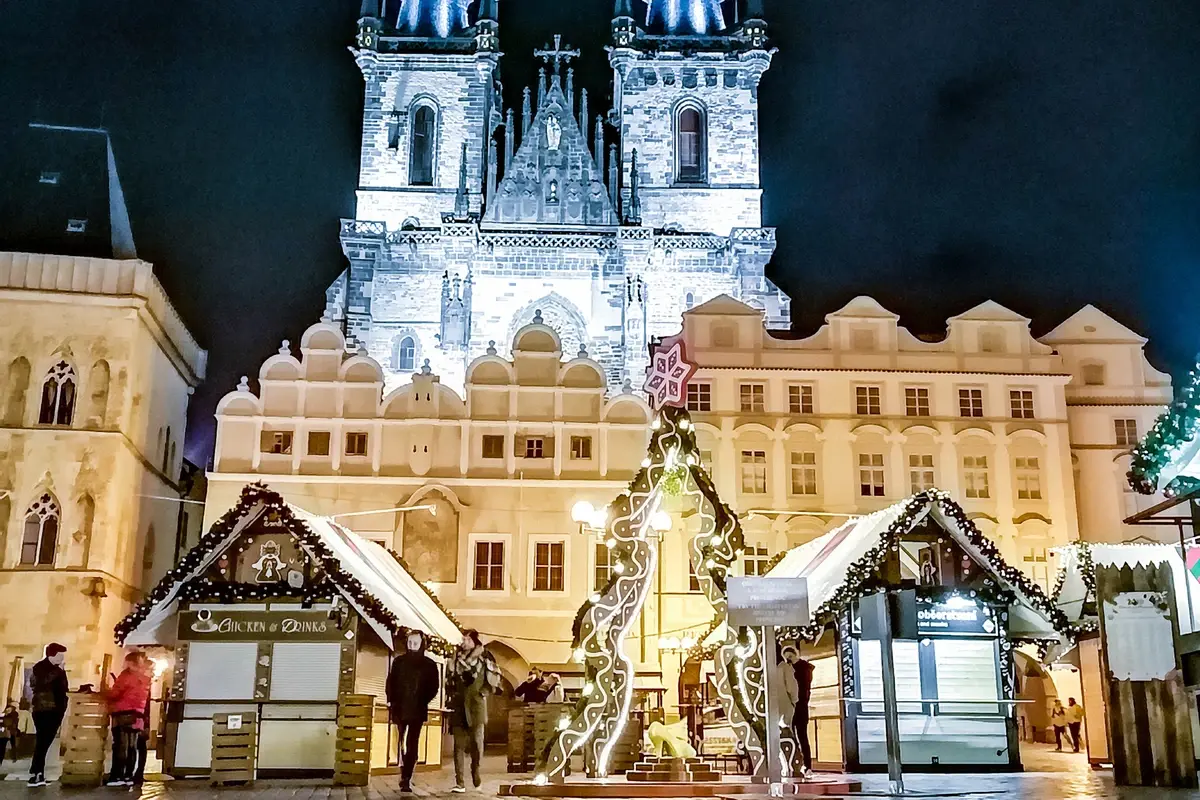
The Church of Our Lady before Týn is the most striking building on Prague's Old Town Square.
Its predecessor was built in 1135, while the present structure dates from 1365. It is famous for its Gothic twin towers, topped with pure gold orbs, reaching a height of about 80 meters. Unlike the traditional cruciform Catholic church, Týn looks like a fairytale devil's castle, hence it is popularly called the "Devil's Church."
The Old Town Hall on the square, built in 1338, is a Gothic building. On its façade, the Astronomical Clock is surely the most unusual clock you'll ever see.
The Astronomical Clock dates from the 16th century. It consists of three parts: the statues of the saints, the clock dial, and the calendar.
Every hour on the hour, the figure of Death (a skeleton) strikes the bell and nods, while the Turk shakes his head, symbolizing the refusal to surrender. To the right, two figures representing Vanity and Avarice shake their heads, signifying their unwillingness to leave the world's pleasures.
Meanwhile, the twelve apostles appear one by one in the upper windows. When the last apostle passes and the window closes, a golden rooster above flaps its wings and crows, signaling the end of the chime.
The central part is the astronomical dial, based on the medieval geocentric model, showing the movement of the sun and moon.
The lowest part is a calendar with 12 medallions depicting rural life for each month of the year. On the sides, angels with swords, batons, and shields, and three figures symbolizing justice, guard the city.
Every hour, the unique self-striking clock draws crowds of visitors from around the world, all eager to photograph the spectacle.
On the Old Town Square, many shops sell crystal products. Bohemian crystal has an ancient history and comes in a wide range: decorative items, everyday objects, from small pendants and earrings to wine glasses, vases, and crystal chandeliers—all with Bohemian brands.
Moser royal crystal has been favored by royal courts for centuries, the exclusive crystal of monarchs, exquisitely crafted. Unlike colorful Bohemian crystal, Moser crystal is simple and pure, with hand-engraved patterns and high clarity, reflecting an elegant and noble lineage.
In the 14th century, Charles IV, after becoming King of Bohemia, was twice elected King of the Romans, and in 1355 he conquered Italy, becoming Holy Roman Emperor. Making Prague his capital, he connected the castles and palaces built by earlier kings, turning Prague Castle into the largest medieval castle in Central Europe.
He also built the New Town south of the Old Town, Charles Bridge, the earliest Gothic cathedral in Central Europe—St. Vitus Cathedral—and the oldest university in Central Europe, Charles University.
At that time, Prague was the third-largest city in Europe and became a major political, economic, and cultural center.
The Czech Republic is the land of puppets. Many small shops sell marionettes, lifelike puppets that are the soul of the Czech nation. String puppet shows reflect the lives of the people and their spirit of resistance against tyranny. As early as the 17th and 18th centuries, puppet shows were a very popular form of entertainment in Czech lands.
Back then, under the long rule of the Austrian Habsburg monarchy, regular theaters in Czech lands only staged plays in German. Afraid that their own language would be forgotten, Czechs used puppet theater performed in Czech as an important tool to build national confidence. From the 18th century onward, no government persecution could destroy this seemingly fragile art; instead, it grew stronger and even helped revive a nation.
At the center of the Old Town Square stands the statue of Jan Hus, unveiled on July 6, 1915, on the 500th anniversary of his burning at the stake.
Jan Hus graduated from Charles University in 1396, stayed on as a teacher, and soon became its rector. He became a preacher in 1401, reformed and simplified Czech grammar, advocated teaching in Czech at universities, opposed Germanization and clerical despotism, and criticized the Church for selling indulgences. He believed the Church's vast landholdings were the root of all evil and called for the confiscation of church property.
The Roman Catholic Church declared him a heretic, excommunicated him in 1411, and burned him at the stake in 1415.
The Czechs were furious! Hus's death directly triggered the Hussite Wars in 1419.
In 1419, the First Defenestration of Prague: Hussites stormed the Old Town Hall and threw the mayor and several councilors, representing the Catholic Church, out of the windows to the protesters below.
In 1618, the Second Defenestration of Prague: the people of Prague threw Catholic officials out of a window, signaling the start of rebellion and becoming the spark for the Thirty Years' War.
These two defenestrations shook Europe and profoundly influenced the continent's religious wars and political landscape. Yet on a spiritual level, Czechs lost interest in religion. Today, less than 30% of Czechs profess any religious belief, one of the lowest rates in Europe.
Walking through the mysterious, magnificent medieval architecture is like hearing the story of Czech glory and bloodshed.
This trip coincided with the 2019 Christmas season. On November 24, stalls for the Christmas market began to be set up on the square.
Ten days later, when we returned to Prague, the Christmas market was open, adding a mysterious, romantic charm to the Old Town Square.
The Powder Tower is one of the 13 original gates of the Old Town, built in the 11th century. It was the most important entrance, as precious silver and coins from the silver mines of Kutná Hora entered Prague through this gate.
Many streets in the Old Town still retain their medieval character—narrow cobblestone lanes, old gas lamps, walls adorned with religious frescoes.
Strolling through the streets and alleys of the Old Town again and again, surrounded by churches, castles, and monasteries, one constantly relives medieval history.
Influenced by architectural styles, one feels a sense of the cruel beauty found in Goethe's works, knightly spirit, and impassioned idealism—the entire Old Town is like a Gothic jigsaw puzzle.
Dawn and dusk at Republic Square near the Powder Tower,
the rattling trams weaving through the city,
the Museum of Communism we searched for several times, with its bright red winged horse at the entrance and in the courtyard,
the romantic open-air museum known as Charles Bridge, the most famous ancient stone bridge in Europe,
the countless pedestrians and visitors...
And if you cross Manesův Bridge, parallel to Charles Bridge, and look into the distance, you see the shimmering Vltava, the mother river of the Czech people.
At the Old Town end of the bridge stands the Rudolfinum, a concert hall built in 1884, home to the Czech Philharmonic Orchestra and a witness to key moments in Prague's history.
At the Lesser Town end, a park contains a memorial to the fallen soldiers of World War II.
In September 1938, Britain, France, Germany, and Italy signed the Munich Agreement, ceding the Sudetenland region of Czechoslovakia to Germany. In March 1939, Czechoslovakia was occupied by Nazi Germany. On May 9, 1945, with Soviet help, it was liberated.
After World War I, the Austro-Hungarian Empire disintegrated. Czechs and Slovaks united and, on October 28, 1918, founded the Czechoslovak Republic.
Climbing the hill to Prague Castle—once the palace of Bohemian kings, later a residence of the Habsburgs, now the office of the Czech president.
The spires, pointed arches, and flying buttresses of St. Vitus Cathedral, the most famous church in Bohemia.
Arriving at Wallenstein Palace Square in the Lesser Town, which began to be built in the 15th century.
Walking through the streets of Prague, passing by buildings that started as early medieval castles and later fused into a harmonious ensemble of styles, it feels like traveling through a tunnel of time, experiencing the "lightness of being."
Through a small alley beside Charles Bridge,
hidden in a corner is an ordinary wall covered in graffiti, known as the Lennon Wall. After the Prague Spring, it became a place where Czechs poured out their feelings.
At night, Prague citizens would come to paint images of resistance on the wall.
Today, the Lennon Wall has become a place where young people from around the world express their thoughts on current events.
In my mind, the melody of "Hey Jude" still drifts through the mysterious, medieval mix that is Prague...
Travel Directory: Itinerary, Highlights, Travelogue. Travel Information: Hotel Index, Guide Index, Flight Index, Website Navigation, Travel Index, Cruise Index, Corporate Travel Index. Cooperation: Join Us, Distribution Alliance, Friendly Links, Corporate Gift Card Procurement, Insurance Agency, Agency Cooperation, Hotel Partnership, Destination & Attraction Cooperation, More Cooperation. About Ctrip: About Ctrip, Ctrip Hot Topics, Contact Us, Careers, User Agreement, Privacy Policy, Business License, Security Center, Ctrip Content Center, Intellectual Property, Trip.com Group Algorithm Announcement.


