Has Nainai Temple Taken Over Your Social Feed? These Qingdao Temples and Daoist Sites Are the Real ‘Internet Hits’
Recently, Nainai Temple has taken over countless social media feeds. Inside, you’ll find a full lineup of gods covering every possible function — it’s dubbed the “Number One Daoist Site in North China.” During the travel season, it’s not just Nainai Temple that draws crowds; a whole host of temples and Daoist abbeys in Qingdao are also basking in the limelight. Today, follow along as we check out the Qingdao “internet sensations” beloved by visitors.
NO.1 Huayan Temple
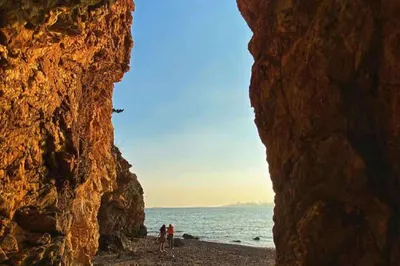
Huayan Temple is the largest Buddhist temple in Laoshan. Its fame was originally spread far and wide by the Ming Dynasty monk Hanshan, who meditated facing a wall in the “Nailuoyan Grotto.” The temple was funded by Ming Dynasty censor Huang Zongchang after he retired to his hometown Jimo during the Chongzhen era, but construction remained unfinished and was later destroyed by war. In the early Qing Dynasty, his son Huang Tan relocated and continued the construction, completing it in the ninth year of the Shunzhi reign (1652). It was initially named “Huayan Temple,” also known as “Huayan Chan Temple”; in 1931, its name was changed to “Huayan Temple.” Grand and elegant, it represents the pinnacle of ancient architectural art in Laoshan. It originally consisted of four courtyards, with over 130 rooms including halls, monks’ quarters, and guest rooms, covering a floor area of more than 2,500 square meters on a site over 4,000 square meters. The temple’s surroundings include scenic spots such as Nailuoyan Grotto, Guayue Peak, Wanghai Tower, and Yugu Stone. During the Anti-Japanese War, the Qingdao municipal government of the Republic of China was based here.
Address: West of Fanlinghou Village, Wanggezhuang Town, Laoshan District, Qingdao, on Nailuoyan Mountain
NO.2 Taiqing Palace
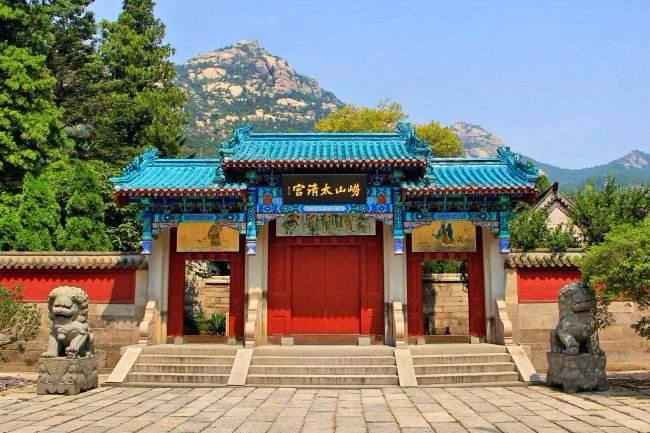
Laoshan stretches a hundred li, dotted with Daoist and Buddhist temples as numerous as stars — it’s said there are “nine palaces, eight temples, and seventy-two hermitages,” among which Taiqing Palace is the most famous. According to records, during the Han Dynasty, Zhang Lianfu of Ruizhou Prefecture in Jiangxi gave up his official post to pursue Daoism on Laoshan, building a thatched hut dedicated to the Three Officials Emperor, calling it “Sanguan Temple.” In the first year of the Tianyou era of the Tang Dynasty (904 AD), Daoist Li Zhexuan came here to build halls for the Three Sovereigns, naming it “Sanhuang Hut,” later known as “Taiqing Palace.” During the Mingchang era of Emperor Jin Zhangzong, Quanzhen Daoists such as Qiu Chuji and Liu Changsheng preached here. Liu Changsheng founded the Suishan sect of Quanzhen Daoism here, attracting many followers, and Taiqing Palace became the ancestral temple of the Suishan sect. Taiqing Palace covers 30,000 square meters, with a building area of 2,500 square meters. The complex mainly comprises three sections: Sanguan Hall, Sanqing Hall, and Sanhuang Hall, along with additional structures like Guanyue Pavilion, east and west guest halls, and Kundai Courtyard, totaling over 150 rooms. Laoshan’s Taiqing Palace, together with Beijing’s Baiyun Temple, Shanxi’s Yongle Palace, Shaanxi’s Chongyang Palace, Sichuan Qingcheng’s Tianshi Cave, Hubei Wudang’s Zhenwu Palace, and Jiangxi’s Wanshou Palace, are among the most influential Daoist temples.
Address: At the foot of Laojun Peak, 50 li east of Qingdao, Shandong, on the shore of Laoshan Bay
NO.3 Tianhou Palace
First came Tianhou Palace, then came Qingdao City. Originally built in the third year of the Chenghua reign of the Ming Dynasty (1467), it has a history of over 500 years and is the oldest surviving Ming-Qing brick-and-wood architectural complex in downtown Qingdao. When first built over five centuries ago, Tianhou Palace consisted of three main halls dedicated to the Heavenly Mother, along with side halls for the Dragon King and the God of Wealth. Through the Ming, Qing, and Republican eras, it underwent seven renovations and expansions. Apart from the opera tower’s glazed tile roof, the other buildings feature plain brick walls, small grey tiles, and Suzhou-style painted decorations — richly ornamented with carved beams and gilded splendor. Among all ancient buildings in the Qingdao area, the architectural and painted artistry of Qingdao’s Tianhou Palace is second to none. In 1996, the Qingdao municipal government fully restored it and transformed it into the “Qingdao Folk Customs Museum,” officially opening to the public on December 26, 1998.
Address: No. 19 Taiping Road, within the Qingdao Pier Scenic Area
NO.4 Zhanshan Temple
Zhanshan Temple nestles against the mountain and faces the sea, offering spectacular scenery. Its construction began in 1934, funded by donations from the Buddhist lay community. That autumn, the “Western Three Saints Hall” was completed and a consecration ceremony held. By 1944, when the main gate was finished, a decade had passed, making it one of China’s youngest famous monasteries. Built along the hillside, the temple features four consecutive courtyards from the gate to the scripture repository, all modeled after Ming Dynasty palace architecture, with exposed columns and wooden-and-stone structures. The entire temple complex covers over 200 mu, divided into three sections: central, west, and east. The central courtyard houses the Hall of Heavenly Kings, the Mahavira Hall, the Three Saints Hall, and the scripture repository. The west courtyard comprises the Memorial Hall for Master Tanxu, the Sanxue Hall, and the dining hall. The east courtyard includes a retirement home for elderly monks and a vegetarian restaurant for guests.
Address: No. 2 Zhiquan Road, Shinan District, Qingdao
NO.5 Shimen Temple
Shimen Temple is renowned for several unique features: In front of the temple stands a mountain peak crowned by a giant natural Buddha statue, 141 meters high, with a kneeling monk beside it seemingly chanting sutras — a spectacle found nowhere else on earth. The temple faces the mountain rather than backing onto it; its gate faces east instead of the traditional south; the entrance is formed by a colossal natural boulder. Nearby, a never-drying spring with crystal-clear, jade-green water lends the temple its alternative name, Yuquan (Jade Spring) Temple. Stepping from Shimen Temple into Dazhu Mountain reveals a wealth of sights. The ancient stupa forest, Zhushan stone chambers, Sui-Tang grottoes, and other Buddhist relics, along with hermitage sites like the poetry recitation platform, Mayi Hut, and Wanghai Tower, are vividly present. Natural rock formations such as Giant Crocodile Descending the Mountain, Immortal Asking for Directions, Reversed Seated Guanyin, Jiang Gong Carrying His Wife, and Sleeping Arhat showcase the uncanny workmanship of nature.
Address: Dazhu Mountain Scenic Area, Huangdao District, Qingdao
NO.6 Xuanyang Temple
Xuanyang Temple in Qingdao is said to have been first built in the third year of the Xiankang era of the Eastern Jin Dynasty (337 AD). Made of locally quarried stones stacked without mortar, its shape resembled an ancient bell, earning it the folk name “Bell Stone House.” Rebuilt during the Qianlong period of the Qing Dynasty, Xuanyang Temple is one of the “nine palaces, eight temples, and seventy-two hermitages” of Laoshan, a part of the area’s Daoist culture, with deep religious and folk traditions. It is a precious cultural heritage in Licang District. Every year on the sixteenth day of the first lunar month, the Xuanyang Temple Fair takes place. Villagers from surrounding areas flock here, tying strip after strip of red cloth onto a large female ginkgo tree — a truly enchanting sight.
Address: Beishan of Daijia Village, 6.5 kilometers northeast of Licun, Licang District, Qingdao