High-Speed Rail Tour of Hunan, Henan, and Shandong
With the rise in temperature, my wife and I decided to take a high-speed rail trip.
Day 1: Zhuhai - Chenzhou West
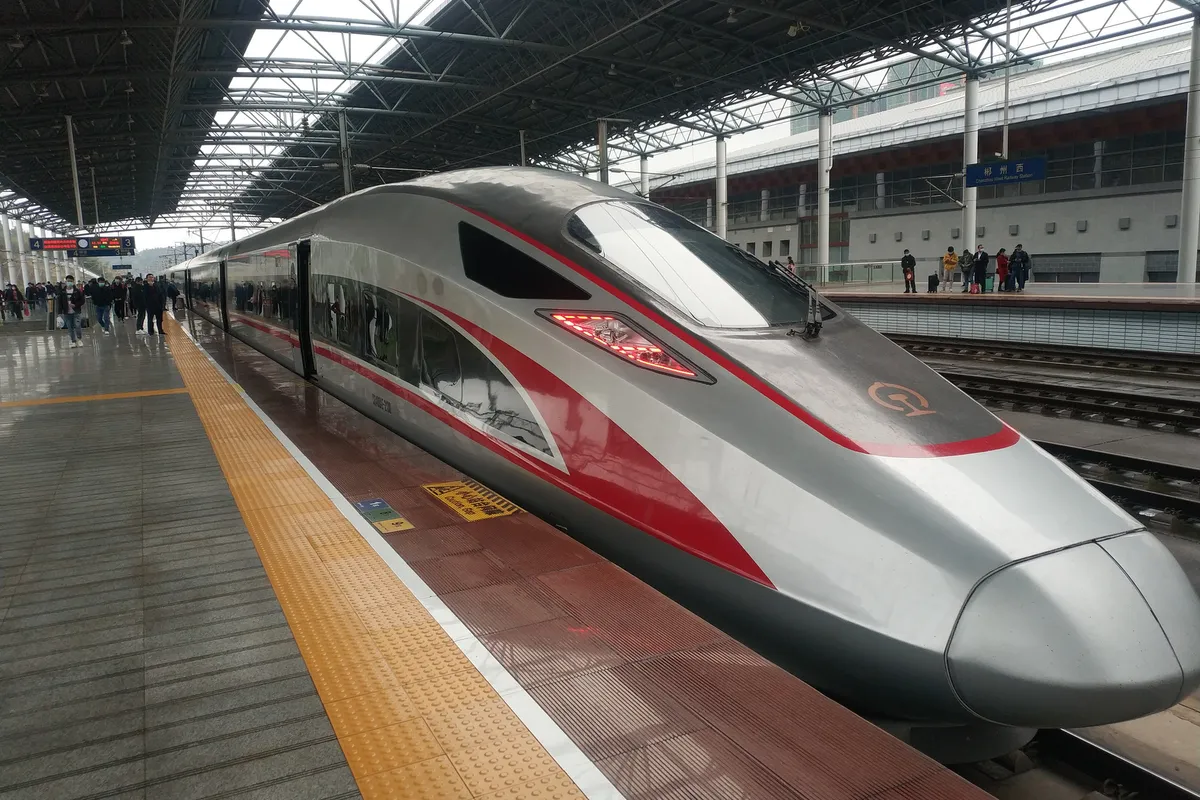
Around eight in the morning, we set off from Zhuhai to Chenzhou. The high-speed train was very comfortable, with seats much more spacious than on airplanes, very smooth, and not too noisy. There were charging sockets under the seats, so we could play on our phones without worrying about battery life. Time passed quickly, and two or three hours flew by.
Passing through Shaoguan, it was stormy outside. When we arrived in Chenzhou at noon, it wasn't raining there, just cloudy and overcast. After scanning the health code and exiting the station, we took a taxi from the high-speed rail station to the pre-booked Dinghe Hotel. The Dinghe Hotel claimed to be four-star standard but wasn't officially rated. The basic facilities were decent, but the elevator and hallways were filled with smoke, indicating poor management.
After dropping off our luggage, we went to the lively Ziyun Local Cuisine Restaurant next to the hotel for lunch. We ordered the restaurant's signature dish, steamed pork ribs with rice flour, and other items. The portions were generous, the taste was excellent, and it was reasonably priced.
After lunch, we took a taxi directly to Wanhua Rock to explore. I felt that Chenzhou is a city built in the middle of a large mountain valley, with mineral crystal advertisements everywhere along the streets, indicating rich mineral resources.
Arriving at Wanhua Rock scenic area, there were few visitors. The stalactites and stalagmites in the karst cave were in various poses—no need to elaborate. Compared to other caves, Wanhua Rock is special because it has an underground river, and you can go rafting in the cave during summer. At the entrance, a guide led tourists with explanations, controlling the colorful lights along the way, which revealed a splendid view.
The rock formations were lifelike. We didn't follow the guide but explored on our own. The main scenic area was about one kilometer long. After the guide's explanation ended, the rafting area was open for visitors to walk through.
At the starting point, many rafts were stacked on the open ground. After about 800 meters, we reached the exit, which was Heiya Tiankeng (Black Cliff Sinkhole), with a depth of over 130 meters.
Looking up, we could see a circular patch of sky. The cliffs on both sides were as if cut by a knife or axe, very majestic.
Near the Tiankeng, there was a stele from the tenth year of Xianfeng in the Qing Dynasty recording the history of the Taiping Heavenly Kingdom, titled "Tanshan Wanhua Rock Narrative." At the bottom of the Tiankeng, a wall left by the Taiping Army was preserved.
The floor of the Tiankeng was very flat and spacious, able to accommodate thousands of people. We climbed up the winding path from the bottom to the top of the rock, rested briefly at a pavilion, and then walked a long path back to the visitor center, tired. The whole visit took over three hours.
It was quite difficult to get a taxi back to the city from here, but fortunately, there was a bus every half hour to the city, with a stop right across from our hotel.
The bus was convenient for nearby villagers and schoolchildren commuting. We happened to meet a group of children after school, and the carriage became lively.
We had dinner at a restaurant called Yao Family Eight Bowl Dishes near the hotel, enjoying Yao ethnic local cuisine, then returned to the hotel to rest.
Day 2: Full-day tour of Dongjiang Lake Scenic Area
Today was cloudy and overcast. After the hotel's buffet breakfast, we took a taxi to Dongjiang Lake Scenic Area, the only 5A-level scenic spot in Chenzhou, located in Zixing City under Chenzhou's jurisdiction. It was about 35 kilometers away with good road conditions, and we arrived at the scenic area entrance in less than an hour.
We bought a combo ticket mainly for visiting Xiao Dongjiang, Longjing Scenic Area, and Doushuai Lingyan. From the visitor center at the entrance, we took a sightseeing bus along Xiao Dongjiang upstream. There were several stops where we could get off and walk along the riverside boardwalk. We could choose a few sections to walk and then continue by bus to the dock near Dongjiang Dam.
Too lazy to walk, we stayed on the bus and enjoyed the scenery of Xiao Dongjiang. This season we couldn't see the legendary misty river scene, but it was indeed beautiful.
The Dongjiang Dam was very majestic. There was a cruise dock next to the dam, and many restaurants and inns around the parking lot. Not far ahead was the entrance to Longjing Scenic Area.
The staff told us that the boat to Doushuai Lingyan would depart at 11:00. Seeing it was still early, we first visited Longjing Scenic Area.
There were many waterfalls inside. According to the map, there were small and large loops for walking.
We only walked the small loop and didn't have the energy to go deeper.
At 11:00, we took a cruise to Doushuai Island in the middle of the lake to visit Doushuai Lingyan. The lake water was clear and clean, with beautiful mountain colors on the shores.
The boat ride took about half an hour to reach Doushuai Island dock.
After landing, we gathered at the entrance of Doushuai Rock and were led by a guide to explore the cave.
In front of the cave was an ancient nunnery; passing through it led to the Doushuai Lingyan cave.
The cave was an extremely large limestone cave, characterized by height, size, majesty, strangeness, depth, and spaciousness.
Inside, there was a towering stone pillar 36 meters high. Wide areas were like squares, narrow ones like corridors. The cave was deep and winding.
The entire cave was tortuous on the plane and could be divided into three levels vertically.
After an hour of exploration, we exited the cave and went to another dock to take a cruise back to Dongjiang Dam.
After disembarking, we bought two fried golden Dongjiang Lake whitefish from a nearby shop to taste. The meat was delicious. Around 3:00 PM, we ended our visit and took a taxi back to Chenzhou city center.
For dinner, we went to the Ziyun Local Cuisine Restaurant near the hotel, which we had visited the previous day.
Day 3: Chenzhou West - Hengshan West
We woke up naturally, had the hotel's buffet breakfast, then took a taxi to the high-speed rail station for today's trip to Hengshan.
After arriving at Hengshan West Station, the driver from the pre-booked Manyun Hotel sent us a message with our specific location. After exiting the station, we saw a high-end business van waiting in the parking lot. It took about 20 minutes to reach the hotel, which was not far from the Hengshan Scenic Area.
After checking in and resting briefly, we went to a food street across from the hotel and found a busy restaurant for lunch. After lunch, we walked to the nearby Nanyue Grand Temple to visit.
Nanyue Grand Temple is the largest ancient building complex temple in Jiangnan, known as "the first temple in Jiangnan" and "the Forbidden City of the South." According to existing records, it was first built in the Tang Dynasty and underwent six fires and sixteen renovations and expansions through the Tang, Song, Yuan, Ming, and Qing dynasties, reaching an area of 98,500 square meters in the eighth year of Guangxu (1882).
Nanyue Grand Temple features nine halls and four courtyards, surrounded by red walls with high corner towers. The Shoujian mountain spring flows around the walls, resembling the style of Beijing's Forbidden City.
Buddhism and Taoism coexist in Nanyue Grand Temple: eight Taoist temples on the east side and eight Buddhist temples on the west side, making it a unique temple in China. Large-scale temple fairs are held here every year, attracting overseas Chinese from Southeast Asia, Japanese Buddhist figures, and pilgrims from afar, so incense never ceases.
The first hall is the main gate, also called Lingxing Gate, built of granite. A pair of majestic stone lions stand in front. Inside the gate, cypress trees stand upright with green grass.
The second hall is Panlong Pavilion, also called Kuixing Pavilion, once used for performances. The pavilion is square with a granite base about 2 meters high, with a cross passage inside. It is a wood-stone structure with double-eave hip-and-gable roof covered in yellow glazed tiles. Under the eaves are brackets, painted carvings. The caisson ceiling features a huge gilded coiled dragon, hence the name Panlong Pavilion. On the north side hangs a horizontal plaque: "Gu Wang Jin Lai" (From Ancient to Present). On the south eaves is a vertical plaque "Kuixing Ge." To the left is a bell pavilion, to the right a drum pavilion, both double-eave hip-and-gable style, now restored with new bells and drums. South of these two pavilions are two hexagonal pointed pavilions. The east pavilion houses the stele "Record of Rebuilding Nanyue Temple" written by Minister Shang Lu in the Chenghua period of Ming Dynasty (1460-1487). The west pavilion houses the stele "Sacrificial Essay to Hengyue" written by Fan Chunren of Song Dynasty.
The third hall is the three gate towers in the style of a city gate. The central one is called Zhengchuan Gate. Inside the gate is an exquisite Imperial Stele Pavilion. Inside the pavilion stands a huge tortoise-borne stele erected in the 47th year of Kangxi of Qing Dynasty (1708) for the reconstruction of Nanyue Temple, with the inscription personally written by Kangxi.
The fourth hall is the Imperial Stele Pavilion. It has an octagonal double-eave pointed roof with red pillars and green tiles, with upturned eaves. Under the eaves are exquisite brackets. The pavilion is surrounded by red walls with an arched door on each side. Inside, a huge tortoise-shaped stele base (bixi) carries a stele. The stele is 3.2 meters high and 2 meters wide, made of a single piece of bluestone, inscribed with "Record of Rebuilding Nanyue Temple" personally written by Emperor Kangxi. The pavilion has a vertical plaque "Imperial Stele Pavilion" and on the architrave are 200 different ancient seal-script characters for "shou" (longevity), symbolizing Nanyue as the "Longevity Mountain."
The fifth hall is Jiaying Gate, now converted into the Nanyue Cultural Relics Preservation Office, Nanyue Painting and Calligraphy Institute, and the Grand Temple guesthouse.
The sixth hall is the Imperial Book Tower. It is a brick-wood structure with double-eave hip-and-gable roof, surrounded by a corridor. In front is a red stone step with a coiled dragon in the middle. The upper floor has lattice windows with unique bracket structures. Under the south eaves is a horizontal plaque "Imperial Book Tower." Originally there were five imperial steles downstairs, but they are no longer extant.
The seventh hall is the Main Hall. In front is a large square. The main hall stands on a 17-step stone staircase. The central steps feature a white marble relief of a swimming dragon. The main hall is 7.2 zhang high, with double-eave hip-and-gable roof, surrounded by 72 large stone pillars symbolizing the 72 peaks of Nanyue. The roof is covered with orange-yellow glazed tiles, adorned with swords, large and small coiled dragons, and figures from the Eight Immortals. The four corners of the eaves hang copper bells. The window lattices and wall panels are carved with various figure stories, flowers, birds, and animals. The rear wall features large paintings of clouds, dragons, and red phoenixes. Around the steps of the hall are stone railings with carved lions, qilins, elephants, and horses. The railings feature 144 double-sided white marble reliefs. Inside the hall, originally there was a seat for the Yue God, who was given various titles by successive rulers. For example, in early Tang Dynasty he was titled "Sitian Huo Wang," during Kaiyuan period "Nanyue Zhenjun," and in Song Dynasty "Sitian Zhaosheng Emperor." The current "Nanyue Shengdi" statue was reproduced in 1983.
The eighth hall is the Sleeping Palace, also called Jinshen Hall or Rear Hall. It is a brick-wood structure with double-eave hip-and-gable roof, connected to the main hall's red stone step. Inside are statues of the Saintly Emperor and his wife Empress Jingming, as well as the parents of the Saintly Emperor, so it is also called the Hall of Saintly Duke and Saintly Mother. Under the eaves are robust brackets, and the ceiling is beautifully painted.
The ninth hall is the Rear Mountain Gate, also called North Rear Gate, marking the end of the temple's central axis. It is a brick-wood structure with single-eave flush gable roof, red walls and yellow tiles, adorned with precious tops and running animals on the ridge. East of the gate is Zhusheng Hall, dedicated to the True Lord of Giving Birth, commonly known as the Goddess of Sons. West is Xia Shen Hall. One gate and two halls are connected in a row, decorated with ancient elegance. Exiting the rear gate, one can ascend the mountain.
We spent the entire afternoon visiting Nanyue Grand Temple, then walked back to the food street, chose a different restaurant for dinner, and returned to the hotel to rest. Many pilgrims staying at the hotel were there to burn incense at Mount Heng. The hotel front desk sold complete incense bags.
Day 4: Ascending Mount Heng
Cloudy and overcast. After breakfast at the hotel, we took a taxi to the entrance of the Mount Heng Scenic Area. After scanning the health code and entering the visitor center to buy tickets, we took a scenic bus to Nantianmen (South Gate of Heaven).
Mount Heng is a famous sacred site of Taoism and Buddhism in China. Over 200 temples, shrines, nunneries, and Taoist temples surround the mountain. The bus made several stops for tourists to visit, but we were too lazy to exert ourselves and went directly to the terminal at Nantianmen.
Mount Heng is where ancient kings Tang Yao and Yu Shun toured and hunted, performed sacrifices, and where Xia Yu killed a horse and offered sacrifices to heaven and earth to seek flood control methods. The mountain god is Zhurong, the fire god revered by the people, appointed by the Yellow Emperor to guard Mount Heng, teaching people to use fire and nurturing all things. After his death, he was buried at Chidi Peak on Mount Heng and is locally honored as Nanyue Shengdi. Four of Taoism's "thirty-six grotto heavens and seventy-two blessed lands" are located on Mount Heng. Two genuine Sarira of Shakyamuni Buddha are enshrined in the Diamond Sarira Pagoda at Nantai Temple on Mount Heng.
The main peaks of Mount Heng include Huiyan Peak, Zhurong Peak, Zigai Peak, and Yuelu Mountain. The highest peak, Zhurong Peak, has an altitude of 1300.2 meters. The main body of Mount Heng runs northeast-southwest. Zhurong Peak is a peak commemorating the human ancestor Zhurong.
Due to constant smoke and clouds and overlapping peaks, and standing in the relatively low-lying Xiangnan Basin, Zhurong Peak appears extremely steep and towering. In ancient language, "Zhu" means lasting forever, "Rong" means brightness, so "Zhurong" means eternal light. There was a cable car station at Nantianmen, but it is now out of service.
Although it wasn't raining, there was thick fog. Many local villagers were selling raincoats to prevent moisture from wetting clothes. We followed the tourists along a narrow winding mountain road, about 4 kilometers. Some tourists climbed up stone steps, which was a shorter but steeper route of about 2 kilometers.
Along the way, we visited Lion Rock, a large granite rock shaped like a stone lion.
Further up was Gaotai Temple, with some landscape rocks appearing and disappearing in the clouds.
Continuing upward, we reached Shangfeng Temple, one of the oldest ancient temples on Mount Heng. Before the Sui Dynasty, it was called Guangtian Temple and was revered as the 22nd blessed land by Taoism.
Passing Shangfeng Temple and ascending the "Heavenly Steps," we reached the summit of Zhurong Peak, Zhurong Hall, built to commemorate the merits of the fire god Zhurong. There was a structure here before the Sui Dynasty, initially the Temple of Sitian Huo Wang, later moved down the mountain (the predecessor of Nanyue Temple), then renamed Tianchi Nunnery, and during the Ming Dynasty as Kaishun Temple, finally renamed Zhurong Hall during the Qianlong period of the Qing Dynasty.
The entire hall consists of two sections, all built with granite. The roof is covered with tin-plated iron tiles, each 70 cm long, 30 cm wide, and weighing 15 kg. Among these iron tiles, several dozen from the Song Dynasty, polished for a millennium and rust-free, are preserved.
Ascending the highest peak of Nanyue, although surrounded by fog and cold wind, the fervent excitement and devout incense of pilgrims could not be suppressed. The fragrance of incense filled the entire mountaintop.
We rested at a pavilion on the mountain, eating snacks we brought, then leisurely descended to the Nantianmen parking lot to take a bus down. The downhill route was different from the uphill one, allowing stops at other scenic spots on Mount Heng. But we were exhausted and didn't get off; we went directly to the visitor center, ending our Mount Heng tour. After returning to the hotel and resting for a while, we went to the food street again to find a restaurant for dinner. Hunan cuisine is diverse; over these two days we ordered different dishes and found them all quite palatable.
Day 5: Hengshan West - Yueyang East
Today's breakfast was at the Yunj Hotel next door. According to the staff, both hotels are owned by the same boss. Yunj Hotel is five-star standard, and the breakfast was much more abundant than the previous day.
After breakfast, the hotel driver took us to the high-speed rail station. High-speed rail is indeed convenient.
We arrived in Yueyang by noon. After exiting the station, we took a taxi to the Meisu Huanzhi Hotel in the city center to check in. The hotel facilities and service were excellent.
At noon, we took a taxi to the "Wangwangxian" restaurant to taste handmade fish balls and fresh fish. They were truly delicious. The handmade fish balls came in a huge pot. The portions were generous, and we packed the leftovers.
After lunch, we took a taxi directly to Yueyang Tower Scenic Area. Arriving at Yueyang Square, we found it crowded with people, mostly female tourists.
It turned out to be Women's Day today. Women could visit for free, while male tourists had to buy tickets.
In the afternoon, we entered to visit Yueyang Tower. The queue to ascend the tower was extremely long. We couldn't find the end of the line, so we gave up on climbing the tower and explored other areas of the park.
Yueyang Tower is located on the west gate wall of Yueyang's ancient city, close to Dongting Lake, overlooking the lake and facing Junshan Island.
It was first built in the 20th year of Jian'an of the Eastern Han Dynasty (215 AD) and underwent numerous renovations. The existing structure follows the form and layout from the reconstruction in the 6th year of Guangxu of Qing Dynasty (1880).
Because Teng Zongliang of the Northern Song Dynasty rebuilt Yueyang Tower and invited his friend Fan Zhongyan to write "Record of Yueyang Tower," it became world-famous.
Since ancient times, it has been praised as "the water of Dongting under heaven, the tower of Yueyang under heaven," and is ranked among the "Three Great Towers of Jiangnan" together with Yellow Crane Tower in Wuhan, Hubei, and Tengwang Pavilion in Nanchang, Jiangxi.
The main building of Yueyang Tower is rectangular, 19.42 meters high, 14.54 meters deep, and 17.42 meters wide. It is a three-story, four-pillar, flying-eave, helmet-roofed, all-wood structure. Four nanmu golden pillars run straight up to the top, surrounded by corridors, beams, rafters, and purlins that interlock to form a whole. The roof is covered with yellow glazed tiles, presenting a dignified and generous shape.
Due to the large number of tourists, we left after less than two hours and took a taxi to Sheng'an Temple on the south bank of Nanhu Lake.
This is a temple with a long history in Yueyang. It was first built in the early Tang Dynasty, originally lived in by the eminent monk Master Wuxing. Prime Minister Yang Yan often visited Sheng'an Temple. Jingzhao Yin Yang Ping donated huge sums to build it. The famous Tang Dynasty essayist Liu Zongyuan wrote the stele inscription "Bei Yin Ji" for Sheng'an Temple, recording the life of Master Wuxing. Sheng'an Temple, standing on Daguishan Hill, is magnificent with flying eaves, bracketing, and splendid decorations.
Entering the temple, the melodious "Great Compassion Mantra," peaceful chanting, and curling sandalwood incense brought the few visitors into a strong Buddhist cultural atmosphere. Following the path, the temple consists of the Mountain Gate, Heavenly Kings Hall, Mahavira Hall, Buddha Recitation Hall, Guanyin Hall, and Ten Thousand Buddhas Pagoda.
The Mountain Gate is the main gate of Sheng'an Temple, modeled after the Buddhist Incense Pavilion archway in the Summer Palace, with five gates collectively called the Wisdom Gate. Stepping up the stone steps, we reached the Heavenly Kings Hall. This is one of the main buildings of Sheng'an Temple, unique among modern Chinese temple architecture. Inside, incense smoke curls around a statue of Maitreya Buddha, who is depicted with a bare belly and chest, fingers counting prayer beads, always smiling. On both sides of Maitreya are the Four Heavenly Kings, also known as the Four Great Vajra Guardians. The statues are tall and majestic, with smooth and graceful lines, lifelike.
Further along, we reached the Buddha Recitation Hall and Guanyin Hall. Inside Guanyin Hall, a sitting statue of Avalokiteshvara with a thousand arms and eyes, compassionate and merciful, is the largest Guanyin statue in Hunan, covered in real gold with a kind expression.
The Ten Thousand Buddhas Pagoda is built on the top of Daguishan Hill, also serving as the temple's protector. The pagoda has flying eaves and bracketing, shining with glazed tiles. It stands tall among green hills and clear waters, pointing to the sky above and standing on the sacred mountain below, majestic in harmony between heaven, earth, and people. The pagoda radiates Buddha light and spiritual energy, truly a blessed place of Buddhist affinity. The surrounding pavilions, terraces, flowers, and trees complement it, creating a scene like the Western Pure Land, extremely beautiful.
We returned to the hotel in the evening. Hearing that Yueyang's barbecue is famous, we went to the Dingsanmao BBQ restaurant near the hotel and had barbecue. It lived up to its reputation.
The service at Meisu Huanzhi Hotel was really good. At around 9 PM, they specially brought us a late-night snack, including wontons and nourishing congee.
Day 6: Yueyang Museum - Nanhu Square - Baling Square
After a hearty hotel buffet breakfast, we took a taxi to Yueyang Museum.
Yueyang Museum is a comprehensive local history museum with a collection of over 20,000 artifacts. Among them, excavations at the Neolithic site of Chegu Mountain in Huarong County, the Neolithic sites of Huangjiayuan-Fushanyuan in Miluo City, the Shang Dynasty site at Tonggushan in Yunxi District, and the Sui Dynasty dragon kiln at Mawangkan in Xiangyin County have yielded a large number of artifacts, providing convincing material evidence for exploring major academic issues such as the origin of primitive agriculture in the Dongting Lake area of the middle Yangtze River, the social economy of the Neolithic Age, the entry of Shang and Zhou cultures into Hunan, and the evolution of southern celadon.
After exiting the museum, we walked along the scenic road by Nanhu Lake to Nanhu Square.
My wife was a bit tired and sat on a leisure chair by the square to rest while enjoying the lake scenery.
I continued walking along the lakeshore, all the way to Nanhu Hotel.
Nanhu Lake is a natural lake derived from Dongting Lake. It leans against the mountains and coexists with the city, with undulating peaks, deep shorelines, and beautiful scenery.
Nanhu Lake covers an area of 1200 hectares. The lake surface is always rippling with green waves, quiet and elegant. The lake shore has many bays with winding harbors, forming a geomorphic shape called "one dragon chasing nine turtles."
At the north bay mouth of Nanhu Lake, there is an ancient three-arch bridge built in the middle of Zijing Embankment. Over the past several hundred years, Zijing Embankment was the only water passage from Yueyang to the outside world.
Around noon, we took a taxi to Baling Square. Since it was too crowded yesterday afternoon, we didn't explore it carefully.
Today we came specifically to see the outer scenery of Yueyang Tower.
Dongting Lake is the second-largest freshwater lake in China. Although it was cloudy, thin mist shrouded the lake, so there were not many tourists, a stark contrast to yesterday's overcrowding.
In the afternoon, we walked back along Baling Avenue to the hotel to rest. In the evening, we went to Dingsanmao again for barbecue,
consolidating our taste memories of Yueyang barbecue.
Day 7: Yueyang East - Zhengzhou
It took about three and a half hours by high-speed rail from Yueyang East to Zhengzhou.
After arriving in the afternoon, we checked into the Yuehai Hotel, located near Zhengzhou Railway Station, right next to Erqi Square.
After dropping off our luggage and resting, we visited the nearby Erqi Memorial Tower.
The Zhengzhou Erqi Strike Memorial Tower covers an area of 352 square meters, with a building area of 1,923 square meters. It is a reinforced concrete structure, shaped like two pentagons joined together, a unique architectural twin-tower imitating ancient styles. The tower is 63 meters high with 14 floors (including basement). The base has three levels of railings surrounding a viewing platform, gradually narrowing. Each level has white cement railings.
The tower body has 10 floors, each with upturned eaves and corners, covered with green glazed tiles. The exterior is coated with white dry-stick stones. On each side of every floor are red-lacquered square lattice windows. At the top is a bell tower with six large bells, each 2.7 meters in diameter. The bell tower summit stands a 9-meter flagpole with a red five-pointed star.
The basement has an underground passage extending northwest. The architectural plan consists of two pentagons connected east-west; viewed from east-west it appears as a single tower, but from north-south it appears as twin towers.
The tower is novel, unique, and majestic, embodying Chinese national architectural characteristics. Each floor's top corners have imitation ancient upturned flying eaves covered with green glazed tiles. The bell tower plays the tune "The East Is Red" on the hour. A red five-pointed star stands high on the bell tower.
After visiting the exhibition rooms on each floor, it was already evening. Erqi Square is surrounded by tall buildings and many large shopping centers. We had dinner at the Yellow River Carp restaurant among them, tasting large carp, spicy soup, and braised noodles, then returned to the hotel to rest.
The pedestrian street by the hotel was brightly lit and crowded with tourists.
Day 8: Henan Provincial Museum - Bishagang Park
Breakfast at the Yuehai Hotel was in the revolving restaurant on the 28th floor. We enjoyed a hearty breakfast while overlooking the cityscape of Zhengzhou, very pleasant.
After breakfast, we took a taxi to the Henan Provincial Museum, which we had reserved the day before. The Henan Museum is located on Nongye Road in Zhengzhou. The main exhibition hall is in the center of the museum area, pyramidal in shape, with the artifact repository behind. The overall building structure is rigorous, majestic, simple, and elegant, with a unique artistic style that reflects the characteristics of Central Plains culture.
The Henan Museum includes a square, a prologue hall, permanent exhibition halls, special exhibition halls, temporary exhibition halls, artifact repositories, an academic lecture hall, an audio-visual building, etc. There are landscaped gardens outside the building complex, forming a beautiful pattern of "a garden within a museum, a museum within a garden."
The main exhibition building's design is based on the ancient Yuan Dynasty astronomical observatory, artistically exaggerated into a "crowned pyramid." Its base is a square 63 meters on each side, 45.5 meters high, with five floors internally, one underground. The crown is a square bucket shape, rising upward and covering downward, symbolizing receiving "sweet dew" above and absorbing "earth energy" below, implying that the Central Plains is the source of Chinese civilization, merging all directions. The external walls are yellow-brown, representing the loess and Yellow River that nurtured Chinese civilization. On the front, from top to bottom, are light blue transparent windows and transparent light strips, conveying the majestic momentum of "the Yellow River comes from heaven." The exhibition halls include "Light of Ancient Central Plains Civilization," "Central Plains Chu Bronze Art Hall," "Ancient Henan Jade Hall," "Ming and Qing Treasures Hall," and "Ancient Stone Carving Art Hall."
"Light of Ancient Civilization" is divided into eight halls. Halls 1-4 are on the first floor: Primitive Society Hall, Xia-Shang Hall, Western Zhou Hall, and Eastern Zhou Hall. Halls 5-8 are on the second floor: Han Dynasty Hall, Han-Jin Hall, Sui-Tang Hall, and Song-Yuan Hall.
Bronze Art Hall: The Central Plains Chu Bronze Art Hall displays fine bronze wares from the Chu noble cemetery in Xichuan County, Henan. They are categorized by usage, showcasing the superb artistry of Central Plains Chu bronze art.
The ornate decoration and 85-character inscription on the Prince Wu Ding are important physical evidence for studying Chu nobility. The Cloud-pattern Bronze Forbidden, as the earliest known lost-wax casting artifact in China, features five-layer openwork carving with 24 dragon-shaped beasts climbing and supporting it, its craftsmanship breathtaking. Other remarkable pieces include the "Wangsun Gao Bells," majestic and grand, the bizarre and exquisite Bronze Divine Beast, and a cloud-pattern square pot, Kehuang Sheng Ding, cloud-pattern lacquered tripod, and many other stunning works that have lain silent for 2,500 years.
Ancient Jade Hall: In ancient China, jade was a ritual vessel for communicating with heaven and earth and worshiping spirits; a material symbol of power and status; a burial tool for preserving the body and preventing decay; and a personality symbol for self-cultivation and expressing noble sentiments. The jades from the Central Plains are mostly fine products crafted by skilled artisans of the Three Ancient Dynasties.
Ming and Qing Treasures Hall: The arts and crafts of the Ming and Qing Dynasties reached a brilliant stage, including porcelain, embroidery, ivory carving, lacquerware, enamel, and gold and silver work, covering all categories.
We lingered in the museum until around 3 PM. Then we took a taxi directly to Bishagang Park to see the crabapple flowers.
Bishagang Park, as a modern Chinese revolutionary historical site, houses Zhongshan Park, the Martyrs' Shrine, and a monument pavilion, serving as historical witnesses.
Marshal Nie Rongzhen inscribed the monument with "Eternal Glory to the Fallen Soldiers of the Northern Expedition."
The park features specialty gardens such as Peony Garden, Magnolia Garden, and Aloeswood Garden, with many tree species.
This season, the crabapple flowers are in full bloom, attracting many visitors. The blooming flowers are pleasing to the eye.
In the evening, near the hotel, we bought Guo's Roast Chicken, Zheng's Beef, Xinjiang Lamb Skewers, Bao's Pastry, and other foods,
and some beer to have as dinner in the hotel.
Day 9: Shaolin Temple - Sanhuang Village - Luoyang
After breakfast at the revolving restaurant, we checked out and rented a car to visit Shaolin Temple on Mount Song. Due to heavy fog in the morning, the expressway was closed, so we took a national road to Shaolin Temple in Dengfeng City.
We arrived at Shaolin Temple after 10 AM. Dengfeng City has many martial arts schools. Along the way, we could see groups of people in uniform practicing martial arts on the large playgrounds of various schools.
We had already bought tickets online the day before. After entering the scenic area by scanning our ID cards, we walked about 300 meters to the Shaolin Martial Arts Hall to watch the 11 AM Shaolin martial arts performance.
Due to the pandemic, the performance, originally indoors, was moved outdoors. The half-hour performance was not particularly exciting, but it demonstrated the depth of Shaolin kung fu.
Shaolin Temple is the birthplace of Chinese Chan Buddhism and the cradle of Chinese martial arts. It is a World Cultural Heritage site and a national 5A-level tourist attraction. It is located at the foot of Wuru Peak of Mount Song in Dengfeng City. Because it is situated in the dense forest of Shaoshi Mountain in the hinterland of Mount Song, it is named "Shaolin Temple" (Temple in the Forest of Shaoshi).
Shaolin Temple was first built in the 19th year of Taihe of the Northern Wei Dynasty (495 AD) by Emperor Xiaowen to accommodate the Indian monk Bhadra, whom he revered. It was built at the northern foot of Shaoshi Mountain, facing the capital Luoyang. The permanent residential area of Shaolin Temple covers about 57,600 square meters. The current abbot is the 47th generation of the Caodong sect, the 33rd patriarch, Venerable Shi Yongxin.
Shaolin Temple is a world-famous Buddhist temple, the ancestral home of Han Buddhism's Chan sect, holding an important position in Chinese Buddhist history, known as "the first temple under heaven."
It is renowned worldwide for the Shaolin kung fu developed through the dedicated research and continuous innovation of successive generations of Shaolin warrior monks. There is a saying: "All kung fu originates from Shaolin; Shaolin kung fu is supreme under heaven."
The permanent residential buildings of Shaolin Temple are located on the north bank of Shaoxi River, from the mountain gate to the Thousand Buddha Hall, comprising seven courtyards. They include the permanent residence, the Forest of Stupas, and the First Patriarch's Temple. Along the central axis from south to north are the Mountain Gate, Heavenly Kings Hall, Mahavira Hall, Sutra Library (Dharma Hall), Abbot's Court, Snow-Planting Pavilion, and Thousand Buddha Hall. Additionally, west of the temple is the Forest of Stupas; north are the First Patriarch's Temple, Damo Cave, and Sweet Dew Terrace; southwest is the Second Patriarch's Temple; northeast is Guanghui Nunnery. Around the temple are over ten ancient pagodas, including the Pagoda of Master Tongguang, the Pagoda of Master Fau, and the Pagoda of Master Fahua.
The Mountain Gate is the main entrance of Shaolin Temple, built in the 13th year of Yongzheng of the Qing Dynasty (1735) and renovated in 1974. Above the gate is a plaque with three characters "Shào Lín Sì" written by Emperor Kangxi. In the center of the plaque is a seal reading "Kangxi's Imperial Brush Treasure." In front of the gate are a pair of stone lions, male and female, carved in the Qing Dynasty.
Flanking the Mountain Gate are two stone archways, one on each side of the figure-eight wall. The eastern archway's outer horizontal inscription reads "Origin of the Source and Fundamental Truth," and the inner inscription reads "Founded by Bhadra." The western archway's inner inscription reads "Mahayana Sacred Place," and the outer inscription reads "Song-Shao Chan Forest." The main gate is a single-eave hip-and-gable building with three bays, sitting on a 2-meter-high brick platform, with flush gable side gates and figure-eight walls on both sides.
After passing the Mountain Gate, we entered a brick pathway flanked by a forest of stelae, so called because the stelae are like a forest. There are over 20 stelae from various dynasties, such as the "Monument to the Return of Zong Daochen" and the "Stele of Master Xixi."
On the east side of the path, there is a long corridor housing over 100 famous stelae from the Tang to Qing dynasties, known as the Stele Corridor. The Hammer Manual Hall is located west of the stelae forest inside the Mountain Gate, containing clay and wood sculptures.
Following the pathway through the stelae forest, we reached the Heavenly Kings Hall, located at the end of the stelae forest. It is named after the Four Heavenly Kings, who symbolize "wind, harmony, rain, and harvest." The hall has red walls and green tiles with painted brackets. Inside the screen wall in front of the door are two vajra statues on left and right. The three-bay double-eave hip-and-gable hall has two vajras outside and four heavenly kings inside, powerful and majestic.
Behind the Heavenly Kings Hall is the Mahavira Hall, the center of Buddhist activities in the temple. Together with the Heavenly Kings Hall and the Sutra Library, they are called the three great Buddhist halls. Inside are statues of Sakyamuni, Bhaisajyaguru, and Amitabha. A plaque in the center of the hall bears four characters "Bǎo Shù Fāng Lián" written by Emperor Kangxi. On the back wall of the screen is a statue of Guanyin, flanked by eighteen arhats. On the east side of the Mahavira Hall is the Kinnara Hall.
On the west side of the Mahavira Hall is the Six Patriarchs Hall. Inside, the front wall features statues of Mahasthamaprapta, Manjusri, Avalokiteshvara, Samantabhadra, and Ksitigarbha. On both sides are statues of the six Chan patriarchs: Bodhidharma (1st), Huike (2nd), Sengcan (3rd), Daoxin (4th), Hongren (5th), and Huineng (6th). This grouping is called "Six Patriarchs Paying Homage to Guanyin."
On the west wall of the Six Patriarchs Hall is a large colored clay sculpture titled "Bodhidharma Returning West with One Shoe." In front of the hall, on the corridor, is a large iron bell cast during the Wanli period of the Ming Dynasty, weighing about 650 kg. The Bell Tower and Drum Tower stand on either side of the Mahavira Hall; the east one is the Bell Tower, the west one the Drum Tower. Both are four-story structures, ingeniously shaped and majestic, considered treasures of Chinese architectural history.
"Morning bells and evening drums" are signals for the monks' daily routine and Buddhist activities. In front of the Bell Tower is a stele called the "Emperor's Stele of Shaolin Temple on Mount Song," commonly known as the "Li Shimin Stele," erected in the 16th year of Kaiyuan of Tang Xuanzong (728 AD).
The front side bears an imperial edict from Li Shimin (Emperor Taizong) to the abbot and senior monks of Shaolin Temple, commending the temple's monks for their military merits in helping the Tang dynasty defeat Wang Shichong. The fifth line from the right contains Li Shimin's cursive signature "Shimin" and the seven characters "Imperial Calligraphy of Emperor Wen of Tang" written by Tang Xuanzong (Li Longji). The back side bears Li Shimin's "Imperial Stele Record of Bestowing Baigu Valley to Shaolin Temple," recounting the story of the thirteen stick-swinging monks rescuing the Prince of Qin, which is also the historical basis for the film "Shaolin Temple."
The Bodhidharma Pavilion, also called the Snow-Planting Pavilion, was built in the Ming Dynasty. According to legend, this is where the second patriarch Huike stood in the snow, cutting off his arm to seek Dharma from Bodhidharma. Inside the shrine, a bronze seated statue of Bodhidharma, cast in the 10th year of Jiajing of Ming (1531), is enshrined. Flanking him are the second patriarch Huike, third patriarch Sengcan, fourth patriarch Daoxin, and fifth patriarch Hongren. A plaque hanging above the shrine reads "Xuě Yìn Xīn Zhū" (Snow Seals the Pearl of the Heart), written by Emperor Qianlong of Qing, with vigorous strokes and bold spirit. This hall is now used for daily Buddhist services by the monks.
The East Side Hall is located west of the Bodhidharma Pavilion, containing a stone statue of Amitabha Buddha and the "Bodhidharma's Shadow Stone."
The Thousand Buddha Hall, also called Vairocana Hall, is the last hall in the temple. Its murals are very famous, treasures among Shaolin Temple murals. The back wall and the east and west walls are covered with colorful murals, the most famous being "Thirteen Stick-Swinging Monks Rescuing the King of Tang" and "Five Hundred Arhats Paying Homage to Vairocana," with bright colors, harmonious composition, and flowing robes, showcasing the high level of Tang Dynasty murals. In the center of the hall, bronze statues of Vairocana Buddha and a white jade Sakyamuni are enshrined, covering an area of several hundred square meters, making it the largest hall in the temple. East of the Thousand Buddha Hall is the White Robe Hall, and west is the Ksitigarbha Hall.
The Abbot's Court is the residence and office of the temple's abbot. Emperor Qianlong once crossed the Luo River to visit Shaolin Temple and stayed here, composing a poem: "Tomorrow I will gaze upon Mount Zhong, tonight I lodge in Shaolin." In the 15th year of Qianlong (1750), Emperor Gaozong (Hongli) used the Abbot's Court as a temporary palace when he visited Shaolin Temple, so it is also called "Dragon Court." The court was first built in the early Ming Dynasty and underwent repairs over the centuries; the existing structure dates from the Qing Dynasty.
After touring the temple, we sat on stone tables and chairs in the square in front of the temple, eating the food we brought to replenish energy. Then, mingling with the bustling crowd of tourists, we walked to the Forest of Stupas.
The Forest of Stupas is located about 300 meters west of Shaolin Temple at the foot of a small hill, covering an area of about 20,000 square meters. This is the largest forest of stupas in China. It faces Shaoxi River to the south, backs onto Longhu Ridge to the north, connects to Funiu Mountains to the east, and leans against Dangyang Slope to the west. The lush trees and beautiful environment create a serene atmosphere.
There are 256 stupas from the Tang Dynasty to the present, including 47 from the Yuan Dynasty, second only in number to those from the Ming Dynasty. It is said that the existing stupas are only half of the original number, the rest having been washed away by floods over the years. The 47 Yuan Dynasty stupas provide valuable material for studying Yuan Dynasty architectural styles and brick-stone carvings.
More importantly, almost every stupa has an inscription, providing precious data for studying the history of Shaolin Temple and Yuan Dynasty culture.
Several important Yuan stupas, such as the Yugong Pagoda, the Yueyan Elder's Longevity Pagoda, and the Hanyuan Elder's Pagoda, are located in the middle of the forest.
Further west of the Forest of Stupas, there are two cableways: one is the Songyang Cableway, leading to the Second Patriarch's Nunnery,
and the other is the Shaolin Cableway, leading to Sanhuang Village on Shaoshi Mountain. We took the Shaolin Cableway up Shaoshi Mountain.
Each cable car can carry eight people. It took about 15 minutes to reach the cable car station on Shaoshi Mountain, and then we walked along the Songshan Plank Road towards Sanhuang Village.
Sanhuang Village is named to commemorate the Three Sovereigns (Heavenly Sovereign, Earthly Sovereign, and Human Sovereign), who are said to have created the world in the Songshan area. Among all the temples and monasteries on Songshan, only this one worships deities outside the three major religions, revering human ancestors with devotion. Legend has it that Empress Wu Zetian once came here to perform the Fengshan ceremony to worship heaven.
Sanhuang Village is a natural village suspended on the mountainside of Shaoshi Mountain. The entire scenic area has steep slopes and a flat, wide mountaintop.
It possesses the majesty of Mount Tai, the peril of Mount Hua, the peculiarity of Northern Hengshan, and the beauty of Southern Hengshan, famous in the Central Plains for its unique peaks, dangerous paths, strange rocks, and beautiful scenery.
The Sanhuang Village scenic area boasts unique natural landscapes, rich cultural attractions, and beautiful forest environments. Natural sights include Shaoshi Clear Snow, Shaoshi Sunset,
Hero Slope, Dragon Ridge Gorge, Monkeys Watching Clouds, Tiger Rock, Dragon Head, Dragon Tail, Camel Rock,
Elephant Gate Pass, Line of Sky, Flying Rock, Suspension Bridge, Three Immortals Rock,
Stone Forest, Thousand Buddhas Welcoming Guests, Hanging Plank Road, and dozens more.
Major cultural attractions include Lotus Temple, Qingwei Palace, Anyang Palace, Sanhuang Temple, Pangu Cave, Jade Emperor Temple,
the 486-step Hero Slope,
the 50-meter-long "Liantian Suspension Bridge," and the 500-meter-long "Sanhuang Plank Road."
Starting from the cable car station, we spent over an hour climbing to the suspension bridge. Hearing from villagers selling snacks that it would take another half hour to reach Sanhuang Village on the opposite side, we had no energy to continue and had to return by cable car.
Around 5 PM, we left Shaolin Temple. The driver took us to the Zhengsheng Licheng Hotel in Luoyang, arriving at 6 PM.
After checking in and dropping off our luggage, we went to a nearby beef soup restaurant called Niuxiang Pavilion for dinner. The beef offal and beef soup were very tasty, and we ate our fill.
Day 10: Longmen Grottoes - Luoyang Museum - Lijing Gate Old City
After the hotel's buffet breakfast, we took a taxi to the Longmen Grottoes scenic area. The driver told us it was more convenient to enter from the southeast gate. The scenic area is large, with the Yi River dividing it into east and west parts.
After arriving at the East Visitor Center, we took an electric cart to the West Hill, the Longmen Grottoes, to begin our visit.
The Longmen Grottoes are the world's largest collection of stone carvings, recognized by UNESCO as the "highest peak of Chinese stone carving art." Longmen was created by Yu the Great during his flood control efforts, and the legend of the carp leaping over the dragon gate also takes place here.
The grottoes were first carved during the reign of Emperor Xiaowen of the Northern Wei Dynasty, flourished in the Tang Dynasty, and continued until the end of the Qing Dynasty. They were built over more than 10 dynasties, lasting over 1,400 years, making them the longest-constructed grottoes in the world. Originally richly painted, most colors have faded.
The grottoes are densely distributed on the cliffs of the east and west banks of the Yi River, stretching about 1 kilometer from north to south. There are 2,345 niches, over 110,000 statues, and more than 60 pagodas. Together with the Mogao Caves and Yungang Grottoes, they are called the three major grottoes in China, and with the addition of Maijishan Grottoes, they become the four major grottoes.
Most of the statues at Longmen were commissioned by royalty and nobility, making it a unique royal grotto in the world.
Here, Wu Zetian had the Lushena Buddha carved according to her own appearance; Emperor Xiaowen had Guyang Cave built for Empress Dowager Feng; the grandson of the Prince of Lanling dedicated statues in Ten Thousand Buddhas Cave; Li Tai built Binyang South Cave for Empress Zhangsun; Consort Wei had Jingshan Temple carved; and Gao Lishi created the Amitayus Buddha for Emperor Xuanzong.
The Longmen Grottoes represent a trend toward sinicization of grotto art and are a "milestone" in Chinese grotto art.
With contributions from countries such as India, Silla, Tokhara, and Sogdiana, European patterns and ancient Greek columns can be found,
making them arguably the most internationalized grottoes in the world.
Longmen, also called Yique (Gate of the Yi River), features the east and west hills facing each other, with the Yi River flowing between them, forming a natural gate-like gap, so it was anciently called Yique. "Both banks are steep cliffs facing each other like a gate; only divine dragons can cross, hence the name Longmen (Dragon Gate)."
The most magnificent statue on the West Hill is the Great Lushena Buddha, consisting of nine figures. The central main Buddha is Lushena, carved according to Wu Zetian's appearance. On its right is the eldest disciple Kasyapa, on the left the younger disciple Ananda, followed by Samantabhadra Bodhisattva (left) and Manjusri Bodhisattva (right), a brave and vigorous heavenly king, and a ferocious vajra warrior, together forming a highly emotional and textured group of artistic figures.
It was first carved in the early years of Emperor Gaozong of Tang. In the third year of Xianheng (672 AD), Empress Wu Zetian donated 20,000 strings of cash from her cosmetics allowance. Completed in the second year of Shangyuan (675 AD), the statue measures over 30 meters in both length and width. The main Buddha Lushena is the reward body of Buddha, meaning "universal light." It is 17.14 meters high, with a 4-meter-high head and 1.9-meter-long ears, famous for its mysterious smile, known as the "Mona Lisa of the East" and "the world's most beautiful statue." The face is full and round, with wavy hair on the crown, crescent-shaped eyebrows, and a pair of beautiful eyes slightly looking down, revealing a serene smile, like a wise and kind middle-aged woman, inspiring respect without fear.
After visiting the West Hill Grottoes, we crossed the bridge over the Yi River to view the West Hill from the opposite bank, which appeared even more magnificent.
The east hill cliffs also have many grottoes, but they are incomparable to the West Hill in number and scale.
All the east hill grottoes date from the Tang Dynasty, with over 20 large and medium-sized caves.
The eastern part of the scenic area also includes Xiangshan Temple and Bai Garden. Xiangshan Temple was first built between 690-700 AD. Empress Wu Zetian often came here when she was on the throne, holding court in the stone building of Xiangshan Temple, leaving behind the story of "composing poems to win a brocade robe at Xiangshan."
Bai Juyi, the famous poet, once donated funds to rebuild Xiangshan Temple and wrote "Record of Rebuilding Xiangshan Temple," greatly enhancing its fame. It was rebuilt during the Kangxi period of the Qing Dynasty. Emperor Qianlong visited the temple and praised it as "Among the ten temples at Longmen, Xiangshan is the best," and had a stele pavilion built, which still exists.
Bai Garden is the tomb garden of the Tang Dynasty poet Bai Juyi.
We finished our visit around 2 PM and took a taxi to the Luoyang Museum. The museum adopts the design concept of "a tripod standing under heaven," with the overall building shaped like a large tripod. In front stands an observation tower modeled after the "Great Zhou Wanguo Songde Tian Shu" (Heavenly Pillar of Virtue of Ten Thousand Nations).
The Luoyang Museum is one of the first batch of national first-class museums and a comprehensive local history museum in China. It houses over 400,000 artifacts, with 11,000 on display, ranking among the top museums in the country in terms of collection size.
The Heluo Civilization Exhibition, located on the first floor, is divided into three halls. It chronologically displays the development of Heluo civilization in prehistoric times, the Xia-Shang-Zhou period, the Han-Wei period, the Sui-Tang period, and the Five Dynasties-Northern Song period. The Treasure Hall special exhibition, on the second floor, showcases the finest selected artifacts from various dynasties, each one a treasure, each a national treasure.
The Han-Tang Pottery Figurine Hall special exhibition, also on the second floor, is divided into Han, Western Jin, Northern Dynasties, and Sui-Tang sections, using over 400 pottery figurines to outline the development of ancient ceramic sculpture art, a vivid textbook of pottery sculpture. Important exhibits include:
Painted pottery figurine of three people performing handstand acrobatics on a zun: Eastern Han Dynasty. Depicts three people doing handstands, realistically capturing the superb skills of acrobatics at that time. Painted pottery figurine of horse-mounted musicians: Tang Dynasty. The musicians have different poses, and the horses look gentle, vividly recreating the scene of playing music on horseback in Tang times. Painted pottery figurine of a horse tamer and dancing horse: Tang Dynasty. Vividly captures the moment of confrontation between horse and tamer during taming, a unity of strength and beauty.
The Luoyang Museum Tang sancai (three-color glazed pottery) hall special exhibition, on the second floor, categorically introduces various types of sancai sculptures, including civil officials, heavenly kings, noblewomen, maids, male servants, horsemen, tomb guardian beasts, foreign figures, animals, and daily utensils. The variety is extremely rare.
Important exhibits include: Tang sancai from the tomb of An Pu and his wife: The joint burial tomb of Tang Dynasty General An Pu and his wife He, discovered in 1981. The tomb owner had a high status, and the tomb was undisturbed, yielding 129 artifacts, including many exquisite Tang sancai pieces that are not only vividly shaped with beautiful glazes but also adorned with painted faces, lifelike. Three-color seated female figurine: Tang Dynasty. Elegant posture, serene expression, showing the dignity and restraint of Tang women.
Three-color horse with blue glaze and white spots: Tang Dynasty. Blue-bodied white-spotted horses are extremely rare in Tang sancai. The blue glaze used a cobalt pigment rarely available in the Central Plains at the time. This cobalt pigment was the precursor to the cobalt used in blue-and-white porcelain, proving that blue-and-white ware existed as early as the Tang Dynasty.
Yellow-green glazed performing figurine: Tang Dynasty. Vividly captures a moment of Tang Dynasty entertainers performing, important material for studying ancient theatrical characters.
Three-color flying geese and lotus tripod dish: Tang Dynasty. Elegant and clear in style, with a few strokes vividly depicting flying geese soaring in the blue sky.
The Luoyang Museum Stone Carving Hall special exhibition, on the first floor. The Luoyang region has numerous stone carvings from the Han to Ming and Qing dynasties, with strong era characteristics and local features, holding an important place in the history of ancient Chinese stone carving art. The exhibition is divided into two parts: stone sculptures and stelae/epitaphs.
Stone sculptures: Highlights include an Eastern Han stone bixie (mythical beast), a Northern Wei stone wengzhong (tomb figure), a Sui dynasty stone lion, and a Song dynasty stone tiger.
Stelae and epitaphs: Highlights include the Eastern Han Xiping Stone Classics, the Western Jin Han Shou tomb table, the Northern Wei Yuan Yi epitaph, the Tang Dynasty Zhang Yue epitaph, and the Northern Song Fu Bi epitaph.
The Luoyang Museum Painting and Calligraphy Hall special exhibition, on the second floor. Exhibits include works by Su Shi, Wang Duo, Zhao Zhiqian, Zha Shibiao, Yun Shouping, Kang Youwei, Wu Changshuo, Ren Bonian, Weng Tonghe, He Shaoji, Qi Baishi, Pu Ru, Yu Youren, Guo Moruo, and other famous masters, mainly from the Qing Dynasty and modern times. An important exhibit is Su Shi's screen with calligraphy after Lin Hejing's poem.
It was nearly dusk when we came out of the Luoyang Museum. We took a taxi to Lijing Gate.
Lijing Gate is known as the first tower of the Central Plains and the first gate of the ancient capital. It was the west gate of Luoyang during the Jin and Ming dynasties, first built in the first year of Xingding of the Jin Dynasty (1217). It is located at the West Pass of the old city of Luoyang, northeast of the Sui-Tang Yingtianmen site.
The Lijing Gate scenic area consists of the gate tower, the barbican, the arrow tower, the city wall, and Lijing Bridge (originally a drawbridge), along with the moat. The city walls are thick and high, the crescent city spacious, with multiple gates and layers, majestic and imposing, making it the leader of the historical and cultural ancient city blocks of Luoyang.
Entering the old city through Lijing Gate, it was bustling with activity.
We found a water feast restaurant in the old street and tasted the specialty Luoyang Water Feast.
At night, the old city's lanterns were lit, colorful and splendid.
We arrived at Luoyi Ancient City, which was extremely lively with numerous specialty restaurants.
It was crowded with people, and we had no energy to continue appreciating. We took a taxi back to the hotel to rest.
Day 11: Mingtang and Tiantang Scenic Area - Guanlin
Woke up naturally, the fatigue of yesterday completely gone. After the hotel's buffet breakfast, we took a taxi to the Mingtang and Tiantang Scenic Area. The towering Yingtianmen gate tower stands in the square in front of the scenic area. Yingtianmen was the main south gate of the Sui-Tang Luoyang Palace City (Ziwei City), commonly known as the Five-Phonenix Tower.
It was first built in the first year of Daye of the Sui Dynasty (605 AD), originally named Zetianmen, renamed Yingtianmen in the first year of Shenlong (705 AD) to avoid Wu Zetian's given name. Yingtianmen was the venue for imperial ceremonies such as enthronements, era changes, amnesties, and banquets, similar in function to Beijing's Meridian Gate. It was also where foreign envoys, such as Japanese missions to the Sui and Tang, were received.
Yingtianmen is a huge U-shaped complex consisting of the gate tower, side towers, and watchtowers connected by corridors. It stretches 137 meters east-west, with side towers 36.4 meters high. On top of the gate tower were two observation pavilions, named "Ziwei Guan"; five main towers were built, resembling five phoenixes, hence the name "Five-Phoenix Tower."
Below, the gate has three passageways: the central one for the imperial carriage, left for entering, right for exiting. In front of the gate are two-way three-fold watchtowers, symbolizing royal authority, with a total of twelve towers on both sides, representing the highest level of ancient city gate architecture, exclusively for the Son of Heaven.
The Mingtang and Tiantang Scenic Area is built on the core area of the Ziwei City ruins, the most important landscape of the Sui-Tang Luoyang project. It was the key site where Empress Wu Zetian conducted state affairs, practiced Buddhism, and lived. This was the political power center of Empress Wu Zetian in the divine capital Luoyang. The scenic area mainly includes two buildings: Mingtang and Tiantang.
Mingtang was the main hall of the Tang Luoyang Ziwei City, known as the "Hall of Ten Thousand Deities." Tiantang was Wu Zetian's private Buddhist worship hall. More than 1,300 years ago, the only female emperor in Chinese history, Wu Zetian, ascended the throne in Luoyang, changed the Tang Dynasty to Zhou, established the Wu Zhou regime, and proclaimed herself "Holy and Divine Emperor." She made Luoyang the capital, calling it Shendu.
Along the north-south axis, she built Mingtang, Tiantang, Tianshu (Heavenly Pillar), and other structures, forming a magnificent skyline that made the three-dimensional outline and style of Ziwei City even more splendid.
Mingtang was the main hall of the Tang Luoyang Ziwei Palace, known as the Hall of Ten Thousand Deities. Mingtang was a Confucian ritual building, a place where ancient emperors promoted enlightenment and education. All grand ceremonies, such as sacrifices, court audiences, celebrations, and selections of scholars, were held here.
Wu Zetian built Mingtang on the site of the Sui Qianyang Hall, and Tiantang on the site of the Sui Daye Hall. They were constructed according to the specifications and rites of imperial palaces, not only a major event in Tang dynasty palace construction but also influencing later generations.
Mingtang was also the venue for national sacrificial ceremonies. Wu Zetian personally performed sacrifices at Mingtang to honor heaven and earth. Mingtang was the tallest wooden structure built in the Tang Dynasty, a famous large-scale building, fully demonstrating the high level of Tang architecture at its peak.
According to records, Mingtang was 300 chi (88 meters) square, polygonal, with a round roof; 294 chi (86 meters) high, three stories. The lower story handled state affairs, the middle for sacrifices, and the upper was a round-roofed pavilion with a 1-zhang (3.33 meters) high gilded iron phoenix on top. The roof was covered with wooden-core hemp-lacquered tiles. Mingtang had a central giant wooden pillar running through the entire building, serving as the main support for the bracket and beam structure.
In 695, Mingtang was burned down, and it was rebuilt in the spring of 696. Both constructions, including clearing the site, took less than a year, reflecting that the design and construction capabilities had reached or approached the highest level of feudal society.
After Wu Zetian's death, in 737, the upper floor was removed, restoring it to Qianyuan Hall, which was destroyed during the An Lushan Rebellion after 755.
The Hall of Ten Thousand Deities displays the grand scene of Wu Zetian's imperial authority, overlooking the world, making decisions on her own, expanding territory, and creating a prosperous era.
This is the main building of the new Mingtang, with performances combining modern song and dance with Tang dynasty historical features, creating distinctive close-up period performances in western Henan, presented through dance, historical scenes, on-site tours, interactive games, etc. Through the dancing at Mingtang, we watched a story, learned some history, and felt the charm of the divine capital.
The central foundation hall is the archaeological excavation of the Mingtang site in 1986, revealing a six-ring, octagonal rammed earth platform. At the center of the Mingtang site is a circular giant pillar pit, with a mouth diameter of 9.8 meters, gradually narrowing inward, a bottom diameter of 6.16 meters, and a depth of 4.06 meters. At the bottom are four large bluestones forming a giant column base, surrounded by two circles of calibration lines, the outer circle diameter 4.17 meters, inner 3.87 meters. Three of the stones have circular mortises. Outside the column base is an octagonal brick enclosure, with rammed earth around it.
Looking west from Mingtang, we could see the golden top of Tiantang, revealing that this is a building related to Buddhism. This is a protective and demonstrative structure built to preserve the Tiantang site from Wu Zetian's time.
The Tiantang site is located 155 meters northwest of the Mingtang site, on the west side of the palace city's central axis, together with Mingtang forming the core building complex of the entire palace city.
Historically, Tiantang had a unique shape, a pavilion-style building housing a huge hemp-lacquered Buddha statue, an important inner temple during Wu Zetian's period.
The current Tiantang is a protective structure with an internal steel frame and a Tang-style exterior, serving double functions of site preservation and display. Unlike most domestic Buddhist buildings, the imperial Buddhist worship hall "Tiantang" of the Wu Zhou period did not appear as a complex but stood alone, tall and extraordinary.
Its purpose was to highlight the ruler's supremacy, commanding the four seas, looking down from above, and demanding absolute obedience. The exterior has five floors, but the interior has nine, alternating light and dark, symbolizing the emperor's supreme status and the unpredictable political situation.
After visiting Tiantang floor by floor, the weather gradually cleared. Near the north exit of the scenic area, there was a peony garden with many tourists taking photos.
At noon, we found the Kuangjia Old Restaurant near Lijing Gate and had beef soup. It was delicious!
From the north gate of the scenic area, we took a taxi to Guanlin. Guanlin is the burial site of the head of Guan Yu, a general of Shu during the Three Kingdoms period. The front part is a temple, the back part is a tomb mound, forming an ancient classical architectural complex combining temple, tomb, and forest.
Guanlin was first built during the Wanli period of the Ming Dynasty and expanded during the Qianlong period of the Qing Dynasty. The existing buildings are mainly from the Ming Dynasty, a well-preserved ancient architectural complex. The buildings follow the palace style, with a rigorous and grand layout. In front of the temple is a stage. On the central axis are the Main Gate, Etiquette Gate, Corridor, Worship Hall, Main Hall, Second Hall, Third Hall, Stone Archway, Forest Stele Pavilion, and Guan Yu's Tomb. On both sides of the central axis are symmetrical buildings with similar forms. The most distinctive is the Dance Tower, combining a front stage with a hip-and-gable roof and a back stage with a flush gable roof, a double-eave pavilion ingeniously constructed. The Main Gate was built in the 56th year of Qianlong (1791). The central door has 81 golden studs, the highest rank mark of the feudal hierarchy. On both sides of the gate are figure-eight walls inscribed with characters "Zhong Yi" (Loyalty and Righteousness) and "Ren Yong" (Benevolence and Bravery), summarizing Guan Yu's life of loyalty to his ruler, friendship with his sworn brothers, benevolence, and bravery. The Etiquette Gate was built during the Wanli period of the Ming Dynasty, named after the meaning "having manners to be observed." It was where civil officials would dismount from their sedan chairs and military officials would dismount from their horses. It was originally the main gate of the Ming Dynasty Guandi Temple and was renamed Etiquette Gate in the Qing Dynasty.
Above the gate is a plaque reading "Wei Yang Liu He" (Prestige Spreading Across the Six Directions), written by Empress Dowager Cixi, very precious. On the left and right side walls of the Etiquette Gate are embedded stone carvings. The east one is "Portrait of Lord Guan" painted by Yue Fei, a famous general of the Song Dynasty who admired Guan Yu's bravery and loyalty. The west one is "Guan Yu's Bamboo Poem," painted by Guan Yu himself. The bamboo leaves in the painting form a poem: "I do not thank the Eastern Lord's will; my pure painting stands alone. Do not mind the scattered leaves; they will never wither."
From the Etiquette Gate to the Main Hall, there is a corridor 35 meters long and 4 meters wide, with stone railings on both sides, 36 pillars, and 104 stone lions. This lion corridor is known as "Luoyang's Little Lugou Bridge." The lion imperial path was used exclusively by the emperor or officials sent by the court for sacrifices. The hundred lions have various postures, lifelike. Since the corridor pillars and panels were mostly donated by believers wishing for prosperous business and wealth, they are often carved with coin patterns, symbolizing wealth from all directions, so it is commonly called the "path to wealth."
The Main Hall was first built in the 24th year of Wanli of Ming (1596), seven bays wide, three bays deep, 26 meters high. It has a hip roof covered with glazed tiles, five ridges standing horizontally, six animals showing power. On the main door are 12 Ming Dynasty carved wood reliefs depicting stories like the Oath of the Peach Garden and the Three Heroes Fighting Lu Bu.
The Worship Hall: Located in front of the main hall and connected to it, it was where officials would pay homage during spring and autumn grand sacrifices. Inside hang plaques with Qianlong's calligraphy "Sheng Ling Yu Shuo" and a couplet: "Assisting Han, manifesting divine merit, as high as Longmen; upholding the principles, spreading righteousness, flowing with Yi River." The Peace Hall: Also called Qisheng Hall, it is the main building of Guanlin, at the center of the temple complex, with carved beams and painted rafters, magnificent. Inside is a gold-leaf statue of Guan Yu, with Guan Ping, Zhou Cang, Wang Fu, and Liao Hua standing on both sides.
The Second Hall has five bays, a hip roof, also called the Wealth God Hall. The existing building was built in the 20th year of Wanli of Ming (1592), one of the earliest buildings in Guanlin. A plaque above the hall door reads "Guang Zhao Ri Yue" (Radiance Illuminating the Sun and Moon), written by Emperor Guangxu. Inside is a statue of Guan Yu as the Martial Wealth God, with Guan Ping holding a seal and Zhou Cang holding a saber behind him, and the Wealth-Attracting Boy and Profit-Bringing Boy serving in front. Throughout history, people have come here to pray for prosperous business, wealth, and career success.
The Five Tigers Hall: The west side hall of the Wealth God Hall, dedicated to Guan Yu, Zhang Fei, Zhao Yun, Ma Chao, and Huang Zhong, hence its name. It was rebuilt in the 20th year of Wanli of Ming (1592).
The Goddess Hall: The east side hall of the Wealth God Hall, built in the Ming Dynasty, dedicated to Guan Yu's wife Lady Hu, daughter Guan Feng (Tiger Girl), and son Guan Xing. On the east and west walls are paintings of "Dispelling Illness and Blessing" and "Praying for Children and Fulfilling Wishes." Folklore says Lady Hu can cure illnesses and grant sons, so people burn incense here to remove disasters and sincerely pray for offspring.
The Third Hall, also called the Spring and Autumn Hall or Sleeping Hall, was built in the 22nd year of Jiaqing of Qing (1817). In front are two strange cypresses named "Xuan Sheng" (Suddenly Sprouted) and "Jie Yi" (Sworn Brotherhood). Inside are statues of Guan Yu reading the Spring and Autumn Annals at night and Guan Yu sleeping.
The stele "Zhong Yi Shen Wu Ling You Ren Yong Wei Xian Guan Sheng Da Di Lin" (Forest of Emperor Guan the Saint, Loyal, Righteous, Divine, Martial, Efficacious, Benevolent, Brave, Illustrious) is erected inside a pavilion in front of Guan Yu's tomb. The stele text records Guan Yu's life, titles, temple construction, etc. It is an important basis for Guanlin being called "Lin" (forest) and reflects the successive emperors' supreme veneration of Guan Yu and the history of worship at Guanlin, also proving Guanlin's leading position among thousands of Guan Yu temples worldwide.
The burial site of Guan Yu's head is 17 meters high, covering an area of 2,600 square meters. On the south wall of the tomb is a stone gate built in the 56th year of Kangxi, with the inscription "Zhong Ling Chu" (Place of Spirit) and couplet: "The spirit travels to the upper garden riding a crane; the bones lie in the center of heaven, a sleeping dragon." Originating from the end of Han Dynasty, the tomb is now covered with green grass, towering and transcendent. Though the country has changed, the ancient mound remains. "Guanlin Green Cypress" is one of Luoyang's "Eight Small Scenes," with thousands of ancient cypresses, lush and intertwined. When a heavy rain suddenly clears, clouds and mist rise like smoke, circling around the tomb, a fantastic sight.
In front of Guan Yu's tomb is a stone archway 10 meters wide, 6 meters high, with three gateways. The central panel reads "Han Shou Ting Hou Mu" (Tomb of the Marquis of Hanshou Village). Many couplets on the archway praise Guan Yu, all in Ming and Qing calligraphy. Behind the archway is an octagonal pavilion built in the 5th year of Kangxi (1666), ingeniously constructed, unique in style. Inside is a tortoise-borne stele, 4.8 meters high, with a carved dragon on the top and the inscription "Le Feng Bei Ji" (Imperial Record Stele). The front of the stele reads "Zhong Yi Shen Wu Ling You Ren Yong Wei Xian Guan Sheng Da Di Lin," the highest title given to Guan Yu by successive emperors.
Exiting the main gate of Guanlin, we saw the pair of Ming Dynasty stone lions standing proudly, exuding an unapproachable dignity. Standing on the grand square in front, we admired the "Qianqiu Jian" (Mirror of a Thousand Autumns) stage at the center of the square.
It was once a stage for songs and dances, combining a front stage with a hip-and-gable roof and a back stage with a flush gable roof, a double-eave pavilion ingeniously constructed.
We returned to the hotel and had dinner at the nearby Niuxiang Pavilion again, then rested in the room.
Day 12: Luoyang Longmen - Kaifeng North
In the morning, the weather cleared from cloudy to sunny. After breakfast, we took the high-speed rail from Luoyang Longmen Station to Kaifeng North Station, arriving before noon. We took a taxi to the Atour Hotel near the Millennium City Park (Qingming Shanghe Yuan) and checked in. After dropping off our luggage, we immediately went to Kaifeng First Floor for lunch.
Kaifeng First Floor is a century-old restaurant. Its specialty, "First Floor Steamed Buns," is a traditional famous food derived from the Northern Song dynasty's "Wanglou Shandong Plum Blossom Steam Bun." First Floor steamed buns are beautifully shaped, "lifted like a lantern, set down like a chrysanthemum," known as "a unique delicacy of Zhongzhou." The buns are carefully selected and finely made, filled with lean meat from the hind leg of pork, wrapped in fine flour, and steamed on high heat. They are characterized by beautiful appearance, petite size, thin skin with ample filling, flowing soup and oil, delicious taste, and a refreshing flavor. The portions were huge; we packed two lunch containers of leftover dishes and buns.
First Floor is near the Drum Tower. Walking south along the pedestrian street from the Drum Tower, we reached the main gate of Daxiangguo Temple. Daxiangguo Temple, originally named Jianguo Temple, is a famous Chinese Buddhist temple first built in the 6th year of Tianbao of the Northern Qi Dynasty (555 AD). In the 1st year of Yanyan of the Tang Dynasty (712 AD), Emperor Ruizong gave it the name Daxiangguo Temple to commemorate his ascension to the throne from the Prince of Xiang.
During the Northern Song Dynasty, the temple was deeply revered by the royal family and underwent several expansions. Later, it was damaged by war and floods. It was rebuilt in the 10th year of Kangxi of the Qing Dynasty (1671).
Now preserved are the Heavenly Kings Hall, Mahavira Hall, Octagonal Glazed Hall, Sutra Library, and the Thousand-Hand Thousand-Eye Buddha and other hall ruins.
About one kilometer southwest of Daxiangguo Temple is Kaifeng Prefecture, located on the north bank of Baogong East Lake. It was the administrative and judicial office of the Northern Song capital's officials, known as the "first prefecture under heaven."
Kaifeng Prefecture is well-planned, solemn and elegant, with high ridges, fine painted decorations, all reflecting the architectural style of the Song Dynasty.
Its central axis includes the Prefecture Gate, Etiquette Gate, Main Hall, Council Hall, and Plum Blossom Hall,
supplemented by more than 50 large and small halls and buildings, including Tianqing Temple, Mingli Courtyard, Qianlong Palace, Qingxin Tower, Prison, Yingwu Tower, and Guest House.
The giant stone standing in the main hall courtyard is the "Jieshi Ming" (Warning Stone Inscription). Its south side is engraved with "Gong Sheng Ming" (Fairness Creates Wisdom), reminding officials that only impartiality and wholehearted public service can lead to clear insight and honest governance.
On the north side is engraved: "You receive your salary from the people's blood and fat; the common people are easy to oppress, but heaven is hard to deceive," warning officials to be honest and virtuous.
Beyond the Warning Stone is the Main Hall of Kaifeng Prefecture, where the prefect issued decrees, handled government affairs, held major ceremonies, and publicly tried important cases.
The hall has a solemn atmosphere. In front of the hall are the famous three copper executioners' axes: "dragon head," "tiger head," and "dog head," inspiring awe. The Plum Blossom Hall is in a small courtyard where plum blossoms fragrance. According to legend, it was where Bao Zheng (Judge Bao) heard cases in reverse.
The next courtyard is Qianlong Palace. According to records, it was built by Emperor Renzong of Song to commemorate his father Emperor Zhenzong, who once served as the prefect of Kaifeng. The main hall behind is the Qianlong Hall, with statues of three emperors who, before becoming emperors, served as the prefect or governor of Kaifeng, so it is said that Kaifeng Prefecture was a place of hidden dragons and crouching tigers.
Mingli Courtyard is located in the northeast corner of Kaifeng Prefecture, the area for imperial examination education and culture. The building in the courtyard is "Gongkui Tower"; its first floor hall was the preliminary examination venue for the Northern Song imperial examinations.
The small building behind it is called "Guiji Hall." After each imperial examination, Kaifeng Prefecture would re-register the successful candidates from its jurisdiction and solemnly hold a ceremony in front of a Confucius statue, then store the name list here.
Since Taoism was revered as the state religion in the Northern Song, a Taoist Tianqing Temple was built within Kaifeng Prefecture. Entering the courtyard, one sees a large Tai Chi Bagua platform and the main Taoist building, Sanqing Hall.
The main building of the Kaifeng Prefecture parade ground, "Yingwu Tower," was the venue for drill performances, welcoming guests, and the martial arts imperial examination during the Song Dynasty.
In the southwest corner of Kaifeng Prefecture is the prison culture area, also called "Fusi West Prison." It features a prison god temple, prisoner carts, the prison god Gao Yao, and vividly displays some scenes of Song Dynasty punishments.
By the time we finished our visit, it was almost dusk. We went to the Muslim Food Street east of the Drum Tower and bought some Kaifeng specialties: peanuts, peanut candy, beef, rabbit legs, and other foods.
We also bought some fruit and beer from a small shop near the hotel and had dinner in the room watching TV.
Day 13: Millennium City Park (Qingming Shanghe Yuan)
After a buffet breakfast at the hotel's fourth-floor restaurant, we walked across the street to the Millennium City Park.
The Millennium City Park is quite large. Although the main gate was just opposite the hotel, it was closed due to pandemic control. We rode a shared bicycle to enter from the Jinshui Gate.
The Millennium City Park is a large Song Dynasty cultural theme park built based on the famous painting "Along the River During the Qingming Festival" by the Northern Song painter Zhang Zeduan.
The park covers an area of over 600 mu (about 100 acres), with 180 mu of water surface, more than 50 ancient-style boats, over 400 rooms,
and over 30,000 square meters of landscape architecture, forming the largest restored Song Dynasty building complex in the Central Plains.
The park has eight functional zones: post station, folk customs, specialty food street, Song culture exhibition, flowers, birds, fish and insects, bustling capital city, leisure shopping, and comprehensive services.
It also has four cultural zones: parade ground, Rainbow Bridge, folk customs, and Song capital. Additionally, there are the Song Dynasty Science and Technology Museum, Song Dynasty Celebrity Museum, Song Dynasty Jewish Culture Museum, and Zhang Zeduan Memorial Hall.
The main buildings in the park include a gate tower, Rainbow Bridge, street scenes, shops, rivers, docks, and boat houses.
The park, following the original layout of the Qingming Festival painting, focuses on showcasing on-site production of items such as taverns, tea houses, pawnshops, Bian embroidery, official porcelain, and New Year paintings;
It also gathers folk games, acrobatics, drum performances, etc., displaying the bustling street scene of Bianjing (Kaifeng) a thousand years ago.
The Rainbow Bridge is an important creation in the history of ancient Chinese bridges and one of the main landscapes in the park. It spans the "Bian River," shaped like a rainbow, allowing horses and people to cross above and cargo ships to pass below.
Fuyun Pavilion is the tallest building in the park, with a structure of four visible and three hidden floors. The three-story red building rises layer by layer, with golden tiles shining on the four eaves. The name "Fuyun" has two meanings: first, "touching the clouds," indicating the pavilion is so high it brushes the clouds; second, "cleaning," blowing away the smoke of history.
Shangshan Gate is 21.6 meters high, covering 1,553 square meters, with a gate opening 8 meters high. On the gate tower, splendid paintings show its glory and magnificence, praised as "carved beams and painted rafters, extraordinary demeanor." In the hierarchical feudal society, buildings were graded. The grand scale of Shangshan Gate demonstrates its important status. The Waterfront Hall, composed of Xuanhe Hall and Xuande Hall, stands majestically side by side like a couple whispering by the water.
These two halls were the large private boxes for men and women in the Song Dynasty, and together with Shuixing Xie (Waterfront Pavilion), they formed a functional royal opera house.
The Shuixing Xie in the park is surrounded by water on four sides, connected by a single bridge, appearing transparent and ethereal; the pavilion roof is exquisite, the beams delicate, elegant and graceful like a lotus emerging from water. Listening to the music from the Shuixing Xie across the water, the soft sounds are so pleasant that it is a joy incomparable even to the celestial palaces.
For the convenience of visitors today, this bridge was built. In the middle, a drawbridge was set for large and small boats to pass up and down. On the left and right, two tiled pavilions were built to provide shade and shelter for travelers from north and south, hence the name "Double Pavilion Bridge." The bridge is flat without undulations, so walking across is not tiring, also convenient for disabled visitors with limited mobility.
The Sifang Courtyard is a small compound, not large in area, not deep in courtyard, and not lofty in halls, but it is an important place. As the name suggests, "Sifang" (four directions) does not only refer to the shape or area but also implies the supreme status and imperial demeanor of "ruling over the four directions."
From morning to night, there were continuous performances in the park. We watched the following main shows:
"Pan Gu" (Drum) - one of China's top five drums, stirring the Central Plains. Drawing on the profound culture of the Central Plains, the drumbeats surge like the Yellow River flowing east, and the dance is vigorous like Shaolin magic. Listening to the Pan Gu drums up close is a soul-shaking impact, each urgent drumbeat matching the pulse and heartbeat, causing the blood to surge uncontrollably.
On festive occasions, not seeing "stilt walking" is as boring as going to a banquet without wine. Walking on tall stilts, using free and fluid body language to express the joy of leaving the ground, that is the charm of stilt walking.
Standing so high without attracting attention is a lack of skill. A "golden rooster standing on one leg," a "disco" dance... joy, height, high difficulty - these stilts are truly high!
At the foot of Rainbow Bridge, Zhang San and Li Si were pulling at a sheepskin, shouting and quarreling, each pulling fiercely, refusing to yield. Along the street, Bao Zheng, the prefect of Kaifeng Prefecture, and his retinue slowly approached. One sheepskin, two claimants - one said he used it to carry firewood, the other to carry salt. Who owns the skin? See how the impartial Bao Zheng cleverly judges!
Gathering street performers with extraordinary skills, presenting a wonderful collection of folk stunts. Dough figurines are lifelike, sugar paintings are vivid, sword swallowing is thrilling, climbing a ladder to the sky is breathtaking... the most thrilling, best, and rarest special performances are all here. Only by seeing with your own eyes can you believe it.
The royal music ceremony "Song Court · Dream Music" is an audio-visual feast spread out in the Northern Song court yet filled with the wonderful sounds of nature. The performance uses Song lyrics as an introduction, blending the sounds of Xiao (vertical flute), Di (horizontal flute), Xun (ocarina), Guqin (seven-stringed zither), Guzheng (zither), Bianqing (stone chimes), and other mainstream Song Dynasty instruments with the beauty of the changing seasons of spring, summer, autumn, and winter. Within 20 minutes, four musical and dance scenarios are included, both down-to-earth and celestial.
It allowed us to feel the warm temptation of the splendid culture of the great Song Dynasty under these double eaves, as if, in an instant, we turned back a thousand years!
Glances like lightning, wings spread like wind, two chickens fighting like martial arts masters, with varied stances and techniques, quick dodging and striking, using beaks and legs, heavy claws and fierce wings, directly opposing each other.
These little creatures are even more persistent in victory than humans, often not fearing strong enemies, fighting to the death. Although they are chickens, they are as proud as cranes and as fierce as eagles.
"One person plays both male and female roles as well as famous officials; a small stage can represent a country, a family, or the world" - this is a vivid depiction of cloth bag puppet shows.
The elaborately painted cloth is empty like a bag, but once the actor's fingers begin to move, it gains vivid life and lively expressions, standing, sitting, lying, nodding, shaking its head, as real as little sprites from another world, awakening long-buried childhood fantasies.
In the elegant pavilion over the clear pool, puppets depict all kinds of life vividly, able to sing and dance, putting on a series of good shows. Every movement perfectly matches the rhythm of music, each scene tells human joys.
Rediscovering long-lost Chinese artistry, combined with modern sound, light, and fireworks technology, the brilliant water puppet show verifies your thousand-year dream search.
In the late Northern Song Dynasty, the Jin Kingdom launched a large-scale invasion, and rebellions broke out everywhere. With internal and external troubles, the court was at a loss, and the powerful dynasty that had lasted for more than 160 years suddenly came to the brink of collapse. While countless people of lofty ideals were immensely saddened, their fervent patriotism remained unchanged.
This year's martial arts imperial examination attracted thousands of candidates from all over the country. Yue Fei became a legend for the first time at this moment in the spotlight...
All professions are base; only scholarship is exalted. Without the imperial examination, there would be no pride for ancient students. After ten years of hard study at cold windows, once passing the examination and appearing on the golden list, one's status skyrocketed. If you have a belly full of knowledge with no way to display it, put on a long gown and a scholar's cap here, write and paint, and if you accidentally win the position of number one scholar, enjoying the admiration of the crowd, you will definitely find this trip worthwhile.