Legends of Laoshan Taiqing Palace: Stories You Must Know Before Visiting
June is almost here, and the scorching summer is already beckoning. Where do you want to travel this summer? If you're planning to visit Laoshan Taiqing Palace, make sure to check out these must-know legends before you go.
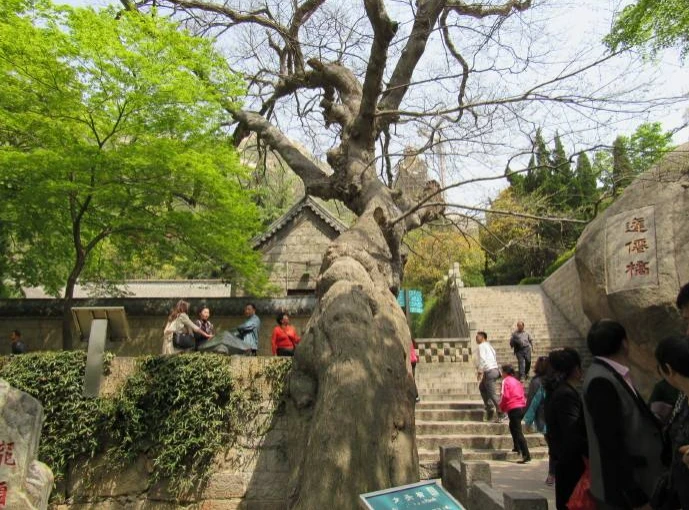
“Touch the old dragon’s head, and never worry for life; touch the old dragon’s tail, and finish everything you start; touch the old dragon’s back, and live to a hundred.” As you approach the Meeting Immortal Bridge in Taiqing Palace, guides always use this chant to introduce the ancient elm tree over 1,100 years old. Because of its unusual shape, which looks just like a dragon’s head, it is called the Dragon Head Elm.
It stands 18.8 meters tall with a trunk circumference of 4.1 meters. Legend says it was planted during the Tang Dynasty; records indicate it was personally planted by Li Zhexuan, a famous Laoshan Taoist priest of the Five Dynasties period. After arriving at Laoshan, Li Zhexuan added the Sanhuang Hall to the existing Sanguan Hall and Sanqing Hall. He further refined the architectural layout of Taiqing Palace, led the resident Taoists in rebuilding roads, planting trees and flowers, and tidying up springs, pools, and drainage channels, elevating the temple’s gardens to the highest standard among similar religious sites in China at the time.
Beside the Dragon Head Elm stands a large stone inscribed with “Meeting Immortal Bridge” and records of how Emperor Taizu of Song (Zhao Kuangyin) bestowed the title “Huagai Zhenren” upon a Laoshan Taoist priest. According to legend, one early morning after a heavy snowfall on New Year’s Eve, Liu Ruozhuo met an old man here. After exchanging a few words, he realized the old man was profoundly learned. When the old man left, Liu noticed there were no footprints in the half-foot-deep snow, so he knew he had met an immortal – and the immortal was none other than the Dragon Head Elm itself, transformed after attaining enlightenment.
To the left and right of the central courtyard gate of Sanguan Hall in Taiqing Palace grow two male ginkgo trees planted by Huagai Zhenren Liu Ruozhuo. Both are over 1,040 years old. According to the Records of Taiqing Palace on Laoshan, “They sprout earlier in spring and lose their leaves later in autumn – dozens of days different from other trees.” It is said that because Quanzhen Taoist priests are not allowed to marry or have children, they planted these two male, non-fruiting ginkgoes to stand guard before Sanguan Hall. The ginkgo is also called the white-fruit tree. It grows slowly and lives extremely long, earning it the name “living fossil.” Moreover, since ginkgo trees rarely attract pests – aligning with the monastic precept of not killing – they are often chosen as the tree to plant at Taoist temples and Buddhist monasteries. Folk tradition calls the ginkgo the “Grandfather-Grandson tree” because it grows so slowly: the tree planted by a grandfather only bears fruit when his grandson is of age. Hence the saying: “Peach three years, pear four, apricot five; don’t plant a white-fruit orchard unless you have a son.”
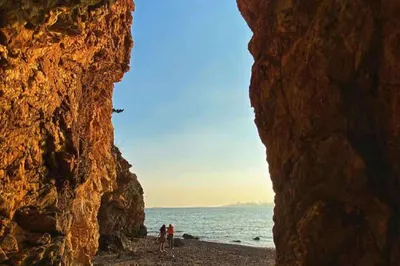
The Eight Immortals Terrace sits on Laoshan Cape, a headland jutting southeast from Mount Laoshan. The Records of Laoshan describe it: “The Eight Immortals Terrace comprises a stone slope covering several mu, slanting down into the sea to the east. The waters surge fiercely; the mountain seems to tremble. To its north, steep cliffs rise a thousand ren high, perilously close to the heavens, seeming about to topple over. Rock layers are mottled in five colors like rust – below them lies the Immortal Terrace.” “Scattered and flat-topped rocks serve as seats. Surging waves rush straight up and crash against the terrace, sending spray dozens of feet into the air – shimmering like jade trees, silver blossoms, colored glass, and sparkling pearls, a sight both thrilling and breathtaking – truly the most magnificent spectacle of mountain and sea.” Exactly because the waters here rage so violently, with towering waves and surging breakers, and because the stone terraces and cliffs are all metamorphic rock streaked with red, black, grey, blue and white layers, richly colorful and dazzling, this spot is also called the Sea Bridge Immortal Terrace. Ming Dynasty Grand Secretary Gao Hongtu declared: “The Eight Immortals Terrace is like a spread of brocade cushions and embroidered mats – truly the most wondrous, most beautiful of all.” With strong winds and high waves, after eons of pounding, the base on the southern side of the cape was gradually eroded and hollowed out until it collapsed, forming a sheer cliff face. The overhanging part at the top looks like a sweeping roof eave; the fallen section includes over ten giant boulders, some lying, some standing, of varied sizes, with flat tops where you can sit. This is how the Eight Immortals Terrace came to be.
The Eight Immortals are Han Zhongli, Zhang Guolao, Tieguai Li, Cao Guojiu, Lü Dongbin, Lan Caihe, Han Xiangzi, and He Xiangu. Many folk stories swirl around them, and the tale “The Eight Immortals Cross the Sea, Starting from Laoshan” is directly linked to this terrace. It is said that while cultivating on Mount Kunlun, they set out from Laoshan to collect herbs from the Eastern Sea, hoping to cure a plague and save the people. Sights here like the “Husband’s Hat” rock and “Boot Stone” as well as the Eight Immortals Terrace itself are all said to be traces left behind by the Immortals.
In addition to these tales, Laoshan is rich in many other magical stories. The fictional settings for “Xiangyu” and “The Taoist Priest of Laoshan” from Strange Tales from a Chinese Studio are both located on Laoshan. Visitors to Laoshan Taiqing Palace can savor these fantastical stories while enjoying the beautiful scenery.