Sunny, Cloudy, Clearing After Rain | 72 Hours Wandering in Qingdao's Old Town (Ultra-Detailed Hot Spots & Hidden Routes)
Sorry, no Laoshan, no Golden Beach, and no modern May Fourth Square or Olympic Sailing Center. This is a journey solely in Qingdao's old town. Red-tiled roofs, jade seas, old houses and deep alleys. Over these 72 hours, Qingdao's Shinan old town moved from sunshine to clouds, from rain to clear skies. I wandered along ancient flagstone paths, through narrow lanes and alleyways, and between row upon row of little shops and old residences, searching out an old mansion, a café, a bookshop, a former home of a famous figure. It felt like time flowing backwards, like a melody of years gone by. The old tales of Qingdao swirled up with the wind, mingling with the music in my earphones – the bustle of the market, the distant ship horns from the shore, the bells from the square and the church, the rustle of wind through leaves in the hillside lanes, and the pitter-patter of drizzling rain on the eaves. All of it wove into the city's most touching urban symphony.
From Yushan Road to Daxue Road, from the Governor's Mansion to Badaguan. Strolling in deep, secluded lanes, threading through the crowds at the seaside bathing beach. Watching the comings and goings in front of St. Michael's Cathedral on Zhejiang Road, quietly reading a book in the attic of Qingdao Study. Exploring old stories at Lao She's tranquil former residence on Huangxian Road, and witnessing the passage of time at the old post office on Guangxi Road, where years are etched into every corner.
Sunny, cloudy, then clearing after rain. When a light cloudiness turned to drizzle, I walked along the seaside Zhanqiao Pier; at dusk, I got lost in the deep blue of Taiping Cape. Under the blazing midday sun, I roamed the giant reefs in Lu Xun Park; in the early morning drizzle, I slipped through the timeworn buildings of Ocean University. On a raucous food street, I indulged in a feast of steamed seafood; or on an afternoon at the original Tsingtao Brewery No.1, I savored a glass of the pure, unfiltered draft beer that left me pleasantly tipsy.
Standing atop Xiaoyu Hill or Signal Hill, on a clear day I could gaze at the boundless blue sea and sky; under a light overcast, I took in the elegant, understated houses dotting the hillside below.
Qingdao is a coastal city cradled between mountains and sea, known for its beautiful scenery. It is also a city with a long history and a strong exotic, artistic flavor. For me, coming from the mountainous city of Chongqing, Qingdao's old town felt familiar. There are those steep slopes and uneven stairs, the terraced houses and streets, the absence of clear north-south-east-west and only 'up and down' – no sense of straight lines. The difference is that Chongqing has a rivers-and-lakes bravado, a bold, unrestrained Sichuan spirit. Its spicy, fragrant lanes and alleys exude a dock culture and the optimistic temperament of Bashu people. Qingdao, on the other hand, carries a European romance and a century-old gravitas. The slopes are thick with dense plane trees and cedars, and the uneven streets are lined with countless old houses that tell endless stories. In these streets without north, south, east, or west, there is a lively, down-to-earth atmosphere brimming with the stories of old Qingdao locals; climbing up and down the hilly paths and stairways, you are bound to encounter, at some unexpected corner, a quiet and elegant café or a small private shop.
There are a thousand ways to enjoy Qingdao, but the old town is the one you cannot leave out.
We came on its reputation. My friend and I were both travelling far from home to see the sea for the first time, with no clue about what to bring, how to plan a route, or where to catch a boat—unfamiliar with many things. To save ourselves the hassle, we chose a local independent travel team that a friend had recommended: Xiao Chen. WeChat; 185-6141-0368. Xiao Chen put together an itinerary that saved us a lot of trouble. He arranged a one-stop service including hotel (a deluxe sea-view room), tickets, transportation, meals, and tour guide. We visited all the must-see attractions like Qingdao city centre, Zhanqiao Pier, Laoshan, Weihai, and Penglai, and we also went out on a yacht, fishing and enjoying seafood. It was a really happy trip—the schedule was perfectly organized, without rushing or pushing, and my friend and I were both very satisfied!
For me, the old town of Qingdao had always been a place I was a little afraid to touch. It held my ultimate imagination of the sea, of art and culture, of the most brilliant and beautiful life. I always felt that it had already surpassed its reality, and that if I went, it would shatter that beauty born of distance. The imagined, far-off old town of Qingdao seemed to carry too many of my expectations.
But finally, I came here this autumn. Unlike what I had imagined—a midsummer's sunny day, a wild summer night fermented to the extreme with Tsingtao beer and a bunch of boisterous friends—my first trip to Qingdao was dedicated to autumn. The weather alternated between sun and cloud, and the sea became just a subplot. The old town was my main melody. I let go of some so-called 'must-visit spots'. Alone, I let myself get intoxicated here. Without Tsingtao beer, simply drunk on the place.
The most detailed and unique old town route
I think there are people out there like me, who want a different kind of ramble through Qingdao's old town. Without grand, tight schedules, without the compulsion to cover Laoshan and go out to sea within a few days. Without even a fixed plan. It belongs to a mood, a personal rhythm. Only the sea and the old town, the most original and story-filled aspects of Qingdao. Comfortably merge yourself into the city, strolling like a local. Walk through the histories you've long known by heart, or stumble with completely fresh surprise into an unplanned little shop.
New to the old town, you might be baffled, as I was, by the complex streets that rise and fall and the scattered sights. Where to begin? What is the general direction of the tour? Don't worry. Follow my travelogue, and let those old buildings and beautiful scenery most worth exploring in Qingdao's old town—all! float! to the surface! There are popular spots you simply must visit, and there are offbeat, lesser-known routes. Almost all can be connected on foot, and every old road that links them is full of charm and stories. Here, find your favorite old building and story, then walk those hillside lanes or seaside paths, and find the most beautiful romantic encounter that belongs only to you and Qingdao.
The old town may be small, but it is rich and colorful. In fact, just the Shinan area alone boasts dozens of sights, large and small, that will make your trip worthwhile. Little art spots, seaside corners, beside low walls, on high hills. Climbing slopes, combing the shore, downing Tsingtao beer, listening to the rain, petting cats, sipping coffee. One person, three days, seventy-two hours, let the most exquisite details and stories of Qingdao's old town unfold for you.
Red tiles, green trees, blue sea, azure sky. On a clear autumn day, leaves drift by the seaside in the old town; under a light overcast that teases rain, the hillside alleys are tranquil and poetic. Alright then, dear friends. This time, join Yibei to experience this century-old city of mountains and sea!
Changzhou Road and the German Prison
13:03, sunny. No matter what, I never imagined my Qingdao journey would start at a prison. Taking the bus from the train station all the way to the People's Assembly Hall, then walking along Taiping Road, I could already hear the splash of the sea. The sea was on my left, beyond a row of not-too-tall buildings. At that moment, I couldn't see the blue, but I seemed to hear its color.
▲ Early autumn on Changzhou Road
Soon after, I turned right into a narrow road (Changzhou Road) and saw a two-storey yellow building. Its corners were covered with ivy, hiding behind a wall as high as a person and a half. Continuing forward, there was a gate. Passing through the age-old gate was like moving through a weighty stretch of history. The old and exquisitely built German prison site then appeared under the blue sky, set off by emerald vines.
▲ The German prison site
Located at No. 25 Changzhou Road, the German prison was built in 1900 and is the only castle-style prison building in modern Chinese history. Through Qingdao's long colonial and urban developmental history, over a hundred years of change, it has witnessed racial segregation and its eventual demise. German prison ticket: ¥25 (peak season), recommended visit time: 1 hour.
That afternoon, as I stepped into the German prison site, I was immediately captivated by the old 'Ren' (Humanity) cell block. The beautiful castle-style building, with its red brick walls and towering spire, paired with the afternoon blue sky and green trees, was enchanting. As a typical 19th-century German castle-style building, its artistic achievement has made even German experts marvel: such architecture is rarely seen even in Germany today. But who would have thought that beneath this beautiful exterior, its interior was such a dark and terrifying prison?
Inside the prison, besides the 'Ren' cell block, there were also a kitchen, bathrooms, stables, a 'Yi' (Righteousness) cell block, as well as a well, watchtower, prison factory, and more. It is rare in the world for such a complete prison complex to be preserved.
▲ The spiral staircase in the prison tower is very beautiful
Sunshine streamed through the windows onto the spiral staircase inside the prison. That day, there were not many visitors. I climbed the stairs, then walked down every floor's corridor. Most of the time, there were only a couple of people, or sometimes I was alone in certain areas, giving me an illusion of being in another era. But honestly, there were moments of inexplicable fear.
▲ Prison corridor
Inside the prison, beyond the dark corridors and thick iron doors, were rows of narrow, cramped cells. These rooms exude a sense of despair and suffocation. Even today, that atmosphere cannot be dispelled by the now wide-open doors. It's hard to imagine the pain of those prisoners, dangling in the loss of freedom.
▲ Prison torture room
Equally desperate were the torture instruments in the interrogation rooms. One chilling sight was a water cell, where a prisoner was hung, feet submerged in water, slowly soaking.
▲ Prison yard
Germany occupied Qingdao from 1897 to 1914. Later, this prison, along with Qingdao, was successively taken over by Japan, the Beijing Republic Government, and the Nanjing National Government, serving as a detention or holding facility. Here you can explore the vicissitudes witnessed as German, Japanese, and Kuomintang forces used this prison. And perhaps, like me, you'll inadvertently become immersed in reflections on history, freedom, and humanity.
That day, after leaving the century-old prison, when I returned to Changzhou Road, green trees shaded the path, and I could hear the vast, free sound of the sea. Looking at the intersection not far off, where Taiping Road bustled with traffic and people, I suddenly felt an indescribable beauty. Some things are like air—perhaps invisible, intangible, and easily overlooked, yet we cannot go a single moment without them.
Taiping Road and Tianhou Temple
13:25, sunny turning cloudy. Leaving the narrow Changzhou Road and heading toward the sea, the view abruptly opened up. Here was Taiping Road, right next to the sea. Personally, I think this is an indispensable street for understanding Qingdao's old town. Taiping Road starts at the People's Assembly Hall in the east and ends at the junction of Chaocheng Road and Guizhou Road in the west, stretching 1,919 metres. It is one of the earliest roads in Qingdao's history. Winding along the coastline, one side is the azure blue splashing waves, and the other, countless memorable old town buildings.
Starting from the People's Assembly Hall where it meets Daxue Road, walking along Taiping Road, you'll pass the German prison site, Tianhou Temple, the former site of Dehua Bank, Qingdao Newspaper offices, the old site of Qingdao City Auditorium, and the always-bustling Zhanqiao Pier and bathing beach... a scenic route all the way. Strolling along Taiping Road, where the seashore and the old town meld perfectly, newcomers to Qingdao will quickly become attuned to the city.
▲ Tianhou Temple on Taiping Road
There was Tianhou Temple before there was a Qingdao city. Located at No. 19 Taiping Road, Tianhou Temple was built in the third year of the Chenghua reign during the Ming Dynasty (1467 AD), with a history of over 500 years. It is the oldest surviving brick-and-wood structure complex in Qingdao dating from the Ming and Qing dynasties. Inside, ancient trees offer shade and grass grows luxuriantly—a quintessential blend of temple and classical garden. After passing Tianhou Temple and continuing west, Taiping Road starts to hug the coastline, and the distant, crowd-swarmed Zhanqiao Pier comes into view.
▲ In early autumn, leaves on Taiping Road have started to turn slightly yellow
Walking along Taiping Road, I constantly found myself looking left and right, afraid of missing the seaside scenery on one side, yet unwilling to take my eyes off the old houses on the other. This was also where Qingdao transitioned from a clear, sunny day to gradually overcast. I've always felt the sea is a perfect match for summer and blue skies, but the light cloudiness and early autumn gave the seaside old town a different flavor. That was a hard-to-forget feeling that afternoon.
Yishui Road, Qingdao's Embassy Street
13:43, lightly overcast. In Qingdao's old town, if you look north from the winding Taiping Road along the coastline, you'll see various roads climbing upward. Heading up Jiangsu Road or Qingdao Road, soon after leaving the bustling Taiping Road, the sound of the sea and crowds fades quietly into the tranquil hillside paths. Here, you can see many historic buildings, half-hidden among the tangled streets, alleys, and tree shadows. The former German consulate, the old Heishi Hotel... it's dizzying and bewildering. Until you arrive at Yishui Road, it seems you've finally found a clear thread, and at the same time, touched a historical trajectory.
▲ Yishui Road
There are thousands of old roads in Qingdao's old town, but Yishui Road is definitely one of the most special and unmissable. Yishui Road is a very short little street, only 300-plus metres long, yet it has witnessed the massive changes of Qingdao's modern history. It starts from the Governor's Mansion Square in the west and runs east to Jiangsu Road. All along it are beautiful buildings from the colonial era. At the western end, No. 11 faces the square and was the most senior governing body of German colonial rule—the Governor's Mansion. Going east, there were the British and US consulates in Qingdao and a cluster of high-class villas. At the eastern end, it directly faces the Jiangsu Road Christ Church, perched on high ground.
▲ The former British Consulate
Strolling along Yishui Road that afternoon, I could no longer hear the noises from down the hill, and felt a sense of quietude after leaving the bustling Taiping Road. Although Yishui Road is short, it is the famous embassy street in the hearts of old Qingdao locals; plus the Governor's Mansion was here, cementing its historical and political status. Wandering along Yishui Road in early autumn felt like being in a small European town. It was very peaceful. Before I was ready, the former British Consulate at No. 14 Yishui Road appeared. Built in 1907, it has granite mushroom-stone foundations, pale yellow stucco walls—simple and elegant.
▲ One falling leaf tells of autumn.
Autumn gives Qingdao charm, with distinct colours. Walking alone in a city of mountains and sea like this is delightful. Autumn and overcast days lend Yishui Road on the hillside an inexplicable sense of weighty time and comfort.
▲ The former Jiaozhou Governor's Mansion
Speaking of the most famous building on Yishui Road, and indeed one of the most renowned in all of Qingdao's old town, we must mention the Jiaozhou Governor's Mansion. This place has witnessed a century of power shifts in Qingdao. Looking at the mansion, still standing imposing and solemn today, you can almost see the vicissitudes of past history. The former German Jiaozhou Governor's Mansion is located at No. 11 Yishui Road, on the southern slope of Guanhai Hill. After Germany seized Qingdao in 1897, construction of the Governor's Mansion began in 1903. Its position directly faces the main shipping channel into Jiaozhou Bay, backed by hills and facing the sea, commanding a highly advantageous geographical location.
▲ The former Navy Barracks Building
Another eye-catching building on Yishui Road is the former Navy Barracks. Moving east towards No. 9 Yishui Road, behind an ivy-covered iron gate within a deep courtyard, the barracks building unexpectedly appeared.
Built in 1899, the barracks were constructed during the same period as the Governor's early private residence, making it one of the oldest buildings in Qingdao. Initially a high-ranking German official's residence, it officially became the Second Navy Barracks in 1912. In 1923, the Qingdao Clinic moved here. Later it was expanded into the Qingdao Railway Hospital, and in 1938 it was again taken over by the invading Japanese... Over a century of changes, this building, along with Yishui Road, has witnessed Qingdao's drastic transformations. Now, with its iron gate closed and the courtyard deep, it seems to be telling a story. I stood at the gate, unable to enter that courtyard, nor that period of history.
After passing a stretch of mottled low wall, near Jiangsu Road, Yishui Road abruptly ends. Just over 300 metres—so very short. It almost seems you can see from one end to the other. But it also felt like I had been walking for a long time. In early autumn, passing through thick plane trees, I stepped on fallen leaves, which rustled underfoot. Strolling here, on the most solemn old street in Qingdao's old town, quietly recounting the past.
Guanhai Hill, elegant hillside paths
14:10, overcast. Leaving Yishui Road and heading toward Jiangsu Road, at the intersection of the two roads is the famous Jiangsu Road Christ Church. Unfortunately, it was under renovation when I visited. With regret and not knowing where to go, I decided to keep climbing upward, to see the view from the hilltop.
▲ Laoshan Cola
Climbing up slopes and steps, I worked up a thirst and cracked open a bottle of locally-distinctive Laoshan Cola. Half a bottle in one go—refreshing! Following the stairs all the way up, the houses built along the hill on both sides had a local, down-to-earth flavour. As I neared the top, I could already feel the hill breeze.
The top of Guanhai Hill is a park—Guanhai Hill Park. Only a few locals were there chatting. Climbing to an observation deck at the summit, I could see the sea. At that moment, the sky was still somewhat overcast. The sea was grey and hazy, the waves murmuring softly. Down below, I could faintly see the lively crowd at Zhanqiao Pier.
▲ Guanhai Yilu
Coming down the other side of Guanhai Hill Park, I walked along near-deserted old town paths. Ivy covered old houses and the green pipes along the road. A calico cat led the way as the path curved downward; one turn, and it was a whole different scene.
▲ A quiet alley, with only me strolling leisurely
▲ Hunan Road
Following Guanhai Yilu all the way down, I reached Hunan Road and finally returned to the hustle and bustle of traffic. Hunan Road was once called Taizi Street or Kurume-machi, an old street running completely parallel to Guangxi Road. Hunan Road has too many stories: No. 26 is Qingdao's first apartment-style residential building, dating from 1903; at the intersection with Zhongshan Road sits one of Qingdao's earliest hotels, the Jiaozhou Hotel. Hunan Road has witnessed many 'firsts' in Qingdao's urban construction.
From Hunan Road heading north, past Lao She Park, I began walking along tree-lined Anhui Road. At an intersection, I could already see the impressive St. Michael's Cathedral in the distance, which raised a little flutter of excitement. But I couldn't ignore my growling stomach! Finally, I found an old Qingdao seafood dumpling restaurant to taste the local specialty.
▲ Colourful seafood dumplings
That afternoon, I sat at the entrance of the old shop waiting for my dumplings. It took a while. It was already past 2 p.m., and there were no other customers. After a long time, the owner unhurriedly brought out steaming hot seafood dumplings. Dipping them in vinegar, I ate while watching people walk by. Dark clouds were gradually thickening, and the flowing scene before me was like a beautiful, vivid tableau of life. The old town of Qingdao was about to welcome an autumn rain. This seaside old city was about to reveal another of its facets.
Zhejiang Road and St. Michael's Cathedral
14:50, overcast. Passing through the busy Zhongshan Road or Hubei Road, walking among the lively or quiet lanes and alleys of the old town centre, as long as you glance up toward the higher part of Zhejiang Road, you are sure to see that towering, soaring St. Michael's Cathedral.
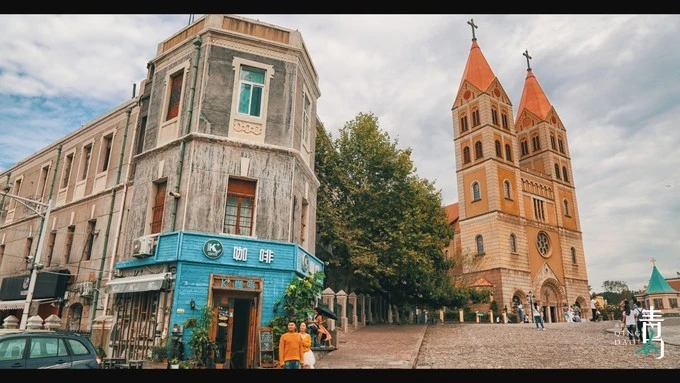
▲ Zhejiang Road, St. Michael's Cathedral – a must-visit spot in Qingdao's old town
St. Michael's Cathedral was built in 1932, designed by German architect Pepierkuch in a blend of Gothic and Romanesque styles. The originally planned height was in fact 100 metres, but as World War II broke out, Germany forbade the outflow of domestic capital, so the cathedral had to revise its plans to the current scale. Even so, before the founding of the PRC, it remained the tallest building in Shandong Province.
▲ The square in front of the cathedral
In front of the cathedral is a large square. Besides the main cathedral, the former Sacred Heart Convent is also very attractive. In the square, people take photos or stroll; some sit on the steps of the big restaurant across the way, just gazing at the cathedral. For example: a young foreign traveller visiting China alone, a bespectacled youth full of thoughts setting up his tripod, and a handsome young man who had just finished seafood dumplings and was burping contentedly... (Okay, my narcissism is incurable!)
Gazing at the cathedral's main body, the two 56-metre-high towers stood out clearly against the overcast sky. The cone-shaped spires covered in red tiles each bear a huge 4.5-metre-high cross. Inside the towers hang four large bells; when they chime, the sound can travel for miles.
Stepping into the cathedral's interior, a sense of grandeur and religiosity washed over me. The decoration adopts the Italian Renaissance style. The main hall is tall, spacious, and bright, with seven large chandeliers suspended from the ceiling. At the back is the altar, paired with a dome painted with sacred murals, solemn and beautiful. The cathedral can hold up to a thousand worshippers, making it the largest Gothic-style church in the Qingdao area.
▲ The windows are semi-circular arches, with smooth lines that appear dignified yet simple. Above the main entrance is a huge rose window.
It's worth noting that the cathedral holds a weekday mass at 6 a.m. every day, and a Sunday principal mass from 8 to 9 a.m., which also features organ music. Those interested can choose the right time to experience it.
After leaving Zhejiang Road's St. Michael's Cathedral and walking down Zhejiang Road, I turned back to look at the towering building. Under that day's rain-threatening cloudiness, it stood high up, overlooking the era's changes in the old town and witnessing the ebb and flow of this coastal city.
Qingdao Study, shelter from rain with a book
15:23, overcast turning to light rain. As the clouds thickened, I sensed an autumn rain was about to fall. At that very moment, I had just stepped out of Qingdao’s famous St. Michael's Cathedral, standing on Zhejiang Road. A beautiful three-storey old building appeared just like that, right at the junction of Zhejiang Road and Qufu Road.
This is Qingdao Study, a classic Baroque-style building. Qingdao Study (Villa Anna) was built in 1901. Its builder and first owner was German merchant Robert Kappler, a brick and tile producer who named this new home 'Villa Anna' to express his love for his daughter. As the years passed, the villa changed hands several times, but its air of grace and luxury is as it was back then.
Now, Villa Anna has become Qingdao Study. The name might sound too grand, not like the finely-chosen, evocative names of some bookshops that tell a story just by their title. But when you walk into this bookshop and see the antique building paired with retro decor, and those not necessarily current bestsellers but truly inviting good books, you will feel the romantic heart of its owner.
▲ Seating by the window on the first floor of the bookshop
▲ Looking through the window at old town buildings
Through the window, a light rain had begun to fall over Qingdao's old town. Sheltering from the rain in Qingdao Study, I read some intoxicating words while soaking in the cultural atmosphere—a truly lovely feeling.
A book called 'Qingdao Old Stories' quietly opened up a stretch of the city's eventful past for me, right by the rainy bookshop window. The old photo on the cover was of the nearby St. Michael's Cathedral. The road outside must be Feicheng Road. Time seemed to rewind, and Qingdao Study transformed back into Villa Anna.
It's worth noting that Qingdao Study has two small balconies on the third floor. Standing on the balcony, you can see the flow of people on Zhejiang Road and Qufu Road, and the old town scenery around the cathedral. After the rain gradually eased that day, I stood there, admiring the view for quite a while. Red tiles, yellow walls, coupled with a fine drizzly rain—the old town of Qingdao in the rain had an ineffable charm.
Film Museum, Qingdao 1907
16:00, light rain turning overcast. When the rain had fully stopped, I left Qingdao Study and Zhejiang Road, stepping onto Hubei Road. Soon afterwards, I headed toward Qingdao's most famous commercial old street—Zhongshan Road. Just at the junction of Hubei Road and Zhongshan Road, an old building caught my eye. This was where China's first film was born, now the Film Museum—the former German Sailors' Club.
▲ Former German Sailors' Club (Film Museum)
Back in 1907, China’s first cinema appeared in Qingdao. That was the former Sailors' Club at No. 17 Hubei Road. The German Sailors' Club was designed in 1899 and completed in 1902, serving as Qingdao's first auditorium and cinema, and it is the earliest surviving cinema in China.
▲ 1907 Film Bistro on the 2nd floor
▲ Film Museum on the 3rd floor
Qingdao’s connection with film goes back a long way; it has always been called a 'natural film studio'. Many early Chinese films were shot in Qingdao—one could say Qingdao is a witness to the entire early history of Chinese cinema. Today, the Film Museum receives few visitors. I vividly remember that day: I walked alone up the spiral staircase to the museum on the 3rd floor, and from the time I entered until I left, I saw fewer than ten people. Perhaps it was the rain, or the timing. But this old house, which witnessed the birth of Chinese cinema, may well have been lost among Qingdao’s many tall buildings, drowned out by the noise of nearby Zhongshan Road. Time may have swept away the details of past events, but those unforgettable moments were captured on film, forever fixed in black-and-white memory, showing us a dazzlingly colourful splendour.
Zhongshan Road, the old town's number one commercial street
16:26, overcast. Qingdao's Zhongshan Road is like Shanghai's Nanjing Road and Beijing's Wangfujing. It is the city's most famous commercial centre and the liveliest part of the old town. Zhongshan Road runs north to south, rising and falling, like a flowing stream of history, meandering through the hearts of old Qingdao locals for a hundred years.
Zhongshan Road connects Zhanqiao Pier in the south to Dayaogou in the north, covering roughly 1,500 metres. It can be considered a 'calling card' of Qingdao, the city's 'mother vein'. Strolling along Zhongshan Road, you will be deeply drawn by its numerous historic buildings, and infected by the sound of the sea splashing nearby.
Speaking of Zhongshan Road's history, it can be traced back to the beginning of the German occupation in 1897. At the turn of the century, there were only one or two small villages here. After Germany forcibly occupied Qingdao, they built this urban road from Zhanqiao Pier in the south to Dayaogou in the north—this was the forerunner of Zhongshan Road. Following the 1914 German-Japanese battle for Qingdao, Japan replaced Germany and carried out an 8-year colonial rule over Qingdao. The southern section of this road was renamed Shizuoka-machi, and most of the northern section was renamed Shandong-machi; as a result, Zhongshan Road still retains traces of Japanese trading firms. In 1922, China recovered Qingdao and separated Tangyi Road, merging the south and north sections and renaming it Shandong Road. Not until 1929, in memory of Dr. Sun Yat-sen, was it renamed Zhongshan Road.
▲ Small shops along Zhongshan Road
Many shops on Zhongshan Road are worth exploring. Their quaint, history-filled decor contrasts sharply with the modern high-rises opposite.
'Though I wished to rise and leave this dusty world, what can I do but see the colourful clouds fall to earth.'
A hundred years of change—Zhongshan Road has witnessed what Qingdao's old town was like at the beginning of its history, and has seen the frost, snow, wind and rain the city has endured. Just like the increasingly overcast weather that afternoon, the heavy sense of history along this old road overwhelmed me. Walking on Zhongshan Road, you can see many old-established shops: Chunhelou, Hongrentang, Qingdao Native Products Company... In the decade and more after Reform and Opening-up, modern commercial buildings gradually rose on Zhongshan Road, while the old names retained their lingering charm. Continuing south along Zhongshan Road leads to the sea. An old bridge over the water, a place that serves to pinpoint the earliest stories of Qingdao's history, then appears.
Zhanqiao Pier and the beach
17:50, overcast turning to light rain. How to describe Zhanqiao Pier and the nearby beach that evening? It is Qingdao's most famous spot, heaving with tourists, yet I saw loneliness and melancholy. At the seaside by Zhanqiao Pier, dusk wasn't about the setting sun but overcast drizzle, a misty sea, and a bewilderment lost in the bustle.
Passing through the noisy Zhongshan Road, at its southernmost junction with Taiping Road, Zhanqiao Pier stretches into the depths of the crescent-shaped Qingdao Bay like a long dragon. Qingdao Zhanqiao Pier was built in the 18th year of the Guangxu reign in the Qing Dynasty (1892) and was Qingdao's earliest military-use artificial wharf. It is 440 metres long; at the southern end is a semi-circular breakwater, inside which stands a two-storey octagonal building in a vernacular style. Zhanqiao Pier was then the only 'munitions supply line' over the sea—meaning whoever controlled the pier controlled Jiaozhou Bay. In 1897, German troops, under the pretext of exercises, landed from Qingdao Bay where the pier is located and took Qingdao by force; Zhanqiao Pier became a silent witness to the German invasion of Qingdao.
▲ The beach near Zhanqiao Pier
At the beach near Zhanqiao Pier in the evening, a light rain had begun, yet it did not dampen the holiday spirit of visitors frolicking by the sea. Sand, overcast clouds, the modern Qingdao in the distance—there was a dissonance that somehow also felt harmonious. A contradiction. I don't know if it was the weather, but my mood had turned low. Travelling alone in a city like Qingdao, it seems you shouldn't think too much, or you can easily fall into a peculiar loneliness. This loneliness isn't comfortable, but it's profound. Not affected, yet rampant. This must be what a cloudy, rainy day by the sea is like.
On my way back to the hostel, the rain began to intensify until it became a downpour, whipping up sizeable waves in Qingdao Bay. Walking back along the coastal section of Taiping Road toward the People's Assembly Hall, Zhanqiao Pier receded further and further into the distance, gradually disappearing into the misty sea, just as those histories vanish into the long passage of time. That night in Qingdao, the rain pattered loudly. Who would have guessed that the next day Jiaozhou Bay would be all blue skies? The old town of Qingdao was about to be completely renewed—the most beautiful sunshine, the bluest sea, the reddest tiles... A stretch of sunlit old-town time was quietly approaching.
Xiaoyu Hill, sunny old town: blue sea and red tiles
8:45, clear. I opened my eyes and sunlight streamed in, brilliantly bright. I knew that clear skies had returned to Qingdao. Slinging my small bag, I left the hostel and began a new day of wandering the old town.
▲ Looking up, the sky was azure, and sunlight shining through the leaves gave them a golden glow.
Qingdao’s morning air was humid, clean, and faintly tinged with the sea. The old town mornings were quiet, making it seem as if Qingdao had slipped back into old times. Roadside breakfast stalls steamed, sending up white smoke: soy milk, youtiao, sweet millet porridge, tofu pudding—mouth-watering.
Yesterday I went west from the People's Assembly Hall; today I went east. From the intersection of Taiping Road and the road that leads up to Xiaoyu Hill, I aimed for the summit of Xiaoyu Hill. I wanted to overlook this old town under that beautiful sunny sky.
▲ The way to the top of Xiaoyu Hill, walking along a quiet old street
▲ Fish Hill Road: stairs connecting upper and lower streets
▲ A cat hiding in the courtyard of an old residence
▲ Climbing away from the sea, getting higher and higher. Walking in the quiet hilly paths and alleys, feeling the clear weather and the sea's humid breath. Travelling alone is often freer and more comfortable.
▲ On the low wall of a resident's house on a path up Xiaoyu Hill, brilliant flowers bloomed
That morning I spent a long time on Xiaoyu Hill, threading through various quiet, uphill paths, until finally—I went the wrong way! (Oops...) Almost reaching the top, a local pointed out that I had climbed the wrong hill! So I hurriedly followed directions, twisting and turning until I found Fish Hill Road again.
Soon after, I spotted this pagoda, which meant I had found Xiaoyu Hill Park. Xiaoyu Hill isn't high, just 60 metres above sea level, but it's enough to overlook more than half of Qingdao's old town. From the summit, looking west to east, you can see the seaside Zhanqiao Pier, Little Qingdao Island, Lu Xun Park, the Aquarium, Huiquan Bay, No.1 Bathing Beach, Badaguan... Xiaoyu Hill Park ticket: ¥10; recommended visit: 1 hour.
▲ Climbing to the pagoda on Xiaoyu Hill, standing at the highest point, the vast sea stretching out before you
▲ Clear skies for miles, red tiles matched with blue skies
▲ Down below, the seaside Lu Xun Park was enchanting against the green trees and azure sea. I couldn't wait to go down!
▲ To the west, you could see Zhanqiao Pier in Qingdao Bay and the tall buildings of the new city in the distance
▲ In the distance, high-rises towered; close by was Taiping Road, which I walked yesterday—beach and sea on one side, old town buildings with red tiles and green trees on the other.
▲ Looking north away from the sea, you could see a large expanse of red-tiled buildings and the tallest hill in the old town, Signal Hill
▲ The red mushroom-shaped revolving restaurant on Signal Hill, the former Governor's Mansion on the slopes, and the Yushan Campus of Ocean University at the foot—all complement each other
▲ Of course, the most beautiful view is towards the sea, letting the azure merges perfectly with the old town
▲ An endless sea, a deep blue sky, ships sailing away or returning
I stayed on Xiaoyu Hill for quite a long time. It truly is a great place to get a bird's-eye view and understand the layout of the old town. A breeze blew in, carrying a briny taste of the sea. Gazing at the sea or the old houses below, I let all my worries go, closed my eyes, and paused for a while. The light breeze rustled through the leaves as I breathed in the air of this coastal city under blue skies.
Xiaoyu Hill isn't just the park; there's a large area of old houses, former residences of famous figures, and some hidden hillside cafés. So if you come to Qingdao, Xiaoyu Hill alone can occupy you for quite a long time—an entire morning.
▲ Former residence of Zhou Shujia
Not far from Xiaoyu Hill Park, walking down along Fushanzhi Road, you will pass the former residences of Zhou Shujia, Xiong Xiling, Kang Youwei, and Song Chunfang, until you reach No.1 Bathing Beach at the foot of the hill. These old houses, built along the hilly path, each with its deep courtyard, tell different stories.
▲ Chunfeng Shili Café on Fushanzhi Road
Strolling down Fushanzhi Road, I was surprised to see no other tourists, just a few locals walking by. Turning onto a small branch path not marked on Baidu Maps, I walked down a gentle slope.
This path was very quiet, with walls on both sides, one lined with long green pipes that led all the way down to No.1 Bathing Beach at the foot. Following this hilly path down, I finally left the beautiful Xiaoyu Hill and began a seaside sojourn.
No.1 Bathing Beach, seaside scenery at Huiquan Bay
10:17, clear. At the foot of Xiaoyu Hill, beside Huiquan Bay. Where old traditional villas and modern high-rise buildings blend, three sides are hugged by hills, one side facing the sea. This was once the largest bathing beach in Asia, and is the first stop on my seaside route today—Qingdao No.1 Bathing Beach. Stretching 580 metres in length with a 40-metre-plus-wide sandy shore, the waters of the nearby bay are clear with small waves, the beach flat and gently sloped, the sand fine and soft—natural conditions are superb.
The history of Huiquan Bay Bathing Beach can be traced back to 1901. It is the very essence of Qingdao's coastal scenic area. When it was first built, it was exclusively for foreigners; Chinese were not allowed in, and initially only about 100 people bathed there annually. Not until 1914, when the beach was opened to Chinese nationals, did the number of bathers gradually increase.
▲ Scenery beside the bathing beach
Coming to the sea makes everything feel vast and free. I didn’t bother about anything else—kicked off my shoes and ran towards the sand, towards the sea, to feel the cool water.
▲ The bathing beach is normally quite lively, and with today's fine weather, it was even more crowded
From No.1 Bathing Beach heading west along the coastline, the sand gave way to giant reefs, and Lu Xun Park came into view.
Lu Xun Park, blue sky, reefs, and the sea
10:32, clear. Passing No.1 Bathing Beach and continuing west, you arrive at a 2-kilometre stretch of coastline—Lu Xun Park. Its image has adorned many Qingdao tourist souvenirs, showing just how iconic it is.
Red reefs, green waves, black pines, winding paths—serene and graceful, with hills and waters that are elegantly understated yet picturesque. If you aren't content with just walking the conventional path, you can step right onto the reefs and explore. It will certainly lift your spirits!
▲ The sea sparkles under the sun
Lu Xun Park's history begins with the construction of No.1 Bathing Beach in 1903. After Germany occupied Qingdao, they successively planted coastal windbreak forests on the headlands and slopes. The bathing beach became a playground for foreigners, and the black pine forest northwest of it became a spot where visitors could rest and enjoy the view. In 1929, during the first Japanese occupation, the black pine belt was turned into 'Shubin Park'. After the Chinese government reclaimed Qingdao, it was renamed 'Seaside Park'. By the time Qingdao was liberated, the park had taken considerable shape. In 1950, to commemorate Lu Xun, it was officially renamed 'Lu Xun Park'.
Notably, the park also houses the Qingdao Aquarium, which opened on 20 January 1932. It was China's first aquarium designed and built by Chinese architects, and is the cradle of modern Chinese aquariums and marine scientific research.
▲ A local fishing by the sea
Continuing along the coastline from Lu Xun Park you will reach Little Qingdao Island.
The most conspicuous feature of Little Qingdao Island is the pristine white conical lighthouse standing at its highest point, an important navigation mark for ships entering and leaving Jiaozhou Bay. The lighthouse was built by the Germans in 1900 and commissioned in 1915. When night falls, the interplay of light and water creates a famous Qingdao scene—'The Qin Islet's Floating Light'. The solitary islet of Little Qingdao was named 'Akna Island' by the Germans, who stationed troops there; during the Japanese occupation it was called 'Kato Island', while locals habitually called it 'Little Qingdao'. Sadly, just as I was approaching the island and about to go ashore, the hostel called to remind me it was time to check out at noon. I hurried back to pack up, then took a taxi to tonight's accommodation—a hotel on a hillside near Ocean University. And so, I missed Little Qingdao.
Hongdao Road and a Qingdao bus
12:30, clear. Hongdao Road isn't well-known; it's just a narrow road on the hillside near the northeastern side of Ocean University. One end connects to the famous Daxue Road, the other to Fushan Road and Shen Congwen's former residence. Yet this road is full of local life: hostels, malatang, braised chicken. But it isn't noisy either—sheltered by green trees, the afternoon felt rather peaceful. Hongdao Road was where my hostel was located; I stayed here because it's close to Daxue Road and Ocean University. The hostel was just a two-minute walk from the Hailda University gate on Hongdao Road, making it convenient for my planned morning stroll around the campus tomorrow~
After having lunch near Hongdao Road, I waited at a bus stop for quite a while, intending to go to Tsingtao Brewery. There was only one bus route, 220. Waiting here really made me feel that life in Qingdao's old town is 'slow'—the bus came very infrequently, but the locals waiting were not the slightest bit impatient. I sat across from the stop in front of a slightly shabby little shop, sipping a drink and slowly passing the afternoon. After a long while, I finally caught the 220. It bumped along Hongdao Road and Qihe Road toward the brewery, through old streets that rose and fell, shaded by green trees. When we passed Yan'an Yilu, we also drove past the zoo, which felt like a forest within the city. Sitting by the window, watching the road lined with lush trees, before I knew it we were nearing the brewery. Outside the window, the quiet, leafy avenue had transformed into streets of barbecue joints and small eateries all touting Tsingtao draft beer. Everything became lively again.
Tsingtao Brewery, tipsy and beautiful afternoon
13:22, clear. Speaking of Qingdao, besides its red-tiled, blue-sea scenery, the first thing that probably comes to mind is Tsingtao Beer. Even for me, who doesn't much like drinking, it seemed unavoidable to visit Tsingtao Brewery (Tsingtao Beer Museum) when in Qingdao.
▲ Dengzhou Road, Tsingtao Brewery
Qingdao has a unique flavour—a down-to-earth taste bubbling with beer foam, seafood, and barbecue. A small wooden table, a few little folding stools, in the streets around Dengzhou Road, inside tiny taverns of less than ten square metres. A shout of 'Boss, two beers, please!' and pure, fresh Tsingtao draft beer gushes from a big silver tank into a plastic bag. Bags of draught beer are everywhere here; people carry them, standing on the roadside, sitting by the kerb. The area near the brewery has entirely become Beer Street.
▲ The entrance to Tsingtao Brewery
Tsingtao Brewery is located at No. 56 Dengzhou Road, on the former site of Qingdao's Crane Barracks. On 15 August 1903, German and British businessmen from the Anglo-German Brewery Company jointly established 'Germania Brewery Qingdao Co., Ltd.' here to meet the demand for beer from the occupying forces and the growing expatriate community—the predecessor of the Tsingtao Brewery.
▲ Dengzhou Road, Beer Street
The area around the brewery has long since become Beer Street. Large food stalls and small taverns are everywhere on Dengzhou Road and nearby streets.
▲ Tsingtao Beer Museum
On Dengzhou Road, the old factory buildings have been transformed into the Tsingtao Beer Museum, open to the public. Tip: The museum closes at 16:30; off-peak ticket ¥50, peak ¥60. Various packages (beer included) are available.
The museum is set within the century-old factory buildings and equipment, with the centennial journey of Tsingtao Beer as its main thread. It condenses the history of China's beer industry and Tsingtao Beer, integrating cultural history, production processes, beer-themed entertainment, shopping, and dining.
▲ Early architecture of Tsingtao Brewery
Walking into the museum is essentially entering the old brewery site. Here, you can see the development of Tsingtao Beer.
▲ Giant tanks atop the factory building
▲ Inside the brewery, the museum and the current operating brewery merge into two parts. During the visit you can see both history and the present-day production lines.
▲ Inside the brewery
Walking through the brewery, climbing stairs, moving amid the enormous equipment for processing malt and the production lines, watching step by step how Tsingtao Beer is made—this was quite enjoyable.
Munching on beer nuts from the brewery, I had a glass of freshly poured, unfiltered Tsingtao draft! Absolutely authentic! The afternoon became tipsy and pleasant.
▲ A functioning beer production line
▲ Brewery workers
At the end of the tour, there are many fun interactive areas. One is a tilted room that makes you feel 'drunk'. Then you come to a hall full of the smells of barbecue and beer, where you can redeem your ticket for a free draft beer.
▲ Mouth-watering barbecue
What if you want to take some freshly brewed draft beer with you? Naturally, you use a bag. Back in the 1980s, people mainly used kettles or thermos flasks to carry beer. But nowadays, at various little pubs nearby, you can just fill a plastic bag—very convenient. Locals even coined a name for it: the beer pouch. After work, office workers in suits or shirtless labourers, clustered together, hand over their beer tokens and come away with a pouch of Tsingtao to carry home—it has become a distinctive Qingdao scene. When transparent beer mugs clink, the streets around the brewery bustle with noise and joy. This has become a small gathering spot for everyday folks, where gossip, national affairs, and domestic matters are chewed over along with the beer foam, cheerful emotions continuing to ferment under the neon night. Tsingtao Beer has undeniably become an indelible city symbol, flowing through the urban memories of several generations of Qingdao people.
Badaguan and Huashi (Flower Stone) Villa
15:16, sunny turning partly cloudy. Leaving the brewery, I headed back to the sea. The much-anticipated journey through the old town’s calling card—Badaguan—finally began. I think no lengthy introduction is needed; Badaguan is already one of the most famous scenic areas in Qingdao's old town. No matter which travel blog you read, it's almost always a must-visit.
▲ Badaguan in early autumn
'If the scenery of Badaguan were not so fine, why would one ever want to live in Qingdao?' From Taiping Cape in the east to Huiquan Cape in the west, north to Yueyang Road, and south to the sea, this has always been Qingdao’s most precious gem. Over the past hundred years, many domestic politicians and celebrities have visited, adding countless fascinating layers and leaving many anecdotes behind.
▲ Near the Princess Villa
The streets of Badaguan criss-cross like a chessboard, thick with lush trees. Most importantly, there are close to a hundred Western-style villas of wildly different designs, along with exquisite little courtyards.
▲ Juyongguan Road
▲ Spanish-style Villa
Badaguan has a nickname: 'The Expo of World Architecture'. Here you can find architectural styles from more than 20 countries: Russian, English, French, German, American, Danish, Greek, Spanish, Japanese, and more. Among them, the Butterfly Villa, Princess Villa, and Spanish Style Pavilion are particularly famous and open to the public. Tips: All three spots sell tickets; it’s recommended to buy a combination ticket (¥40; student ¥25). The Princess Villa has the most photogenic exterior, so queues can be very long—plan your time accordingly.
But my favourite building in Badaguan is the Huashi (Flower Stone) Villa standing sentinel alone by the sea. When you come to Badaguan and have toured various buildings, head towards the sea. At the beautiful No.2 Bathing Beach, while taking in the splendid blue, you will also spy Huashi Villa by the shore.
▲ Huashi Villa
Huashi Villa sits on a headland at the southern end of Badaguan, backed by the scenic area and facing No.2 Bathing Beach, offering unique scenery.
Built in 1930, its exterior walls are made of granite rubble, and the top of its tower is a crenellated parapet. It is a European castle-style building that merges various Western architectural styles.
▲ Inside Huashi Villa
After the October Socialist Revolution in the Soviet Union, a large number of Russians settled in Qingdao; some were quite wealthy. In 1932, a White Russian named Grashimov built this seaside villa on the promontory—this is Huashi Villa. Before the Liberation, Chiang Kai-shek once stayed here, as did the spy chief Dai Li and the movie star Bai Guang when they visited Qingdao. After the Liberation, Huashi Villa became a guesthouse for hosting Chinese and foreign dignitaries. Its address is No. 18 Huanghai Road. Party and state leaders like Dong Biwu and Chen Yi have also lodged here.
By the time I left Huashi Villa, dusk was approaching. The villa stood dignified and solemn against the puffy white clouds, recounting the history and vicissitudes of this seaside stone mansion.
Leaving No.2 Bathing Beach, the sky gradually darkened. With no particular destination, I continued east along the coastline, heading in the direction of 'Taiping Cape Park' as marked on the map.
That evening by the sea, there were no large waves, no spectacular sunset glow. Just the sound of surf and seabirds. Carrying my backpack, I walked alone along the shore for a long, long time. Taiping Cape was much farther than I’d thought.
▲ Guo Moruo's Study
Along the coast, with the sea on one side and the cliff face on the other, at No. 23 Taiping Cape, deep within a courtyard, a red-tiled little house stood quietly by the sea, counting the years. This is Guo Moruo's Study. If you were to leave the shore here and climb up, reaching the busy Taiping Cape First Road, you would also see the old consulate sites of Belgium and Finland. But I didn't leave the coast; I kept walking by the sea.
Dusk gradually descended. Warm sunset light pierced through the thick clouds, sprinkling golden sparkles on the sea. Qingdao was about to welcome the night.
Taiping Cape, watching the sea at dusk
17:27, partly cloudy. Qingdao's coast boasts many scenic headlands, but Taiping Cape is surely one of the most beautiful and most unmissable. Taiping Cape was anciently called 'Ludou Island'. After China reclaimed sovereignty, recalling the repeated humiliation by foreign powers, people hoped for peace (taiping) and named a batch of local places with 'Taiping'—Taiping Road, Taiping Hill, Taiping Bay, Taiping Cape, and so on.
▲ The setting sun spreading over the evening sea just before dark
Walking a full circuit around Taiping Cape takes a long time, and there are no shortcuts cutting north. But that also means fewer people venture deep into Taiping Cape; it is beautiful and quiet.
▲ The seaside boardwalk at Taiping Cape
Strolling through Taiping Cape at dusk is leisurely and comfortable. The evening breeze blew in from the sea, making the 2.5-kilometre coastal path feel short.
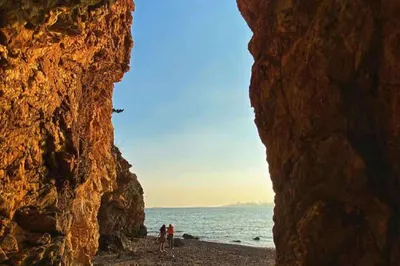
At the junctions of the headlands, wedge-shaped reefs form small beaches, including some rare blue reef rock. Gazing out to sea, you can see fishing boats at work and, further out, ships heading away or returning. Looking into the distance, your mind tends to empty. Standing quietly to feel the sea breeze and enjoy Qingdao’s enchanting seaside evening is truly delightful.
When I reached the southernmost tip of Taiping Cape and turned north, I could see a cluster of modern buildings to the east. The nearby seaside May Fourth Square and Olympic Sailing Center were almost within reach. For me, here was the dividing line of the 'old town'. I had no desire to disturb the burgeoning new Qingdao beyond. Quietly observing the march of time, the high-rises seemed taller than the distant hills. Qingdao is developing at an unprecedented pace. Fortunately, the old town remains unchanged. Just turn your head, and the green trees and red tiles, the expanse of old houses, continue to tell their moving stories in this coastal city.
Half-hill nightscape and the Insta-famous wall
20:56, partly cloudy turning clear. I suspect even Qingdao locals don't know how an ordinary intersection of Daxue Road and Fish Hill Road suddenly became the Insta-famous wall it is today. But now this intersection is indeed packed with people, with long queues every day, threatening to overshadow all the old houses in the Daxue Road and Fish Hill Road area. Of course, I’m talking about daytime.
When night fell, I finally arrived here, having stayed nearby on Daxue Road but never actually strolled it. The night breeze drifted down the hillside Daxue Road. Burping contentedly after a huge meal of plainly steamed seafood, I accidentally found myself at the junction with Fish Hill Road. Surprised, I thought—hey! There's no one here at night! Actually, this intersection is quite beautiful at night, with a unique cinematic quality. On the Daxue Road side, there’s a traffic light; when it shifts from red to green, the wall on that side shifts quickly from warm light to cool green. This creates a fascinating contrast of cold and warm tones, light and shadow, against the unlit wall of Fish Hill Road. Very beautiful.
Best of all, no one is fighting for the background at this hour! You are the star, strike any pose you like, take as long as you want!
From Daxue Road, I headed towards Huangxian Road. In my impression, Huangxian Road is a place with a strong artsy vibe, where cafés and bars jostle side by side. It shouldn't be hard to find a quiet lounge bar to while away this enchanting evening. However, I was wrong. All the way from Daxue Road to Huangxian Road, I saw not a single soul! At Lao She’s Former Residence, it was completely dark! I saw cafés and bars, all shut tight! Well, truly a quiet old town! Suddenly it felt desolate. Even if I came across a lounge bar now, I no longer wanted to go in. Now, I just wanted some liveliness! So I turned towards the sea, knowing very well that the beach would surely be full of people. Sure enough, after returning to the bustling Taiping Road, I descended to the sand and stood there. The dark sea stretched out in the distance, while nearby, brilliant lights from towering buildings shone. Many people were on the beach, scavenging among the reefs exposed by the receding tide. Only then did I notice that compared to the evening before, tonight's beach seemed much larger—the sea had receded considerably. Sitting on a reef, with my back to the city's neon glow, I stared out at the faint fishing lights on the sea. Qingdao old town, thank you for this enchanting night. The lighthouse on Little Qingdao pointed a direction, like that night by the Ranwu Lake in some distant memory. In the endless depths of the sea, ships that have lost their way will eventually reach harbour.
Ocean University, soft rain in morning light
8:55, overcast turning to drizzle, then drizzle turning sunny. Speaking of Ocean University (Hai Da), it truly carries a profound past. The current campus of China Ocean University on Xiaoyu Hill has witnessed countless historical upheavals, leaving behind many beautiful old buildings and anecdotes of famous figures.
In the early morning, crisp air filled the slopes of Xiaoyu Hill, and I walked into Hai Da campus from my hostel just two minutes away. In early autumn, the campus exuded a unique cultural atmosphere and a weight of history, making it feel as if you were walking both through a university and through a bygone era.
Wandering around Ocean University, early morning paths were sparsely populated. Students clutching books or basketballs passed by, their youthful vigour almost masking the weighty past. But every time I looked at those nameless old school buildings and halls, I knew clearly how many stories had played out here, what key roles this place had played on Qingdao’s historical stage.
▲ Quiet campus paths
The history of the site of Hai Da is full of twists and turns. On 14 November 1897, Germany used the 'Juye Missionary Incident' as an excuse to seize Qingdao, turning it into a colony. At that time, the Germans named Qingdao Hill 'Bismarck Hill' and built the Bismarck Barracks at its foot. After the Beiyang Government reclaimed Qingdao, the private Qingdao University was founded on this barracks site in 1924, and this was Hai Da's predecessor. In April 1930, the Nanjing National Government established National Qingdao University here; in 1932, it was renamed National Shandong University. When the War of Resistance against Japan broke out in 1937, the university was ordered to relocate—first to Anqing in Anhui, then to Wan County in Sichuan. Not until the spring of 1946 did National Shandong University return to its old site on Xiaoyu Hill. In 1958, the entire Shandong University moved to Jinan; the marine, fishery, and geology departments that stayed in Qingdao formed Shandong Ocean College, which was renamed Qingdao Ocean University in 1988. Finally in 2002, it became today's China Ocean University.
▲ Greenery in front of old buildings
Walking through the Hai Da campus, looking at old houses built at uncertain times, reflecting on nearly a century of institutional changes on this land, I was deeply struck by the weight of years.
▲ A glimpse of Hai Da
▲ Through a chain-link fence, a ball game was underway on a field. Above was a beautiful building with red tiles and yellow walls, and even higher up, the pagoda of Xiaoyu Hill Park.
▲ Down at the football field, getting closer to campus life
▲ At Hai Da, I saw the former Governor's Mansion on the slopes of Signal Hill—a truly beautiful and uniquely styled building.
The Hai Da campus is practically built on a hillside slope, with roads constantly rising and falling, climbing up and down. The Yushan campus, with its sky-high ancient trees and buildings hidden within the grounds, is exceptionally charming.
During the hour or so I spent wandering around Hai Da, the weather shifted from overcast to rain, and then from rain to clear skies. That drizzle in the Hai Da morning left a deep impression. Sheltering under trees or building eaves, or sometimes just walking on regardless, watching the gentle mountain rain flow down inclines and stairways, the clear raindrops pattering on stone steps—there were no other pedestrians. It was a rare and precious sensation. It seemed that Hai Da and rain were a perfect match. Only the sound of rain could fully recount those countless layers of history.
Fish Hill Road and the Art Museum on the Slope
9:45, partly cloudy turning overcast. Exiting through the main gate of the Ocean University campus, you land squarely on Fish Hill Road. From Daxue Road in the northwest to Wendeng Road in the southeast, it's just 896 metres long, yet it's a road with a lot of character and a noticeable gradient.
Fish Hill Road was built during Japan's first occupation of Qingdao, originally a gravel road serving as a shortcut from the urban area to Huiquan Bay and Zhongshan Park. The former residences of Liang Qiushi, Tong Di Zhou, the old site of the Red Cross Society Qingdao branch... The beautiful old houses and the sloping road form a captivating picture.
▲ Intersection of Fish Hill Road and Jinkou Third Road
▲ A café on Fish Hill Road
▲ A red wall along Fish Hill Road, covered with ivy
▲ Qingdao Art Museum (Old site of Qingdao Red Cross Society World Branch)
The old office building of the Red Cross at No. 37 Fish Hill Road was built from 1937 and completed in 1941. Modelled on German architecture, it is a reinforced concrete building with a dome, four storeys (three above ground, one below). The use of granite plinths and rough-hewn surrounds for the windows gives it a solid, dignified look. After the Liberation, it was taken over by the Qingdao Chinese Relief Association; the office building was used by the Qingdao City Library, which later moved to Shandong Road, and the site was incorporated into the Qingdao City Museum. After the museum moved to the Laoshan District, it became the current Qingdao Art Museum.
▲ Coincidentally, the museum was hosting an exhibition. A painting by a child depicting Qingdao's old town caught my attention.
▲ A residential building on Fish Hill Road
▲ Greenery on iron railings
Fish Hill Road isn't long; it soon disappears at a crossroad not far off. It also isn't as famous as its neighbours Daxue Road and Huangxian Road. Today, despite its many historic buildings, this sloping old road still seems to be forgotten in a chilly corner. Only those few tourists wanting a glimpse of the Ocean University gate might casually stroll here. Most people, after snapping photos at the lively Insta-wall, continue along Daxue Road and turn to Huangxian Road. Perhaps Fish Hill Road is reserved only for its few connoisseurs, who share its past in this quiet nook.
Daxue Road, a wander through time
9:51, overcast turning sunny. In Qingdao, every old road has a story. The story of Daxue Road, whether ancient or modern, is brilliant and fascinating. This is yet another 'slow' and 'romantic' road, starting from the busy Taiping Road by the sea in the south, and ending at the bustling Beer Street—Dengzhou Road—in the north. Yet Daxue Road carries absolutely no trace of commercialism or rowdiness; it is petit-bourgeois and laid-back, appearing charmingly lazy under two rows of towering old trees.
Following the crimson walls, I turned from Fish Hill Road onto Daxue Road. The famous Insta-wall was right here. Then, like most tourists, I began to wander along Daxue Road. Behind me, Taiping Road and the sea receded further away; in front, an uphill path stretched endlessly upward.
Daxue Road is the earliest modernized street in Qingdao's history, also known as 'Qingdao’s First Road'. It was built after the German occupation of Qingdao. At that time, a modern road was laid along the former Qingdao River; a stone bridge was built at the present-day Huangxian Road junction, extending the road northward, and it was named Ostpass Strasse. In 1924, after the private Qingdao University was established on the nearby Bismarck Barracks, the road in front was renamed Daxue Road (University Road). Since then, despite the many changes the university has undergone, the road has always been called Daxue Road—never altered.
▲ Small shops on Daxue Road
▲ Old houses on Daxue Road
Daxue Road is lined with dense, century-old plane trees. Old buildings with red brick or yellow walls hide behind those tree shadows. Walking along Daxue Road, you'll be infected by its romantic air and comfort.
Huangxian Road, the artiness of Qingdao
10:05, clear turning overcast. Wandering on Daxue Road, if you aren't paying close attention, you might just miss that inconspicuous intersection with Huangxian Road. And I'll tell you, you might also be missing the most artistic street in all of Qingdao.
▲ When you see the street sign, turn immediately!
Flanked by the old Shandong University, the old museum, the old library, and the Guest House, Huangxian Road has long been renowned for its unique geographical richness. Strolling along Huangxian Road, you'll see pubs, cafés, bookshops, and former residences of famous people. In just a short stretch, Huangxian Road seems to want to narrate Qingdao’s artistic temperament all at once.
▲ A café on Huangxian Road
▲ A sundries shop
▲ Curious Western-style vintage items that tempt you to explore
As for the beginnings of Huangxian Road's artistic vibe, you could trace it back to the touring performance era. From the 1980s to the early 1990s, for over a decade, a generation stirred up the streets here. Breakdance masters spun and danced wildly, singers belted out songs spontaneously, and the old buildings tucked in courtyards seemed to join in the liveliness. This place gradually became a gathering spot for artists.
▲ Lao She's Former Residence
On Huangxian Road, you mustn't miss Lao She's Former Residence. At No. 12 Huangxian Road, in this yellow old house, Lao She wrote his famous 'Ricksha Boy'. From 1934 to 1937, Lao She lived here most of the time. Tip: Free admission; note it is closed on Mondays.
▲ Huangdao Bookshop
After visiting the former residence, don’t miss the tiny ten-square-metre 'Huangdao' next door. Beside the residence, through an inconspicuous door, is a very distinctive bookshop—Huangdao.
Huangdao Bookshop, tucked in a corner of Lao She's Former Residence, has yellow-grey walls, red-brown doors and windows, and a simple wooden sign—low-key yet full of literary flair. Walking in, you’re greeted by solid wood furniture from the 1930s, with portraits of Lao She, Xiao Hong, and others displayed on the shelves.
▲ An umbrella in the bookshop
The shop is very small, you can take it all in at a single glance. But it contains many likeable things. Apart from books, there are also cultural and creative items that are very endearing.
▲ The lamp of Huangdao Bookshop
▲ On Huangxian Road, besides the shops to explore, the wall paintings along the street also command attention
▲ Wall painting on Huangxian Road
▲ A girl eating ice cream
▲ Mailbox wall? Nice!
▲ 'She Bu De Zhou Ye' (Reluctant to Leave Day and Night) Café
Another recommended spot is at the intersection of Huangxian Road and Longjiang Road. A two-storey building covered in ivy climbing all over its walls. This is the famously 'Instagrammable' café in the old town—She Bu De Zhou Ye.
▲ Even before entering the café, the artistic atmosphere outside attracts many tourists to take photos
▲ Inside the café
The café isn't large; though it has two floors, it still holds only a limited number of people. The decor is old-fashioned, perfectly matching the old house. A small café drifting with the aroma of coffee and books, its predominantly green retro palette paired with warm-toned lamps makes it feel cozy.
▲ Besides Instagram-famous cafés, Huangxian Road also has shops that you might easily miss. Beidao at No. 17 is one such place. Behind its closed gate, you have no idea what kind of shop lurks within the courtyard.
Short as it is, Huangxian Road is Qingdao old town’s perfect interpretation of all things literary and artistic. Here, a cup of coffee or a glass of wine, a book or a door, makes a stretch of lightly overcast time profound and unforgettable, infusing the old town with the most romantic humanistic atmosphere through art and culture.
The former Governor's Mansion, a magnificent castle-like building
10:37, partly cloudy. Turning from Huangxian Road onto Longshan Road, and then heading up towards Signal Hill, very soon you'll see this Governor’s Mansion on the hillside. Yes, you can see it from far, far away! Because it is truly spectacular! It can be said to be the supreme representative of German architecture in China.
▲ The former German Governor's Mansion
Though I was prepared, I was still awed by its appearance at first close glance. This 'Guest House' is simply too beautiful; worthy of the former Governor’s Mansion.
The Governor's Mansion, also known as the Guest House, is a typical German castle-style building. Completed in 1907, it was already drop-dead gorgeous and loved by architects and artists alike. Its orientation is nearly perfectly south-facing—rare in Qingdao—and its imposing stature gives it a solemn, dignified feel.
The mansion has four floors. The first and fourth floors are auxiliary rooms with noticeably smaller windows. The second and third floors are the main offices, with large doors and windows that are bright and spacious; the sunny side also has long balconies similar to verandas.
Touring the Governor's Mansion is fascinating; walking inside feels as if you're watching various historical stories unfold. A brief primer on its history and functions: In 1914, Japan replaced Germany in ruling Qingdao, and the Japanese garrison headquarters worked in this building. At the end of 1922, after the Chinese government reclaimed Qingdao, it served as the offices for the Jiaozhou Commercial Port Supervisory Office and later the Jiaozhou Commercial Port Bureau. After April 1929, it successively became the working site for the Qingdao Reclamation Commissioner's Office, the Qingdao Special City Government, and the puppet 'Qingdao Special City Office'. On 2 June 1949, Qingdao was liberated, and the Qingdao Municipal People's Government operated here. In 1995, it was designated a key national cultural heritage site.
▲ Surroundings of the Governor's Mansion
▲ Descending after leaving the mansion
Although I was already halfway up Signal Hill, I decided to save Signal Hill for last. Perhaps it’s due to Signal Hill's unique charm—I wanted to climb to its summit only at the very end, to take in the full panorama of the old town I had been traversing for days. So after leaving the Governor's Mansion, I started downhill, encountering many old streets that were nameless yet tranquil and beautiful.
▲ Many of Qingdao's intersections and little streets are actually quite lovely. These old hillside streets rise and fall; one intersection, a few old houses, some messy yet somehow perfect utility poles. Perhaps this is the charm of the old town—you don't need a famous sight; beauty is written everywhere by the passage of time.
Guangxi Road and the Post & Telegraph Museum
11:53, partly cloudy. Speaking of Qingdao's central business district, you might think of the CBD in the new city with its forest of skyscrapers. But in fact, as early as when the Germans built the old town, they had already planned a commercial street. That is Guangxi Road. After I left the slopes of Signal Hill, I returned to the hostel, packed my things and left them at the front desk. Then I descended to the seafront and found my way to this history-laden Guangxi Road.
Guangxi Road was once called Prinz Heinrich Strasse, then Saga-machi. It was the oldest asphalt road in old Qingdao—long, wide, flat, and lush with trees. Built between 1899 and 1901, it stretches 1,600 metres and was where Qingdao’s underground drainage system was first constructed.
When first built, Guangxi Road already separated vehicle and pedestrian lanes. The sidewalks were even planted with spineless locust trees imported from Berlin. If you look at Guangxi Road from above, you’ll notice an interesting fact: it runs parallel to two other famously old streets I mentioned earlier—Hunan Road and Taiping Road. Hunan Road is to its north (closer to the hills), and Taiping Road to its south (near the sea). It’s easy to see the meticulous urban planning by the Germans back then. By 1914, at the end of the German occupation, Guangxi Road was already lined with tall buildings, housing department stores, newspaper offices, a post office, a police station, and other institutions. Today, one of my main aims was to visit that old post office—now the Qingdao Post & Telegraph Museum.
▲ Qingdao Post & Telegraph Museum at the corner of Guangxi Road and Anhui Road
Wandering along Guangxi Road in autumn, passing the old post office, I was already deeply drawn by its exterior. The Post & Telegraph Museum is on the site of the former Imperial German Post Office, built in 1901 and the oldest surviving postal building in Qingdao.
▲ The red walls of the post office, green plants, and the bustling Guangxi Road
▲ Inside the museum
The museum currently has three floors open: The ground floor is a reception hall with an antique telephone wall, Jiao'ao 1901 slow postal service, and a souvenir shop—free to enter. The second floor is the main exhibition hall, requiring a ticket; the fourth floor is the Tower 1901 Hall. The main exhibition hall on the second floor displays many postal and telegraph-related artifacts and the postal history of Qingdao.
That day, I walked alone into the main hall on the second floor; besides a man in his early twenties, there were no other visitors. I spent time looking at the old exhibits, as if stepping into history, listening to the past, reading the mottled marks of time.
▲ A glimpse of the second-floor exhibition hall, arranged like the old post office
Tracing Qingdao’s earliest postal history, you can go back to 1893, before the German occupation. The Qing government set up Qingdao’s first modern communication agency—the Jiao'ao Telegraph Office—in Yangjia Village behind the Jiao'ao Commander-in-Chief's office in the rear hills. This marked an important first step for Qingdao’s postal services. After Germany invaded Qingdao in 1897, they established a systematic postal and telecommunications infrastructure in the leased territory and along the Jiaoji Railway. In 1914, after Japan replaced Germany, they took over these facilities. After 1922, 1938, and 1945, as Qingdao’s tumultuous history and political control shifted, the postal system was successively controlled by the occupying governments, until the founding of New China in 1949, after which Qingdao’s postal service entered a period of great development.
In addition to the museum, there is a café on the ground floor of the post office building, decorated in a vintage style, well worth a visit. I really liked it here.
▲ The café’s interior
▲ The tower staircase
However, the most impressive part was visiting after the museum—the 1901 Hall at the top of the tower, accessed directly from the fourth floor. This is the only hundred-year-old wooden tower currently open to the public in Qingdao. The Gothic double-tower structure of the 1901 Hall showcases 120-year-old construction techniques.
Nowadays, the twin towers, separated by a staircase, are both furnished with seating and have been transformed into a venue that combines a bookshop, café, and cultural creative shop, brimming with historical charm.
▲ Atop the 120-year-old wooden tower, reading 'Qingdao Past'
In this wooden tower top, I seemed to travel back to the very beginning of the city's last century. The old post office nearby was still quietly recounting the years. It had witnessed a hundred years of tremendous change and development in Qingdao’s postal service, just as Qingdao had witnessed its decline, resurgence, and the future yet to come.
Feicheng Road, the overlooked old street beside the cathedral
13:34, sunny. In the afternoon, Qingdao cleared up again. I returned to St. Michael's Cathedral on Zhejiang Road. This was my last stop before climbing Signal Hill. Not the cathedral itself, but a nearby road called 'Feicheng'.
▲ The intersection of Zhejiang Road and Qufu Road
Re-encountering Villa Anna and Zhejiang Road, and seeing the cathedral again was different from two days earlier when it had been overcast and drizzly. The sky had gradually cleared, and the area around the cathedral was crowded with tourists.
▲ The cathedral under a sunny sky—bright and beautiful in a different way
Passing through the crowded square in front of the cathedral, I finally spotted Feicheng Road, which I had overlooked before—an old street sloping downwards.
▲ Feicheng Road
Qingdao's most famous cathedral has its official address on Zhejiang Road, and many tourists and even locals call it Zhejiang Road Cathedral, but in fact, it sits at the eastern end of Feicheng Road. Because Qingdao's streets are quite irregular, Zhejiang Road is shaped like a 'ㄣ' (angle), and this short horizontal stroke is the beginning of Feicheng Road.
Feicheng Road is an old street with a considerable gradient, a classic example of roads shaped by Qingdao's hilly terrain. Looking up at the cathedral from here, the view is exceptionally magnificent and beautiful.
Feicheng Road was first called Bremen Strasse, and during the Japanese occupation, Shimonoseki-machi. It crosses Zhongshan Road, passes the former German police station, and reaches the railway. At its intersection with Zhongshan Road are two old German buildings: one is the Hamburg Building, and the other a two-storey building with a tower, said to have once been a German hotel. Feicheng Road was also once a street of journalism; publications like the 'Commoners' Daily', 'Zhengbao', 'Qingdao Daily', 'Qingdao Advertiser', and the Qingdao News Agency all once had offices here.
Walking on the mottled old stone paving of Feicheng Road, you can almost touch those traces of history.
The buildings on both sides of Feicheng Road are full of a sense of age; paired with its beautiful incline, the street looks uniquely beautiful whether viewed up or down. Perhaps Feicheng Road is no longer so well-known, or perhaps it has always been overshadowed by Zhongshan Road and Zhejiang Road. But this old street extending downward beside the cathedral, having witnessed the development of Qingdao's news industry, left an unforgettable, profound mark on me that afternoon.
Huangdao Road, a taste of the local old market
13:54, sunny turning partly cloudy. After leaving Feicheng Road, I passed the cathedral and headed steadily towards Signal Hill, finally approaching my very last old-town scenic spot, to overlook this beautiful old town.
▲ Unnamed old buildings could be seen everywhere
Just as I neared the area of Guaxiang Hill, a road stretching downward suddenly appeared. Compared to Feicheng Road, this road was narrower and more down-to-earth, yet it possessed the same charming gradient. This was Huangdao Road, once prosperous for a time.
Huangdao Road was an area where Chinese residents lived during the colonial era, with comparatively poor conditions back then. The old road is paved with mottled stone slabs; due to its steep slope and narrow width, it is still largely impassable for vehicles today—only nearby residents park there briefly.
The stepped section of Huangdao Road is unique in the city. From the 1920s to the 1950s, Huangdao Road was for long periods a street market; stalls occupied half the road width, mainly selling old ironware, ceramics, wooden items, poultry, seafood, etc.—dense with a down-to-earth market flavour. Not until 1957, after the cooperative movement, did the street market begin to shrink. Although it experienced a revival in the new era, it gradually faded away.
▲ The down-to-earth Huangdao Road
Today, Huangdao Road is no longer bustling. A few cars are parked, and a fruit stall here and there provides a faint hint of life. The noisy, lively market of Huangdao Road is gone. In fact, Qingdao has many such old lanes and alleys, each once flourishing, each with its own glorious past and history, yet all have gradually declined with the times, slipping silently away.
Signal Hill, overlooking the old town's half-hill, half-sea
14:12, partly cloudy. After leaving Huangdao Road and continuing uphill, every corner of the hilly road and every old building was endearing. I was growing more and more fond of Qingdao's old town. I didn’t want to leave.
▲ A corner on the hillside road
Finally, not long after, I climbed to the top of Signal Hill, sat down in the red mushroom-shaped revolving restaurant, and took in a 360-degree view of the old town's half-hill, half-sea scenery, a sea of red tiles and old houses.
▲ View from Signal Hill looking at the former Governor's Mansion on the slopes
▲ View from Signal Hill of Taiping Road and Zhanqiao Pier area
▲ Overlooking beautiful Qingdao
Signal Hill is one of the tallest hills in the urban area. After the port of Qingdao was built, a signal flag station was established on the hill to convey signals for steamships and sailboats entering the harbour, hence the name 'Signal Hill', also called 'Flag Display Hill'. It faces the sea in front and has the old town at its back, making it the best vantage point for viewing the waterfront scenic area and the cityscape.
Regarding its history, when German imperialists seized Qingdao in November 1897, they forcibly occupied Signal Hill. At that time, the Germans used it as a commanding height, aiming their guns at the Qing government's Commander-in-Chief's office, forcing the Qing army to withdraw. Later, they built Qingdao's earliest wireless station and a signal steering station to direct ships entering and exiting Jiaozhou Bay. From here, ships coming and going in beautiful Jiaozhou Bay are clearly visible, complemented by the red-tiled houses on the hillside—the beautiful sea just beyond the old town, a feast for the eyes.
Down below: the cathedral, newly built high-rises, old houses... That day, I stayed on Signal Hill for a long time. Looking alone at this beautiful scenery, letting my mind go blank.
From Signal Hill, overlooking the old town felt like counting every building and every road I had walked over the past few days. The layout of the old town gradually became clear: the briny Taiping Road along the sea; the embassy street thick with plane trees in early autumn; the high, red spire of the cathedral; the storied past of Villa Anna and the Film Museum; the azure shores by Zhanqiao Pier and Lu Xun Park; the tipsy beautiful afternoon with the taste of beer; the fishing boats sailing afar at sunset from Taiping Cape; the Insta-famous wall under the half-hill night sky; the soft morning rain and light at Ocean University...
The beautiful old town of Qingdao, in this autumn, finally coincided with my ultimate imagination of the sea, of art and culture, of the most brilliant and beautiful life. Though the weather had its sun and clouds, it also gave the old town its multifaceted and unique charm.
Epilogue, listening to the island city's mountain rain
16:46, overcast turning to light rain. The last moments in the old town were spent in a tiny café on Xiaoyu Hill. That day, I dragged my suitcase up Xiaoyu Hill, past Daxue Road and Fish Hill Road. Just as I was about to reach the top, the mountain rain arrived.
The 'August Café' on Xiaoyu Hill felt like a hidden secret spot. After a few twists and turns, I finally found this Instagram-famous café. That day, there weren't many customers, perhaps because of the rain. I ordered a hot coffee and sat quietly by the window, listening to the mountain rain.
▲ The café’s biggest selling point is that you can drink coffee while overlooking the beautiful view below Xiaoyu Hill
A cup of coffee, idling away the last leisurely and comfortable moments on the island city. In the warm café, there was the occasional meow of a cat. The rain gradually intensified, pattering crisply, dripping on the eaves. A few streaks of water traced down the windowpane. The sky also slowly darkened, and the old town was about to slip into the night.
Watching the rain outside the window, I waited alone for nightfall. Goodbye, old town. One person, three days, seventy-two hours—this is the most beautiful memory of the island city. Sunny, cloudy, clearing after rain. From the German Prison to the former Governor's Mansion, from Huashi Villa in Badaguan to the Art Museum on Fish Hill Road. Encountering the artistic Huangxian Road, wandering along the beautiful Daxue Road and Zhongshan Road. Bustling, or quiet. The stories of the old town are perhaps like this mountain rain, every sound entering the ear, carrying a unique flavour, tapping on the thoughts of a traveller. This is Qingdao's old town. Let all the details unfold. When the genial breeze blows, just stand at that corner! While sunlight filters through the gaps in the lush, leafy trees, every time a breeze passes, the old flagstone path is left with rippling halos of light, like flowing water. Stairways that rise and fall, a calico cat among flowers on a low wall, an unnamed old house covered in ivy. Close your eyes, and the faint song of wind and waves reaches your ears. Is it the sea? At a corner you haven't even had time to think about, beyond the red tiles and green trees, there has long been a vast expanse of deep blue.
Autumn, 2019. Qingdao, August Café on Xiaoyu Hill. Rain.