Qingdao Zhanqiao Pier and May Fourth Square
China is so vast, I want to see it. I'll take you to a place you may have visited or not.
Qingdao Zhanqiao Pier and May Fourth Square
Qingdao is undoubtedly a beautiful coastal city. Any city with a seafront or riverfront inevitably develops public spaces for tourism and leisure, which become a beautiful scenic line.
Stepping out of Qingdao Railway Station, you don't feel modernity at all; instead, a wave of European charm greets you.
Qingdao Station was first built in the 26th year of the Guangxu reign of the Qing Dynasty (1900). Designed by German engineers, the original building featured German Renaissance architectural style. After a century of use, it was demolished and rebuilt in 1991. Following another renovation in 2006, it took its current form. The rebuilt station preserved the old German style, with conspicuous yellow walls, steep roofs, and red tiles—a nod to history.
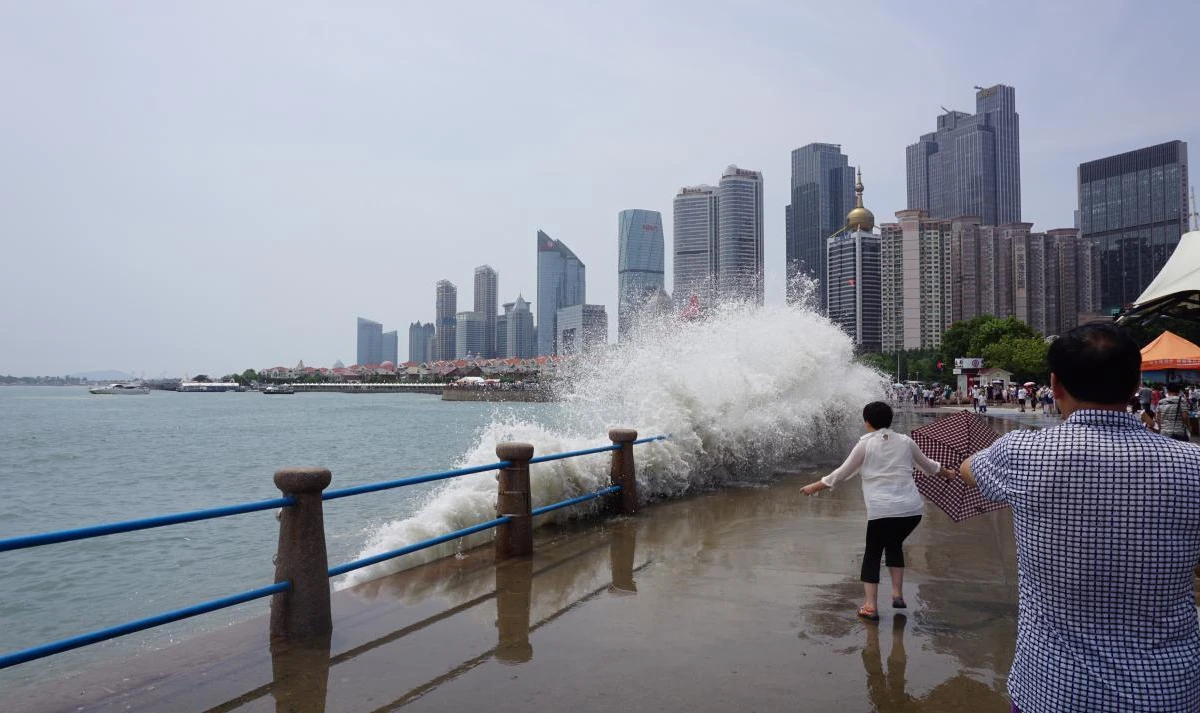
Just a short walk from the train station brings you to the Qingdao Bay coastal scenic area. Strolling along the Zhanqiao Pier seaside, you can see Qingdao’s crescent-shaped city skyline.
As we know, when the water near the shore isn’t deep enough for ships to dock, a pier is built extending from the shore into the bay, serving as a temporary wharf for passengers to embark and disembark or for loading and unloading cargo. Qingdao’s Zhanqiao Pier is a symbol of the city.
Zhanqiao Pier was first built in the 16th year of Guangxu (1891). At the time of its completion, it was simply a temporary iron-and-wood pier for the navy to transport military supplies, with a length of 200 meters.
In 1897, after Germany seized the opportunity to occupy Qingdao, they replaced the northern end of the original pier with a stone foundation and extended the pier to 350 meters. In 1931, the then Qingdao government funded a reconstruction: the piers were all cast in reinforced concrete, the deck paved with cement, and the length was extended to 440 meters.
In 1984 and 1998, the Qingdao municipal government carried out comprehensive renovations, preserving the original style while making the structure sturdier, more attractive, and the deck wider. Iron chain railings and lotus-shaped street lamps were added along both sides, and a breakwater was built at the far end to dampen the impact of wind and waves.
At the southern end, an octagonal Chinese-style pavilion called ‘Huilan Pavilion’ was built, supported by 24 pillars and crowned with golden glazed tiles. It’s considered one of the ‘Ten Scenic Spots of Qingdao.’ Zhanqiao Pier stretches from the shore out into the sea, inspiring the poetic descriptions ‘a long rainbow extending into the distance’ and ‘a flying pavilion above swirling waves.’
In modern times, Qingdao has an inextricable link with Germany. As early as from the 21st to the 23rd year of Guangxu (1895–1897), Germany repeatedly requested from the Qing government the lease of harbors along the southeast coast, but without success. In November 1897 (the 23rd year of Guangxu), the ‘Juye Incident’ occurred in Shandong—villagers killed two German missionaries. Using this as a pretext, Germany dispatched a naval commander with four cruisers to Jiaozhou Bay, landing troops under the guise of exercises. The Qing government’s non-resistance policy allowed the German forces to occupy Qingdao without bloodshed. Eventually, the Treaty of the Lease of Jiaozhou Bay was signed, fulfilling Germany’s aim. From then on, Shandong became Germany’s sphere of influence and a colony.
View from Signal Hill overlooking Zhanqiao Pier and German-style architecture
German Governor’s Mansion on Signal Hill
In 1914, with the outbreak of World War I, Japan declared war on Germany under a pretext, attacked and occupied Qingdao and the entire Jiaoji Railway, and took control of Shandong Province.
In January 1919, the victorious Allied powers held a ‘peace conference’ in Paris. The Chinese delegation attended as a victor nation and proposed abolishing the ‘Twenty-One Demands’ and other unequal treaties Japan had imposed on Yuan Shikai’s government, and returning to China the rights in Shandong that Japan had seized from Germany during the war. The Paris Peace Conference not only rejected China’s demands but explicitly stipulated in the treaty with Germany that all German privileges in Shandong be transferred to Japan. The Beiyang government was prepared to sign the treaty. When news of this reached home, it sparked the May Fourth Movement.
May Fourth Square is not far from Zhanqiao Pier. Its centerpiece sculpture, ‘May Wind,’ with its spiraling, wind-like shape and fiery red color, vividly embodies the patriotic, anti-imperialist, and anti-feudal spirit of the May Fourth Movement, as well as a surging national strength.
Along the Qingdao Bay waterfront, both natural and cultural scenery is exceptionally rich—so much so that it can’t be fully recounted in one go.
Lu Xun never actually visited Qingdao. The city’s pleasant climate and beautiful scenery were suitable for recuperation, and friends urged him to come here to recover from illness, but for various reasons he never did. In 1950, to commemorate Lu Xun, the Qingdao People’s Congress of All Circles approved renaming the former ‘Seaside Park’ to ‘Lu Xun Park.’
First built in the early 20th century and largely formed by the 1930s, it is called ‘Badaguan’ (Eight Great Passes) because its eight main streets are named after important passes in China. It is renowned for its European-style courtyard villas, earning it the title ‘Exposition of World Architecture.’
Danish Princess House in Badaguan
The sailing events of the 2008 Beijing Olympics were held in Qingdao.
Yinhai Yacht Club
There is a site in the club, China’s Sea Level Zero, which I’ll talk about another time.