Visit Laoshan in Qingdao, Experience a Spectacle of Mountains and Sea
China is so vast, I want to go and see it. I'll take you to a place you may have visited or not.
Visit Laoshan in Qingdao, Experience a Spectacle of Mountains and Sea
Laoshan is a captivating famed Taoist mountain. Throughout history, it has been praised as a “spectacle of mountains and sea.” Visiting Qingdao without going to Laoshan is like not visiting Qingdao at all, so Laoshan is a must-see.
In 2015, the entrance ticket to Laoshan in Qingdao cost 130 yuan.
In ancient times, Laoshan was part of the Eastern Yi territory, and during the Spring and Autumn period it belonged to the State of Qi. After Qin unified China, it was placed under Langya Prefecture, and in the Han Dynasty, Buqi County was established here. Historically, Laoshan has been known by various names, including Lao Shan, Buqi Mountain, Laosheng Mountain, and Ao Mountain.
The Qing Dynasty scholar Gu Yanwu researched the origin of the name Laoshan and believed that when Emperor Qin Shi Huang heard of the mountain's fame and came to climb it, the steep paths required tens of thousands to clear the way, thousands to assist, and hundreds of officials to follow, causing great hardship and expense to the people. Thus, “the people of Qi found it burdensome and called it Lao Mountain (meaning toil),” and the character for 'Lao' with a mountain radical was derived from this.
From the city center, I took a special tourist bus, then transferred to a scenic area shuttle, arriving at the service center over 40 kilometers away. The Laoshan scenic area is vast, divided into the south route's Taiqing Palace, the east route's Yangkou, the central route's Jiushui, the west route's Hualou, the north route's Heshan, and the central area's Jufeng—each with its own unique features. For my day trip, I chose the southern Taiqing Palace scenic route, which faces the sea with mountains at its back and is named after the renowned Taiqing Palace.
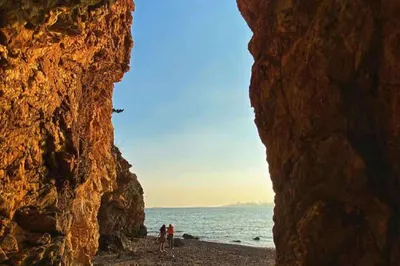
The coastline here winds and twists, forming numerous capes and bays. The sea surface and the rocky coastal scenery are naturally stunning, but unfortunately the inshore water is not azure blue; instead, a layer of green film floats on it. You can tell it's algae caused by eutrophication, and there's a strong algal smell.
From the base, you can gaze up at the mountains. Of course, taking a boat to view Laoshan from the sea offers an even better experience of the “spectacle of mountains and sea.” The main peak that Taiqing Palace backs onto is called Laojun Peak.
Taiqing Palace, also known as Xiaqing Palace, is the oldest and largest Taoist temple on Laoshan. It was first built in the first year of the Jianyuan era of the Western Han Dynasty (140 BC) by a fangshi (alchemist) named Zhang Lianfu from Jiangxi, who lived on the mountain. During the reign of Emperor Taizu of Song, funds were allocated to renovate and expand the palace by imperial decree, establishing the scale seen today. It still retains Song Dynasty architectural styles, which is very rare among religious buildings in China.
Laoshan is famous for its immortals. In Liaozhai (Strange Tales from a Chinese Studio), there is a story called “The Taoist Priest of Laoshan,” about a young man surnamed Wang who was drawn to Taoism and came to Laoshan. He learned the “wall-penetrating art” from an immortal, but when he went home and tried to show it off, it failed, ending in failure. The legendary screen wall through which the Laoshan priest passed is located right here in this palace.
Wang Chongyang founded the Quanzhen (Complete Perfection) School of Taoism and had seven disciples known as the “Seven Immortals of Quanzhen.” In the first year of the Qingyuan era of the Song Dynasty (1195), Qiu Chuji, the head of the Quanzhen School and leader of the Seven Immortals, came to this palace on Laoshan with fellow Taoists, spreading profound doctrines and expounding the teachings. Thus, Laoshan became the second largest Quanzhen Taoist center in the world.
Entering Taiqing Palace requires a separate ticket. I was put off by the “ticket economy” back then, so I didn't go in. Now I somewhat regret it. From Taiqing Palace, you can directly start climbing. I started climbing from the side of the palace, and there is also a cable car option.
Whether Laozi ever climbed Laoshan is unverifiable; I take it with a grain of salt, but who cares.
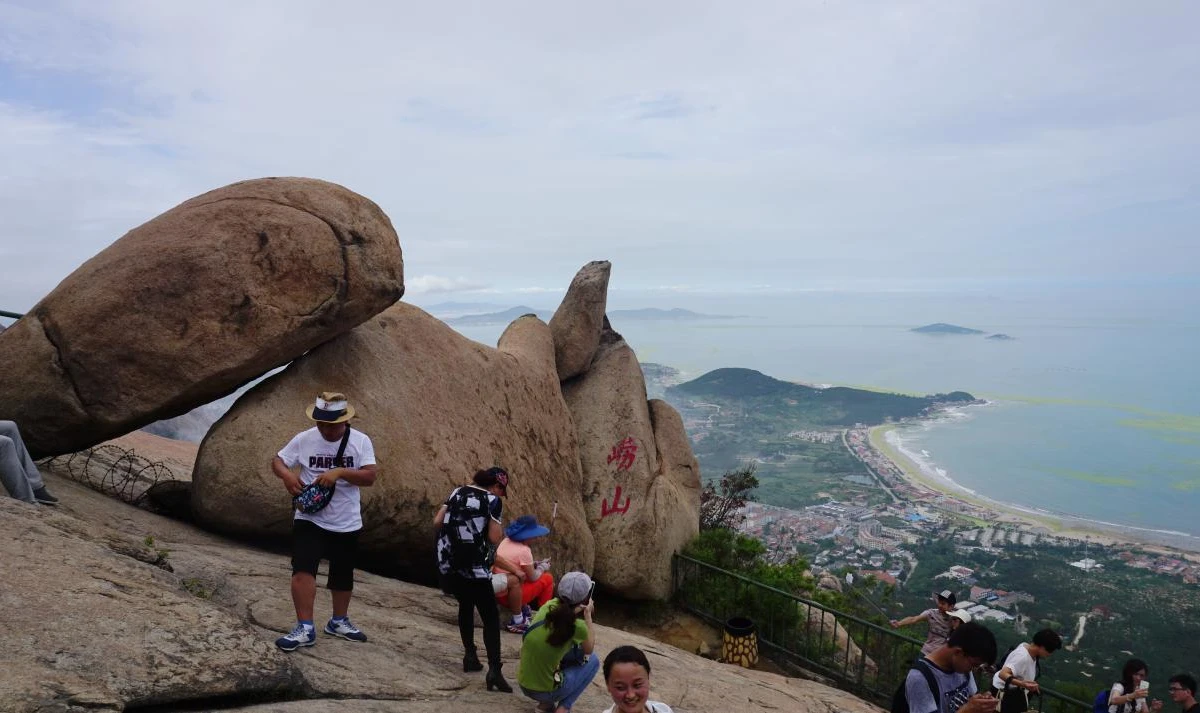
The climb is not very difficult; Laoshan's highest peak (Jufeng) is only 1,132.7 meters above sea level. Along the way, I felt there weren't many scenic sights. The mountain is covered with huge granite rocks formed in the Cretaceous period a hundred million years ago. Through eons of time and change, nature's artistry has carved them into majestic, spectacular, unique, and beautiful landforms.
The massive rocks conveniently lend themselves to cliff inscriptions. Since ancient times, landscapes and culture have been intertwined; even the finest scenery needs literary renown to be widely known, and these carvings serve that purpose. Most of the inscriptions date from the Yuan, Ming, and Qing dynasties, which also indicates that Laoshan became a noted Taoist mountain only after the Song Dynasty.
The Jade Pool (Yaochi) is the Taoist fairyland, where the Queen Mother of the West (Wangmu Niangniang) has her peach orchard. Every year on her birthday, the Queen Mother hosts a grand peach banquet at the Jade Pool and invites many immortals to celebrate her longevity.
Li Bai, however, did climb Laoshan. In a poem, he recalled: “I once upon the Eastern Sea, on Laoshan dined on purple clouds,” and “I wish to follow the Master to the Altar of Heaven, leisurely sweeping fallen petals with immortals.”
This huge carved character for ‘shou’ (longevity), 20 meters high and 16 meters wide—the largest such carving in China—was created in 1993 by enlarging the calligraphic style of Ouyang Xun.
Mitian Cave, also called Locust Tree Cave, is formed by multiple giant rocks stacked in a crevice between two steep cliffs. It has five levels from bottom to top, over 30 meters high. After exiting the cave, there are attractions such as Tongtian Bridge, One-Line Sky, Divine Turtle Overlooking the Sea, Just Inches Away at the Edge of the World, and Tianyuan (Heavenly Garden).
Tianyuan is a sloping platform. The greatest feeling during the climb is that of facing the sea with spring warmth and blooming flowers around. However, August is the rainy season here, and without a clear sky, I couldn't experience the true “sea and sky merging in one color,” and my photos turned out poorly. Looking at the greenish algae along the coast further detracted from the sense of beauty.
Climbing further up leads to Shizi Peak (Lion Peak), the highest peak in the Taiqing scenic area.
I didn't have time to visit other spots like Mingxia Cave, Shangqing Palace, and Longtan Waterfall. Because this place is far from the city, I had to consider the return trip time. One more look at the Laoshan carvings and the mountain-sea spectacle.