Poetic Laoshan | A Hidden Kingdom of Rare Plants Can Be Found Right Here in Laoshan!
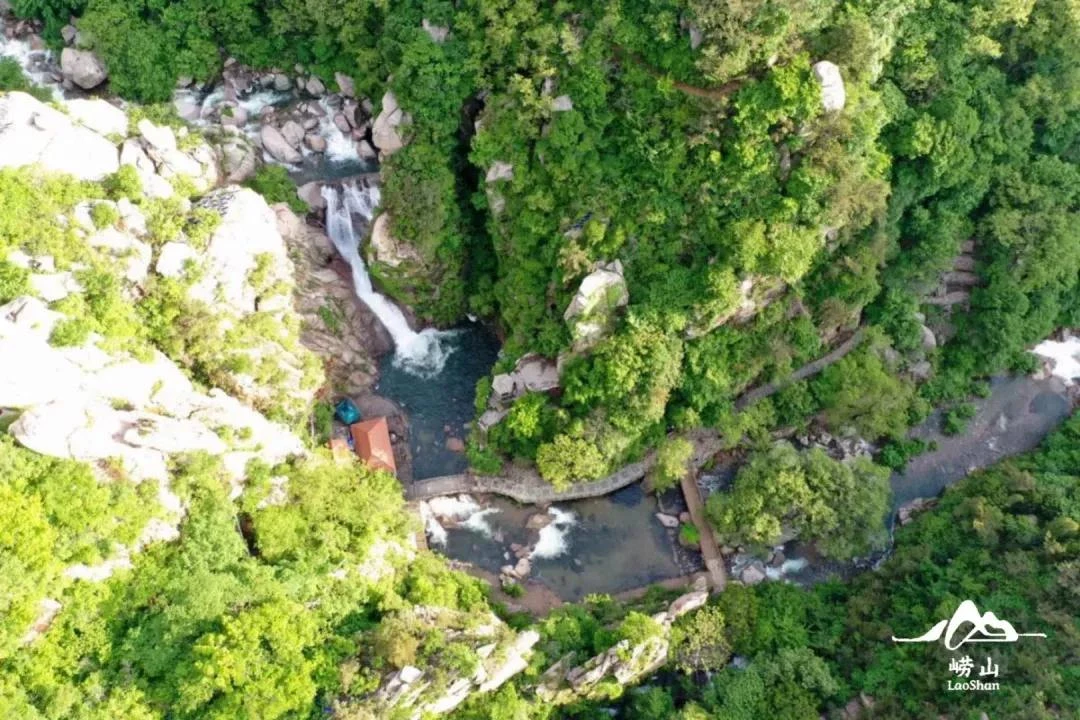
"Beijiushui is located on the upper reaches of the Baisha River in Laoshan. The Baisha River originates from the northern foot of the mountain peak... Each stream crossing is counted as one 'water,' hence the name 'Jiu Shui' (Nine Waters)."
In the sweltering dog days of summer, there's no better place in Qingdao to escape the heat and enjoy the scenery than Mount Laoshan. Within this natural oxygen bar of Laoshan lies a hidden kingdom of rare plants—Beijiushui.
Photo by @ Wang Hua, specially appointed photographer of Laoshan.
Today, the Jiushui Scenic Area is an important travel route within the Laoshan Scenic Area, offering countless beautiful sights along the way. As early as the 'Jiao'ao Zhi' (Records of Jiaozhou and Aomen) described: 'Two mountains flank a deep pool; along the route, mountain gorges are marvelously scenic, clear streams meander, waters roar like dragons, rocks crouch like tigers, sheer cliffs and perilous crags meet the eye everywhere—music and painting combined.'
Photo by @ Liu Mingyuan, specially appointed photographer of Laoshan.
Photo by @ Zhang Haoyu.
Photo by @ Sheng Bo.
Amidst such fairy-tale mountains and sacred waters, one discovers a different beauty each time. Compared to other routes in Laoshan, the Jiushui trail is less strenuous, allowing visitors to wind their way up along the paths beside the streams, where they encounter not only clear springs flowing over rocks but also a wide variety of plants.
So, what members does this plant kingdom have? Let's take a look together~
This is a small flower with white and purple hues, delicate stems, opposite leaves, and slender spike inflorescences bearing a series of fresh, lip-shaped blooms. The whole plant seems fragile, yet it has a tough name—Tou Gu Cao (phryma). The name likely comes from its purported effectiveness in treating bruises and injuries.
[Phryma leptostachya, family Phrymaceae, genus Phryma]
Also eye-catching is the equally delicate mountain sorrel flower (Melampyrum roseum). Its leaves are opposite, terminal raceme inflorescence, corolla purplish-red, with all the lip-shaped flowers seemingly facing the same direction.
[Melampyrum roseum, family Scrophulariaceae, genus Melampyrum]
Two Adenophora species, Adenophora trachelioides and Adenophora tetraphylla, are scattered on the slopes. At first glance, they look similar, but a closer look reveals distinct differences: Adenophora trachelioides has ovate leaves, the stem leaves clearly have petioles, and the style does not extend beyond the corolla; whereas Adenophora tetraphylla has leaves in whorls of 3-6, sessile, and the style clearly protrudes beyond the corolla.
[Adenophora trachelioides, family Campanulaceae, genus Adenophora]
[Adenophora tetraphylla, family Campanulaceae, genus Adenophora]
In addition to Phryma and Melampyrum, other herbaceous plants visible here include Carpesium cernuum, Circaea, and Thalictrum minus var. hypoleucum.
Carpesium cernuum is a perennial herb, shaped like a tobacco pipe, with branched stems, solitary capitulum at stem tips and branch ends, flowers yellowish-green. When blooming, they droop, and there are several bracts of unequal length at the base of the flower.
[Carpesium cernuum, family Asteraceae, genus Carpesium]
Circaea is a perennial herb with opposite leaves, terminal racemes, white petals that are obcordate at the tip with a notch reaching 1/2 to 2/3 of the petal length, and fruits covered with hooked hairs—very distinctive.
[Circaea, family Onagraceae, genus Circaea]
Thalictrum minus var. hypoleucum is also a perennial herb, with leaves 3-4 times ternately compound, leaflets shallowly three-lobed at the apex, paniculate inflorescence, no petals, 4 greenish-white sepals, filiform filaments, drooping.
[Thalictrum minus var. hypoleucum, family Ranunculaceae, genus Thalictrum]
In early summer, the Hovenia acerba (Japanese raisin tree) is already laden with small green drupes, and the enlarged fruit stalks between the fruits are clearly visible.
[Hovenia acerba, family Rhamnaceae, genus Hovenia]
There is also Diospyros lotus (date-plum): the unripe small berries are spherical with a faint white waxy coating; when ripe, they turn black and are edible. Locals in Laoshan call them 'ruan zao' (soft dates). Every autumn when the fruits ripen, the sweet glutinous flavor of soft dates is one of the fondest childhood memories for many.
[Diospyros lotus, family Ebenaceae, genus Diospyros]
The hazel tree (Corylus mandshurica) has very ordinary leaf and tree shapes, but its fruit is uniquely shaped. The nuts are solitary or clustered in groups of 2-6, with a tubular involucre that constricts above the nut and is densely covered with yellow bristles.
[Corylus mandshurica, family Betulaceae, genus Corylus]
Many Rhus chinensis (Chinese sumac) trees are also scattered on the mountain: odd-pinnate compound leaves with winged rachis and petioles, terminal panicles, and yellowish-white flowers, making them highly recognizable.
[Rhus chinensis, family Anacardiaceae, genus Rhus]
There is also a tree with leaf and flower shapes similar to Rhus chinensis: Evodia daniellii (Korean evodia). It also has odd-pinnate compound leaves, corymbose cymes, nearly spherical flower buds, and white flowers.
[Evodia daniellii, family Rutaceae, genus Evodia]
Of course, in the forest treasure trove of Laoshan, there is a diverse array of plants and trees. Many of Laoshan's culinary specialties also come from here, and places that promote health and wellness are everywhere. The reputation as a 'natural oxygen bar' is well-deserved!
The mountain rocks stand in silence, streams gurgle, and the plants covering the hills adorn this famous coastal mountain with ever-changing postures, making a trip to the mountain forest all the more enchanting.
Text and images source: Plant Notes from Seaside Cottage
Copyright belongs to the author; please credit the source if reposting.