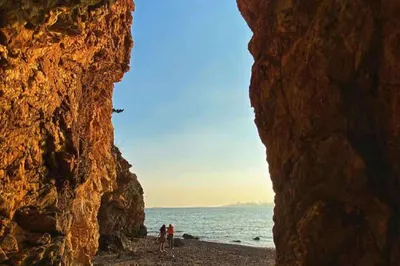
Jiaodong Ocean Children's Play Festival: A Two-Day Qingdao Travel Guide
My second visit to Qingdao, but each time has been rushed, always just two days. Last time I mostly stayed in the old town, wandering among colonial-era buildings and watching the seaside crowds. This time, I made up for what I missed before, heading to the northernmost Laoshan and the southernmost Huangdao district. Both places are quite far from the city center, and public transport would waste a lot of time, so if you want to follow my route, you really need to rent a car and drive yourself.
Day 1: Yangkou Scenic Area – Momer – Taiqing Palace
Day 2: Binhai University World Animal Museum – Golden Beach – Starlight Island – Mangrove Tree Resort World
Yangkou – Momer – Taiqing Palace, all lie within Qingdao's Laoshan Scenic Area. Laoshan is actually a huge scenic zone (see map). Yangkou sits in the far northwest, a few kilometers below is Momer, and Taiqing Palace is at the very south. The road used to connect them all; now you need to enter Yangkou and Taiqing Palace from different visitor centers.
Worth noting: all Laoshan scenic spots now have free entry; you only need to buy a 60-yuan sightseeing bus ticket. For Yangkou, you can reach it without the bus – just drive to Yangkou parking lot, the entrance is opposite. Even better, parking at all Laoshan scenic areas is free. That's a model other attractions nationwide should follow.
Even though tickets are free, you still need to pre-register your ID on Laoshan's official website, then just scan your ID at the gate.
Once inside, the Yangkou cable car entrance is on the left. A one-way ticket costs 35 yuan, about a 20-minute ride. It's quite worth it; climbing up in this heat would be really hot and tiring. And once you reach the top station, there's still some hiking down to do. I suggest taking the cable car up and walking down so you don't miss the scenery along the way.
The mountain path isn't very steep, making for an easy walk, just hot weather.
Midway on the cable car, I saw people carrying supplies up the mountain – no wonder bottled water costs more, it's all brought up by hand like this.
On one side, determined hikers; on the other, leisurely cable car riders.
In about 10 minutes, the coastline came into clear view. Growing up in Sichuan, every time I see the sea, I'm awed by its vastness and openness.
On a large rock beside the stone steps, four bold characters read "Huagai Yingbin" (Canopy Welcomes Guests). Huagai refers to the Daoist Huagai Zhenren, Liu Ruozhuo, a very famous Daoist in Laoshan's history.
Continuing uphill is Huagai Zhenren's temple, "Taiping Palace." Among the surviving temples in Laoshan, Taiping Palace is the oldest documented Daoist temple.
According to inscriptions from 1566 (Ming Jiajing reign) and 1653 (Qing Shunzhi reign) recording its restorations, Taiping Palace was built by Emperor Taizu of Song (Zhao Kuangyin, 960–976) as a Daoist center for Liu Ruozhuo. Completed during the Taiping Xingguo era, it was first named Taiping Xingguo Temple, later Taiping Palace.
Inside, ancient trees flourish with new leaves, lush under the summer sun. Winding into the inner courtyard, we spotted a uniquely shaped tree – a juniper with a trunk covered in knobs, truly living up to its name "tumorous juniper." In this bustling temple, its gnarled form oddly harmonizes with the surroundings, uniquely beautiful. Below it is the God of Wealth Hall.
The main hall is dedicated to Mazu (sea goddess).
The left side hall is the Wenchang Hall (god of literature).
Passing through a path to the right of Taiping Palace, continuing uphill, the scenery changes again. Large and small boulders take on animal shapes.
There's also an observation deck offering a panoramic coastline view. From here, the view is stunning, even prettier than from higher up.
Sea on one side, mountains on the other – that's what draws me most to Qingdao. People say you haven't been to Qingdao if you haven't visited Laoshan, so I had to come check it off.
Actually, not taking the cable car has its perks; you can measure Laoshan step by step from the base, discovering hidden scenery along the way. That feeling is completely different from reaching the summit at once, seeing the peaks, then descending to look at the path below. After viewing the sea and mountains, seeing this giant "longevity" character carved on the rock felt different again.
Then looking back at the trail just walked and that beautiful beach.
The beach opposite Yangkou scenic area is a public beach. Despite the heat, the parking lot was full – most visitors were heading there. With more time, I'd have loved to lie down and relax on the sand.
Leaving Yangkou, I continued driving along the coastal road, arriving at Momer minsu in 10 minutes.
This minsu, called Momer, has become a landmark. The four-story villa with green roof and red tiles exudes typical Qingdao style. While preserving the villa's structure, Momer makes the most of its cliffside sea views. When Laoshan's scenic spots get crowded, here in your room, in this tranquil spot between mountain and sea, you quietly enjoy the most beautiful scenery of Laoshan.
I really love this cliffside seaside feel, with the sea and village opposite. Sitting on the cliff edge with a friend, sipping coffee, feeling the sea breeze – so pleasant.
The minsu also has an infinity pool on the cliff, a local Instagram hotspot. On a fine day, it must be incredibly beautiful.
All sea-facing rooms feature large floor-to-ceiling windows. On good days, sunlight streams in with shimmering reflections, and the vast white sand beach tempts you to run down. In the evening, watch the sunset dye the mountains and sea red; at night, see a sky full of stars. With luck, you might even spot a meteor.
Another must-see in Laoshan is Taiqing Palace. Note that after visiting Yangkou, to go to Taiqing Palace, you need to head to "Dahedong Visitor Center" and take the sightseeing bus.
The bus ticket to Taiqing Palace is also a general pass covering all of Laoshan, just requiring different visitor centers. Buses run every 20 minutes, last one at 5:30 pm – don't miss the return bus.
The road to Taiqing Palace square is a beautiful coastal cliff road. Make sure to sit on the right side. Pity there are no viewpoints to stop for photos along the way.
The terminal is Laoshan's famous Taiqing Palace, the oldest and largest Daoist temple in Qingdao, with over 2,100 years of history.
Laoshan, covering a hundred square miles, is dotted with temples – said to have "nine palaces, eight temples, seventy-two shrines," with Taiqing Palace the most renowned. Records say that during the Han dynasty, Zhang Lianfu from Ruizhou (Jiangxi) abandoned his official post to practice Daoism here, building a thatched hut for the Three Officials, called "San Guan Temple." In 904 AD (Tang Tianyou era), Daoist Li Zhexuan constructed halls here for the Three Sovereigns, named "San Huang Temple," later called Taiqing Palace. During the Jin Zhangzong Mingchang period, Quanzhen Daoists like Qiu Chuji and Liu Changsheng propagated the Quanzhen sect here. Liu Changsheng founded the Quanzhen Suishan branch, attracting many followers, making Taiqing Palace the ancestral court of this branch.
Among the many Daoist halls, Taiqing Palace is the earliest recorded ancestral temple of Laoshan Daoism. Renovated in almost every dynasty, its architectural style still retains typical Song Dynasty features, rare among religious buildings nationwide.
When tired, opposite Taiqing Palace there's even a Western-style KFC for a break.
Coming to Qingdao, I discovered that right inside Binhai University there's actually a 4A-level scenic spot – a museum. Suggested visit time: 1–2 hours. Ticket: 80 yuan (adult). Transport: self-drive (advance online booking required; if driving, input your license plate to enter campus the next day).
The Qingdao Binhai University World Animal Natural Ecology Museum opened in March 2005, covering over 14,000 square meters with tens of thousands of specimens, integrating nature, animals, geology, and oil paintings.
The museum has two buildings, visited in order: Cosmic Evolution Zone, Natural Ecology Zone, and Oil Painting Zone.
The Cosmic Evolution Zone covers the Milky Way, solar system, and earth-moon system, using high-tech sound, light, and electricity to explore cosmic mysteries and the origins of life. Three video rooms on the left show educational films about the universe, animals, and plants.
Inside are all specimens of marine animals.
The Africa Zone displays various African animal specimens you can observe up close.
Entering the Africa Zone, there's also a karst cave section.
The specimens are lifelike; you can examine them very closely – perfect for bringing children to learn natural history.
Many animals rarely seen on the African savannah are easy to view here.
There's a giraffe from Africa, the tallest animal here.
An African elephant, probably the largest.
Even our national treasure, the giant panda, is here.
Other small forest animals too.
Many precious animal fossils are also on display.
Oil Painting Zone: mainly consists of copies of famous Chinese and foreign paintings, original Western oil paintings, and works themed on Binhai University campus life, totaling nearly a thousand paintings.
The zone primarily serves students for art appreciation and professional painting technique training. It lets visitors see masterpieces by Western masters without leaving the country and study their different styles up close, cultivating both aesthetic knowledge and sentiment.
Revolution-themed oil paintings foster patriotism while appreciating art. Campus-themed creations are a recent endeavor and the future direction, showcasing the university's atmosphere and landscape.
Qingdao Oriental Movie Metropolis Starlight Island, hailed as the world's ninth wonder. In 2001, the Crown Prince of Dubai's dream became reality; from the vast desert rose Palm Jumeirah, the world's eighth wonder – an island empire based on ultra-luxury and visionary planning, attracting global elites. In 2015, Chinese culture and tourism giant Wanda Group invested 50 billion yuan to create the world's ninth wonder in Qingdao, an oriental dream city – a super island spanning a thousand acres, with six world-class pinnacle formats, commanding the world's center. That's how local media describe Starlight Island; slightly overhyped perhaps, but the island is truly beautiful. Those who haven't been should plan a visit.
Entering Starlight Island, you cross a unique shell-shaped bridge, now an internet-famous "Instagram bridge."
The Silver Snail Theater and Golden Snail Showplace are two landmark buildings.
The bar street is completed, with many bars open. Rows of European-style buildings have become a popular wedding photo spot.
My last stop in Qingdao: Mangrove Tree Resort World. As northern China's one-stop vacation destination, it integrates fashion, leisure, cultural creativity, international conferences, film and TV locations, shopping, and entertainment. If you're in Qingdao and unsure where to go, you can easily spend two days here.
Coral Hotel and Coconut Grove Hotel are just a 2-minute walk to the beach, letting you feel the sea from every corner.
The hotel's sea-view room has a large bathtub.
Children's Adventure Kingdom – a paradise for kids; parents can even leave their children fully under supervision here.
The 4,000㎡ children's park features full imported equipment from world-renowned brand David Taylor.
And a thrilling devil's slide, a favorite among little ones.
Mangrove Tree Hot Springs: a huge open-air hot spring area where you can soak while gazing at the sea.
Facing the sea, with a prime coastal view of Lingshan Bay.
It combines hot springs, spa, Japanese cuisine, children's playground, KTV, and more all in one.
German Town Square: reminiscent of a European central station, also a popular wedding photo backdrop.
At a café beside the square, order a coffee, sit back, and enjoy an afternoon tea break.
I especially recommend their 3D printed coffee – just send a photo to the owner, and your image appears on the foam.
Mangrove Tree Food Plaza: gathers snacks from all over China, from noodles to local Qingdao seafood – it has it all.
Finally, before a storm hit, I visited Golden Beach. Next to it is the Beer Plaza; reportedly the main venue for the Qingdao Beer Festival has moved here. Despite a typhoon warning, the beach was closed, and no one was allowed into the water, but plenty still played on the sand. Cars kept streaming into the parking lot. Maybe because it was Qixi festival, despite the bad weather, it felt especially crowded.
Golden Beach is among China's finest, largest, and most scenic beaches, dubbed "Asia's No.1 Beach." It's free and open to the public; parking is cheap, just 5 yuan for a long stay.
But when I arrived, the typhoon was approaching, waves were huge, and entry to the sea was banned. Staff busily dismantled shore-side amusements; tent rental vendors packed up, covering them with tarps and a thick layer of sand.
Rain began to fall on the beach, the sky gradually darkened, and my Qingdao trip was drawing to a close. This time I visited all the places I missed last time. I'm already looking forward to my next Qingdao trip – where to next?