A Quick Shandong Getaway: Changdao, Qingdao, Qingzhou, Jinan, Tai’an & Qufu
At the end of July, I spontaneously decided to travel to Shandong. With a few other things to take care of, I didn’t plan well from the start, so I was bound to run into some bumps. Having been to Tai’an and Qufu before, this time I visited Changdao, Qingdao, Qingzhou, and Jinan. Starting August 1, many of Shandong’s 5A attractions were running promotions—something to keep in mind if you're planning a trip:
To reach Changdao, you must take a boat from Penglai. Train services to Penglai are limited, so plan your itinerary carefully. You can keep an eye on the “Changdao Ferry Ticket” WeChat official account for boat tickets (sailing can be suspended in bad weather, so it’s best to check ahead and even book tickets in advance). Changdao is divided into South Island and North Island. North Island is less developed, quieter but with rougher facilities—more like an agritourism experience. South Island has many apartment hotels around Mingzhu Square, with plenty of dining options. It all depends on your personal preference. Tickets for Changdao come in three types: a full-island pass (valid 3 days), and separate tickets for North Island and South Island (valid 2 days). You can choose according to your route; buying online is very convenient.
With good weather, seagulls follow the boat all the way from departure to Changdao. If you want to feed them, bring bread and sausages.
We stayed one night each on the North and South Islands to make sightseeing easier.
We first stayed on North Island, near Crescent Moon Bay. We arrived at the hotel around 3 p.m. In the photo, you can see the four-person lunch we shared with two other travelers—large portions, tasty. When booking, find a homestay you like on a platform, then call directly to inquire about meal-inclusive rates (ask how many large seafood dishes and small seafood dishes are included) and request a port pickup. That simplifies everything. Better to order meals at the homestay ahead of time; if you miss the dining window, finding food on your own is inconvenient.
There are many ways to explore Changdao, split between island sightseeing and boat trips. On North Island, if you have the energy, you can walk along the coastal trail from Crescent Moon Bay to Nine Zhang Cliff, where you can watch the sunset in the evening.
Crescent Moon Bay’s spherical stone beach is truly unique, completely different from a sandy beach. But be warned: the water is very cold—entering requires courage. Also, the spherical stones are a mineral resource and it’s forbidden to take them away.
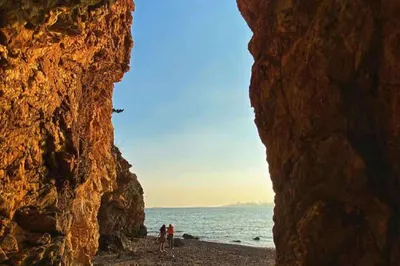
This coastal path leads to a prominent cape, a great spot for sunset watching.
If crowds are thin, you can find a good spot, quietly wait for the sun to set, and soak in the superb view. After sunset, head up to Nine Zhang Cliff, where there’s an Instagram-worthy lighthouse to check out.
The next day we went on a sea excursion. In the morning, we visited a small island recommended by our homestay (locals also call it Diaoyu Island). The departure point wasn’t Changdao port but a small dock on North Island; a car took us straight there.
On the way, the boat hauled up a cage of seafood from the sea—included in the cost. On the island you can comb the beach, swim, fish, and there’s even a sizable inland lagoon with various activities like jet skis and small boats. Half the island is a hill you can climb for views; there were lots of daylilies in bloom when we visited, and some seniors were picking them. Walking around and playing took about two to three hours.
When you’re tired, you can have the earlier catch cooked for you (free—just steamed in a large stackable steamer). The beauty of seafood is that simple preparation brings out great flavors.
In the afternoon, we headed to Ten Thousand Birds Island. Note that there are actually three types of tours on this route. The ordinary large boat tours come in two kinds, with quite a price difference. The cheaper one has a shorter route and less time, so it’s not really cheaper—it’s less content. There’s also a speedboat option, a faster small boat. It depends on your preference: if you like thrills and don’t mind comfort, go for the speedboat. If you’re confused, just buy tickets at the Changdao port.
Feeding seagulls at Ten Thousand Birds Island is a delightful experience, perfect for seniors and kids. Here’s a photo tip: hold a sausage or bread (sausage works best) and let the gulls peck at it while you snap a candid expression—definitely a surprise. No photo here, because safety first!
All boat trips, including the ferry between Penglai and Changdao, offer seagull feeding. If interested, stock up on bread and sausages in advance. Ten Thousand Birds Island is worth visiting—the scenery is nice and the number of gulls is on a whole different level, quite spectacular. Also, you can upgrade to the upper deck on the large boats for a better view and easier feeding, but the regular deck already has spacious platforms and works fine. It’s up to personal taste. If you decide to upgrade, do it right after boarding to secure a good spot near the rail; try not to switch mid-way—it’s pretty much the same otherwise.
On the return from Ten Thousand Birds Island, we stopped at Miao Island. There’s a temple called Xianying Palace, a Mazu temple. It’s the earliest, largest, and most influential Mazu temple in northern China, honored as the ‘Northern Court of the Heavenly Consort’ and the ‘Divine Land of the North Sea.’ Inside is the world’s only surviving bronze statue of Mazu from the Song Dynasty. The grilled fresh squid at the island’s pier tastes decent—just watch the time and don’t miss your boat back.
The whole trip takes three to four hours. You can board right after lunch and return around 5 p.m. Try to pick a later departure so you can watch the sunset from the boat—though that means dinner will be late. We returned around 5 p.m., with the sun still high and colorful aquaculture rafts dotting the sea—beautiful scenery. There are many island-hopping tours from Changdao; you can check the schedule at Changdao port, and some islands even offer accommodation.
At night we stayed on South Island, in a serviced apartment at Mingzhu Square. It had a kitchen, and the window faced the square directly. Nearby was a seafood market—more like a wet market without processing services. Rumor had it you could buy cheap seafood and cook it yourself, but the market closed early; we got there after 5 p.m. and it was shut, so go early if you’re keen. South Island is more developed, and Mingzhu Square especially so, with plenty of dining, drinks, and entertainment. Nearby there’s a whole street of night-market barbecue stalls—lots of options, prices clearly marked, though seafood isn’t cheap.
On the third day, we explored South Island. The Wangfu Reef scenic area was closed for environmental protection, with no reopening date announced. At the southern tip of South Island, Forest Sea Park is great for a stroll if you have the stamina.
The park has a long glass observation walkway along the sea—excellent for ocean views.
You can also climb to see the dividing line between the Yellow Sea and the Bohai Sea, and take in a full view of Changdao from the viewing platform.
Transportation on Changdao is a hassle. I’ve seen people online asking whether you should charter a car—my advice: yes. Negotiate a price with your accommodation or a reliable taxi driver for all transfers during your visit. The driver may be late sometimes, but at least you won’t be stranded; during midday and evening, you simply can’t get a taxi, no matter which app you use. Cycling is an option, but shared bikes on Changdao are outrageously expensive, and long daytime rides are a test of endurance.
Overall, Changdao is suited for family trips. Rent a suite for the weekend, take the kids and elders to the beach, feed seagulls on a boat trip, and sample the seafood. The tourism infrastructure—accommodation, dining, activities—still feels a bit lacking, so some people might find it just okay. It depends on personal expectations.
We left Changdao at noon and took a train to Qingdao.
Around noon we found a highly rated restaurant near Penglai Port—good flavors at a reasonable price; the mackerel dumplings were quite delicious. Also, try the figs this season—they’re tasty. You’ll see many fig orchards; the taste is much milder than Xinjiang figs, which are incredibly sweet.
Qingdao, as an established tourist destination, should be very well-developed and convenient, but it ended up being the most frustrating part of the trip:
On the fourth day of our trip, it was raining in Qingdao and a bit chilly. We visited Badaguan in the city center. It’s mainly eight roads (now ten), named after passes of the ancient Great Wall. Each road is lined with different trees, so the scenery changes with the seasons. By the time we went, the flowering season was over, but the views were still lovely, with villas of various architectural styles. Roadside signs indicate sightseeing spots; you can visit according to your interest and time (some charge extra fees).
Badaguan is a great place for photos.
After Badaguan, we planned to have lunch at Pichai Yuan. Online reviews said it was just a tourist check-in spot and quite mediocre, but we still wanted to see it. We took a taxi. The driver was very friendly, chatting the whole way with recommendations and warnings: the Beer Museum was worth a visit, the best beer comes from a certain factory, and many shops outside the museum were scams. Then he said Pichai Yuan had nothing special—just a commercial street with overpriced food—and pivoted to recommend a restaurant in a nearby alley that locals frequented for authentic seafood cooking. Without overthinking, we agreed to go. It was a large storefront advertising itself as an ‘old and famous’ brand. The owner greeted us warmly as soon as we stepped out of the cab, touting their yellow croaker—one fish prepared three ways, freshly weighed while alive. Only when it arrived did we realize it was essentially Chongqing grilled fish style, which seemed absurd for seafood. In the time we were there, five or six groups came in, all dropped off by taxis. Checking Dianping, I found it was actually a new restaurant, not an old one. Sensing something off, we only ordered the fish and a discounted clam dish. The meal cost nearly 400 yuan for two; I saw the average per person on Dianping was 200–300. More importantly, the taste was just mediocre. So the ‘Qingdao prawn’ scam isn’t an isolated incident—never trust a Qingdao taxi driver’s recommendation; they’ll rip you off without mercy!
Also, transportation in Qingdao is inconvenient for tourists. The downtown attractions are clustered together and easy to reach, but getting to places like Mount Lao or Golden Beach is a hassle unless you’re rich enough to hire a private car.
Visiting Mount Lao is a definite trap. I read some guides beforehand, but they only covered how to tour, not how to get there. From downtown, without renting a car, hiring a car, or joining a tour, you can only take a bus (or metro plus bus)—over an hour. But that’s not the biggest problem. Mount Lao is split into a southern route and a northern route, with most people taking the southern one: Yangkou, Jufeng, and Liuqing. You can buy a combined ticket for these three, so naturally you’d think you can reach them by scenic shuttle once you’re at the Mount Lao area. However, Yangkou, the most recommended spot, has no direct scenic bus. At the information desk, crowds ask how to get there, and the staff give a crazy suggestion: drive around the outside of the scenic area, supposedly 40–50 kilometers. Alternatively, transfer within the area: take the scenic bus to Liuqing (Taiqing Palace), then another scenic bus to Yakou parking station, then local bus 618 to Yangkou—another hour’s ride. So if you’re staying downtown and planning a day trip to Mount Lao and want to see Yangkou, you’ll only have time for that one place. Don’t try to pack in too much, because the round trip alone takes nearly four hours. You can drop by Huayan Temple and Taiqing Palace along the way if you like.
The Tianyuan area at Yangkou is indeed beautiful—with strange rocks, forested hills, and sea blending with sky. Yangkou has a cable car, but from the upper station to Tianyuan there’s still quite a trek; it’s not easy. The bay at the foot of the mountain is good for swimming and splashing around. Bus 618 passes several stops along the way; the small villages en route have many homestays, some facing the sea. If you’re interested, you can stay inside the scenic area—though transportation is inconvenient!
While climbing Yangkou, you might spot monkeys. If you have time, check out Taiqing Palace, commonly called the Lower Palace. It’s the birthplace of Mount Lao’s Taoism and the second most important Quanzhen sect monastery. Inside, there are several notable Chinese trumpet vine-entwined cypress trees—especially stunning when the vines bloom.
On the bus back to May Fourth Square, four girls were about to get off at Shilaoren (Stone Elder) station, but the friendly conductor stopped them. ‘Are you heading to Shilaoren Beach? There are still six stops—get off at Hongkong East Road & Haier Road stop.’ The nearby metro station is called Shilaoren Bathing Beach though. No wonder Qingdao buses still have conductors—they really come in handy!
We had dinner at May Fourth Square and took in the night view.
I recommend Signal Hill in Qingdao for a panoramic city view. The scenery was stunning even in the rain, almost mirage-like.
Perhaps Qingdao is just too famous for its own good, resting on its reputation. Without a local guide, traveling to outlying areas is inconvenient; you might be taken by a taxi driver to sample ‘prawns,’ and you won’t know where to find reliable beer. To a Qingdao like this, I can only say goodbye.
Qingzhou is somewhat off the beaten path, though it was originally the chief among the ancient Nine Provinces. Strolling through Qingzhou Ancient City is quite pleasant.
Due to the pandemic at the time, there were few people and some shops were closed, giving it an even more authentic old-town, old-street vibe.
Qingzhou has plenty of delicious food, especially the halal mutton soup recommended in some guides. The small eateries near the old city serve it wonderfully, with griddle cakes as a staple. Old Locust Tree pan-fried buns make a great breakfast, and they’re cheap. The Qingzhou Museum is small but well worth a visit, complementing the Shandong Provincial Museum. Note: when taking the train to Qingzhou, it’s best to go to Qingzhoushi Station; Qingzhoushi North Station is quite far from the city. Worth a trip!
Living up to its nickname ‘City of Springs,’ Jinan offers a route from Baotu Spring Park along the city moat to Jiefang Pavilion. The riversides are dotted with various springs, though you can no longer fetch water from Black Tiger Spring now. Jiefang Pavilion is close to Kuanhouli, a snack street you can head to directly.
Qianfo Mountain has nice scenery, but the popular alpine slide was closed—no word on when it might reopen. The municipal museum at the foot of the mountain is okay, but I’d recommend the provincial museum instead, even though it’s further from the mountain.
Many downtown attractions are close together; you can walk if you’re fit, or cycle—shared bikes are very convenient.
A note about Jinan taxis: especially at the train station, drivers would refuse short trips. Our accommodation was only 2–3 kilometers from the station. Once we got in, the driver looked reluctant, but since we were already in, he immediately asked if anyone else was heading somewhere, looking to share a ride. Since our trip was short, we didn’t object. But even with many empty cabs behind us, no one wanted to share. After creeping forward five or six meters, a young woman with a large suitcase was standing by the road and hopped in when the driver mentioned sharing. She had been first in line but was refused boarding because her destination was too close. She sat in the car, on the verge of tears, saying she’d originally planned to go to Xi’an but a friend convinced her to come to Jinan, and she never expected this. She probably won’t visit Jinan again. There were staff maintaining order at the taxi stand, yet they did nothing about the refusal!
We wrapped up with seafood again, and honestly, the seafood in Jinan didn’t seem more expensive than in Changdao or Qingdao.
Taking the train to Tai’an is very convenient. We stayed near Dai Temple, not far from Mount Tai, and could visit the temple the next day.
We took the traditional route: starting from Hongmen, following the central Imperial Ascent Path through Zhongtianmen (Mid-Heaven Gate), up to Nantianmen (South Heaven Gate), then along Heavenly Street past the summit to Jade Emperor Peak. We set off around 7 a.m. and left Jade Emperor Peak around 2 p.m. From a T-shirt at the base to a jacket at South Heaven Gate and finally a raincoat at the top (it started raining), the temperature changed drastically. At Zhongtianmen there happened to be a climbing competition; we later heard someone made it from Zhongtianmen to South Heaven Gate in under an hour.
We didn’t return the same way but descended via the Heavenly Candle Peak route. The central path of Mount Tai is richer in cultural sights, while the eastern route offers more natural scenery. Compared with the central path, this side was really quiet, ideal for those with good stamina. We finally exited the scenic area around 5 p.m., having spent nearly ten hours climbing up and down. Once out, my legs felt like they weren’t mine, and my knees ached terribly. After dinner, we found a massage place near our lodgings and got rubbed down amid howls of pain. Thankfully, that session loosened things up; otherwise, we probably couldn’t have walked the next day.
Staying near Dai Temple meant we could visit it early the next morning.
Dai Temple is modeled after imperial palace architecture, with the main hall called Tiankuang Hall. It features Tang-era locust trees, Han-dynasty cypresses, a bronze pavilion, an iron pagoda, and the Qin Dynasty’s Li Si Stele. Along with the Forbidden City, the Three Confucian Sites in Qufu, and the Eight Outer Temples of Chengde Mountain Resort, Dai Temple is considered one of China’s four great ancient architectural complexes. We spent about two hours here.
We took a high-speed train to Qufu, which was very convenient—frequent and quick.
The Three Confucian Sites consist of the Kong Family Mansion, the Temple of Confucius, and the Cemetery of Confucius. At the cemetery, you can take an electric shuttle to various points; walking would be quite far. Also, renting an audio guide is recommended, otherwise you’ll just be staring blankly. The three sites took about three hours to tour.
Changdao, Qingdao, Qingzhou, and Jinan were visited in July 2020, while Tai’an and Qufu were done on a weekend in September 2018.
1. Overall, I think Shandong has excellent tourism resources. The locals embody the straightforward warmth of northerners, friendly and hospitable. However, the supporting infrastructure is quite mediocre and not friendly to independent travelers, especially the local transport—I’m not talking about intercity transport, but the small-scale connections at tourist sites. You can build as many high-speed railways as you want, but if the last-mile transport doesn’t keep up, it’s still inconvenient. That said, Tai’an and Qufu have very good transport; these two places are already highly developed.
2. For summer trips, bring a pair of crocs; they’re great for rain and handy at the beach. And about the claim that Qingdao never floods when it rains—that’s definitely toxic ‘chicken soup’ (a misleading feel-good claim).
3. All the Instagram-famous Catholic churches—Qingdao’s St. Michael’s Cathedral, Jinan’s Xianwen Village Catholic Church, and even the one in Qingzhou Ancient City—were closed to visitors due to the pandemic, viewable only from outside. Not sure if they’ve reopened; it’s best to check before going!
4. Climbing Mount Tai is physically demanding, so a walking stick is a must. They’re sold at Hongmen and Zhongtianmen. Bring some juicy fruits; water is available along the way and not overly expensive even at Heavenly Street, so don’t overpack. But remember to drink regularly instead of waiting until you’re thirsty. The visitor facilities on Mount Tai are very user-friendly: you can take a vehicle straight to Zhongtianmen, then a cable car to South Heaven Gate, reaching the summit with almost no effort—though there’s still a climb from South Heaven Gate to Jade Emperor Peak. Even the elderly or those with mobility issues can make it to South Heaven Gate. Choose your route based on your fitness. If you’re fit, I recommend descending via the Heavenly Candle Peak route for the great scenery. Allow plenty of time and pack some high-calorie snacks. There’s a huge temperature difference between the base and the summit; even in summer, bring long sleeves because after sweating you’ll feel quite chilly at the top. A raincoat is also a good idea, as the weather on Mount Tai is changeable. We had clear skies at the bottom but drizzle at the peak, so catching the sunrise is a gamble. If you plan to visit Dai Temple and the Three Confucian Sites, do them before climbing Mount Tai; otherwise, you might end up like us, unable to bend your knees going down stairs!
5. Local Shandong cuisine tends to be on the salty side, so when ordering at authentic restaurants, ask them to go easy on the salt.
6. With convenient intercity transport nowadays, these Shandong destinations are great for weekend trips, especially Changdao and Qingzhou for a relaxed weekend. Mount Tai is a bit tiring, but if transport is handy and you have limited time off, you can split the visits.