Shandong Travel: Reflecting on the Legend of the Eight Immortals Crossing the Sea at Penglai (Photo)
Penglai in Shandong is a place of many legends, considered a fairyland. I recall on July 29, 2015, I joined the capital media's Penglai tour, and the final stop was the Eight Immortals Crossing the Sea Scenic Area. This is where, according to mythology, the Eight Immortals crossed the sea, so visiting this scenic spot—also known as Baxian Ferry or Baxian Crossing—while reflecting on the ancient legends was a truly unforgettable and wonderful experience.
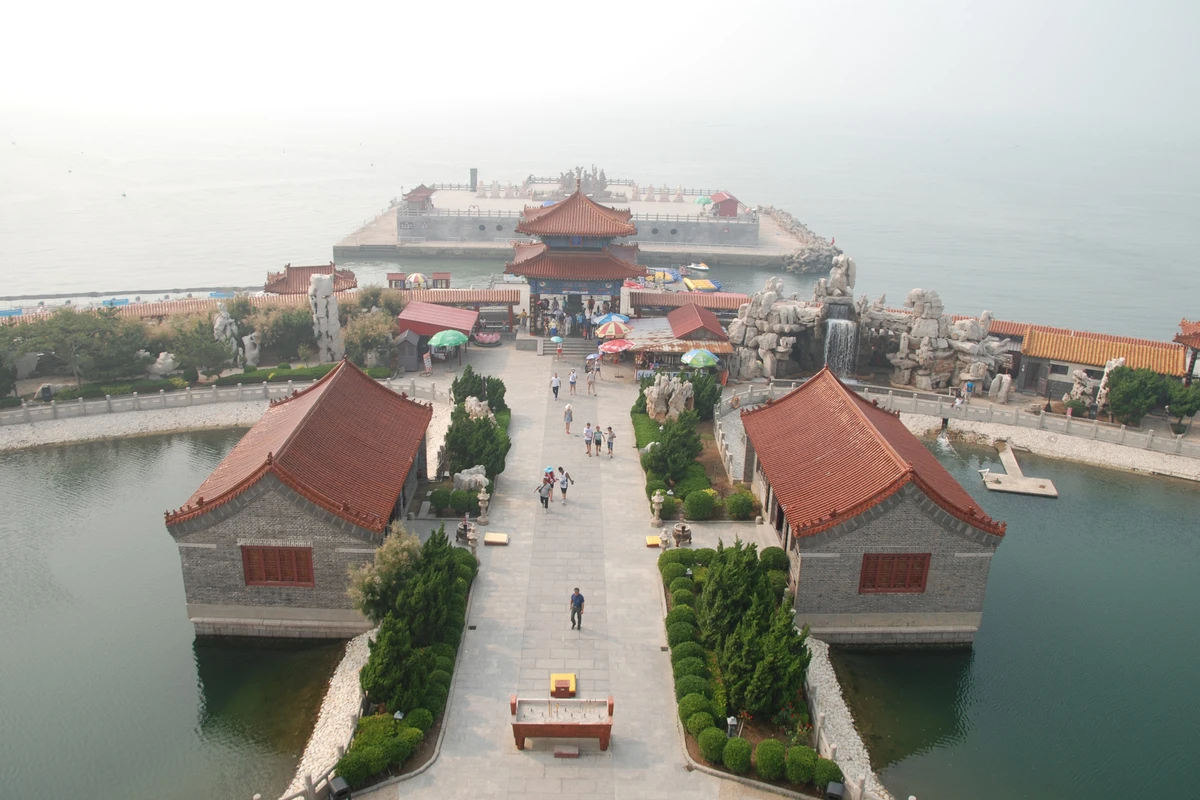
Aerial panoramic view of the Eight Immortals Crossing the Sea Scenic Area
After taking an electric sightseeing cart from the Europark Dream World, it was about ten minutes' drive to the Eight Immortals Crossing the Sea Scenic Area by the sea. This national AAAAA-level scenic spot is located on the northern Yellow Sea coast of Penglai, facing Danya Mountain, Penglai Pavilion, and Changshan Islands across the water. The entire area is shaped like a treasure gourd lying on the sea, comprising nearly 40 attractions including the Eight Immortals Archway, Eight Immortals Bridge, Wangying Tower, Eight Immortals Shrine, Huixian Pavilion, and Bai Xian Terrace, plus surrounding features like the seaside platform, sightseeing corridor, exotic rock forest, seal island, and speedboat tours.
Stone archway at the scenic area (Photo: Feng Ganyong)
Entering the Eight Immortals Crossing the Sea Tourist Area, a stone archway bearing five large characters 'Eight Immortals Crossing the Sea' catches the eye. It was inscribed by Su Shi, the great literary figure of the Song Dynasty, when he served as prefect of Dengzhou. The name speaks for itself: the place where the Eight Immortals crossed the sea. And with our arrival, we had now set foot in the legendary spot.
Panoramic view of Eight Immortals Crossing the Sea (file photo)
Turning back after passing the archway, you see four characters on the back reading 'Fairyland on Earth,' also inscribed by Su Shi (Su Dongpo) at the same time. In late spring and early summer, mirages often appear over this sea, a spectacular sight, which is why Penglai has enjoyed the reputation of a fairyland since ancient times.
Statue of the Eight Immortals crossing the sea (Photo: Feng Ganyong)
Walking along the sightseeing path, the guide explained: Look, the scenic area resembles a treasure gourd lying on the sea. Legend has it that when the Eight Immortals crossed the sea using their own magical tools, Iron Crutch Li threw his treasure gourd into the sea, rode it across to show his power, and later this spot transformed into an immortal island shaped like a gourd. Clearly, the scenic area was built based on these ancient tales.
Seagulls flying in the scenic area (file photo)
Strolling through the area, you see the boundless sea beside you, where countless seagulls—reputed as birds of good fortune—leisurely play on the water or freely soar between blue sky, white clouds, and turquoise sea. Why are they so content here? It seems they also know this is a fairyland. As the old saying goes, phoenixes don't land on barren places. Since immortals cultivate themselves here, the seagulls, like humans, also want to soak up the immortal aura.
A corner of the scenic area (Photo: Feng Ganyong)
At the national-level Penglai Eight Immortals Crossing the Sea Scenic Area, the well-preserved ecological environment is evident. Through this scene, one can witness the harmony between man and nature, which inspires greater respect and care for the ecology. It seems quite logical that immortals chose this place for self-cultivation, gatherings, and crossing the sea. Today, when people come to pay homage, pray, and tour, the immortals will surely bring them peace and good fortune.
Exterior view of the scenic area at dusk
We casually walked onto a bridge called the Eight Immortals Bridge. As the story goes, the Eight Immortals took it as their mission to punish evil, promote good, and help those in need. Their many tales are deeply rooted in people's hearts, and meeting them is considered a blessing. Thus, this bridge is naturally filled with auspiciousness and fortune; whoever walks on it is blessed. The guide said: 'As the local saying goes: Stand on the Eight Immortals Bridge, and you'll be safe from disaster; walk across it, and you'll enjoy blessings and longevity all your life.'
Stone archway of 'Cloud-Outer Immortal Capital' (Photo: Feng Ganyong)
Walking on, we faced an archway inscribed with four large characters 'Cloud-Outer Immortal Capital' by Mi Fu, a great calligrapher and contemporary of Su Dongpo. This 'Cloud-Outer Immortal Capital' is a place where immortals gather to cultivate, an auspicious blessed land. Turning around further inside, the back of the archway bears 'Attaining Dao and Becoming Immortal' written by Huang Tingjian, another calligrapher of the same era. I've already seen so many 'immortal' characters along the way; any visitor to the Eight Immortals area might, by soaking in the immortal air, attain immortality themselves. Of course, that's a joke, but it seems to be a dream for many.
Xianyuan Tower (Photo: Feng Ganyong)
Suddenly we arrived at a tower called Xianyuan Tower, its name meaning 'Source of Immortals,' inscribed by Emperor Taizong of Tang, Li Shimin. Legend has it that when Li Shimin conquered Goguryeo and passed through here, he witnessed a mirage: auspicious clouds swirling, pavilions appearing and disappearing, immortals moving about. In awe, he dashed off 'Xianyuan.' The meaning: Penglai is the origin of Chinese immortal culture in the east, the homeland of immortals. Stepping through the Xianyuan gate, one enters a fairyland.
Wangying Tower (Photo: Feng Ganyong)
Looking down, the couplet on both sides of the door reads: 'Purifying the mind leads to clarity; comprehending the Dao brings coolness.' It was composed by the contemporary master calligrapher Ouyang Zhongshi during his visit. The couplet means that only by having a clean heart, few desires, and indifference to fame can one truly grasp the profundity of the Dao and pursue the highest realm of emptiness and non-action. It advises people to be open-minded, carefree, detached, and tranquil. Shedding worldly restlessness, the mind naturally feels refreshed and untroubled.
Shunxin Pavilion (Photo: Feng Ganyong)
We came to a crescent-shaped screen wall called the Eight Immortals Wall, which depicts the story of them crossing the sea. As told, the Eight Immortals, after many trials, attained the Dao and became immortals. One day, they gathered in Penglai for a drink and, on a whim, decided to cross the sea without boats, each using their own powers. Arriving here, Han Zhongli first threw his fan, which instantly expanded to the size of a reed mat and floated. He leaped onto it and drifted away. He Xiangu, not to be outdone, tossed her lotus flower, which grew as big as a millstone, glowing red and fragrant; she stood gracefully on it, riding the waves. The other six then cast their own treasures into the sea and floated over the blue expanse. Their magical artifacts shook the Dragon Palace, enraging the Dragon King. He sent his son to investigate, and the Dragon Prince tried to seize the treasures, leading to a fierce battle. Later, through Guanyin's mediation, both sides ceased fighting, and the Eight Immortals finally crossed the sea. This left the well-known saying: 'The Eight Immortals cross the sea, each showing their prowess.'
Huixian Pavilion (Photo: Feng Ganyong)
Passing the screen wall, we reached an intricately carved tower called Wangying Tower. The plaque 'Wangying Tower' was written by the leading contemporary calligrapher Mr. Qi Gong. According to Sima Qian's Records of the Grand Historian, there are three immortal mountains off the eastern sea: Penglai, Yingzhou, and Fangzhang, where immortals live and elixir of life grows; their towers and pavilions are made of gold and jade. Climbing this tower, one can gaze at those sea-surrounded immortal mountains. Wangying Tower has six floors: four above water and two underwater, housing an ocean world that displays hundreds of rare marine creatures, including dozens of sea turtles and hundreds of sharks, the largest nearly three meters long and weighing over 300 jin. The sharks can even be playful: one allowed a diver to swim hand-in-hand, which was truly astonishing.
Aerial view of Wangying Tower (Photo: Feng Ganyong)
We arrived at 'Liuxiang Xuan' (Fragrance Pavilion). Legend has it that when He Xiangu crossed the sea, she stopped here. At that moment, her lotus flower was in full bloom, so she casually plucked a petal and left it, and ever since, a faint lotus fragrance has wafted through the pavilion, hence the name. The waterside pavilion to the west is called Qingfeng Xie (Clear Breeze Pavilion), with the couplet: 'Playing the qin by the pond, the moon reflects; drinking wine to the immortal pavilion, sipping the breeze.'
Distant view of Penglai city (Photo: Feng Ganyong)
Ahead by the rockery stands the bell tower. Striking the bell five or six times brings blessings; seven or eight times brings great luck. Visitors can ring it to pray, each toll having a different meaning. To the west is the drum tower, where the drum sounds farewell the evening, and fishing boats sing at sunset to greet the morning tide. Listening to the morning bell and evening drum helps one cast away all worldly troubles.
Circular corridor (Photo: Feng Ganyong)
Looking up at Wangying Tower, the plaque reads 'Tian Feng Hai Tao' (Heavenly Wind, Sea Waves), inscribed by the master Liu Haisu in 1982 at the age of 88 during his visit. The couplet below—'Climb this tower to listen to the waves and embrace the sea; wait for distant boats, welcoming and seeing off'—was written by the contemporary calligrapher Ouyang Zhongshi. It signifies that from here, the magnificent sea view is unobstructed, the sound of waves refreshing and pleasing. Every day, crowds of visitors come and go, as immortals warmly welcome and bid farewell to all. Deeper meaning: everyone is a passerby in nature, with hellos and goodbyes in an endless cycle; life is but a fleeting moment, so cherish life and love living.
Overlooking the Eight Immortals scenic spot (Photo: Feng Ganyong)
The building in front of Wangying Tower is the Eight Immortals Shrine. At the gate stands a child holding a tray, the Boy of Wealth, who bestows riches and fortune on the generous. Facing the gate is the main hall; its plaque 'Eight Immortals Shrine' was written by the famous contemporary calligrapher Liu Bingsen, and the couplet 'The heavenly palace gates open; the Eight Immortals cross the sea at Penglai' by the nationally honored artist and scholar Yang Renkai. Inside is enshrined the world-renowned Eight Immortals. The west side hall is the God of Wealth Hall, housing the Civil and Martial Gods of Wealth, the Matchmaker, and the Star of Literature. The east side hall is the Blessing Hall, with the gods of Fortune, Prosperity, Longevity, and Happiness.
Scenic area bordering the sea (Photo: Feng Ganyong)
In the center of the shrine are the Eight Immortals who crossed the sea. To their east are the gods of the four directions: Azure Dragon, White Tiger, Vermilion Bird, and Black Tortoise, who under the orders of Taishang Laojun govern the 28 lunar mansions and protect the human world. To the west are the gods of wind, rain, thunder, and lightning. Among the Eight Immortals in the middle, the first—the most handsome—is Han Xiangzi, said to be the grandnephew of the great Tang poet Han Yu, unrestrained by nature, with his treasure a flute. The second is Han Zhongli, the earliest to become immortal, originally named Zhongli Quan from the Han Dynasty, his treasure a palm-leaf fan. The third, the ugliest yet highest in Daoist power, is Iron Crutch Li. His large gourd contains elixir to cure all ailments, hence also called the Medicine Immortal; in the rear area there's a large white marble gourd, said to be left by him. The fourth is the eldest, Zhang Guolao, known for riding his donkey backwards. Why? A saying goes: 'After meeting many, none compare to this old fellow; not that he rides backwards, but he looks back at things.' This cautious old man looks back to learn from experience; his treasure is a fish-drum.
Photo with the Eight Immortals (Photo: Yang Jun)
The fifth is the leader of the Eight Immortals, Lü Dongbin, styled Chunyangzi. He failed the imperial examinations twice in the Tang Dynasty, then retreated to Zhongnan Mountain to cultivate the Dao. Legend says he could turn stone into gold; his treasure is his yin-yang sword. The sixth is the only female immortal, He Xiangu, from Zengcheng, Guangdong. As a poor girl, she gathered wild fruit for her mother while eating mica powder herself. Her filial piety moved heaven and earth, and she became an immortal; her treasure is a blooming lotus. The seventh is the youngest, Lan Caihe, who became immortal at just 14; her treasure is a flower basket. The last to become immortal is the imperial relative Cao Guojiu, from the Song Dynasty, originally named Cao Quan. Disgusted by his brother's abuse of power, he saw through the world, gave away his wealth, and went into the mountains to cultivate, eventually joining the immortals; his treasure is a jade tablet.
Statue of Yuchi Gong (Photo: Feng Ganyong)
Reaching the northern part of the scenic area, the circular sightseeing corridor encloses the whole site. Here there are islands within the sea and sea within islands. Before us is the Jade Pool, where local sea cucumbers and various fish are raised, and in its center stands Huixian Pavilion. By the roadside, a large gourd is said to be left by Iron Crutch Li. The local saying goes: 'Rub the gourd's head, never a worry ahead; rub its bottom, and illness is forgotten.' Visitors touch it for a bit of immortal aura to ward off misfortune and sickness. To the west, a divine donkey, reputedly Zhang Guolao's mount, invites the curious to ride and experience the fun of looking back.
Ornately decorated corridor (Photo: Feng Ganyong)
We arrived at the Immortal Worship Altar. According to Sima Qian's Records of the Grand Historian, the Qin Emperor and Han Emperor came to the East Sea seeking immortals and the elixir of life, so they built this altar and held grand worship ceremonies here. The spectacular events, with drumming and firecrackers, resounded across the three immortal mountains of Penglai, Yingzhou, and Fangzhang, praying for blessings and peace. Lighting firecrackers to worship immortals and pray has since become a traditional custom.
Elegant moon gate (Photo: Feng Ganyong)
Passing the Mazu Hall and Dragon King Palace, the majestic 42-meter-tall ancient building ahead is Huixian Pavilion, meaning a gathering of immortals and a meeting place for mortals with immortals. It brings together 72 of the most representative Taoist deities, including the highest gods—the Three Pure Ones and Four Sovereigns—as well as the Dipper Lords, the Four Merit Officers, the Goddess of the Nine Heavens, Qianliyan, Shunfenger, and 32 other immortals. In the basement Hui Xian Hall, 40 more immortals are enshrined, such as the Beast-Taming Eight Immortals, Zhuangzi, Jiang Shang, and An Qigong.
Waterside pavilion (Photo: Feng Ganyong)
The plaque 'Huixian Pavilion' and the couplet 'Often praised as Hong Kong's gateway to the sea, yet see immortals gather in Penglai' were written by the contemporary master calligrapher Ouyang Zhongshi, while the plaque 'Wrapped in Clouds, Sleeping in Snow' on the other side was inscribed by Shen Peng, chairman of the Chinese Calligraphers Association. Look at the large characters on the main gate: 'The Gate of All Wonders,' meaning that stepping through, you can feel the profundity of Taoism inside. Climbing to the top and leaning on the railing, the blue sea and sky stretch endlessly before you, just as the famous writer Yang Shuo described: 'Looking at the vast, clear, and bright sea and sky, it can truly wash your innards completely clean.' Climbing the pavilion and viewing the sea is considered the process of attaining the Dao and becoming immortal.
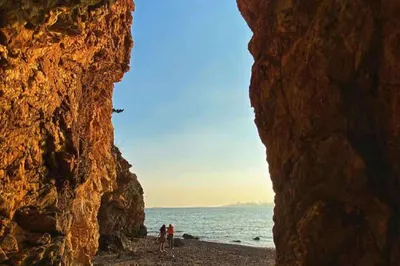
Beach outside the scenic area (Photo: Feng Ganyong)
I climbed 93 steps to the fourth floor; the upper floors were closed, and the door from the fourth floor to the observation deck was also shut. So I descended to the open deck on the third floor, walked around, and gazed into the distance. The boundless sea under the high sky presented a spectacular view. It's said that in late spring and early summer, mirages often appear here, ethereal and breathtakingly beautiful. Thus, the two-day capital media Penglai tour came to a perfect close.
Huixian Pavilion at sunset (file photo)
Though the Penglai tour lasted only two days, it was deeply moving. For millennia, the legend of the Eight Immortals crossing the sea, the wonder of mirages, the beauty of blue seas and skies, and the stories of Qin and Han emperors seeking immortals have made Penglai the premier destination for worship, prayer, and sightseeing. Only by visiting in person can one truly appreciate its reputation as 'The Fairyland on Earth, a Leisure Paradise.' In fact, the Eight Immortals Crossing the Sea Scenic Area, rooted in Taoist culture and Penglai mythology, centers on the Eight Immortals legend to explore, promote, and carry forward their cultural image and spirit, forging their unique charm. It advocates the spirit of 'each showing their prowess while pulling together'—competition without forgetting harmony, and harmony without abolishing competition. Farewell, Penglai! Given the chance, I will definitely return. (Text and photos: Feng Ganyong)