Qingdao in July: Chasing the May Wind and Instagram-Worthy Island Vibes
After 13 years, meeting Qingdao again
Life is full of firsts — first day of school, first graduation, first trip, and first graduation trip. My first graduation trip started in Qingdao. It was the first time I traveled without my parents, instead with classmates, on a unique junior high graduation trip. 13 years later, meeting Qingdao again, both myself and the city have changed a lot. Summer in Qingdao is cool, with hardly any sweltering heat. Walking through the city, feeling the natural sea breeze, the sensation is truly magical. This time in Qingdao, besides visiting classic routes, I also explored some lesser-known photo spots. I have to say, Qingdao is full of hidden Instagram-worthy attractions everywhere.
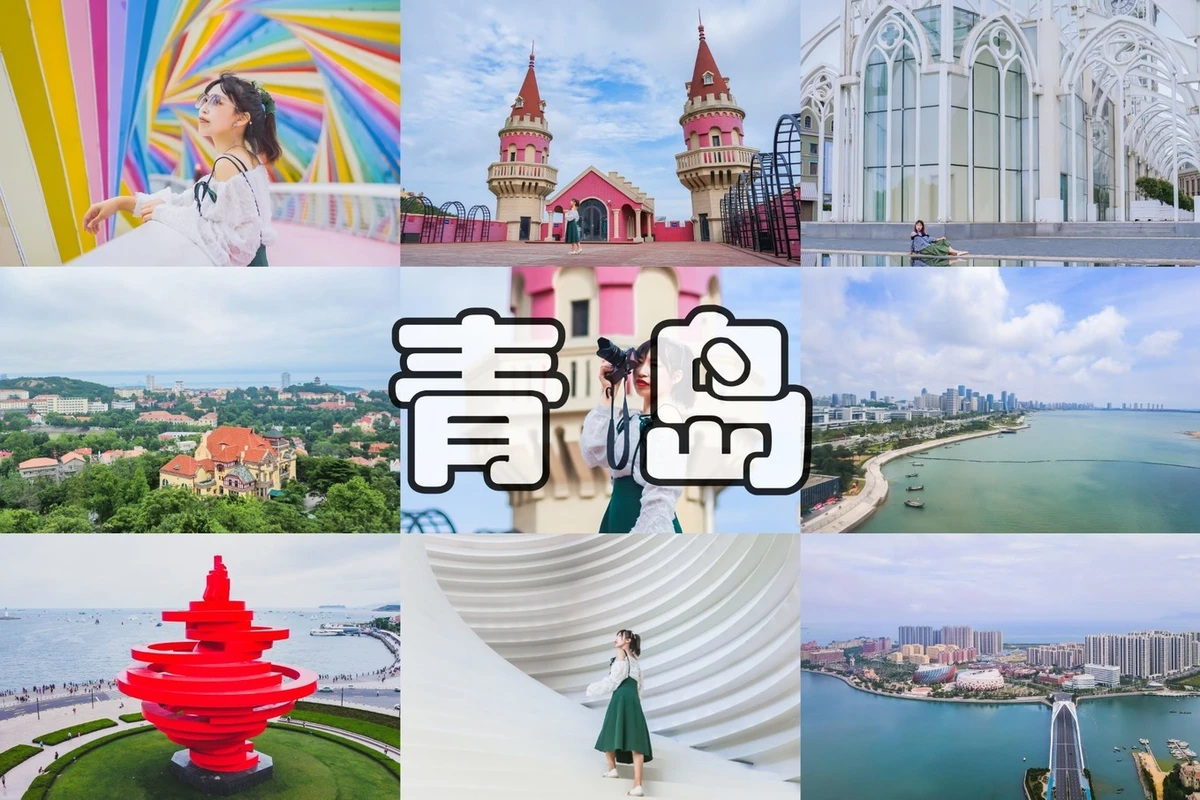
Qingdao has countless Instagram-worthy spots, and this trip focused on both classic and offbeat places. Together with my friends, we embarked on a Qingdao-exclusive photo walk. Classic route: St. Michael's Cathedral — Signal Hill Park — Old Stone Man Bathing Beach — May Fourth Square. Instagram-worthy route: Shell Bridge → 💒 Pink Castle → 🌊 Joyful Bay → ⛪ Openwork Church → 🎡 Eye of the Sea → 🌈 Rainbow Bridge → ✨ Starlight Island.
I love Qingdao with its coastal hills. Qingdao has so many tourist attractions that even after two visits, I still haven’t seen them all. Qingdao has distinct four seasons and humid air, but the summer heat isn’t intense — making it a great choice for a summer trip. There are many famous sights, and most people come specifically for them. My first stop this time was St. Michael's Cathedral, a solemn and holy place, a gem of Qingdao tourism and the only consecrated cathedral in China.
St. Michael's Cathedral is also Qingdao’s most iconic building. Before the founding of the People's Republic of China, it was the tallest structure in Shandong province. Its other name is St. Michael’s. In the Bible, St. Michael is an archangel who fought against the devil, and through his victory, humanity was saved.
The architectural style of St. Michael's Cathedral is worth noting. It was designed by German architect Arthur Bialucha, based on Romanesque and Gothic styles. Construction took two years, completing in 1934. World War II had already broken out before construction began, but since Germany prohibited capital outflows, the cathedral was built with some modifications, resulting in its present appearance.
The art of St. Michael's Cathedral is worth admiring. As a representative Christian building, it conveys the solemnity of Christianity and Biblical stories. The church covers 6,301.54 square meters, and its tower rises 56 meters high. The exterior is quite striking.
The church is built with reinforced concrete, appearing grand yet simple. The semi-circular arched windows and doors look elegant and dignified, with smooth lines, overall dominated by simplicity. The vivid color comes from the red tiles covering the conical spires, exuding a minimalist designer feel.
Entering the cathedral, you immediately feel a sense of purity and solemnity. It is very clean and tidy. The spacious and bright hall can hold over a thousand people, and the lighting is soft. The altar features distinctive design, and the murals of sacred figures are highly ornamental. Some decorative elements reflect the Italian Renaissance style.
Standing inside, surrounded by a strong religious atmosphere and meaningful architectural details and paintings, such solemnity and beauty truly befit China’s only consecrated cathedral.
When visiting Qingdao, many people come specifically for this holy cathedral. Photography enthusiasts also come to capture it, and even newlyweds choose it as a backdrop for wedding photos. Art lovers also sketch the cathedral’s silhouette here.
The cathedral we see today is a solemn, sacred place. It not only attracts visitors from afar but also integrates into the daily life of Qingdao locals. In their leisure time, residents come to stroll and relax here, and upon seeing such a sacred and solemn church, any inner turmoil gradually subsides.
The city of Qingdao always surprises me. I came with romance and dreams to this beautiful coastal city, to experience the blue skies, blue seas, and mountains embracing the ocean. Summer in Qingdao is pleasantly cool, perfect for escaping the heat. As one of China’s first open coastal cities and home to the “World Beer City” title, the city brought me many surprises.
After arriving, you’ll realize there’s so much to explore, and you’ll fall in love with this beautiful coastal city. The deep blue sea and ocean views vividly display Qingdao’s unique beauty. The city has many iconic structures; the observation deck at Signal Hill Park is one of the most representative and something I had been looking forward to.
Signal Hill Park is the highest hill in downtown Qingdao, offering a panoramic view of the entire city. Its location is excellent, situated in the heart of the old town, close to many famous sights like St. Michael's Cathedral, the Naval Museum, and Lu Xun Park. Transportation is convenient, with the train station and bus stops nearby. Though it’s the highest point in the city, Signal Hill only rises 98 meters above sea level.
Hiking in Signal Hill Park isn’t too hot because of the abundant vegetation. Breathing the fresh air with its high concentration of negative ions makes the climb a pleasure. Even before reaching the top, I was captivated by the beautiful scenery around the park. Every spot offered a different view, conveying a different mood.
Finally, at the summit, I saw three very distinct red mushroom-shaped towers standing out among the greenery. Shaped like torches, they seem to burn brightly from afar. The mushroom towers are actually a former maritime exhibition hall where you can also enjoy Italian espresso, lychee fizzy drinks, iced Americano, and more. Reaching the highest point, I just wanted to quietly take in the scenery of the Qianhai area and Qingdao city — a rare spot to see so many views at once.
From the hilltop, the distant sea, the overall appearance of Qingdao’s old town, and the far-off Zhanqiao Pier came into view. The fatigue from the climb instantly vanished, replaced by the beauty before my eyes. For the best views, it’s best to visit Signal Hill on a clear day. Green trees, blue skies, white clouds, the sea, and Qingdao’s red-tiled buildings — the photos you take will look like a stunning painting.
The May Wind sculpture, Qingdao in July — after 13 years, I returned to Qingdao again. When you come to Qingdao, you must see the sea. The most iconic landmark is the “May Wind” sculpture in May Fourth Square. Whenever I see promotional material about Qingdao, I always see this red spiral sculpture.
Many visitors come to see the “May Wind,” a fiery red, spiraling wind-shaped sculpture that embodies the patriotic spirit and national strength of the May Fourth Movement — anti-imperialist and anti-feudal.
Coming to Qingdao means you must see the sea. Blowing the sea breeze at May Fourth Square, feeling the taste of the sea, walking along the beach, gazing at the azure water, and feeling the cool breeze — it brought back memories of my youth.
Beyond May Fourth Square lies the Coastal Park. Not only do tourists love it, but locals also enjoy strolling here. Qingdao is undoubtedly a beautiful coastal city, and this waterfront park has become a lovely scenic line.
Across Fushan Bay are the Olympic symbols. This was the only sub-venue for the 2008 Beijing Olympics — the sailing competition venue.
Qingdao’s Huangdao District is truly a paradise for Instagram-worthy spots: 🐚 Shell Bridge → 💒 Pink Castle → 🌊 Joyful Bay → ⛪ Openwork Church → 🎡 Eye of the Sea → 🌈 Rainbow Bridge → ✨ Starlight Island. Every place is full of Instagram-style elements, perfect for girls to take photos, representing dreamy openwork churches, Ferris wheels, dazzling rainbow bridges, and shell bridges.
The Eye of the Sea is the largest sea-view Ferris wheel in Shandong Province. Located on the shore of Tangdao Bay in Huangdao District, it stands 68 meters tall and offers a fully transparent, unbeatable panoramic sea view — you can see the sea in all 360 degrees.
As the sea-view Ferris wheel slowly rises, I could overlook the West Coast from the gondola, taking in the majestic grandeur of greater Qingdao.
Right next to the Eye of the Sea is the Rainbow Bridge. Together they form a popular Instagram spot. Standing on the Rainbow Bridge feels like being on a bridge from a healing fairy-tale world. The colorful geometric lines spiral inward, as if passing through a time tunnel.
The Rainbow Bridge is perfect for photos, and walking on it is very comfortable. With the gentle sea breeze, even during the daytime, it’s not hot at all.
At sunset, by the riverside, I flew a small drone over the water. The little Starlight Island where I stood was so lovely.
The Shell Bridge is another internet-famous bridge in the West Coast New Area. Located on the south side of Binhai Avenue, it’s a coral-shell-shaped bridge connecting Huangdao and Starlight Island. The unique coral shell design is both aesthetically pleasing and modern.
At night, the Shell Bridge lights up brilliantly, and you can also see the dazzling nightscape of downtown Qingdao in the distance.
During the day, I visited the openwork church in the West Coast Mangrove Resort District. The white openwork church is very iconic, its pure and flawless reflection mirrored on the water, beautiful in its solitude. The surrounding buildings are European-style, very fresh and cute — another excellent photo spot.
When we describe Qingdao, we call it a coastal city or a city of exotic charm. But now, Qingdao has gained another title: Oriental Movie Metropolis. To understand Qingdao’s film charm, you must visit the Qingdao Film Museum to learn about the past and present of Chinese cinema. The building itself has also become another Instagram hit.
Qingdao Film Museum is located in the core area of the Lingshan Bay Film and Television Cultural Industry Zone in Huangdao. Approaching the museum, I was deeply attracted by its magnificent castle-like exterior. The dreamy castle, backed by mountains and facing the sea, enjoys an excellent location. It was once one of the venues for the first Shanghai Cooperation Organization (SCO) Film Festival, contributing to Qingdao’s bid to become a “City of Film.”
Walking into the museum, I was amazed by all the high-tech displays, giving a sense of technological wonder. The exhibition highlights the concept of a “river of light and shadow,” cleverly combining images and time. You can not only learn about the history of world cinema but also interact with exhibits, truly experiencing the evolution of film. The design is truly unique.
In the World Cinema Exhibition Hall, you can trace the origins of film from its birth to the present — from the era of celluloid to digital, from black-and-white to color. Familiar film characters and roles bring back memories of the golden age of cinema. Representative works from each era are displayed on the walls, and looking at the movie posters, I recalled the films that accompanied my own growth.
Through holographic displays, VR experiences, green-screen compositing, and other technologies, the museum immerses visitors in the visuals. For example, a digital holographic demonstration of the Titanic shows the scene where the ship hit the iceberg — proving how advanced the technology was back then.
Walking through the Film Museum, following the footsteps of time, I got to appreciate how the film industry developed. The Qingdao Film Exhibition Hall showcases a century of the island city’s cinematic history, from China’s first cinema to its first sound film, and a recreated scene of China’s first movie queen, Hu Die, filming in Qingdao. It deeply reveals Qingdao’s century-old ties with Chinese cinema. The display panels are designed like film strips, making me feel even more immersed as I followed the history of Chinese film.
What surprised me most was the castle on the second floor. The pink castle is full of girlish charm. On this spacious open terrace, you can pose freely for photos, and the results are surprisingly good. Two spired buildings accented with red and pink make you feel like you’re on top of a real castle.
On the second floor, there’s also a lounge area showing movies. The open-air balcony offers nice views. The lobby has a bar and a cultural and creative bookstore. The artistic vibe of the Qingdao Film Museum is vividly displayed.
This beautiful island city has preserved many classic cinematic memories and produced batch after batch of outstanding filmmakers. In the future, even more filmmakers will come here, devoting themselves wholeheartedly to the development of film culture and bringing Qingdao’s film and urban culture to the world.
Qingdao is a city filled with Instagram-worthy elements. Whether it’s St. Michael's Cathedral in the old town or Zhanqiao Pier by the sea, many tourists come specifically to take photos. Today, Qingdao is also known as an Instagram-style destination because there are so many photogenic places. In Huangdao on the West Coast, you’ll find most of Qingdao’s Instagram-worthy spots, from bridges, museums, Ferris wheels to art galleries. The Yellow Box Art Museum by the sea is one of them.
The Yellow Box Art Museum is located in Qingdao’s West Coast New Area. It’s China’s first comprehensive art museum built around the “Yellow Box Theory,” combining art, culture, lifestyle, and academic rigor. An art museum by the sea — utterly romantic. The concept of the Yellow Box comes from traditional Chinese culture, bridging art with life, nature, and commerce so that ordinary viewers can also understand art.
Upon entering the museum, right in the center is a huge spiral staircase. The massive staircase spirals up to the second and third floors — it’s incredibly beautiful. This creative staircase sculpture, called “Angel’s Wings,” stands in the 14-meter-high central hall. The staircase itself is a piece of art.
Angel’s Wings was designed by a renowned designer. The steps form a smooth spiral curve, a challenging feat in architectural design. It unfurls a Silk Road connecting heaven and earth in the museum hall. We could walk up the Angel’s Wings to reach the exhibition halls on each floor. However, during my visit, the second and third floors weren’t open, so I could only take photos on the spiral staircase.
You can reach for the stars or lie on the crescent moon — both make for striking, high-fashion photos. In fact, the staircase is built from white LEGO-like blocks. A spiral white staircase instantly creates a blockbuster look with just a casual snap. It’s like the museum’s name “Yellow Box” — a Pandora’s box about to be opened. The spiraling staircase is equally full of mystery.
There are many artworks inside the museum to enjoy slowly, mainly paintings. There were few visitors when I went, so it was very quiet, perfect for quiet appreciation. If you get tired, there’s a café on the first floor. Grab a coffee, sit at a round table, and enjoy a slow-paced seaside life in Qingdao.
On the first floor, there are also artworks like teapots and teacups, creating a rather homely atmosphere. The Yellow Box Art Museum is built by the sea. You can also walk along the coastal road, feeling the salty sea breeze — very pleasant.
If you want to eat authentic seafood in Qingdao, you must go to a local seafood market, select the seafood yourself, and then have a restaurant cook it for you. So I got the chance to explore a Qingdao market like a local. With so much seafood available, markets are everywhere. Stepping inside, you see a dazzling array of seafood and can soak up the local hustle and bustle.
The variety of seafood in Qingdao is so vast that I couldn’t even identify them all. So I picked some familiar ones, like razor clams and conch.
The abalone at the market was big and fresh, so I couldn’t resist scooping up a basketful.
Qingdao prawns are a must-try local specialty — I had to buy a few jin to taste.
Shopping at the seafood market allowed me to immerse myself more deeply in local life — a pretty special experience.
The purchased seafood ingredients were taken to a restaurant next door for cooking. Here, they mostly use steaming to preserve the original flavor of the seafood.
The abalone was tender and flavorful. One after another, I couldn’t stop eating.
This fish was my favorite — the meat was tender and delicate, with only large bones and no small ones, easy to eat. Paired with the sauce, it was absolutely divine.
If you prefer a nicer ambiance, you can go to Hedou Seafood Buffet in Ginza Mall, Qingdao’s most popular seafood buffet. The variety is incredibly rich, and you must try a few skewers of local grilled Qingdao prawns.
This buffet spares no expense, offering top-quality seafood that’s very fresh and unlimited — giving me complete seafood freedom.
Of course, you must also try Qingdao beer when you’re here. Chatting over a little drink — this is how Qingdao locals enjoy their leisure time.
This time in Huangdao, I stayed at the Mangrove Tree Resort Hotel. This coastal area is full of resort hotels, and Mangrove Tree is one of the larger ones.
The lobby style leans toward modern Thai, with abundant exhibits, making it feel like browsing a museum.
Entering the room, I was surprised by its enormous size. Besides the bedroom, there’s a separate walk-in closet and a bar/workspace area. Outside the window is the blue sea and sky — a true vacation setup.
The washbasin is also large, with two sinks to accommodate two people’s needs.
Meeting Qingdao once again, I explored many Instagram-famous spots with my friends, leaving behind more unique memories. Qingdao is vast, and I know there are still many places I haven’t visited — Zhanqiao Pier, Badaguan… Maybe next time, it’ll be soon.