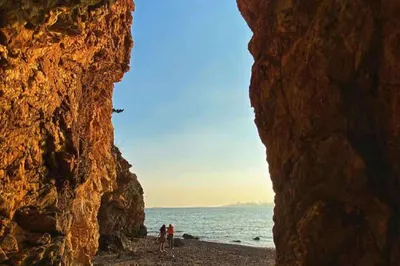
Qingdao Weekend Family Trip | Qingdao Has More Than Just the Sea — A Kids’ Paradise
Qingdao is a city of red tiles, green trees, and blue seas and skies.
Summer memories are always linked to the ocean. I remember Kang Youwei writing in a letter to his family: “Qingdao is red tiles, green trees, blue sea, blue sky.” Qingdao has always been a city I’ve wanted to bring my little ones to. It’s so close to Beijing — just three hours by high-speed train, and we’re at the seaside with the kids. We all love a slow, unhurried pace. The old town hides many stunning corners; even if you don’t head to the main sights, simply wandering around is a kind of romance.
Lu Xun Park — gazing at the city’s most classic coastline
In the historic Lu Xun Park, follow the seaside boardwalk and gaze out at the city’s most classic coastline. At First Bathing Beach, the kids watched curiously as locals foraged endless sea lettuce from the sand. At the revolving restaurant by the sea, we feasted on delicious local food while drinking in the panoramic views of Qingdao.
Although the recent run of overcast, drizzly days dashed our hopes for that postcard-blue sky, exploring Qingdao in the rain has its own charm. The red tiles and green trees, veiled in mist, feel even more refreshingly pure and almost fairy-tale-like.
A children’s paradise — Hisense Discovery Center
Thunderstorms here come out of nowhere. When the rain poured, we darted into a seaside café or sought out indoor playgrounds perfect for the kids. The biggest surprise of this trip? The Hisense Discovery Center. It’s a comprehensive science and nature discovery base — the first of its kind to group experiences by age, knowledge level, and zone, truly a next-generation science museum.
The Hisense Discovery Center has been repurposed from the old factory buildings of the Qingdao TV Factory, reportedly the predecessor of the Hisense Group. The very first Qingdao-brand colour TV, China’s first domestically developed mass-produced digital video processing chip, and the first Hisense smart traffic solution all trace their origins back to this site — a place already steeped in meaning. The renovated four-storey building’s first impression on us was its sheer scale: 13,000 square metres, the equivalent of 31 basketball courts. With over 500 exhibits, 200 of them hands-on and interactive, it’s an absolute dream for curious little minds. Five major halls — Science Enlightenment Hall, Science Discovery Hall, Nature Discovery Hall, World Consumer Electronics Museum, and Hisense History & Culture Hall — cover disciplines from scientific exploration to natural and historical discovery. Kids truly learn while playing here.
Both our children were so enthralled they didn’t want to leave, and we two grown-ups were just as captivated — I’d almost forgotten the joy of being a science nerd. The mysteries of the human body, water droplets flowing uphill, a giant Earth that a whole family can lever together, the marvellous Möbius strip, a Rubik’s Cube-solving robot, rare marine specimens from around the globe… We literally stayed until closing time, the kids still begging for more. Hisense thoughtfully gives young visitors a welcome surprise: inflatable bear mascots, custom badges, and a stamp-collection passport that adds a real sense of ceremony. Each hall has stamp stations; complete the exploration and get your stamp. It sparked Summer and Mango’s competitive spirit — they bounced excitedly into the galleries.
The four floors are packed with different content, much of it a first in China. The exhibits are closely linked to primary and secondary school textbooks, from cells and human anatomy to polar plains, all displayed in vivid, tangible ways. Even though Summer and Mango are only five, the lively displays and rich interactive experiences kindled their curiosity about science and nature. We had to nudge them to move on to the next zone.
The ground floor houses the World of Display, Science Enlightenment Hall, World Consumer Electronics Museum, and Hisense History & Culture Hall. From the world’s first television, refrigerator, and washing machine to the earliest mobile phones and computers, the Consumer Electronics Museum showcases over a hundred rare household appliances — the largest collection in the country. The kids were wide-eyed with amazement, and many exhibits even reshaped my own understanding of consumer electronics.
No little boy can resist real vehicles, of course. Fire trucks, helicopters, excavators, seed drills — a whole fleet they could climb into and pretend to drive, fully satisfying their “little driver” dreams. At the far end of the floor, they could even try being a car mechanic, figuring out which tool removes which screw — a challenge they tackled all on their own.
Floors one and two both house the Science Enlightenment Hall, but with different themes and focuses. There are seven permanent sections: Mysteries of the Human Body, Laws of Motion, Magical Light & Shadow, Wondrous Science, Intimate Magnetism, a transportation area featuring Hisense’s smart traffic thermal imaging system and functional vehicles, and a Water Science Station. On the ground floor, a fantastic “space capsule” offers a 5D immersive experience — we took a thrilling, adrenaline-filled journey to Africa there. (This is one of the few paid experiences.)
Up on the first floor (second storey), the science enlightenment zones become even richer. In “Mysteries of the Human Body”, you can see the body’s makeup from inside out, and it answers one of the questions kids are most curious about: “Where do I come from?” The simulated foetal development process had both children utterly engrossed. They also loved the exhibit where pedalling a bike shows corresponding bone movements.
Beyond biological evolution and human history, you can even try an ancestry facial recognition scan. The result for Mango was a little startling — the composite image spooked Summer so much she ran off, haha! “Laws of Motion” was another favourite for the kids, with experiments like racing balls down different tracks, comparing circles and squares, and experiencing centrifugal force. The bright colours and easy-to-grasp game setups make new knowledge a breeze. The most popular exhibit? A lever that “lifts” the Earth — it reminded me of Archimedes’ famous saying: “Give me a place to stand, and I will move the Earth.”
Kaleidoscopes, funny mirrors, an illusion room… “Magical Light & Shadow” is packed with fun. The kids and we grown-ups adored the mirror maze; without the guide stick, even adults easily get lost. I’d tried one before at Jewel Changi Airport in Singapore, where tickets were pricey. Here, it’s free — go as many times as you want!
The Science Enlightenment Hall on the first two floors is perfect for younger children. Moving up to the second floor’s Science Discovery Hall (third storey), the official recommended age is eight and above. The five permanent zones cover acoustics, mathematics, mechanics, electromagnetism, and optics, and the interactive exhibits go a bit deeper. But they still use simple hands-on, wonderfully magical ways to demonstrate fundamental science principles.
For school-age kids, this hall is the ultimate hands-on textbook companion. Each exhibit has a QR code description; just scan and listen to the scientific principle behind it, and even trace it back to the chapter in their schoolbooks where it appears. It made me sigh — if only I’d had a science museum like this as a child, maybe physics would have been a lot easier! Air tunnels, wind-powered generators, that spring you can’t touch, Möbius strips, dancing paperclips, optical illusions… Although Summer and Mango aren’t yet in primary school, that didn’t stop them from experiencing the magic of science on this floor, planting seeds of discovery.
I especially loved the “Science Celebrity Wall” here. Newton, Galileo, Pythagoras… the scientists behind the exhibits are vividly hand-painted on the wall beside them. It felt like a bridge across time, a silent dialogue with those great minds.
Also, on this floor there are scheduled guided tours where staff walk kids through a bunch of science demonstrations. Be sure to listen for the announcements!
The fourth floor is the Nature Discovery Hall, themed “Nature – Scientific Exploration”, and it’s great for all ages. You enter through a cosmic, starry passage that inspires awe. Then come six walk-through landscape zones: desert, ocean, plain, grassland, rainforest, and more. Each one demonstrates the natural phenomena of that environment — in the desert zone, for example, you can simulate how a sandstorm forms. There are live animals too: adorable marmots, guinea pigs, bunnies, and a very rare lizard (apologies, I’ve forgotten its name, only the species).
With simulated natural habitats, hands-on interaction with live plants and animals, science exhibits, educational film screenings, and mini science classes woven through the six landscapes, it felt like we’d journeyed around the entire planet.
When hunger strikes, there’s no need to leave the building. The 25Plus café on the ground floor serves up lots of kid-friendly dishes, and this coffee lover found my favourite coffee in Qingdao right here.
I really love the Hisense Discovery Center’s slogan: Success comes from curiosity. One visit is absolutely not enough. If only they’d open one in Beijing — I’d definitely get an annual pass and bring the kids all the time. Right now they even have summer ticket deals, and I have to say I’m envious of Qingdao kids! Our short three-day, two-night Qingdao trip came to an end. When I asked the two little ones what they loved most, the answer was no surprise: “Hisense Discovery Center.” Well, you two are little scientists in the making, aren’t you? Keep it up! We’ll be back again.
Hisense Discovery Center
Summer holiday tickets: Children 138 RMB/person, Adults 168 RMB/person
Address: No. 11 Jiangxi Road, Shinan District, Qingdao, Shandong Province
Opening hours (summer): Monday to Sunday, 9:00 am – 8:00 pm