Shandong’s ‘Switzerland of the East’: Only 20°C in Summer, Beautiful and Cool – Have You Been?
When it comes to seaside cities, you might think of Sanya with its tropical flair, or Xiamen where the hipsters gather, but I prefer the down-to-earth charm of Qingdao in Shandong. A Qingdao friend once told me: “I visited Xiamen one year, and it felt no different from Qingdao – just with a stronger influencer vibe.” Indeed, among countless coastal cities, perhaps only in Qingdao can you truly experience the local way: “Drink beer, eat clams, take a sea bath.”
As you get to know Qingdao better, you realize that the postcard-perfect red roofs and green trees are just its veneer. Surrounded by sea on three sides and backed by mountains, its bare-faced truth lies in the coastline right at your doorstep. Walking along undulating roads lined with century-old Gothic buildings, passersby carrying plastic bags of draft beer, the air fragrant with grilled seafood – that retro, lived-in vibe instantly lifts your spirits.
Summer in Qingdao is especially delightful. You can gaze at the sea, hike up hills to watch the sunrise, feast on seafood and skewers while enjoying the sea breeze, or wander the streets like a local. The best part? The average temperature is just around 20°C, wonderfully cool. Every summer, I make a point of spending a few days in this Shandong city, strolling, pausing, eating and relaxing, and each time brings new surprises – it’s simply perfect for escaping the heat.
**Wandering the old town of red roofs and green trees**
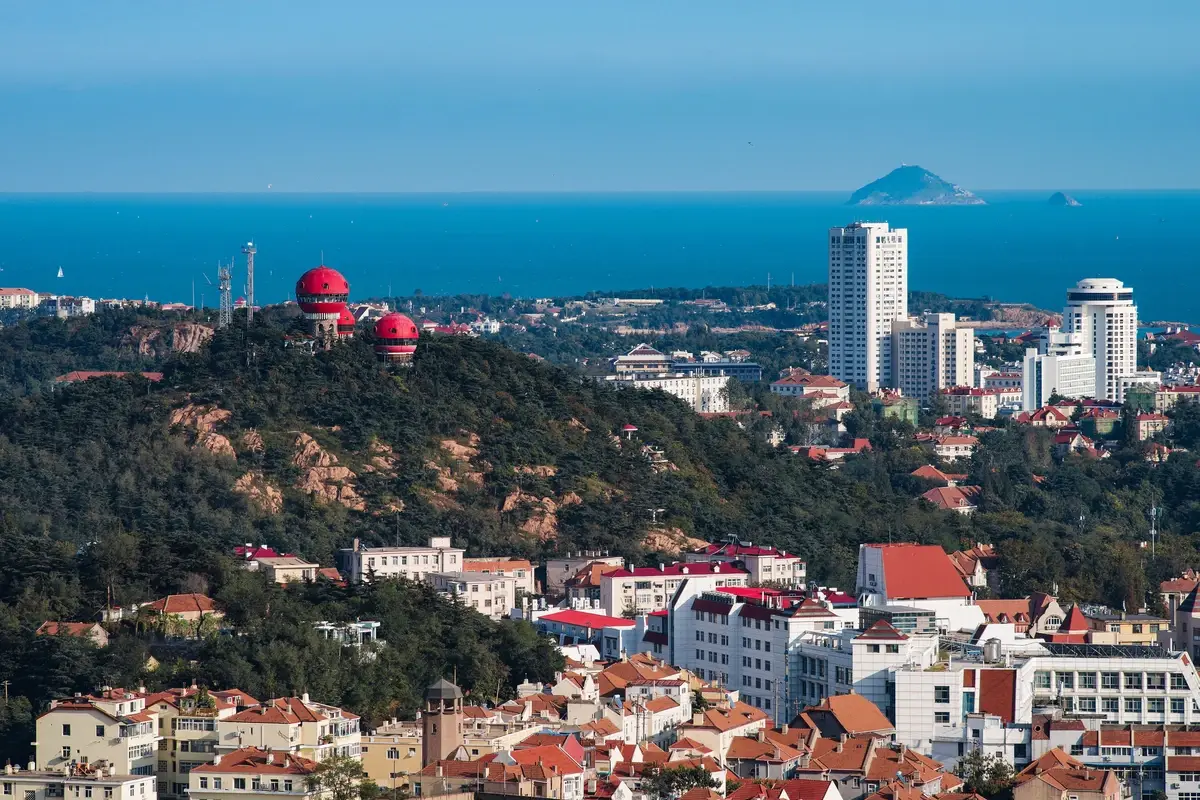
“Red roofs, green trees, blue sea, clear sky” – every visitor to Qingdao has heard this. To truly experience the scene these words paint, you must not miss Signal Hill. Situated in the heart of the old town, Signal Hill may be a mere 98-metre peak, but it was originally built for signal flags to guide ships and sailboats into the harbour, making it the most commanding hill in the area.
Stroll along the Signal Hill branch road, where there are no cars, only narrow stone-paved lanes. Fiery trumpet vines occasionally tumble like waterfalls from old houses – a quintessential Qingdao scene. The closer you get to the hill, the cooler the breeze feels, as if spring still lingers. Looking up, you’ll see three red mushroom-shaped structures standing on the lush green slope, both playful and almost surreal.
Each “mushroom” serves a different purpose: the largest is a revolving observation tower, the other two house a post office microwave station and an entertainment hall. Sitting in the revolving tower, the seats slowly rotate, unfolding a 360-degree panorama of mountains and sea. Landmarks usually looked up to – the TV tower, the former German Governor’s Residence, churches, the Zhanqiao Pier – now spread out before you, soothing the mind. You suddenly understand why Qingdao is called the “Switzerland of the East.” If not for time, I could have sat there all day.
After descending Signal Hill, the nearby Yushan Road, University Road, and Fushan Road beg to be explored. Row upon row of historic buildings and former residences of notable figures are tucked away here, still along narrow streets, where almost every courtyard bears the footprints of someone famous. Surprises await around every corner: the magnificent old mansion at No. 1 Yushan Road, once home to German Ernst Ohlmer; Wen Yiduo’s former residence at No. 5; Liang Shiqiu’s at No. 33, and more.
My favourite is Wen Yiduo’s former home at the northeast corner of Ocean University of China on No. 5 Yushan Road. This two-storey red-roofed German-style villa was originally quarters for German officers. Later, Wen Yiduo lived in a south-facing room, and it became known as “Yiduo Building.” Today, a monument stands before the courtyard; the statue of the thinker, head bowed in reflection, brow heavy with concern. Behind it, a brief inscription by his student Zang Kejia, barely a hundred words, captures his worry for the nation and his noble character.
On University Road, romantic plane trees form a beautiful canopy. Beyond the Qingdao Art Museum, Lao She’s former residence, and scattered independent bookshops, there are cafés with distinctive styles – minimalist, industrial, retro… Pick a streetside café, sit down, and gaze at the red walls through the green of the plane trees; time seems to stand still.
**Exploring the mystical Mount Lao over the sea**
In the hearts of Qingdao locals, Mount Lao holds equal weight with Mount Tai. An ancient geographer of the Southern Yan, Yan Mo, after traversing the five sacred mountains, left a remark still widely quoted: “Though Mount Tai is said to be high, it cannot match East Sea’s Mount Lao.” Anyone who encounters Mount Lao is invariably moved by its spirit of mountain meeting sea – deep gorges, cloud-soaked waterfalls, ancient trees and rare blossoms. Calling it a “mystical mountain over the sea” is no exaggeration.
Beyond its scenic beauty, Mount Lao is also a famous Taoist mountain. Since the Spring and Autumn Period, it has drawn numerous Taoist practitioners, leaving behind countless sacred sites. There’s the Taiqing Palace, the second-largest Taoist Quanzhen sanctuary under heaven; the Youlong Cave where Taoist monks once cultivated; Lion Peak and more. Amid nature’s handiwork, one senses the wisdom of the formless Dao – a blessing of geography that Qingdao people are most proud of.
It takes about one and a half hours from central Qingdao to Mount Lao, by bus or coach. After July, with increased rainfall and cool sea breezes, summer’s scorching heat is swept away, and Mount Lao enters a refreshingly cool world. Today, Mount Lao refers not to a single peak but to five scenic areas: Yangkou, Taiqing, and Qipanshi on the south line; Beijiushui on the north line; and Jufeng in the centre.
If you’re interested in Taoist culture, start at the Taiqing Scenic Area for a journey of seeking truth and enlightenment. To see the grand spectacle of mountain and sea, hike up Yangkou for an unobstructed view of majestic scenery. The Jiushui (Nine Waters) Scenic Area, meanwhile, reveals a graceful, Jiangnan-like landscape, with streams bubbling with vitality and green hills reflected in clear water along the way, all giving that sense of a peaceful summer.
Though I have no religious beliefs, Taiqing Palace was the place I most looked forward to before visiting Mount Lao. It was here that Pu Songling once stayed, and the story “The Taoist Priest of Mount Lao” originated, making me intensely curious about this palace with over 2,000 years of history. Stepping into Taiqing Palace, I found the architecture delicate and elegant, divided into three sections: the Three Officials Hall, the Three Pure Ones Hall, and the Three Sovereigns Hall. There also stands China’s largest open-air statue of Laozi, imposing amid the peaks, exuding silent authority.
Inside Taiqing Palace, sea breezes bring coolness, and ancient trees are everywhere – thousand-year-old ginkgoes, century-old camellias. Lush greenery and ancient buildings complement each other, as if you’ve walked into a wuxia novel, bearing a celestial aura of their own.