7-Day Road Trip on the Shandong Peninsula
From October 7 to 13, 2021, my wife and I embarked on a road trip around the Shandong Peninsula. We had many concerns before starting this trip. The sudden COVID outbreak in Yining, Xinjiang, made us worry about being locked out. If we didn't go, my wife would likely be unhappy for the rest of the year, and you know the consequences of an unhappy wife. So, on the last day of the holiday, also the last toll-free day, we set off.
On October 7, we originally planned to go straight to Yantai, but as expected, the 7th was also a lucky day for the return rush. So we were stuck in traffic and, before dark, stopped in Weifang, a place we hadn't planned for. After a day of driving, we were ravenous and eager to find a place for a good meal. The receptionist at our hotel warmly recommended the snacks near Shandong Weifang University, just a ten-minute walk away. Wanting to enjoy Weifang's night scene, we followed the navigation on foot to find the snack street. The roads in Weifang are not wide but are very clean, not a scrap of paper to be seen. Compared to Zhengzhou, the hygiene is much better. However, the city's architectural planning seemed a bit outdated, with monotonous high-rise matchboxes lacking artistic design and densely packed, creating a sense of oppression. Perhaps my view is narrow—just one stretch of road can't define the whole city. But since we're both laborers, we like to critique architecture. Speaking of which, the snacks at Weifang University were really good! They stir-fried vegetables on a shovel head, sprinkled with cumin, and served beans, pork kidney, and large oysters—all very tasty. In particular, the oysters, nearly ten 10-cm ones for only 26 yuan, left a deep impression. For the rest of the trip, even as we headed to the coast, we never found oysters at that price again.
That evening, I asked a former classmate from military school, now working at the Weifang court, for local sightseeing tips. He recommended the botanical garden for natural scenery and Shihu Garden for cultural heritage.
On the morning of the 8th, we went to the botanical garden. It isn't very large and is free to enter. It had rained the night before, making the air especially fresh, particularly in the bamboo garden, where the misty moisture made it “a little sweet,” like what that Yunnan female traitor who studied in America said in her graduation speech. We strolled around three times, thoroughly enjoying ourselves.
Shihu Garden is the private residence of Ding Baoshan, the richest man in Weifang during the Qing Dynasty. The architecture is not very large, similar in style to the Humble Administrator's Garden in Suzhou. Ding was the head of the four richest families, with his income reportedly equivalent to half the local tax revenue. But he was very fond of charitable donations, generous and well-regarded. His family was steeped in scholarly atmosphere, with many members passing imperial exams and becoming officials. The local government preserved the original residence and built a large commercial area around it, attracting many shops—perhaps open at night, so during the day it was deserted and desolate. A niche attraction, but worth a visit to understand the city.
Around three in the afternoon, we left Weifang for Penglai. The highway was in good condition, and before dark we checked into a government hotel near Penglai Pavilion. Although Penglai is a tourist city, its sanitation and traffic conditions were a step down from Weifang, rather chaotic. The highlight of the Shandong trip was seafood. We asked the hotel front desk and again were recommended the Mozhikou specialty seafood restaurant near Penglai Pavilion. Using Amap's walking navigation, we walked through a local fishing village and saw a seafood street market, admiring all kinds of seafood we hadn't seen before. After about 40 minutes, we arrived. Around 7 p.m., the restaurant was packed. Dishes were displayed as real samples for ordering. We ordered steamed sea urchin with egg, oysters, and octopus, a satisfying meal for 116 yuan. It tasted great, with a wide variety of seafood on offer, so we planned to come back after visiting Penglai Pavilion the next day. On the way back, we saw a beautiful night view and learned it was Penglai Pavilion, which we were to visit tomorrow. Taking the chance for a post-meal walk, we strolled over and asked the staff. They said tonight's evening session and tomorrow's ticket could be a combined pass for 100 yuan per person, so we eagerly enjoyed the night scenery. The legend of the Eight Immortals is well-known, and netizens say you'll regret not seeing it, but you'll regret it even more after seeing it. The ancient city wall was closed, so we could only tour the water features inside the walls. The scenic area mainly introduces the national hero Qi Jiguang, a famous anti-Japanese warrior who was frustrated in later life. There are many memorials to him in eastern Zhejiang; a national hero worthy of admiration.
A few scattered tourists took photos under the neon lights on the stone arch bridge. Suddenly, a few fairy-like girls in Hanfu, wearing masks, performed a graceful long dance, but by the time we got close, the show had ended. Thanks to a young lady at the gate who reminded us, just as we were about to leave we learned that the evening's finale, iron flower forging, was about to start. I'd seen it on TV, but this was my first time live. Six strong men, bare-armed and legged, threw molten iron into the air to rousing music, creating a spectacular display in the night sky. The performance lasted about half an hour, and experiencing this intangible cultural heritage live made it worthwhile. The path to the ancient fort was closed at night for safety, so we had to wait until the next day to visit the fort and see Penglai Pavilion and the sea up close.
At 8 a.m. on the 9th, we entered Penglai Pavilion. The weather was surprisingly good—blue sky, white clouds, bright sunshine, and few visitors. The place the Eight Immortals chose was indeed splendid, with blue seawater and fresh air. We happily took photos all the way to the top. Most of the pavilions were Taoist immortal halls, except for one Buddhist hall on the way down, showing that both Buddhas and immortals prefer quiet surroundings.
At noon, we left Penglai Pavilion and took a ferry to Changdao Island. As outside vehicles are not allowed on the island, we parked at our previous hotel free of charge. A taxi to the ferry pier cost only 10 yuan, much cheaper than the 30 yuan daily parking fee at the pier. On the ferry, we browsed Ctrip for accommodation and found a Changtong Hotel near Changdao pier, priced attractively at just over 100 yuan, but reviews were poor, so we didn't book. Since it was off-season and within walking distance from the pier, we thought we'd check the facilities. As expected, the drab conditions matched the reviews, and the front desk staff was cold and indifferent. We left promptly. Just as we were looking for another place, we met a farmer surnamed Chi, who was escorting a Shanghai couple to the boat. Learning that he was honest, we arranged to stay at his farmhouse. A room was 100 yuan, no meals included, and conditions were basic, but since we were there for the scenery, it didn't matter.
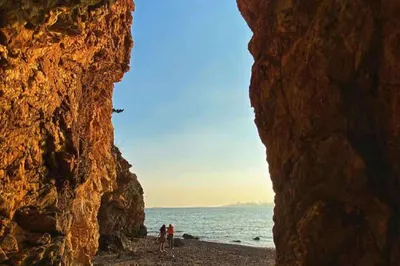
After dropping off our luggage, we went to Fengshan Linhai Scenic Area on the island. The coastal weather was changeable, alternating rain and sunshine, but with an umbrella we were fearless. Nature is truly marvelous. At the boundary of the Yellow Sea and the Bohai Sea, the waters show different colors, forming a natural line. We checked in, took photos, and enjoyed having the whole vast scenic spot practically to ourselves. From the boundary monument at the hilltop to the coastline below, we walked a man-made plank path that extends half a meter above the sea surface, with water so clear you could see the bottom—the best water quality we saw on this trip. Looking out from the plank path, the sea stretched endlessly. In the vast sky, a few seagulls flew among dark clouds, crying loudly, reminding me of Gorky's prose 'The Stormy Petrel.' At the confluence of the Yellow and Bohai Seas, the beach was strewn with colorful stones. We each picked a few we thought pretty as souvenirs, planning to compare them with ones we'd brought back from the Gobi Desert in Xinjiang.
There were four or five local anglers braving the wind and rain, standing and fishing. Checking their baskets, they said they'd caught seven or eight fish weighing about 150-200 grams each between 2 and 4:30 in the afternoon—pretty good results.
On the way back to the farmhouse, we bought freshly caught mantis shrimp, crab, octopus, and small shrimp from a fisherman. Only the shrimps were braised; all the rest were boiled. Dipped in soy sauce and vinegar, we tasted truly fresh seafood. Though the crab had little meat, my wife was thoroughly delighted.
On the morning of the 10th, we had planned to take a big boat to visit islets near Changdao, but the sea wind was too strong and the boats were canceled, so we went to Moon Bay and Jiuzhang Cliff on North Changdao Island instead. We bought tickets at Moon Bay; the two scenic areas are about two kilometers apart. Moon Bay is a seaside bathing beach where summer visitors swim; the water is very clear and should offer a great experience. By October, the water was already too cold for swimming, and with the strong wind, there were few tourists. Its concave shape gives it the lovely name Moon Bay. Jiuzhang Cliff is the highest point on Changdao, with a lighthouse and a tunnel. In the 1950s and 60s, it was a strategically important location manned by the People's Navy. Now that the nation has grown stronger and the navy has moved farther out to sea, the military site was handed over to the local government. At the cliff top are a few sculptures depicting ancient fishermen performing rituals to pray for safety before heading out to sea. Due to weather, the trail at the base of the cliff was closed; from above, we could see it was carved out of the rock along the shore. We felt the core sights of both spots weren't remarkable—one just a closed beach, the other a high cliff. However, the coastal boardwalk between them was worth seeing. The boardwalk is well built, with a lane for scenic cars and pedestrian paths on both sides, painted bright yellow-red, very eye-catching and photogenic. The pedestrian path has steps that allow you to get close to the water, sand, and rocks. The sea wind whipped up the waves, surging onto the shore and splashing half-meter high against the reefs. My wife's short, thin hair was blown about, making it look long and flowing. The different shores created varied landscapes, giving us numerous photo opportunities.
At noon we finished our Changdao trip and returned to Penglai. Still not having had our fill of seafood, we went back to Mozhikou restaurant. The previous time we had shellfish; this time we had fish, choosing ones we hadn't tried before. A pot of stewed fish for 128 yuan included four or five fish of about 150 grams each. We also had Penglai sea urchin noodles for 4 yuan a bowl. The least worthwhile dish was the jellyfish with cabbage—just a plate of cabbage with jellyfish used as sparingly as MSG, priced at 30 yuan. Before leaving, my wife spotted the chef's big steamed buns and bought one for 12 yuan to take on the road.
The taxi driver from the ferry pier to the hotel, a fast-talking northeastern lady, recommended we buy some Yantai apples along Route 228. Relying entirely on Amap, we finally spotted an old man selling apples on our way to Weihai. My wife decisively bargained and bought two boxes at 3.5 yuan per jin for 160 yuan. That evening, we checked into a hotel in Weihai.
On the morning of the 11th, we took a ferry to Liugong Island, a half-hour trip from Weihai. The island has a botanical garden and tells the story of Liu Gong from the Han Dynasty rescuing fishermen; grateful fishermen built Liu Gong Temple, hence the island's name. The most impressive building is the First Sino-Japanese War Memorial Museum, which details the causes of the war and houses many artifacts and photos from that time, reminding us not to forget national humiliation and to rejuvenate China. A replica of the Qing navy's flagship, the Dingyuan, is on display for visitors to board. The island also preserves Western-style buildings from when the British occupied it after the war, as well as several fortresses. Interestingly, all the cannon muzzles point east, directly toward the 'Japanese invaders,' haha—.
One thing to criticize: this island should ideally be a patriotic education base, yet with an entrance fee already at 122 yuan, they still charge an extra 30 yuan to board a decommissioned navy submarine. Meanwhile, the Qing flagship Dingyuan is free to board (though it's a high-fidelity replica). The site managers should reconsider this.
Just after the Olympics, Wang Nan gifted villas to the national table tennis champions in Weihai's sports town, which our navigation quickly found on the way to Qingdao. But for some reason, the road became narrow and crowded, so we dropped the idea. My wife decided to skip it and head straight to Qingdao. We arrived and stayed overnight.
Once we exited the highway in Qingdao, we were immediately stuck in traffic, with no police directing. The road was jammed and dusty—our first impression. The 5-kilometer drive to the hotel took almost an hour. We had relatives in Qingdao, and we shared a seafood meal together. It reminded me of the news a few years ago about the 'sky-high priced Qingdao prawns.' Unsurprisingly, the seafood was very fresh, but the prices were outrageous. For three people, the bill was 461 yuan, for just a plate of conch, a seafood stewed fish (similar to the 126-yuan stew in Penglai), a portion of seaweed jelly, and fried silverfish.
Laoshan and the Oceanarium are Qingdao's main tourist attractions. Laoshan, a Taoist holy site, is essentially just a mountain to climb, and the oceanarium is a kids' paradise. My wife wasn't impressed with Qingdao, so we decided to head directly to Tai'erzhuang in Zaozhuang the next day.
On the morning of the 12th, after visiting a relative's tea shop, we set off for Tai'erzhuang. We arrived around 3 p.m. The hotel we booked was inside the scenic area, so we parked in the lot outside, collected our luggage, and checked in. Then we started wandering the old town. By about 4 or 5 p.m., it was getting dim, and the lights began to come on. The traditional Chinese buildings and stone arch bridges reflected in the water, hinting at the charm of a southern water town. But no matter how you looked, it felt lacking in cultural depth. Apart from the shops on both sides of Dazhimen Road, which were fully rented, most other streets had many vacant storefronts. In particular, the dilapidated houses east of the south gate and the unfinished building outside the gate made it hard to reconcile the 160-yuan ticket price with a 5-star scenic area rating.
Nightlife in Tai'erzhuang began. Barges rowed by young ladies would occasionally glide through the canals, telling legends to elderly tourists riding in them. Restaurant owners loudly beckoned customers from doorways. You could suddenly hear a singer in a street-side bar belting out 'You love me, I love you.' In open spaces, the film 'The Bloody Battle of Tai'erzhuang' was projected. There weren't many visitors, mostly elderly people with free admission. Various exhibition halls were still open. While my wife went to try the local specialty, yellow flower beef noodles, I visited the Buddhist hall north of the east gate. With dim lights, murmuring streams, secluded trees, and utter silence, I entered the main gate, passed through two inner gates, and reached the main hall. As I was admiring the Buddha statues, a voice behind me suddenly asked, 'What is your wish, benefactor?' making me flee in alarm. I then strolled along the city wall from the west gate to the east gate, a night tour that took about 40 minutes. Tai'erzhuang, rebuilt after the war, stands as a memorial and comfort to the heroes who sacrificed for national freedom and independence.
On the morning of the 13th, we revisited places we hadn't seen the night before, but nothing felt new, so we started the journey home at noon, ending the trip.
Seven days on the road in Shandong, not a single traffic violation,
Jiaodong Peninsula free of outbreaks, a leisurely life slowly enjoyed.
In Weifang, Shihu Garden and botanical garden, witness culture and scenery.
Penglai Pavilion seeking the Eight Immortals, the best seafood at Mozhikou.
Changdao's Yellow-Bohai boundary, nature's wonder needs no words,
Moon Bay and Jiuzhang Cliff, just sea bathing and climbing high.
Liugong Island of the Sino-Japanese War, telling the nation's rise and fall.
Qingdao seafood costs too much, better to eat well at home.
Five-star Tai'erzhuang, expensive admission, experience too poor.
Total spending over five thousand, accommodation at four-star standard.
Overall a satisfying trip, my wife certainly pleased.
Friday night, October 22, 2021.