Mount Tai, Mount Lao, and Lesser-Known Attractions in Shandong and Qingdao
All photos in the article were taken by the author of "Black and White Touch," all rights reserved. Unauthorized use is strictly prohibited!
The official around-China journey began with a trip to Jinan in late March 2018. Over four years, the "main project" has been largely settled, and I planned to write a summary over the past couple of days. During this process, I realized that before 2018 I had also visited some important sites, but never put them into words—such as Mount Tai and Mount Lao. I thought that a travel map of China would be incomplete without them, so I decided to use a round-up format to fill in these missing spots one by one. "He who has traveled a hundred miles is only halfway there"; a complete cycle is the most meaningful reward for a "long-distance runner."
Having lived in Qingdao for a long time, most of the following places are in Qingdao and Shandong. Some are famous mountains known to all, others are little-known but distinctive spots. Without further ado, let's begin our round-up.
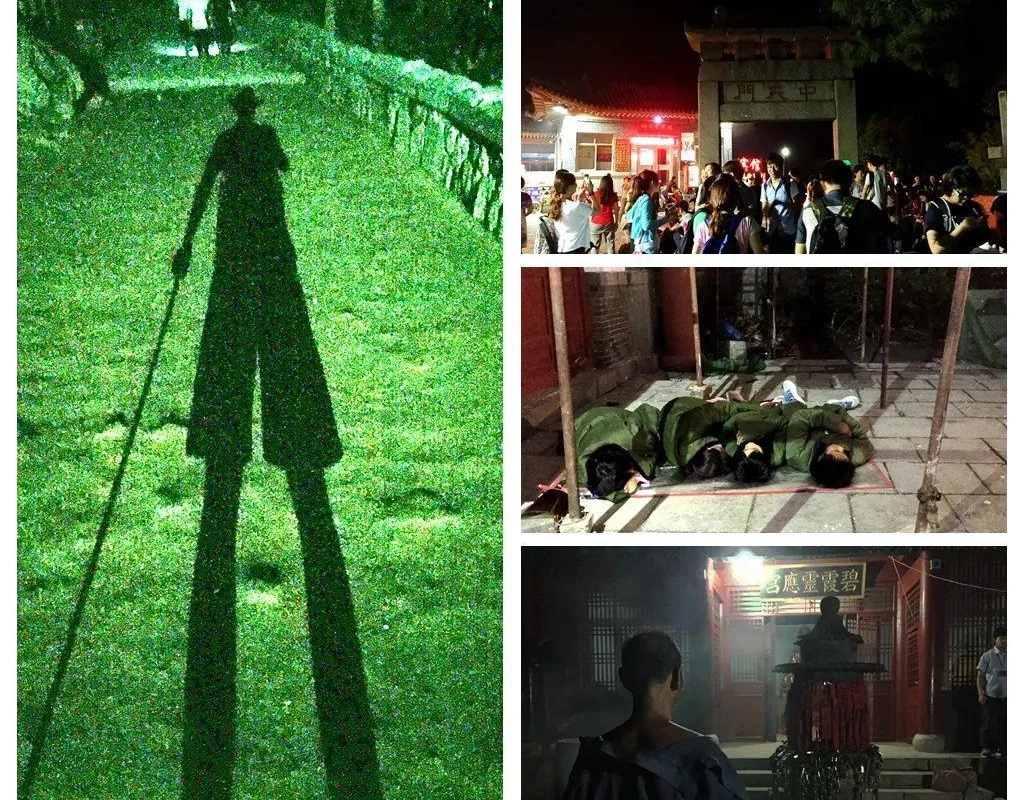
I climbed Mount Tai in June 2015. It was my first night hike. Looking back, the conditions were quite tough: at the foot, a T-shirt felt too hot, while on the mountain, wrapped in a coat I still felt cold. Hotels were fully booked, and some early-bird visitors who arrived to see the sunrise simply slept on the floor. Even so, I have no memory of exhaustion. Walking up the Hongmen mountain trail, with many people along the way, I climbed all the way to Jade Emperor Peak without fatigue.
That was also my first time seeing a sunrise. Now when I recall it, the sunrise that day was quite ordinary. Thick clouds shrouded the sky; the sun had already risen high before breaking through, gray and unremarkable. But at the time, like the crowds packing Riguan Peak, I was yawning and beside myself with excitement, pressing the shutter at the sight of a few fiery clouds.
Mount Tai is the foremost of the Five Great Mountains. Ancient people saw it as a heavenly realm "directly linked to the imperial throne," a sacred mountain revered by commoners and where emperors offered sacrifices. Since ancient times, it has been said, "When Mount Tai is at peace, all within the four seas is at peace." From Qin Shi Huang to the Qing Dynasty, thirteen emperors personally ascended Mount Tai to perform the Feng and Shan rituals or sacrifices, and another 24 emperors dispatched officials to conduct sacrifices 72 times, leaving behind over 20 architectural complexes and more than 2,200 stone steles and carvings on the mountain. Combined with its exceptional landforms and cloudscape, Mount Tai is designated a UNESCO World Cultural and Natural Heritage site.
The numerous cliff carvings compile the best of Chinese calligraphy, and the ancient temples and halls embody a profound and distant history. Other famous mountains also have cliff carvings, but nowhere are there more tourists taking photos with the calligraphy on the rocks than on Mount Tai.
On Mount Tai, you might also chance upon quirky sights, such as the oddly shaped Tianmenju that resembles a Fujian Tulou, or groups of chickens that don't shy away from people on the mountain path.
And amid the bustling crowds, steadfast porters and cheerful, open-hearted square dancers.
Hiking enthusiasts from Tai'an and even all of Shandong climb Mount Tai several times a year. Though I am not keen on mountain climbing, how can one fully appreciate Mount Tai's nature and culture with just one ascent? So given the chance in the future, I will once again "embrace the summit and look down upon the smaller hills."
As an old saying goes: "Though Mount Tai is said to be high, it cannot match Mount Lao on the East Sea."
Though less famous than Mount Tai, the scenery of Mount Lao is absolutely its match. The reputation as "the foremost mountain on the sea" is well-deserved, not hollow praise.
Mount Lao is located in the Laoshan District of Qingdao. It is a renowned Taoist mountain in China. Many people first heard of Mount Lao from the story "The Taoist of Mount Lao" in Strange Tales from a Chinese Studio. The mountain includes scenic areas such as Taiqing, Huayan, Yangkou, Jufeng, and Jiushui—names that hint at their Taoist origins. At the end of the Southern Song Dynasty, Qiu Chuji came to Mount Lao three times to preach and expound on Taoist teachings, leaving a profound influence. During the Ming Dynasty, various sects vied to build Taoist temples here, leading to the prosperity of "nine palaces, eight temples, and seventy-two nunneries," making Mount Lao the second largest Quanzhen Taoist sanctuary in the world. Many famous Taoist figures, such as Zhang Sanfeng and Qi Benshou, once practiced self-cultivation on Mount Lao.
Scenery right at one's doorstep is often overlooked. So although Mount Lao is a must-visit for people coming to Qingdao from outside, I still haven't fully explored all five scenic areas. Each area reveals its beauty in different seasons.
My first visit to Mount Lao was not long after climbing Mount Tai. Honestly, the scenery of Mount Lao suits my aesthetic more. There's an old saying: "The benevolent enjoy the mountains, the wise enjoy the waters." I think the meaning is that those who love mountains appreciate the steadfastness of the mountains—benevolent people are generous and broad-minded; those who love water enjoy its fluidity—wise people adapt to circumstances. I respect the benevolent, but I'm more drawn to the wise. That's why the majestic scenery of Mount Lao, where mountains meet the sea and green hills embrace turquoise waters, remains as vivid in my mind as a desktop wallpaper.
And the best spot to savor the merging sea and sky is from the summit of Mount Lao, where Qingdao's red tiles, green trees, blue sea, and azure sky all come into view.
Mount Lao is the highest peak along China's coastline, with exceptionally rich scenery. Besides Taoist temples and sea-and-sky vistas, there are bizarre rocks and twisted pines, narrow skylight crevices, cliff carvings, mountain springs, and cascading waterfalls... Whatever other famous mountains have, Mount Lao has it all; and its ability to let you view mountains while overlooking the sea is rare among famous peaks.
Zhushan is the collective name for two separate peaks—Dazhu Mountain and Xiaozhu Mountain—located in the West Coast New District of Qingdao (formerly Jiaonan). The two mountains, one south and one north, are more than 20 kilometers apart. They are the most popular tourist destinations in Jiaonan. Every spring when flowers bloom, Qingdao residents flock here in groups to enjoy the greenery. Some streets and parks in Jiaonan are named after these two mountains: Shuangzhu Street, Zhushan Road, Shuangzhu Park...
Dazhu Mountain includes the Shimen Temple Scenic Area and Zhushan Xiugu (Beautiful Valley) Scenic Area. Its main peak, Dazhai Peak, is 486 meters above sea level. The mountain is home to Buddhist grottoes dating from the Sui and Tang dynasties, the ancient Shimen Temple built during the Dading era of the Jin Dynasty, as well as tomb pagoda forests, Mayi Nunnery, Zhuchao Cave, and Zhushan Stone Chamber—remnants where ancient scholars lived in seclusion and literati explored secluded beauty. It is truly a place of cultural richness.
On the eastern foot of Dazhu Mountain lies a valley called "Zhushan Xiugu." The five-li-long valley has a stream rushing through it, flowing into an artificial lake at the foot. Verdant water and green hills embrace each other; the peaks are reflected in the clear water. Winding around the lake and following the stream into the valley feels like stepping into a painting.
Every year around the Qingming Festival in April, Zhushan Xiugu enters its most beautiful moment. Cherry, apricot, and peach blossoms at the entrance bloom one after another; clusters of bright yellow forsythia adorn the stream banks, and stretches of pure white pear blossoms form a continuous patch. A spring breeze sways the flowering branches, setting off waves of gold and surges of white. Most stunning are the azaleas blanketing the entire mountain, surging like tides and waterfalls, drifting like clouds and rosy mist—an indescribable feast for the eyes.
Xiaozhu Mountain is an offshoot of the Mount Lao range extending southwest across Jiaozhou Bay. Its main peak, Dading Peak, stands 725 meters tall, facing the secondary peak Nantianmen from south to north, making it the highest peak in southwestern Qingdao. It towers majestically above the Qingdao coastline and is famous throughout the Jiaodong Peninsula for its unique beauty.
Xiaozhu Mountain is a layered and serene landscape with dozens of peaks large and small—Wangfu Mountain, Shilao Mountain, Da'an Mountain, Futaitong, Dahei Stream, and more. It also features oddly shaped rocks like Frog Rock, Guanyin Stone, Big Belly Buddha, and Yuanbao Hill. The peaks are steep and spectacular, and the stones are marvelously lifelike. The mountain range stretches for tens of miles, sometimes mighty and imposing, sometimes delicately graceful—varied, colorful, and enchantingly beautiful.
There are also scenic spots on Xiaozhu Mountain such as Azalea Valley, Zhushan Lake, Divine Turtle Stone, Fox Fairy Cave, and Ostrich Garden. With its deep cultural heritage and beautiful natural scenery, along with the artful stones scattered everywhere, it adorns Zhushan with charm and allure.
For spring outings in Qingdao, besides the azaleas on Zhushan, the plum blossoms at Shimei’an should not be missed.
In northern regions, plum blossoms generally bloom in March and April. Shimei’an in Licang District, Qingdao, is the largest plum garden north of the Yangtze River in China, covering 200 hectares with over 10,000 plum trees of more than 100 varieties, hailed as the "Land of Plum Blossoms." Situated at the foot of Mount Lao, legend has it that this was once a desolate hilly area. Later, ten beautiful women built a thatched nunnery here, practiced cultivation together, and eventually attained immortality, leaving behind ten towering plum trees. Their blossoms were as gorgeous as morning glow and as white as auspicious snow, giving rise to the legend-rich name "Shimei’an" (Ten Plum Nunnery).
"Plum blossoms may be three parts less white than snow, but snow lacks the fragrance of plum blossoms." Plum blossom is not just a flower; it's a culture. Along with orchid, bamboo, and chrysanthemum, it is honored by traditional Chinese literati as one of the Four Gentlemen. Because it blooms amid early spring wind and snow, the plum blossom symbolizes unyielding integrity. And since it has five petals, people call it the "five-blessing flower." During festivals, people decorate their homes with plum blossoms. On happy occasions, they cut paper plum blossoms to express joy. In Qingdao's Licang, Laoshan, and other local areas, it's common to see women's names bearing the character "Mei" (plum).
Shimei’an is surrounded by hills on three sides and faces water on one side, with a beautiful environment. A Plum Blossom Festival is held here every year, when rare varieties like "Danfenghou," "Laoshan White," "Green Calyx," "Cinnabar," "Jiangmei," and "Beauty Plum" make their appearances, competing in splendor—a breathtaking sight.
The Langya Terrace Scenic Area is located on Langya Mountain in Langya Town, Huangdao District, Qingdao. It is bordered by the sea on three sides and connected to land on one side. The mountain shape resembles a terrace, hence the name Langya Terrace. It is a historic site along China's eastern coast. During the Spring and Autumn period, Langya was already a major port and military stronghold of the Qi State. After Qin unified the six states, Qin Shi Huang went south to Langya, moved 30,000 households below the terrace, and rebuilt Langya Terrace. In the early Ming Dynasty, this area served as a military stockade called Xiahezhai Garrison, under the jurisdiction of Lingshan Guard.
Langya Terrace is also the departure point where the Qin alchemist Xu Fu led thousands of boys and girls on a voyage east to Japan. On the terrace top stands a sculptural group depicting Qin Shi Huang sending Xu Fu to sea to seek immortality. The figures include Qin Shi Huang, Xu Fu, Hu Hai, Li Si, Zhao Gao, as well as civil and military officials, warriors, maidens, and attendants, vividly portraying the scene in 210 BCE when Xu Fu recounted his sea journeys to the emperor during Qin Shi Huang's third inspection tour to Langya.
The scenic area also features a Cloud Ladder, said to be one of the three imperial paths Qin Shi Huang used to ascend Langya Terrace. The slopes on both sides are covered with trees, shrubs, and vines, lush and vibrant.
Langya Terrace dominates the surrounding hills. From the top, you can gaze up at the sky and clouds, or look down upon the surging waves—a landscape of grand majesty and awesome beauty that broadens the heart.
You may have heard of horticultural expos, auto shows, science and technology expos... but have you ever heard of a vegetable expo?
I'm not making this up. There really is a vegetable expo, and it's an international event. Held annually since 2000, it is an officially approved annual conference by the Ministry of Commerce of the People's Republic of China. It's the China International Vegetable Science and Technology Fair, and it takes place in Shouguang, Shandong.
Why is Shouguang the host city?
Shouguang is a county-level city under Weifang City, Shandong Province. The renowned winter-warm greenhouse vegetables originated here, and Jia Sixie, the author of the world's first comprehensive agricultural text Qimin Yaoshu, was also born here. Over long-term agricultural practice, the people of Shouguang have nurtured and developed a unique agricultural culture, making Shouguang China's "Land of Vegetables."
How unique? Just look at the colossal vegetables below and you'll understand:
At the vegetable expo, there are also various structures "built" from vegetables—airplanes, windmills, cars, pagodas, and more, which are truly astonishing.
There are even "vegetable buildings" modeled after landmark architecture from major cities—see how many you can recognize:
The impressive exhibitions benefit from artists' creativity, but growing good vegetables requires not only diligence but also scientists' experiments and explorations. Solving problems like increasing yield and preventing diseases needs scientific wisdom. The expo also showcases breeding laboratories, instantly making farming seem like a high-end endeavor.
Zhanshan Temple is located southwest of Zhanshan Hill in eastern Qingdao. It is the only Buddhist temple in the city, and the Qingdao scenic spot "Zhanshan Qingfan" (Serene Buddhist Chant at Zhanshan) refers to this place. Zhanshan Temple is not ancient; it was built in the 1930s-40s. Only the two stone lions at the gate are relics from the Ming Dynasty, making it one of China's youngest renowned temples.
The temple is built against the hillside, comprising the Mahavira Hall, Three Saints Hall, Heavenly King Hall, guest quarters, and a scripture depository, all styled after Ming Dynasty palace architecture. It is not large but offers a tranquil and elegant atmosphere. Southeast of the temple stands the Medicine Master Lapis Lazuli Light Tathagata Pagoda, complementing the temple. In front, a pool fed by mountain spring water serves as a life-release pond. Beside the pond is a orchid pavilion; a white jade Guanyin Bodhisattva stands in the water, protected by white jade balustrades, with water and sky merging to wash away worldly dust.
Behind the temple, on a small hill to the east, is an octagonal seven-story brick pagoda reaching into the clouds, exuding a lofty Zen spirit.
The West Coast Ecological Sightseeing Garden is a green park completed in recent years, located west of the Oriental Movie Metropolis on Lingshan Bay, Qingdao. It is a great self-guided travel spot combining flower seas with leisure tourism.
The scenic area features a 100-mu rapeseed flower sea and a 100-mu lavender field, blooming respectively from early April to early May, and in June-July and September-October. You can enjoy vast expanses of golden yellow and lavender blue without traveling to Wuyuan or Yili, breathing in the heady floral fragrance.
There are also attractions like the Rainbow Flower Slope, Fantasy Hall, and a botanical garden, with year-round plantings of seasonal flowers such as lavender, phlox, tulips, pansies, and galsang flowers. European-style buildings like a Polish church-like hall, manor-style structures, a Roman pavilion, and Dutch windmills make it a perfect spot for Western-style weddings and bridal photos.
Some scenes are similar in cities everywhere, while others are unique to a specific place, just as some articles and images are uniformly gorgeous, whereas my travel photography comes from the most ordinary perspective of an ordinary traveler—no aerial photography, no careful plan. Wherever I go, I record with my lens and words. Perhaps it's mundane, but it is definitely the most unique. The likelihood of being overlooked is high, but I will continue on, because it is a kind of memory, and a way of life...