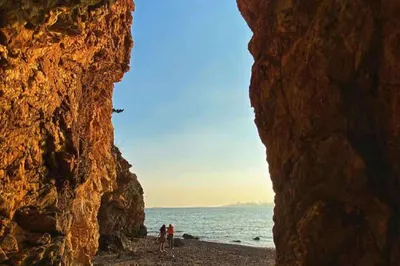
A 500-km Quest for Contrasts on the Jiaodong Peninsula
The Jiaodong Peninsula spans the cities of Qingdao, Yantai, and Weihai, along with their surrounding counties. These three cities share a continuous historical and cultural heritage, yet their temperaments differ vastly. From Qingdao's West Coast to eastern Laoshan, north to Qiu Mountain Valley in Penglai, Yantai, then turning east to Yangma Island, and continuing past downtown Weihai to Chengshantou in Rongcheng—this S-shaped self-drive route covers almost exactly 500 kilometers (a thousand li).
Qingdao is cosmopolitan; Yantai treasures culture; Weihai is picturesque. Behind their differences, the three cities share a defining regional trait of the Jiaodong Peninsula: mountains and sea entwined.
Qingdao is not just a global city; it's also a 'small city' that exudes an artsy, fashionable, and laid-back vibe. For those on holiday or living here, this 'smallness' is deeply endearing. Qingshan Village represents Qingdao's beginnings—people often say the city's history started from a tiny fishing village. Xiaomai Island embodies Qingdao's transformation from old to new: a once-barren islet turned Internet-famous park. The Little Red Mansion Art Museum and numerous galleries form the cultural DNA that Qingdao has never abandoned. The Dabaodao Leisure District also offers a fresh, modern lifestyle to the city.
Yantai is a city with a long history, yet brimming with modern charm and vacation romance. The story of downtown Yantai begins with Suochengli, where troops first built fortifications, giving rise to the city's embryo. At the foot of Yantai Hill, the Hongkou 1920 Micro-vacation District and the old buildings on Chaoyang Street—many listed as national cultural relics—mark the beginning of Yantai's international openness. Meanwhile, Changyu is one of Yantai's famed global name cards; its museum reveals why. Island Diary epitomizes Yantai's contemporary holiday style: seaside, gentle, and carefree.
Weihai is a city built within a park—or rather, the entire city is a park. Driving along the coastal road, from Weihai Park to Yuehai Park, from an Instagram-famous photo frame to an iconic lighthouse, Weihai is dotted with modern art installations that beckon you to stop. At the same time, nature puts on a show at spots like Maotou Mountain, where roaring waves pound against the rocks in a truly awe-inspiring scene.
Laoshan isn't a cold, detached scenic area; it's dotted with thriving villages. The people of Qingshan Fishing Village once lived off the sea, but now they run a much easier business—serving tourists in their fish-farm guesthouses. Yakou is the last traffic junction after entering Laoshan and the farthest point you can reach by car on a self-drive trip. Beyond that lies the Taiqing Scenic Area, accessible only on foot or by shuttle bus. Park at Yakou and look out over the sea and mountains. Amid winding roads, emerald peaks, and jade-green tea plantations, a cluster of 800 red-tiled homes radiates an effortless internet-famous charm—that's Qingshan Fishing Village. Drive down through a marble memorial arch, twist and turn along the hillside road, and eventually you'll snake your way into the village. The narrow one-way street can be a nightmare if you meet another car. The village spreads out across the slope, but its heart is just a small patch. Sip tea, eat fresh fish, stay the night—that's the leisurely pitch of Qingshan Fishing Village.
Xiaomai Island is the 'maritime boundary' between Laoshan District and Shinan District. A few years ago, it was a derelict spot abandoned by urban development—overgrown with weeds, strewn with rocks, and cluttered with broken fishing boats, like a graveyard of old vessels. Today, it's transformed. The renovated Xiaomai Island feels like an entrance to Laoshan, a miniature version of its landscape: brand-new, fresh, and warm. Lawns and groves blanket the islet, dotted with flowers. People come to fish, enjoy the greenery, and stroll around, packing the narrow bridge that connects it to the mainland. Sailboats and speedboats trace elegant curves around the island. At its southern tip, the Tide Sound Pavilion has a golden roof; from an aerial view, it looks quite like the famous Huilan Pavilion on Qingdao's Zhanqiao Pier.
The Dabaodao Cultural and Leisure District thrives on the traditional 'liyuan' courtyard culture. Once a nostalgic memory of old Qingdao's commercial past, it’s now a hotspot for the young and trendy. Courtyards connect yet each is distinct; lanes crisscross but are easy to navigate. Backed by Qingdao’s landmark St. Michael’s Cathedral, from above you see the turquoise waters of Qingdao Bay and the red-tiled roofs of Dabaodao merging into the iconic Qingdao cityscape. Inside the courtyards, red-brick walls, wooden staircases, and flagstone paths weave a yesterday feel, while a host of contemporary art installations blend in seamlessly. In Qingdao, grafting the old onto the new always works.
Walk through Dabaodao, past the Catholic church, and wind your way up the old town’s hilly streets to 18 Anhui Road—that's where the ever-popular Little Red Mansion Art Museum stands. The building has a long history, and an art museum has always been its cultural soul, but the crowds are a recent phenomenon. After a transformation, the old museum gave way to a new one, and as with everything here, the old and the new grafted together to bloom beautifully. Walls covered in roses and a strawberry bear seem to say, 'I knew you’d come, so I waited.'
If there’s one sensory difference that sets Yantai apart from Qingdao and Weihai, it’s the subtle fragrance of wine. As you probably know, Yantai is one of the 'world’s seven great wine coasts' and produces excellent wine. Changyu, the city's iconic brand, was founded over 130 years ago. More precious than its award-winning bottles is the Changyu Wine Culture Museum on Guangren Road. The company name, 'Changyu Wine Company,' handwritten by Weng Tonghe—tutor to the Guangxu Emperor and a high-ranking minister—is still carved above the time-worn porch. Under the dim barrel-vaulted ceiling, Changyu, which has brought Yantai a genuine 'new lifestyle,' seems to transcend a century. The museum was recently renovated. Even if you never drink, you shouldn’t miss a visit (or picking up some wine as a souvenir—everything has been made convenient).
Right next door, Chaoyang Street marks the beginning of Yantai’s modern history. Back then, foreign firms lined the foot of Yantai Hill, merchants gathered in droves, and imported culture took root along the Jiaodong coast, creating a distinctive 'Yantai culture.' On this street, only a few hundred meters long, that culture took tangible form in luxury hotels, bar clubs, Western dining, and red wine. Today, Chaoyang Street has been revitalized but still retains the elegant urban image that best represents modern Yantai.
Equally famous as Chaoyang Street is Suochengli, the very cradle of Yantai’s history. It was here in the early Ming Dynasty that fortifications were built and troops garrisoned, giving birth to Yantai as a 'guards-fortress' town. Today’s Suochengli continues the bustling legacy of South Street, the city’s main commercial thoroughfare. Old buildings from the late Qing and early Republic eras have been restored and transformed into a cross-era commercial strip that blends vintage charm with trendy modern elements.
In Yantai, the poetic idea of 'sleeping to the lull of waves, living by the sea, and walking with the tides' is wonderfully ordinary. Waking up naturally on Yangma Island is a great plan—cafés here don’t open until around 10 a.m. (there’s little to do if you’re up early). Island Diary, on the island, has a large terrace facing the bay. This white building, which is part guesthouse, part café, and part restaurant, 'treasures every trace left by visitors,' much like a diary. Spend a little over 30 yuan on their signature iced drink—a gradient blue 'Island Diary' special—and you can leave your trace here (and take it with you), though you’ll need your own camera.
Island Diary has several branches in Yantai, including one in the Hongkou 1920 Micro-vacation Historical and Cultural District, also facing the sea. Archives say that once every household here had a courtyard, and beyond the courtyard lay a beach from which you could set sail. Actually, life in Hongkou today isn’t much different—the grand residences have become art galleries and fine restaurants within the historical block, courtyards are filled with art installations (including a twisted clock forever frozen at 19:20), and night cruises across Zhifu Bay and sailing trips still launch day and night from the 1920 shoreline.
In Weihai, escaping the sea is no easy feat. The city even carries it in its name—'hai' means sea—ingrained deep in its cultural identity. Luckily, the sea is only one element. Along the long coastline, besides waves and seawalls, countless artistic expressions have emerged. For instance, the colorful little houses on Torch Eighth Street, seemingly perched at the end of a downhill road, are forever surrounded by adoring travelers. In Weihai Park and Yuehai Park, a lighthouse beams not only for ships but also for people holding flower balloons. A sculpture of hands holding a picture frame feels like a giant telescope pointing over the city. In the Jinshiwan Art District and along the Thousand-Li Mountain-Sea Scenic Drive, seaweed-thatched cottages create a dreamlike scene—some say it’s like a Studio Ghibli film, others a Smurf forest. In Weihai, life just feels slightly surreal. Surreal yet beautiful.
A true central square is something Weihai doesn’t lack. Weihai Park comprises a series of squares—Haiya Square, Hailian Square, Haisong Square, Haihui Square—stretching more than six kilometers from north to south along the coast. Verdant trees and themed sculptures complement each other; islands across the water appear now bright, now misty; bicycle wheels roll smoothly over freshly paved paths. The brand-new, transparent, and spacious Weihai City Museum stands right behind the park.
Weihai’s most pivotal story unfolded over 120 years ago during the First Sino-Japanese War, and the history that followed is imbued with solemnity. But these memories are preserved in places like the Weihai City Museum and Liugong Island, rarely mentioned in daily life. Life in little Weihai is so leisurely. Fishing by the sea, splashing in the waves, whiling away an afternoon on a shaded stretch of shore—pleasure is the real priority here.