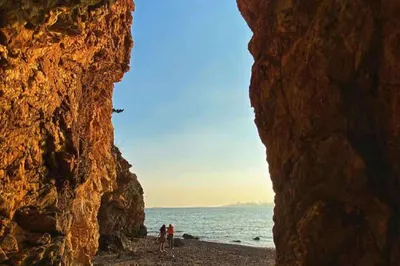
Shandong Travelogue: Badaguan, Qingdao
At 12:45 p.m. on October 24, 2023, after visiting the Tsingtao Beer Museum, I took a bus to Badaguan Scenic Area and arrived at 1:15 p.m.
Badaguan, located in the eastern part of Huiquan, Shinan District, Qingdao, Shandong, at the southern foot of Taiping Mountain, was first built in the 1930s. It is a famous scenic and convalescent area in China, covering over 70 hectares.
Badaguan is the scenic area that best embodies Qingdao's characteristic 'red tiles, green trees, blue sea, and azure sky.' It lies north of the Huiquan Cape Scenic Area in Qingdao, Shandong.
Eight passes, eight landmarks; eight faces, eight charms; eight scenes, eight moods. One end leads to distant frontier fortresses, while the other connects to the nearby mirage of sea and sky.
The name 'Badaguan' (Eight Passes) comes from the eight roads here (now increased to ten), named after famous passes of the ancient Great Wall of China.
This area is a renowned villa district, known as the 'Museum of World Architecture.'
Before liberation, it was a villa area for bureaucratic capitalists. After liberation, the People's Government carried out comprehensive renovations of Badaguan, making it one of China's important convalescent zones. Many Party and state leaders, as well as distinguished international friends, have stayed here.
The first building here, Huashi Lou, is located at the Second Bathing Beach in Taipingjiao, Badaguan. It was originally the summer hunting villa of the German Governor, built in 1906 in a medieval castle style.
At the end of the Qing Dynasty, this area belonged to the territory of Renhua Township, Wendengshe, in Jimo. In the early 20th century, after Germany occupied Qingdao, it was designated as a German residential area.
From 1931 to 1937, when Shen Honglie served as Mayor of Qingdao, the area east of Rongcheng Road, stretching north to Zhanshan Avenue and south to Taiping Bay, covering nearly a thousand mu, was planned as the 'Special Prescribed Building Area East of Rongcheng Road.' Regulations required building density to be under 50%, preservation of green spaces, and the use of openwork walls, among other stipulations.
About ten roads were built in this area, all named after ancient Chinese military passes. These include the vertical Zijingguan Road, Ningwuguan Road, and Shaoguan Road, which connect to Hong Kong West Road, and the horizontally intersecting Wushengguan Road, Jiayuguan Road, Hanguguan Road, Zhengyangguan Road, Linhuaiguan Road, Juyongguan Road, and Shanhaiguan Road. Collectively, they are commonly known as Badaguan.
In this area, there are over 200 buildings showcasing architectural styles from more than 20 countries, including Russia, Britain, France, Germany, the United States, Japan, and Denmark, earning it the reputation of a 'Museum of World Architecture.'
Different roads are lined with different trees: in spring, Shaoguan Road blooms with peach blossoms; in summer, Zhengyangguan Road is ablaze with crape myrtles; in autumn, Juyongguan Road glows with golden ginkgoes. It is both an important architectural and cultural exposition area and a famous scenic spot, always bustling with visitors.
Among them, Huashi Lou and Princess Villa are the standout buildings in the Badaguan villa district. Huashi Lou was built in 1930, its exterior walls made of granite, and its tower topped with crenellated parapets. It is a European castle-style building blending various Western architectural styles, incorporating Greek, Roman, and Gothic elements.
The main structure has five floors, with an observation deck on the top floor and an iron spire to the side. Because the interior walls are lined with marble and the exterior is inlaid with cobblestones, it has long been called 'Huashi Lou' (Flower Stone Villa).
The stone staircase below is divided into two flights: six steps above and nine steps below, leading via a stone path to an iron-fenced gate. The courtyard is planted with flowers and trees, making it a distinctive and famous building in Qingdao.
Before liberation, Chiang Kai-shek once resided here, and the spy chief Dai Li and the then-famous movie star Bai Guang also stayed here when visiting Qingdao.
Princess Villa is located at No. 10 Juyongguan Road. The small building consists of a pointed tower and an irregularly pitched roof structure, with a square platform to the south—reminiscent of a fairy-tale house, charming and exquisite. Princess Villa was built in the mid-1930s, covering nearly 1,000 square meters with a floor area of 721.98 square meters.
It is said that the villa was built by the Danish Consul General in Qingdao for the Danish princess, intended as her summer retreat. However, the princess never visited, but the name 'Princess Villa' has endured.
Unfortunately, we didn't see these buildings at all. We simply wandered randomly through the streets of Badaguan. The villas we saw were all within tightly enclosed courtyards, impossible to visit and difficult to photograph. Outside, fallen leaves carpeted the ground, and the autumn wind was bleak. My wife kept saying it was boring, so we had no choice but to leave hastily. Just as we were about to exit the scenic area, we spotted a tourist map marking Huashi Lou and Princess Villa. Though it was a bit of a pity, we didn't want to turn back.
At 2:50 p.m., we took a bus to Xiaoyushan Park, thinking it was Xinhaoshan (Signal Hill) Park. As it turned out, we had mixed them up. We decided to simply go with the flow and take a stroll there.
Xiaoyushan is located north of the eastern end of Laiyang Road, with an elevation of 60 meters and an area of 2.5 hectares. It is Qingdao's first classical-style hilltop garden park.
The hill originally had no official name but later became known as 'Xiaoyushan' (Little Fish Hill) because it is near Yushan Road. Though not tall, it offers distant views. From the summit, you can take in Zhanqiao Pier, Little Qingdao Isle, Lu Xun Park, the bathing beaches, Badaguan, and more. Though not large, it stands out prominently in the city center, drawing the attention of visitors.
The main structure on the summit, 'Lanchao Pavilion' (Wave-Viewing Pavilion), is an 18-meter-high, three-story, octagonal building with overhanging eaves. It is covered with green glazed tiles and features carved beams and painted rafters. The octagonal eaves are not adorned with dragons or phoenixes, but rather fish heads. The lintels and doorframes break from the tradition of hand-painted wood, using fired porcelain panels that depict colorful designs of marine life.
Inside the pavilion, you can see a polished lacquer mural titled 'Ancient Ships,' a silk tapestry called 'Assorted Qingdao Architecture,' and a lead-etching painting of 'Underwater World.'
Spiral staircases lead to the second and third floors, each with white marble balustrade platforms. From these platforms, you can walk around the pavilion and gaze into the distance, taking in the First Bathing Beach, Huiquan Bay, Qingdao Bay, as well as Zhanqiao Pier and Little Qingdao Isle—the coastal scenery is all in view.
This spot is hailed as the best place to overlook downtown Qingdao and the seaside scenery.
After leaving Xiaoyushan Park, at 4 p.m. we took a bus to Qingdao's Zhanqiao Pier. Having visited the pier many times before, and seeing it crowded with people, we had no interest in going onto it. We just strolled along the seafront, then walked back to the hotel, grabbing dinner along the way. Thus ended the day's outing.