First Encounter with Huangqiao Ancient Town
D1: Taixing Ancient Ginkgo Forest Park – Huangqiao Ancient Town (Huangqiao Park – Fuhui Zen Temple – Pearl Lane)
D2: Qintong Wetland Park
Accommodation: Qinhu Kaiyuan Mingting Hotel
Travel date: 2019.10.26
Mode of travel: Self-driving
Taixing Ancient Ginkgo Forest Park is located in Xuanbao Town, the smallest town in Taixing. Taixing also has a well-known Huangqiao Town. Since we had time, we decided to go and have a look! Huangqiao was established as a town during the Yuanfeng era of Emperor Shenzong of the Northern Song Dynasty. It is a thousand-year-old ancient town with a long history and a culturally rich town. It borders the Yangtze River to the south, connects Rugao to the east, and Jiangyan to the north. It is an important gateway from central and northern Jiangsu to southern Jiangsu, and is also the largest market town in central and northern Jiangsu. What we are most familiar with is the Huangqiao baked sesame cake from Huangqiao Town. The fame of Huangqiao baked sesame cake is closely linked to the famous Huangqiao Campaign. During the decisive battle in Huangqiao, the people of Huangqiao mobilized 60 baked cake shops and 18 mills in the town to produce Huangqiao cakes day and night. Men, women, old, and young, pushing carts and carrying loads, supported the frontline soldiers, creating a classic example in the history of the New Fourth Army where a smaller force defeated a larger one.
Navigating to Huangqiao Town brought us to Huangqiao Park in the middle of the town.
Address: No. 126, East Jinzhong Road, Taixing City, Taizhou City, Jiangsu Province
Huangqiao Park, originally named Huangqiao People's Park, was established in 1952. Facing the street is a gatehouse with eaves, guarded by two cute stone lions.
Entering through the gatehouse leads to a small square. In the center of the square stands a sculpture of a plowing ox, with various shops on one side and a wind-and-rain corridor on the other. Parking spaces are on both sides of the square.
A small stone bridge connects the square to the park's entrance. Citizens are fishing on the stone bridge.
Entering the park from the south gate, two stone horses stand guard. Under an artificial cave mound, a golden Maitreya Buddha smiles contentedly and joyfully.
In front of a cluster of green bamboo, a stone turtle carries a stone tablet – the imperial decree stele for He Song and his wife, chief recorder of the Ming Court of State Ceremonial, which is over 520 years old.
On the west side of the park, there is a nine-bend bridge.
The park has patches of bamboo groves, with vibrant greenery surrounding the white marble nine-bend bridge and a black four-cornered pavilion, giving an elegant and simple color scheme.
Because of the bamboo groves, a Bamboo Pavilion has been built here.
The park has a "Mu Garden," where martyrs who died in the Huangqiao Campaign are buried. On the right side is the burial site of the ashes of General Su Yu. This place not only reflects Su Yu's attachment to the area where he fought, but also the deep remembrance of the general by the local people.
The park is not large; the far end of the nine-bend bridge is closed off, so we had to retrace our steps. Returning to a pavilion on the east side of the park, the pavilion looked ordinary, but upon reading the stone tablet beside it, we realized it was not an ordinary pavilion. This is the place where He E (1404–1456), a local notable from the Ming Dynasty, once studied, called Yunxi Study. Indeed, it faces West Creek and has a room built beside the clouds. Under the pavilion, we asked a local how to get to the ancient town. He was surprised and told us this was the ancient town! After hearing our explanation, he said it was not far outside the park. We were looking for an old street or alley to explore and find the true flavor of the ancient town.
A small garden scene inside the park. This park is a city park, and we were probably the only outsiders walking through it! The park was filled with elderly locals leisurely strolling. They breathed in the air of this green oxygen bar. Huangqiao Park has accompanied generations of Huangqiao people as they grew up! It is an eternal landscape of Huangqiao Ancient Town!
Exiting the gatehouse, we saw a worn-out sign on one wall, which matched the information we had just been given. Turning right out of the gatehouse onto East Jin West Road, we walked westward.
After walking about fifty meters, on the north side of East Jin West Road stood a magnificent temple – Fuhui Zen Temple.
Address: East Jinzhong Road, Taixing City, Taizhou City
Fuhui Zen Temple was first built in the fourth year of the Tiansheng era of Emperor Renzong of the Northern Song Dynasty. It is located at the eastern end of Pearl Lane, with the temple gate facing south. The main buildings include the Vajra Hall, Arhat Hall, Mahavira Hall, and Sutra Library, with side halls such as the Guanyin Hall and Dutian Palace.
The Mahavira Hall has a two-tiered hip-and-gable roof with dougong brackets, flying eaves and upturned corners, giving it a magnificent appearance.
Address: East Jinzhong Road, Taixing City, Taizhou City
The courtyard wall of Fuhui Zen Temple adjoins the eastern entrance of Pearl Lane – Zhenhai Gate. Historically, Huangqiao Town had no city walls. The ancestors built a gate at each end of the streets and alleys. The gate arches were connected to residential houses on both sides, forming an arched doorway. At night, the two thick wooden doors were closed, sealing off the entire street. During the reign of Emperor Zhenzong of the Northern Song Dynasty, seawater flowed backward, causing disaster. The imperial court ordered Fan Zhongyan, the county magistrate of Xinghua, to build a dike to block the sea. In Huangqiao, a gate tower was built on the west side of the temple and named Zhenhai Gate, meaning "suppress the sea" to prevent the sea from invading again. During the Republic of China era, a cholera epidemic broke out in Huangqiao, killing many. The Huangqiao Chamber of Commerce initiated a campaign, and wealthy merchants and households donated money and supplies to build a pure wooden incense platform on top of Zhenhai Gate, praying for the health and safety of the people.
I climbed up to the top of Zhenhai Gate via a staircase on one side. Inside the large incense platform, there were incense burners and candle holders, housing a statue of Lord Guan. Standing high above, I overlooked Pearl Lane. This is one of the best-preserved ancient lanes in Huangqiao.
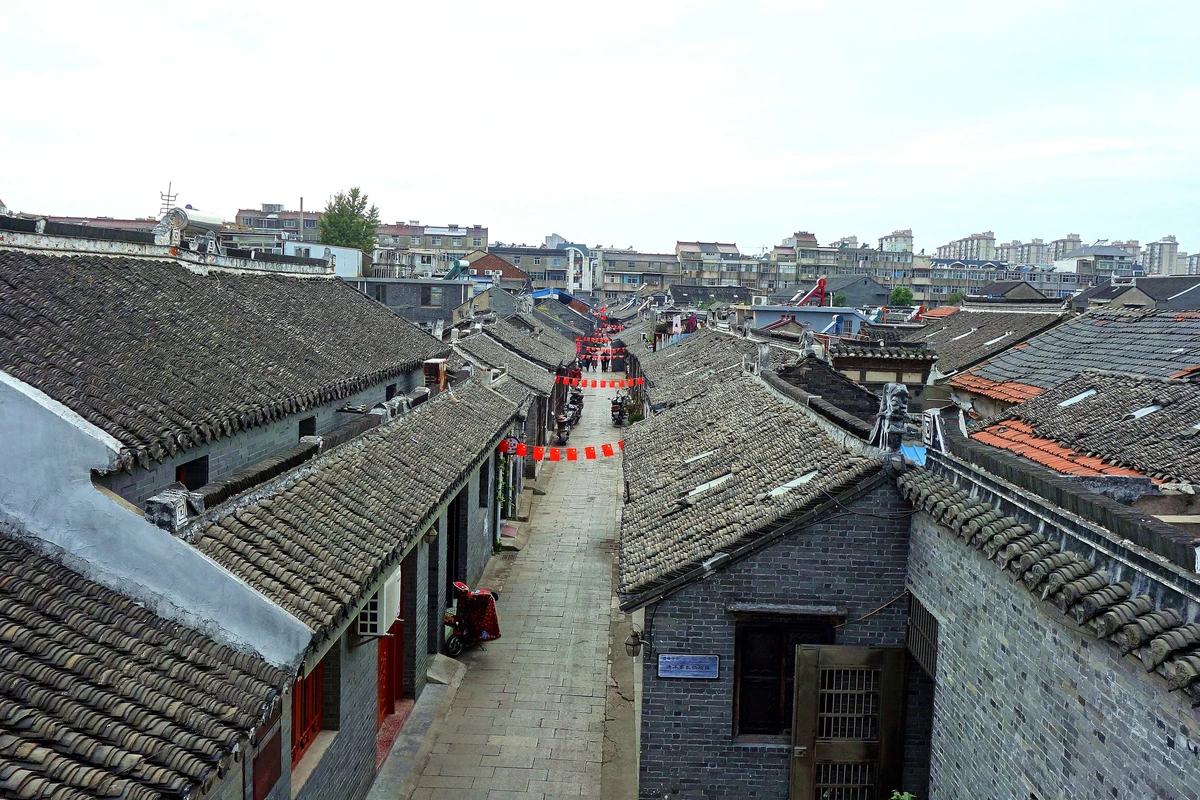
Pearl Lane runs east-west, paved with bluestone slabs, 350 meters long and about 4 meters wide. Most of the street-facing buildings are single-story houses with gray bricks and gray tiles in Ming and Qing styles. They have green bricks, small tiles, and panel doors, with shops in front and workshops or residences behind. Its historical remains are abundant, and its cultural heritage is profound.
This north-south lane next to Fuhui Zen Temple also features uniform gray brick walls and small gray tiles.
Pearl Lane was originally named Pig Lane. Historically, almost every household in the eastern half of Taixing raised pigs, creating a high demand for piglets. Many small pig markets appeared here, and the lane was called Pig Lane. Later, the small pig markets were replaced by various shops. By the 1930s, there were no pig markets left on the old street, and Pig Lane gradually became Pearl Lane.
The solemn street, if not for the red national flags fluttering in the lane, would look like an elegant ink painting.
Looking back at the Zhenhai Gate incense platform we had just passed, the building is quite distinctive – an elevated wooden building over the street, with an arched gateway below allowing pedestrians to pass through.
The gate has a roof, a brick-and-wood structure with sloping eaves on both sides, which not only protects the gate but also provides shelter from rain for passersby.
Pearl Lane is a main street, with many small alleys branching off north and south. On the alley walls, a wooden sign is nailed, indicating the name and origin of the alley. South Welcoming Auspicious Alley: Welcoming Auspicious Alley is divided into north and south sections and is quite long. It was originally home to many silversmiths, and because "silversmith" sounds like "welcoming auspicious" in Chinese, it was named North and South Welcoming Auspicious Alley.
Take a look at the authentic residential houses here.
There is a public bathhouse in the alley.
Under the eaves, a row of birdcages lined up, with birds singing in chorus, creating a lively atmosphere.
An impressive entrance with intricate carvings of two dragons playing with a pearl on the wooden door. The three characters "Qian Long Yuan" (Hidden Dragon Abyss) are engraved in recessed square bricks set into the lintel, clearly indicating a government institution. "Qian Long Yuan" is the former site of the Water Dragon Bureau, which we now call a fire station. Located west of the large incense platform, it covers about 20 square meters. In the old days, firefighting used water dragons (manual pumps) operated by manpower to pressurize and spray water. Inside the Water Dragon Bureau were water dragons, buckets, hoses, and spray guns, with iron hooks, fire-fighting paddles, and fire-proof hats hanging on the walls. Whenever a fire broke out, residents would spontaneously pull out the water dragon to extinguish the fire.
At the junction of the alley and lane stands an impressive South Guan Gate, with layered eaves, each layer featuring exquisite stone carvings of different patterns. The gate has both practical and artistic value.
Horse Lane: In the past, the He family lived in this lane. Because they often rode tall horses, people called it Horse Lane.
The He family is a prominent clan in Huangqiao. During the Ming and Qing dynasties, the He clan alone produced four jinshi (imperial scholars) and ten juren (provincial graduates), and more than three hundred xiucai (licentiates). Most of the He family officials were upright and incorruptible, so they were highly respected.
The former site of the Huangqiao Campaign Support Committee is located in this He Ancestral Hall.
Facing south, the He Ancestral Hall is also nearly 500 years old. Having weathered 500 years of wind, frost, rain, and snow, enduring 500 scorching summers and freezing winters, this ancient building still stands vigorously before the world. The brick corners on both sides of the gate are decorated with large brick carvings featuring auspicious patterns such as ganoderma, writing brushes and ingots, coral, rhinoceros horns, yuanbao, and ancient coins. Although there is only one gate, it adopts the relatively noble General's Gate style in ancient Chinese architecture. Underneath the gate is a high threshold, with two large circular drum-shaped stones carved with lions playing with balls on either side. The pitch-black door has beast-head-shaped bronze door knockers, creating a solemn atmosphere. Above the gate, under the golden ridge beam, hangs a plaque with golden characters reading "He Ancestral Hall."
I wonder why the iron general (lock) is guarding the door here. Is it only opened for special events?
The old streets have lanes and alleys. Lanes were originally transportation arteries. Although they are now just bluestone alleys by modern standards, in the past they were more than sufficient for horse-drawn carriages and sedan chairs. In addition to lanes, there are also alleys within the building clusters, which are narrower, connecting more residential houses.
The alleys have few shops; most are residential homes, making them quieter.
We entered Pearl Lane from Zhenhai Gate on the east side and reached the western end of Pearl Lane. Since the west side faces the Yangtze River, this gate is called Chengjiang Gate. According to expert research, such gate arches are rare in China and are a local feature of Huangqiao.
At the end of Pearl Lane is Shiqiao Middle Road, a modern street. The town is not very bustling, but here you can see two styles of buildings: one side features ancient-style residential houses, while the other side consists of multi-story modern residential complexes. The intersection is lively, with various Huangqiao snacks on display. Some snacks are sold in shops, while others are sold by street vendors, but all are bustling. Across the road is Wangjia Lane, similar in style to Pearl Lane, with stone-paved ground, gray bricks, and black tiles, giving a simple and unadorned feel. It seems that the ancient buildings from the Ming and Qing dynasties are not limited to Pearl Lane alone! If we had more time, we could have explored a few more lanes.
Due to time constraints, we had to head to Jiangyan to meet up with companions, so we turned back. We walked back from the west end of Pearl Lane through the several-hundred-meter-long Pearl Lane to the park's parking lot. Although there were shops lined up side by side, most of their business was with locals, as there were very few tourists. It felt like we were the only two outsiders wandering around curiously. Look at this mop drying on a bamboo pole – interesting, isn't it?
There are many baked cake shops in the alleys. In my impression, Huangqiao baked sesame cakes are small, round, and covered with sesame seeds. But I didn't see any shop selling the kind I remembered. Instead, they sold super-sized cakes, as big as a washbasin. I asked the shopkeeper if these were Huangqiao cakes. They all replied nonchalantly, "Yes." I had some doubts, but since so many cake shops in the alley didn't sell the kind I remembered, I thought that perhaps the cakes sold in Pearl Lane, the most representative lane in the ancient town, must be authentic Huangqiao cakes. I began to doubt my own memory. Regardless, I bought one to eat later during dinner — since I came to Huangqiao, it would be a waste not to try the cakes.
At dinner, when I took out the cake, everyone laughed and said it wasn't a Huangqiao cake. But when I had asked more than one shop in the alley if it was a Huangqiao cake, they all said yes. Whether it was or not, everyone was seeing this food for the first time and didn't know what it was called. Since we hadn't eaten it before, it was nice to try it. This large, drum-shaped cake, as big as a washbasin, was clearly pan-fried in oil. It bulged in the middle, about two or three inches thick, gradually sloping down to a rounded edge all around. We had to ask the restaurant staff to cut this giant into pieces before we could eat it. It was actually made with unleavened dough, somewhat like a fried pancake – soft-looking but still chewy, with a hint of sweetness and a slight sourness from the yeast.
But this left a doubt lingering in my mind. Only today, while writing this travelogue, I resolved to clarify this doubt. Finally, I found a popular and comprehensive article online that answered my months-long question. This is not the famous Huangqiao cake; its name is "Zhangshaobing" (Risen Fried Cake). With this resolved, I felt relieved. But at the same time, I couldn't help feeling puzzled — didn't the shop owners know this wasn't a Huangqiao cake? I felt a bit disappointed. In fact, whether there are beautiful sights on a trip is not the most important thing; what matters are the people you meet. Each living person shapes your overall impression of a place. Here, due to a misunderstanding, I got to taste a "Risen Fried Cake" I had never eaten before – that itself was a pleasant experience. But when more than one local in the alley told me it was a Huangqiao cake, it made me wonder...