Revisiting Jiangsu's Red Classics — A History, A Memory
Starting from the revolutionary spark ignited by the red boat on South Lake in Jiaxing in July 1921, to 2021, over a century of struggle, the Chinese people have achieved splendid accomplishments that have attracted worldwide attention, writing a magnificent historical scroll. Today, let us follow the route of the Watery Jiangsu Red Tour, review the Party's history, strengthen our faith and convictions, draw wisdom and strength, bravely take responsibility, and under the Party's leadership, create new brilliance.
The New Fourth Army Huangqiao Battle Memorial Hall is located at No. 388, Zhifu North Road, Huangqiao Town, Taixing City, Jiangsu Province. The exhibition area covers 8,000 square meters and has eight exhibition halls, comprehensively showcasing the Huangqiao Battle from eight aspects: "Central Decision, Developing Central China," "Advancing into Northern Jiangsu, Eastward to Huangqiao," "Based in Huangqiao, United Resistance Against Japan," "United Front, Maneuvering," "Self-Defense Counterattack, Decisive Battle at Huangqiao," "Joint Efforts, Enthusiastic Support," "Revolutionary Spirit, Shining for Eternity," and "Huangqiao - A Famous Historical and Cultural Town in China."
In 1937, the July 7 Lugou Bridge Incident marked the start of the Japanese imperialists' full-scale war of aggression against China. After the August 13 Incident, Shanghai, Zhenjiang, Nanjing, Wuhu, and other vast areas south of the Yangtze River fell one after another. Starting in October, the Red Army guerrillas from 14 guerrilla zones in eight southern provinces responded to the Central Committee's call and were reorganized into the New Fourth Army. Following the Central Committee's instructions, the New Fourth Army went deep behind enemy lines to carry out anti-Japanese guerrilla warfare and establish anti-Japanese base areas in central China behind enemy lines.
In 1940, the Jiangnan Command of the New Fourth Army was ordered to lead its main forces into northern Jiangsu. At that time, the deputy commander of the Shandong-Jiangsu War Zone was passive in resisting Japan but active in opposing the Communists. After the New Fourth Army advanced east to Huangqiao, in October 1940, Han mobilized over 30,000 troops to attack Huangqiao, while the New Fourth Army had only about 7,000 soldiers.
With the full support of patriotic democratic figures from all walks of life in northern Jiangsu and the people of the Huangqiao area, they rose up in self-defense. In this battle, the New Fourth Army annihilated 11,000 enemy troops and captured 3,200 soldiers, achieving victory in the Huangqiao Battle. This cleared obstacles for a new phase of anti-Japanese resistance in northern Jiangsu and laid the foundation for developing the anti-Japanese battlefield in central China, creating a famous example in the history of Chinese and foreign wars of defeating a larger force with a smaller one.
In the memorial hall, the three-dimensional murals, vivid scenes, small boats used for crossing the river, various old-fashioned weapons, and broken tiles not only show us the cruelty of war but also make us feel the bravery and fearlessness of the New Fourth Army officers and soldiers. Today's hard-won happy life is not easy to come by; let us cherish it and strive hard for the glorious cause of realizing the great rejuvenation of the Chinese nation.
On June 17, 1938, Su Yu led the New Fourth Army's Advance Detachment and part of the Second Regiment of the First Detachment to ambush a Japanese transport convoy at Weigang, southwest of Zhenjiang. The battle lasted only half an hour and was a complete victory. The Weigang Battle was the first battle of the New Fourth Army advancing into the enemy's rear in Jiangnan to resist Japanese aggression. This battle shook Jiangnan, dampened the enemy's arrogance, and opened the prelude to the establishment of the Southern Jiangsu Anti-Japanese Base Area.
The Weigang Ambush Battle Memorial Hall is located in Weigang Town, Runzhou District, Zhenjiang City, and consists of two parts: the Weigang Battle Victory Monument and the Weigang Battle Memorial Room.
Along the road to the monument, the original trenches from that year have been faithfully restored.
The monument is on Gaoli Mountain, 25 meters high. At the top of the monument is a bronze-colored rifle model. The front of the monument body is inlaid with a bronze-cast name. The relief on the base of the monument features the emblem of the New Fourth Army (N4A). On both sides are carved poems praising the Weigang Battle from that time.
The red flag at the top of the base expresses the artistic conception of Chen Yi's famous line, "Our country's banners have reached the south of the Yangtze." The Weigang Battle Site Exhibition Room uses detailed photographic materials to vividly recreate the scene of the New Fourth Army's first victory as they advanced into southern Jiangsu.
Before arriving in Zhenjiang, I had heard of Xijin Ferry. Suanshan (Garlic Hill) is particularly famous. According to legend, more than 1,700 years ago, two legendary figures were in a pavilion on a small hill next to the Zhenjiang Yangtze ferry. They simultaneously wrote the character "fire" (火) in their palms, leading to a famous battle in history known as the "Battle of Red Cliffs." These two legendary figures were Zhuge Liang and Zhou Yu. Because of this strategy, Suanshan is also called Suanshan (Calculating Hill). The Xijin Ferry at the foot of the mountain has a significant history: it is the area in Zhenjiang with the most numerous, concentrated, and well-preserved cultural relics and historic sites, and it is the "cultural vein" of Zhenjiang, a famous historical and cultural city.
Speaking of the history of Xijin Ancient Ferry, it can be traced back to the Six Dynasties period, when the ferry route across the river was already fixed. During the massive "Yongjia Southward Migration," more than half of the northern refugees landed here. During the reign of Empress Wu Zetian of the Tang Dynasty, Xu Jingye, Luo Binwang, and others launched an armed uprising in Yangzhou, shaking the country. After their defeat, Xu Jingye, Luo Binwang, and others crossed the river and "fled to Runzhou, hiding under Suanshan." In the Song Dynasty, this was the front line of resistance against the Jin... In ancient times, Xijin Ferry faced Guazhou Ferry and was known as the "Key to Wu and Chu," "Lock and Key of the Yangtze," and "Throat of Water Transport." Its important strategic position made it a place contested by military strategists since the Three Kingdoms period.
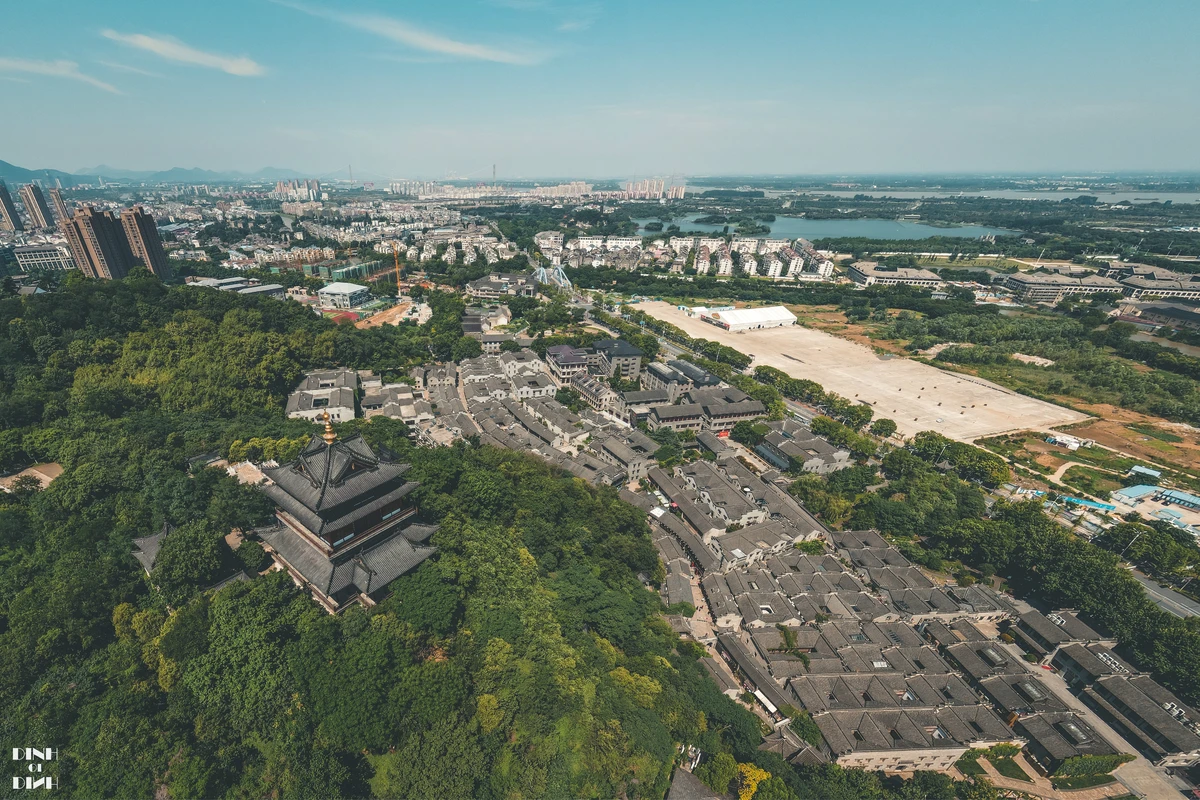
When visiting Xijin Ferry today, you may notice a strange sight: the Waiting Pavilion and the Life-Saving Society are both far from the riverbank. This is because the riverbank shifted northward due to silting on the south side and erosion on the north side. The area originally submerged by the river gradually emerged and formed a road, eventually creating this 1,000-meter-long ancient street. On both sides of the street are buildings from various dynasties, arranged at different heights. The bluestone slabs still bear deep ruts left by thousands of years of horse-drawn carriages and vehicles, forming a historic district with the features of a "thousand-year-old ancient ferry and a century-old street." Within the street are famous attractions such as the Zhenjiang Museum, Zhaoguan Stone Pagoda, Guanyin Cave, and the former site of the Life-Saving Society.
"At Jinling Ferry, a small tower by the hill, a traveler can feel lonely for a night. The tide falls, the river is dark under the slanting moon, a few sparks of light are Guazhou."
Zhang Hu's poem "Inscription at Jinling Ferry" is engraved on the ancient street, and passing tourists often stop to savor the artistic conception of this poem.
[Zhaoguan Stone Pagoda]
The stone pagoda is not far from the entrance of the Life-Saving Society. Zhaoguan Stone Pagoda, also known as Guanyin Cave Lama Pagoda or Bottle Pagoda, is located in the center of Xijin Ferry Ancient Street. It is the only existing lama-style street-crossing stone pagoda in the Jiangnan region of China. The pagoda was originally built in the Yuan Dynasty and rebuilt in the tenth year of the Wanli era of the Ming Dynasty. After weathering many storms, it gradually deteriorated. The stone pagoda we see today was rebuilt in 2000.
The pagoda is 5 meters high and consists of five parts: base, body, neck, top, and the thirteen heavens. It is carved with the Eight Buddhist Treasures, meaning that passing through the pagoda once is equivalent to sincerely worshipping Buddha once. There are four arched doors, each engraved with the phrase "Together Ascend the Path of Enlightenment."
The establishment of the Life-Saving Society can be traced back to the Song Dynasty. As the name implies, it means to rescue and save lives, and it was a charitable water safety and rescue organization.
Entering the main gate and passing through the hall, there is a unique courtyard. On the east side of the courtyard is a two-story wooden building. The first floor hall has an introduction to the Life-Saving Society, and the second floor is an exhibition hall displaying textual and pictorial materials about the Life-Saving Society from the Song, Yuan, Ming, and Qing dynasties.
The red boat displayed in the courtyard is a replica of the rescue boats used by the Life-Saving Society at that time. The rescue boats were painted red, commonly called red boats. A prominent tiger-head plaque was hung on the mast, indicating that they were rescuing by imperial decree. When the copper gong on the boat was struck, no one was allowed to obstruct them.
Its important difference from the official ferry was that the official ferry was mainly responsible for the transportation of merchants and their goods across the river for the imperial court, sometimes also serving rescue purposes; while the Life-Saving Society was specifically responsible for salvage of sunken ships and river rescue operations.
Next, we drove to the Changzhou Martyrs Cemetery. However, because it was Monday and the cemetery was closed to the public, we left with regret and headed to the next stop.
During the hundred-year glorious history of the Communist Party of China, many outstanding sons and daughters of China emerged. We arrived at Li Gongpu's former residence on Gongpu Road, Wujin District, Changzhou City. By the 1990s, most of the houses in the former residence had been destroyed. After restoration, it became the current Li Gongpu Former Residence.
The current former residence faces south and has three sections: the entrance hall, the official hall, and the main building. It is a brick-and-wood structure with hard mountain-style main buildings, maintaining the traditional architectural style of the early Republic of China. Li Gongpu was born in this ordinary house in 1902 and spent his childhood here. On July 11, 1946, Li Gongpu was assassinated by Kuomintang agents in Kunming and died early the next morning.
To praise the virtuous and inspire the public's patriotic enthusiasm for rejuvenating China, a photo exhibition titled "People's Martyr - Li Gongpu" has been launched in the former residence, displaying over 200 historical photos of Mr. Li Gongpu. It consists of seven parts: his striving youth, dedication to civilian education with the aim of rejuvenating China, the shocking "Seven Gentlemen" incident, his advocacy for nationwide resistance against Japan, his yearning for Yan'an and going deep behind enemy lines, his persistence in resistance and advocacy for democracy, and the immortal democratic fighter. These materials vividly reflect Mr. Li Gongpu's unyielding spirit in the face of power, riches, and poverty, his iron backbone, and his firm dedication to the new democratic revolution. Mr. Li Gongpu's spirit of "patriotism, democracy, progress, and dedication" not only has specific historical significance but also has strong contemporary relevance.
Looking at these pictures, we see the patriotic chapters written with blood and life by our predecessors. They teach us the value of life and the meaning of existence, inspiring us to strive hard, work diligently, and contribute our strength to the prosperity of the Chinese nation.
The Crossing the River Campaign Memorial Hall is located within the Jiangyin Revolutionary Martyrs Cemetery, at the foot of the scenic Huangshan Mountain. It is a modern architectural complex blending ancient and modern styles, looking from afar like a warship braving the wind and waves. The memorial hall reflects the magnificent Crossing the River Campaign through six sections: "Preparing to Cross the River," "Greeting the Dawn," "Persuading the Fortress to Surrender," "The Mighty Army Crosses the River," "Pursuing the Cornered Enemy," and "Rebirth of the Ancient City."
Starting from April 20, 1949, the million-strong People's Liberation Army, under the unified command of the Central Military Commission and the General Front Committee of the Crossing the River Campaign, launched the cross-river operation from the thousand-mile front stretching from Hukou in the west to Jiangyin in the east, divided into middle, eastern, and western routes. The victory of this campaign paved the way for the establishment of the People's Republic of China.
The memorial hall uses artifacts, pictures, and sound, light, and electricity effects to vividly reflect the entire process of crossing the river and the grand scene of the million-strong army crossing, vividly demonstrating the great achievements of military-civilian unity and decisive victory, praising the brave spirit of the people's soldiers who sacrificed and fought fearlessly, and realistically recreating the glorious course of a large-scale decisive battle in the history of the War of Liberation.
Dangkou Ancient Town is located at the junction of Wuxi, Suzhou, and Changshu. It is a famous historical and cultural town in China. Dangkou is named because it is located at the entrance of E'zhen Lake. Additionally, Dangkou is the hometown of Grand Tutor Hua, from the story of Tang Bohu dotting the autumn fragrance in "Three Smiles' Romantic Fate." The scenic area has eight tourist attractions: Hua's Charitable Hall, Qian Mu's Former Residence, Guandi Temple, Hua Hengfang's Life Story Exhibition Hall, Hua Junwu's Former Residence, Hengdelei Clock and Watch Museum, Wang Xin's Former Residence, and Huitong Hall.
At the entrance stands a very prominent memorial archway. The two characters "Dangkou" on it are the handwriting of Tang Bohu, a talented scholar from Suzhou in the Ming Dynasty. The four characters "Ren Li Yi Fang" on the back were written by Wen Zhengming.
During the Ming and Qing dynasties, Dangkou produced 25 jinshi (successful candidates in the highest imperial examinations), more than 50 juren (successful candidates in the provincial examinations), and over 130 officials above the fifth rank. However, in the early Ming Dynasty, for nearly 100 years, very few people from Dangkou passed the provincial examinations. Why? It goes back to the battle at Ganlu Town between Chang Yuchun, a founding general of Zhu Yuanzhang, and Mo Tianyou, a fierce general of Zhang Shicheng. The Hua family was responsible for providing grain and fodder support to Mo Tianyou. Afterward, Zhu Yuanzhang held a grudge against the Hua family and cut off their path to the imperial examinations. To appease the matter and avoid being implicated, the Hua ancestors also established a family rule forbidding descendants from taking the imperial examinations in the capital. It was not until the mid-Ming Dynasty that the ban was gradually lifted, and the Hua descendants began to emerge again.
Strolling through the ancient town, we soon arrived at Wang Xin's Former Residence.
[Wang Xin's Former Residence]
"Five-star red flag fluttering in the wind, victory songs so loud and clear, sing praise to our dear motherland, from now on to prosperity and strength."
On September 15, 1950, Wang Xin went from Tianjin to Beijing to purchase musical instruments. On his way back, passing Tiananmen, looking at the five-star red flag flying high over Tiananmen Square, the first four lines of the lyrics came out spontaneously. On the train back to Tianjin, his thoughts flew, and he sang, wrote, and beat time simultaneously; the lyrics and melody gushed out. The birthplace of this great singer is located in Dangkou Ancient Town.
Wang Xin was born in 1918 in Dangkou Town, Wuxi County, Jiangsu Province. In 1935, he met progressive musicians such as Xian Xinghai and was influenced by them to embark on the path of revolutionary music. In 1938, he went to Yan'an and studied music at the Lu Xun Academy of Arts and Literature. On September 15, 1951, the People's Daily published the song "Singing the Motherland." In 2001, Wang Xin was awarded the highest award in the music industry, the "Golden Bell Award" Lifetime Achievement Award.
Arriving at Wang Xin's Former Residence, the first thing that comes into view is a statue of Mr. Wang Xin in the square. His waving arms seem to be conducting everyone to sing. Entering the hall, listening to the looped playing of "Singing the Motherland," a strong shock makes our blood boil.
Going further inside, there are three exhibition halls. The "Song from Dangkou" hall shows the beginning of Wang Xin's music creation. The "Song as Guide" hall displays Wang Xin's pursuit and struggle on the path of song creation. The "Singer Never Stops" hall tells the story of Wang Xin returning to his alma mater after becoming famous.
"Singing the Motherland" has become the ceremonial music for various major events in China, used as the opening or closing music, and is known as the "second national anthem."
River delicacies are a must-try along the way.
Zouyourou (braised pork belly) is a specialty dish of Jiangyin, a must-have on local dining tables, and is served as the final highlight dish to show its importance.
Yao rou (pork roll) is a cold appetizer that should also be tasted, especially paired with Zhenjiang vinegar.
[Zhenjiang Xijin Ferry Argyle Pudi Hotel]
A hotel with an antique charm, with low-rise buildings designed in a pseudo-classical style. Wearing a qipao is especially suitable for taking photos in the hotel. The room layout is also great, and most importantly, the bedding is very comfortable to sleep on.
[Jiangyin Xinyu Hotel]
Because the rooms were fully booked, we were fortunately upgraded to a suite. The space is very large. The newly renovated style is quite likeable, and it is very convenient for traveling and eating nearby.
Table of Contents:
1. Preface
2. Preview of Beautiful Pictures
3. New Fourth Army Huangqiao Battle Memorial Hall
4. New Fourth Army Weigang Battle Memorial Hall
5. Xijin Ferry Historical and Cultural District
6. Changzhou Martyrs Cemetery
7. Li Gongpu's Former Residence
8. Crossing the River Campaign Memorial Hall
9. Dangkou Ancient Town
10. Food Recommendations
11. Accommodation Recommendations
Tourism Information Hotel Index Strategy Index Flight Index Website Navigation Tourism Index Cruise Index Corporate Travel Index Franchise Cooperation Distribution Alliance Friendly Links Corporate Gift Card Procurement Insurance Agency Agency Cooperation Hotel Franchise Destination and Scenic Area Cooperation More Franchise Cooperation About Ctrip About Ctrip Ctrip Hotspots Contact Us Careers User Agreement Privacy Policy Security Center Ctrip Content Center Intellectual Property Trip.com Group Algorithm Disclosure