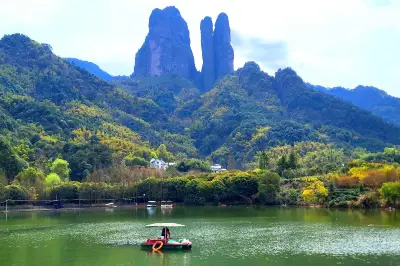
Taking the Bullet Train to Taizhou, Encountering a Romantic and Enchanting Autumn
People are always so peculiar—cherishing the tenderness of their hometown while craving the novelty of the unknown.
In this romantic and enchanting autumn, I keep moving, chasing new passions and reflections.
Taizhou is different from Nanjing’s historical weight as an ancient capital of six dynasties, and different from Suzhou’s classical elegance with gardens everywhere. It’s like a modest beauty—though not stunning to the world, it has an enduring gentleness that flows like a fine stream, forming its own unique charm.
Departing from Shanghai, you can reach Taizhou by bullet train.
Crisscrossing waterways and scattered raised fields are the hallmark of water-town Xinghua. Lizhong Water Forest—here, the forest grows freely on the water, and together with its reflections, it forms this perfect pastoral scene of Jiangnan.
I envy the residents living here, waking with the faint morning light and falling asleep with the twilight sunset.
Lush fields and paths, the sound of flutes and pastoral songs, fishing in the river bends, soft and gentle ripples.
Not far away, Dongluo Village has been renovated, and guesthouses have sprung up just right. Built along the water, each independent courtyard seems to float in the mist above the water, ethereal like a fairyland.
If I could brew a pot of hot tea or sip a glass of strong liquor in such a pleasant dwelling, it would surely be one of life’s great joys.
A boat ticket, a cruise ship—encountering Taizhou’s stunning night scenery and river views.
The cruise passes famous spots such as Wanghai Tower, Wenchang Pavilion, Taoyuan, Yingchun Bridge, Mei Garden, Liufang Teahouse, Beacon Tower, Gulou Bridge, and Bozi Street, ending at the Ancient Guandi Temple Pier in downtown Taizhou. The entire trip takes about 45 minutes.
As night falls, the brilliant lights on both banks adorn the ancient buildings with dazzling splendor, leaving you breathless. A snapshot taken casually needs no post-processing to be stunning.
The cruise also thoughtfully provides a full narration of Taizhou’s culture, customs, and attractions along the shore. While enjoying the night view and listening to the commentary, you can grasp most of the cultural essence of Taizhou.
When passing Yingchun Bridge and Gulou Bridge, pedestrians pause, and the cruise glides by—just like the saying: “You stand on the bridge and watch the scenery, while the one watching the scenery watches you from the boat.” “Young, you don’t understand the meaning in the painting; when you look again, you are already the figure in the painting.”
In the Jiangnan water towns, small cities crisscrossed by rivers are common. Taizhou’s Daohe Ancient Block, with the Dao River and Cao River running north-south, and the Yangtze and Huai waters meeting here. During the Republic of China era, there were over a hundred grain businesses along the Dao River, and the river was filled with boats carrying rice from the Lixiahe region. Hence the name “Dao River.” Water brought prosperity, and also more charm and scenery.
What left the deepest impression on me were the many ancient wells scattered throughout the ancient block, like chess pieces placed on a board. Despite the passage of time, the Dao River still displays its unique vitality and energy.
As a travel blogger, I’ve stayed in countless hotels and guesthouses, big and small. But this time at the Daohe Shuxiang Shijia Hotel, I still received many unexpected surprises. The hotel is located in the historic Daohe Ancient Block of Taizhou, built along the Dao River with green bricks and black tiles, exuding an antique charm. Amidst it, every blade of grass, every tree, and every brick outlines a classical elegance.
In stark contrast to the decor is the integration of smart technology. Every room is equipped with a smart robot to help control lights, air conditioning, curtains, and other basic facilities, allowing guests to fully experience the charm of technology and intelligence, blending tradition with modernity.
It’s time to wake up the sleeping stomach with a delicious morning tea. Compared to Guangzhou’s morning tea, Taizhou’s morning tea has more of the flavor of everyday life. Light and natural, with lingering subtle flavors—this is the magic of Taizhou morning tea.
A plate of scalded dried tofu skin, a basket of steamed buns, shaomai, or steamed dumplings, plus a bowl of fish soup noodles. Sitting in a lane rich with local atmosphere, watching the steam rise from the bamboo steamer, listening to the chatter of nearby diners—this is the start of a beautiful day for many Taizhou residents.
The Caolu Roasted Cakes at Taizhou Old Street have become synonymous with Taizhou cuisine. Every day, many foodies come specifically for them. To some extent, they are not just satisfying their appetite but, through the Caolu roasted cakes, getting a glimpse of China’s traditional grassroots food culture.
The boss skillfully places each cake blank into the sizzling hot oven. Under the heat, the white cakes turn golden and crispy, puffing up. A fragrance of wheat and sesame wafts from the oven. At just the right moment, the boss takes a long-handled iron shovel and a long-handled wire mesh scoop, reaches into the oven, and scoops out the cakes, pouring them into a bamboo basket. Freshly baked Caolu roasted cakes are golden, thick, fragrant, and crispy—delicious and affordable. No wonder so many people buy them. Actually, for Taizhou residents, it’s not just food they’re buying; they’re also buying a piece of childhood joy and memory. After all, Caolu roasted cakes have grown up with them, and they hope to grow old together with them.
The great Peking Opera master Mr. Mei Lanfang not only creatively inherited and developed Peking Opera but also brought China’s national treasure to international stages. His historical status and spirit of righteousness filled me with admiration and reverence when I visited Mei Garden.
This memorial hall was built in the 1980s, surrounded by water on three sides, with lush trees and elegant scenery. It is a small garden-style celebrity memorial hall mainly composed of relocated Ming and Qing buildings. Due to the historical significance behind Mei Garden, it has become a provincial-level patriotic education base, a model scenic spot of Jiangsu Province, and one of “Taizhou’s Top Ten Tourist Attractions” and “Taizhou’s Eight City Scenes.”
As the oldest existing ancient garden in northern Jiangsu, Qiao Garden holds a pivotal position in the study of classical gardens. Over 400 years, Qiao Garden has changed owners and names many times, but this only makes it more mysterious and inviting for exploration.
Stepping into the garden, rocky valleys, forests, and springs complement each other; pavilions, towers, and verandas shine together; flowers, grass, pines, and bamboos are dotted in layers, clearly arranged. No matter which doorway or window you look through, the view before you is a beautiful scenery worth experiencing.
It’s truly marvelous—being in the midst of the city yet having such a quiet place to escape the worldly hustle. “The great hermit hides in the city”—this is exactly it.
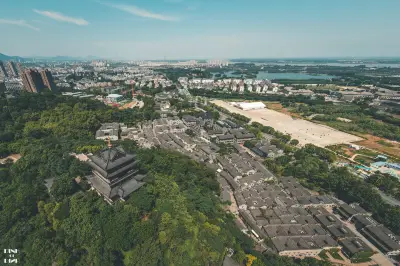
By the graceful Fengcheng River, a tower stands quietly, silently watching the flowing water, undisturbed by changes. This is Wanghai Tower, known as “the first tower of Jianghuai.” As a landmark of Taizhou, it is far more than an ordinary tower to the locals—it is a microcosm of history and a heritage of culture.
Climbing up the steps and taking the elevator to the top floor, a tour along the way deepens your appreciation of Wanghai Tower’s historical weight and humanistic spirit. Standing on the fourth floor and looking into the distance, the entire Taizhou city unfolds before you. The Fengcheng River meanders gracefully; newly built skyscrapers complement ancient historical sites, blending tradition and modernity.
Previously, I only knew salt as an essential condiment for life, but after visiting the “Jiangsu Salt Tax Museum,” I discovered that even a tiny grain of salt has an astonishing history.
A tour through the museum gave me a general understanding of the origin, changes, contributions of the salt tax, and its connection with Jiangsu.
The museum’s style perfectly combines old-world charm with modern technology, making visitors feel immersed in salt tax culture.
I imagine every boy dreams of being a soldier, especially in a white naval uniform, looking dashing and heroic. Before coming to Taizhou, I had no idea that this was the birthplace of the People’s Navy, earning it the nickname “Motherland of Sailors.”
The Memorial Hall of the Birthplace of the Navy consists of an “old site” and a new building. The old site is a two-story Qing-style building, recreating the historical scene where the Third Field Army command headquarters planned and fought the battle to cross the Yangtze River.
The new building’s exterior resembles a warship. On the left side of the outdoor square stands a tall mast symbolizing naval ships. The square and exhibition areas display China’s naval scientific achievements and military strength. A tour inspires a sense of pride and patriotism.
A square building extends the indelible historical and cultural depth of Taizhou.
The Diaohua Lou (Carved Tower) scenic area, like a shy maiden, stepped into my view, half-hidden. Known as the first tower of Jiangdong, its main structure is entirely wooden, with various intricate carvings inside. Upon closer inspection, you marvel at the exquisite craftsmanship of the artisans, with each carving carrying profound meaning.
After leaving Diaohua Lou, sitting on a wooden rocking chair in the square, basking in the sun, and daydreaming is also a good way to pass time.
Qinhu Lake National Wetland Park is a provincial-level scenic spot and a national 5A-level tourist attraction approved by the Jiangsu Provincial Government. It is the second national wetland park approved by the State Forestry Administration and the first in Jiangsu Province.
Vast water surfaces, gently swaying black-canopied boats, and elegant white swans—everything is just right. The beauty of Qinhu Lake can be deeply felt even by a short walk along its shore. Soft reeds sway in the wind; you can pluck a wild grass to play with, dye your clothes with pollen, breathe in floral scents, spot elk, taste lake delicacies, drift in a small boat, and hum a tune—truly a first-class leisure and scenic pleasure.
Every city with deep historical and cultural heritage has such an ancient town, untouched by the hustle and bustle of modern society, still preserving its original pace and genuine simplicity.
Qintong Ancient Town did not disappoint me, an ancient town enthusiast. Surrounded by water outside, with deep alleys, stone-paved streets, old wells in courtyards, and winding rivers inside, it is rightly called “Zhouzhuang of Northern Jiangsu.”
Without overwhelming crowds, I walked slowly through the streets alone, bought a rice cake, tasted a thin pancake—this might be a place forgotten by time.
I have always believed that all stories have a beautiful ending. If the ending is not beautiful enough, then the story is not yet finished.
At this point, the three-day Taizhou trip is drawing to a brief conclusion. Ancient city years, water-town scenery—I am fortunate that this ending is beautiful enough.