Don't Miss This Spring: Admire Floating Rapeseed Flowers in Xinghua and Explore Jindongmen Old Street
A Special Spring
This year’s spring is a bit special. Fortunately, the sudden 'pause button' has slowly turned into the 'play button'. I don't want to miss this spring, and my first stop is Xinghua, Jiangsu.
Xinghua brought me many surprises. I saw the long-dreamt-of Qianduo waterborne rapeseed flowers, the dreamlike Lizhong Water Forest, the beautiful idyllic village of Bishui Dongluo, and numerous cultural and historical sites in the city, such as Zheng Banqiao's Former Residence, Jindongmen Old Street, Zhuangyuan Archway, Sipailou, Baziqiao, and more.
Day 1: Golden Flower Sea + Mist Forest Wonderland
Morning: Qianduo Scenic Area
Afternoon: Lizhong Water Forest Scenic Area
Evening: Yunduo Guesthouse (accommodation)
Day 2: City Cultural and Historical Sites
Morning: Zheng Banqiao's Former Residence - Shangchizhai Pharmacy - Jindongmen Old Street - Zhuangyuan Archway - Zhao Haixian Western Mansion - Dongyue Temple
Afternoon: Xinghua Museum - Zheng Banqiao Memorial Hall - Shi Nai'an Memorial Hall - Li Garden - Song County Government Office - Sipailou - Baziqiao - Fan Zhongyan Memorial Hall
Evening: Return to Hangzhou
TIPS: Notes
Self-driving or chartering a car is recommended.
I chose the Yunduo Guesthouse in Bishui Dongluo, which is only a 5-minute drive from Qianduo Scenic Area. Moreover, Bishui Dongluo itself is a beautiful rural village. Staying in the city is also possible, about 20-30 minutes by car. Book rooms in advance during peak season.
Food is abundant and portions are large. It is recommended to try the morning tea, which is very distinctive.
The rapeseed flowers at Qianduo Scenic Area are perfect for photos; bring props like hats and kites.
Qianduo Rapeseed Flowers: One of the World's Four Great Flower Seas
How can spring be without rapeseed flowers? The waterborne rapeseed flowers at Qianduo Scenic Area, along with Provence lavender fields, Dutch tulip fields, and Kyoto cherry blossoms, are collectively known as the world's 'Four Great Flower Seas'.
Qianduo's rapeseed flowers are the most beautiful rapeseed flower sea I have ever seen!
The most distinctive feature of the scenic area is arguably the 'duotian' (raised fields) covered with rapeseed flowers. Each 'duotian' is surrounded by water, floating like small islands on the surface. Every year around Qingming Festival, throngs of visitors wander amidst the golden flower sea.
'Rivers with countless bends and clear waters, not a single field without yellow flowers.'
In the boundless rapeseed flower sea, row a small boat or ride a dragon boat, weaving through the flower sea and 'duotian' – it's indescribably beautiful! While you enjoy the scenery from the boat, you also become a part of others' view.
Vantage Point – Observation Tower
The Observation Tower is not far from the entrance, the highest point in the scenic area, from which you can overlook the entire flower sea. Here, you might even forgo using a drone.
[Qianduo Scenic Area Summary]
Address: Qianduo Scenic Area, East End of Dongwang Village, Ganggu Township, Xinghua City, Taizhou, Jiangsu Province
Transport: Self-driving or charter car recommended
Opening hours: 07:00-17:00
Ticket price: 100 RMB
Highlight: Waterborne rapeseed flowers
Tip: Pay attention to the rapeseed bloom period
Mist Forest Wonderland – Lizhong Water Forest Scenic Area
This is an absolute Instagram-worthy spot! The scenic area has an attraction called 'Mist Forest Wonderland,' where artificial mist combined with blooming February orchids makes a perfect photo spot. There are two mist performances daily, one in the morning and one in the evening – don't miss out.
Water amid the forest, fish in the water, birds in the forest.
Especially, over 100,000 metasequoia and pond cypress trees are planted in the park; the water between the fields houses fish and shrimp, while branches host over 60,000 birds like egrets. Rafting or walking are both excellent ways to explore.
The whole park is vast, designed around natural resources. Wooden boardwalks wind through secluded paths, rustic wooden tables and chairs add wild charm, stone bridges arch over water, and pavilions seem to touch the clouds. Various structures dot the green trees and clear waters. To let visitors experience the water-town ambiance, the park regularly stages fishing performances like wild duck release and cormorant fishing.
This is a paradise for wildlife; owls, wild ducks, egrets, etc., nest and live here. There are usually over 30,000 birds in the forest, and up to 60,000 at peak times.
[Lizhong Water Forest Scenic Area Summary]
Address: East of Shunchuan Road, Lizhong Town, Xinghua City, Taizhou, Jiangsu Province
Transport: Self-driving or charter car recommended
Opening hours: 08:00-17:00
Ticket price: 90 RMB
Highlights: Mist Forest Wonderland, water tours
Tip: There are two mist shows each day, don't miss the timed artificial mist.
Exploring Sights in Xinghua's City Center
Xinghua, anciently called Zhaoyang and also known as Chushui, boasts a rich historical and cultural heritage dating back over 6,000 years according to archaeological evidence.
Besides the Qianduo waterborne rapeseed flowers, Xinghua is the birthplace of Shi Nai'an, author of 'Water Margin' (one of China's Four Great Classical Novels), and Zheng Banqiao, the foremost of the Eight Eccentrics of Yangzhou (as Xinghua was once part of Yangzhou). The city's profound cultural accumulation has produced numerous talents.
[Xinghua City Sights Summary]
Xinghua’s city center is not large; although there are many sights, they are relatively close to each other. You can leisurely stroll around.
Zheng Banqiao (1693–1766), originally named Zheng Xie, courtesy name Kerou, literary names Li’an and Banqiao, commonly called Mr. Banqiao, was a native of Xinghua, Jiangsu (ancestral home in Suzhou). He was a Qing Dynasty painter, calligrapher, and writer.
Zheng Banqiao's Former Residence is at No. 7-8 Zhengjia Lane, outside the east gate of Xinghua. Facing south, it comprises two rows of buildings: a main house of three rooms facing south, plus a gate tower, a small study, and a kitchen. Inside, his household items, replicas of his paintings and calligraphy, and research materials are displayed.
White walls, dark tiles, rustling orchids and bamboo, and a serene courtyard. The entire residence is simple yet elegant, fully embodying Zheng Banqiao’s line: ‘A room need not be large to be elegant, the fragrance of flowers matters not in abundance.’
Behind the residence, there is also a back garden.
Jindongmen Old Street – The Premier Old Street of Ming and Qing Dynasties in Central Jiangsu
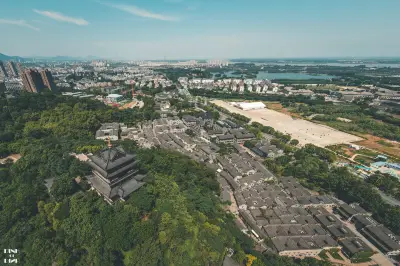
Jindongmen Old Street has a history of over a thousand years. Since the Ming and Qing dynasties, its thriving commerce earned it the name 'Jindongmen' (Golden East Gate), implying daily profits of a thousand gold. The district is dotted with temples, mansions, memorial archways, celebrities’ former residences, grand merchant homes, ancient trees, and old wells, forming a rich cultural tapestry—it is widely regarded as the best-preserved historical block in the Lixiahe region.
Sites like Zheng Banqiao’s Former Residence, Shangchizhai, Zhao Haixian Western Mansion, and Yang Family Courtyard are embedded like stars. Strolling through the antique streets and lanes, your thoughts drift back centuries, as if returning to an age of poetic grace.
Zhuangyuan Archway was built in the 26th year of Jiajing (1547) by imperial decree for the top scholar Li Chunfang. Outside the east gate, there is a Ming-Qing thoroughfare, anciently called Tongtai. Since the Qing Dynasty, it has been called East Outer Street; slightly east, a lane called Zhuangyuan Lane stretches north, where Li Chunfang lived in his early years.
A National Key Cultural Relics Protection Unit. Shangchizhai Pharmacy was founded during the Kangxi and Yongzheng reigns of the Qing Dynasty by Fang Shichuan from Yangzhou. The name 'Shangchizhai' is derived from a story in 'Records of the Grand Historian: Biography of Bian Que'—'Drinking the water from the upper pool, one will understand things after thirty days.' The shop sign was written by Li Peiyuan, acclaimed as the best regular-script calligrapher in the county, and made into a gilded plaque.
The pharmacy faces north, with two sections in brick and wood. The front is two-storeyed: the ground floor was the shop, the upper floor the medicinal herb storehouse; the rear is a single-story Ming Dynasty structure used as the pharmaceutical workshop. Total floor area 280 square meters, site area 216 square meters. Later, during the Republic era, it was renovated by Fang Shaoquan, a descendant of the Fang family.
A protected cultural relic site with a history of over 600 years.
Zheng Banqiao Memorial Hall
It is more a garden mansion containing a memorial hall than a mere museum. Zheng Banqiao Memorial Hall, a national historical figure memorial, is at 2 Pailou North Road, Zhaoyang Town, Xinghua. Established in November 1983 to commemorate the Qing painter-calligrapher-writer, its new building from November 1993 is in classical style, with a large granite statue of Zheng Banqiao at the entrance and a marble wall carving of his orchid-bamboo-rock motif.
The collection includes 33 examples of his calligraphy and paintings, with a permanent exhibit on 'Zheng Banqiao’s Life and Artistic Achievements.' The most famous piece is 'Nan De Hu Tu' — his celebrated motto encapsulating his philosophy of officialdom and life. Moved by its profound philosophy, later generations often display it as a horizontal scroll at home as a daily reminder.
Shi Nai’an Memorial Hall, located within the Zheng Banqiao Memorial Hall complex, is a small exhibition. Shi Nai’an, a native of Xinghua, originally named Yan Duan, courtesy name Zhaorui, pseudonym Zi’an, also known as Nai’an, authored the classic 'Water Margin.'
Stepping further inside, you find Li Garden. Originally the private garden of wealthy Yangzhou merchant Li Xiaobo from the late Qing, built during the Xianfeng period. Its main hall, shaped like a boat and known as the Boat Hall, is ingeniously designed. The garden also contains the Square Hall, Guihua Tower, etc. The entire layout is elegant, timeless, and classic—a true architectural gem.
There is also the Song Dynasty County Government Office, the typical yamen seen in historical dramas.
Sipailou – A Landmark
When in Xinghua, everyone takes a photo at Sipailou. In the Ming Dynasty, it was called 'Sizanfang'; since the Qing, it's been known as Sipailou. No local gazetteer records exactly when it was built. The earliest extant Xinghua gazetteer, Hu Zhi from the 38th year of Jiajing (1559), makes no mention of it at all.
Sipailou is truly 'priceless'! Of the 47 plaques overhead, one is an original, six are replicas, and the other 40 were written by 40 contemporary master calligraphers, making Sipailou not only a historical relic but a treasure trove of modern Chinese calligraphy.
Baziqiao – A Landmark
Located east of Sipailou, it is a single-arch granite bridge spanning the north-flowing Beishi River. According to the 'Xinghua County Gazetteer (revised in Xianfeng era),' 'Also called Dengying, it receives water from the east and turns north. Two bridges, Zhonghe and Yongfu, cross it at angles resembling the character 八 (eight), hence the name Baziqiao.'
It is recommended to stay in Bishui Dongluo; Dongluo Village is a distinctive idyllic countryside with a village service center, auditorium, and canteen. Most importantly, it is very close to both Qianduo Scenic Area and Lizhong Water Forest.
Yunduo Guesthouse is right in the Bishui Dongluo scenic area. The guesthouse consists of standalone villas, surrounded by rapeseed flowers near the lake, creating a refreshing and pleasant atmosphere.
Xinghua is a historical and cultural city, sometimes called a garden-style cultural ancient town. Its cuisine is mainly Huaiyang style but with distinctive Xinghua characteristics: authentic morning tea, abundant fresh lake produce, a variety of tasty snacks, and local specialties like hairy crabs, green shrimp, and long taro.
Xinghua Morning Tea. Yangtai morning tea and Cantonese tea are world-famous. Xinghua’s version, part of the Yangtai tradition, is unique! ‘In the morning, wrap your stomach in water; at night, wrap your body in water’ (referring to tea and baths). Start with pickled ginger, dried beef, celery with spiced tofu, sweet lotus root with sticky rice, red dates, boiled eggs. Then come dried tofu shreds, crab roe buns, shumai. Finally, baked buns, sesame balls, fried dough twists with poached eggs, and more. No, you didn’t misread. Morning tea is this sumptuous! Portions are generous and prices reasonable. Recommended: Zheng’s Kitchen opposite Zheng Banqiao’s Former Residence.
Xinghua is a water-town city worth visiting. Prices are low, scenery pleasant, and attractions plentiful. From March to May, come see the Qianduo rapeseed flowers; July to August for lotus blossoms; September to October to savor crabs and appreciate chrysanthemums. Other times, there are events like the Zheng Banqiao Art Festival and the Shi Nai’an Literature Festival.