This Spring, Self-driving to Xinghua to See the Thousand Islet Flower Sea
A sudden epidemic pressed the pause button for the whole world, affecting the lives of people in all walks of life. Fortunately, with the joint efforts of the Chinese people, the epidemic has been well controlled in China. As we firmly believe, every winter will pass, and every spring will come. As ordinary people like me, we pay tribute to the heroes who fought on the front lines, and we will always thank you!
For a traveler who has been roaming around the world, stopping is also a very, very scary thing. So, after the epidemic, I set off again. This stop is Xinghua, Jiangsu.
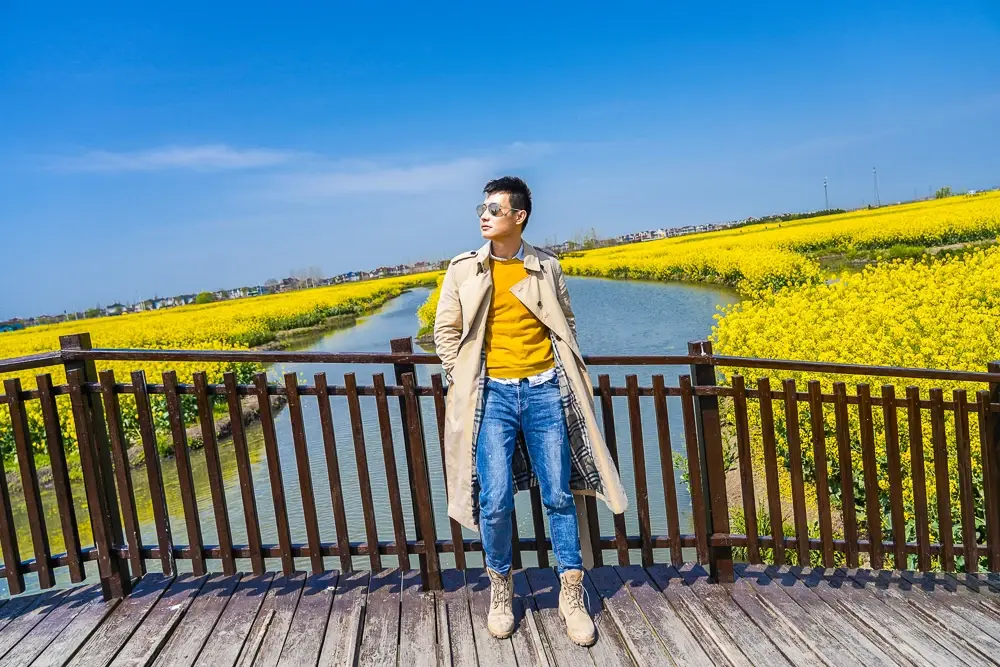
Spring is a season of blooming flowers, and among them, the golden rapeseed flowers are the most dazzling. Driving through the countryside of Xinghua, you will see one golden rapeseed field after another, stretching endlessly. Against the blue sky, white clouds, villages, and small rivers, it looks like a beautiful painting.
People wander in the painting, scenery moves along the bank.
The charm of Chinese poetry is vividly expressed here. How can such spring scenery be let down?
Hi, I'm Feng Shiyishao, a photographer who loves food and fitness. Or you can call me a muscle man delayed by food, or a gourmet delayed by fitness.
Note: Shooting is not easy, writing is even harder; any form of plagiarism of photos or text is strictly prohibited.
This is my first trip to Xinghua, so before coming, I didn't know that Xinghua's economy is so developed, its historical and cultural heritage is so profound, and its rural scenery is so beautiful.
In the 2019 ranking of China's top 100 counties, Xinghua ranked 61st.
The Four-Archway in Xinghua city records 74 famous figures from the Song Dynasty to the early Republic of China. Each plaque features one or several historical figures, each containing heroic achievements worth singing about, such as Zheng Banqiao, the leader of the Eight Eccentrics of Yangzhou, and Shi Nai'an, the author of "Water Margin."
The 2018 China's Most Beautiful Villages list was announced, and Jiangsu Xinghua's Bishui Dongluo was included. Xinghua's characteristic pastoral villages meet the sea. The Thousand Islet Flower Sea, Lizhong Water Forest, Jindongmen Old Street, Zheng Banqiao's Former Residence, and Liyuan Boat Hall attract batches of domestic and international tourists.
Spring is the best season to see rapeseed flowers. Due to China's vast territory, the flowering period varies by latitude and temperature, but among the top ten most beautiful rapeseed flower viewing spots in the country, Dongluo Rapeseed Flower Sea in Xinghua, Jiangsu, is among the best. "The river has many bends and clear water, the fields have no islets without yellow flowers."
Taking a boat tour is the best way to enjoy the Thousand Islet Flower Sea, and this is unique in the country. Xinghua's rapeseed flowers form a raised field landscape in the style of a thousand islands, renowned nationwide. There are raised fields in the lake, fields on the raised fields, and golden dazzling rapeseed flowers in the fields. Between the raised fields are waterways, with small farm boats shuttling back and forth, which is very wonderful.
In the middle of the sea of rapeseed flowers, there are high observation decks. Climbing up, you can clearly see the magical and wonderful aspects of the Thousand Islet Flower Sea, marveling at the amazing wisdom and creativity of ancient working people.
The flowering period of Xinghua rapeseed flowers is in March and April each year, with the best time around Qingming Festival. During this time, Dongluo Flower Sea welcomes tourists from all over the country, including many overseas tourists who come specifically. Boating through, they are all captivated by such beautiful scenery, reluctant to leave.
Overlooking the Dongluo Rapeseed Flower Sea from above reminds me of Qiandao Lake in Zhejiang. The difference is that these raised fields in the lake seem independent but are actually interconnected. There are flower paths on the raised fields and small bridges between them. Tourists walking through feel as if they are sinking into the flower sea.
"Full courtyard of fragrant grass green, flowers scent everywhere." In spring, at Dongluo, you don't need to search deliberately; just follow the path, and greenery and floral fragrances greet you.
If time allows, you must climb the observation deck. It is as good as the God's-eye view of a drone, fully revealing the three-dimensional beauty of the entire flower field.
Seeing so many tourists immersed in the flower sea fills my heart with joy beyond words. The epidemic has been well controlled nationwide, and scenic spots across the country are gradually reopening, with more tourists each day. The atmosphere of daily life is getting stronger.
Currently, Xinghua scenic spots have introduced the following ticket discount policies in response to the epidemic:
1. Medical staff from Jiangsu who aided Hubei, along with their spouses, parents, and children, enjoy free admission to all paid scenic spots in Xinghua for the whole year (including ticket and boat fees for the Thousand Islet Scenic Area and Lizhong Water Forest);
2. National medical staff, with valid work documents, enjoy free admission to paid scenic spots in Xinghua for the whole year;
3. From April 1 to April 30, residents of Taizhou (including three cities and four districts) holding a Taizhou ID card, or non-locals holding a Taizhou temporary residence permit, enjoy free admission to paid scenic spots in Xinghua;
4. From April 1 to April 30, individual tourists from outside Taizhou enjoy half-price tickets and boat fees for all paid scenic spots in Xinghua;
5. From April 1 to April 30, for group tourists, there is a 66 yuan special tour package (Jindongmen + Thousand Islet Scenic Area + Bishui Dongluo + Lizhong Water Forest + Shagou Ancient Town, including tickets and boat fees);
6. From April 1 to April 30, for self-driving tour groups (organized by travel agencies), there is an 88 yuan special tour package (Jindongmen + Thousand Islet Scenic Area + Bishui Dongluo + Lizhong Water Forest + Shagou Ancient Town, including tickets and boat fees);
Xinghua has no mountains, so before coming, I had no expectations for the forest. But after arriving, I found it was truly a forest, full of primitive, mysterious, and quiet water forest.
I have to say, the water forest in spring is full of vitality and picturesque. The air here is very fresh. Walking through, I didn't want to leave.
It is said that this place was once an uninhabited wasteland. In the early 1980s, local cadres and masses, to rationally develop and utilize the wasteland resources, turned the wasteland into strips of raised fields, planting varieties of trees suitable for growing in water, such as pond cypress and metasequoia. Between the trees, cash crops like taro and rapeseed were planted. Later, it became an ecological landscape.
The entertainment at the water forest is richer than I imagined. There are water alleys in the forest, Banqiao plank roads, a Nande Hutu Lin (Hard to Be Foolish Forest), Buyun Bridge, a fishing area, and some popular internet-famous check-in spots.
The water forest is much larger than I imagined. It is said to cover 1050 mu of forest area and 950 mu of water surface. For people who have lived in cities for a long time, this place is simply paradise.
According to local friends, the scenery of the water forest is beautiful all year round. Spring revives everything, summer is green and shady, autumn is golden, and winter is vibrant. The seasons each have their own beauty, but all are equally enticing.
When visiting the water forest, you must take a raft through the water forest. This reminds me of the scenes from Leonardo DiCaprio's movie "The Revenant." I have to say, the scenery here is no less impressive.
Riding the raft along the waterway, you can look up and see countless wild birds. Even more amazing, on each treetop there are at least 5-10 or more bird nests. The boatman told us that in summer, hundreds of thousands of wild birds inhabit here, making it a true paradise for migratory birds.
Strolling along the water alleys and Banqiao plank roads in the forest, sunlight falls from the treetops, and the February orchids on the ground bloom profusely, making you double appreciate the beauty of spring. What is more touching than the beauty is the crowds of tourists here, showing that our great country has united to overcome the epidemic, and now everything is gradually recovering, which is very encouraging.
A vast world of February orchids creates a strange landscape. Every day at 3 p.m., a misty fog spreads here, like a fairyland, making it a favorite photo-taking spot for many tourists. The fog lasts about 10 minutes. During this time, you can see many beautifully dressed ancient-style women and men taking ancient style portraits, adding a very bright landscape to this fairyland.
There are many children's entertainment facilities in the forest. Children can play here all day without getting bored, making it an excellent destination for family vacations.
Walking through the water forest, you often encounter bird droppings falling on your head. This is not an exaggeration; it's because there are so many birds here that they are countless. You can also see various bird eggs everywhere on the ground. According to incomplete statistics, there are owls, wild ducks, egrets, black cuckoos, grass parrots, magpies, and more.
The water forest is far from the city center of Xinghua, so it is suitable for self-driving. On the way, you will pass the Thousand Islet Flower Sea and Bishui Dongluo, with beautiful scenery all along the way.
When traveling to Xinghua, Jiangsu, you must visit Xinghua's Jindongmen Old Street, known as the "No. 1 Old Street of Ming and Qing in Central Jiangsu." This old street is completely different from the commercialized old streets we see elsewhere. On Jindongmen Old Street, you only see the most authentic daily atmosphere of the locals.
Since the Ming and Qing dynasties, this street was highly commercial and prosperous, earning the name "Jindongmen" (Golden East Gate). The preserved Jindongmen Old Street has a complete Ming and Qing ancient building complex and a fishbone-like street system, maintaining and following the traditional style characteristics of the Ming and Qing dynasties. Unlike the typical Jiangnan water town old streets with small bridges, flowing water, and households, this place offers a different historical and cultural charm.
After walking around, a travel companion curiously asked me why this old street didn't have Changsha stinky tofu, Naxi hand drums, grilled squid skewers, and big potatoes. Suddenly, I found his idea interesting. I think this can be used as a reference to determine whether an old street is commercialized.
The unremarkable Jindongmen Old Street has a history of over a thousand years. No wonder it is called the "No. 1 Old Street of Ming and Qing in Central Jiangsu." Countless historical figures have come from here, such as Zheng Banqiao, the leader of the Eight Eccentrics of Yangzhou, whom we are all very familiar with.
Zheng Banqiao only painted orchids, bamboo, and stones in his life, calling himself "the orchid that never withers in four seasons, the bamboo that is always green in a hundred years, the stone that never falls in ten thousand years, and the person who remains unchanged for a thousand years." His poetry, calligraphy, and painting are called the "Three Perfections" and he was a representative literati painter of the Qing Dynasty. So, in Zheng Banqiao's former residence, you can see many elements of orchids, bamboo, and stones, and his personality charm is admirable.
On the bustling street outside the east gate of Xinghua city, a Ming and Qing building facing south stands out. This is the provincial cultural heritage protection unit, "Shangchizhai" pharmacy, a century-old brand in Xinghua, built in the Kangxi reign of the Qing Dynasty. It is said to be even older than the well-known Tongrentang.
Entering Shangchizhai pharmacy gives you a sense of time travel. Such scenes are rarely seen in modern life. Particularly coincidentally, when we went in for a visit, we happened to encounter the provincial TV station interviewing for a program. This shows the historical depth and charm of Shangchizhai.
History keeps moving forward. Now, traditional Chinese medicine has gradually begun to modernize. To keep up with the times, new Chinese medicine shops open one after another, but they are getting further and further away from their original appearance. Only century-old brands like "Shangchizhai" still preserve ancient traditions, quietly telling us stories of the past.
The old street has produced many scholars and successful candidates in imperial examinations, the most famous being the scholar and prime minister Li Chunfang, the chief grand secretary of the Ming Dynasty. He was a Jinshi in the 26th year of the Jiajing reign, a top scholar, and later served as Grand Secretary of the Jianji Hall, Minister of Personnel, and Grand Secretary of the Zhongji Hall.
The old street still maintains a very simple living style. There is no sign of commercialized uniformity. The shops along the street sell daily necessities for ordinary people, giving a very authentic feeling.
To understand the history of Xinghua, you cannot miss the Xinghua Museum. Many people know Xinghua mostly because it is a nationally renowned top 100 county, because it has the magical Thousand Islet Rapeseed Flower Sea, but few know its historical figures and heritage. For example, this place once produced Mr. Banqiao of the Eight Eccentrics of Yangzhou. Shi Nai'an, the author of "Water Margin," was also born in Xinghua. There is also a garden in the shape of a boat hall with very unique design.
The Xinghua Museum is a three-story building in imitation ancient style, with white walls, black tiles, and horse-head walls, antique and elegant. Inside, there are sculptures and murals, small bridges and flowing water, elevated walkways, interconnecting corridors, scattered bamboo and trees, and fragrant flowers. This is somewhat different from the Jiangnan gardens we usually see, but it is also very elegant.
The Liyuan Boat Hall was built during the Xianfeng reign. It is the private garden of Li Xiaobo, a wealthy merchant from Yangzhou. The entire building looks like a large boat, with the bow facing west and the stern facing east. On the south side of the boat hall, there is a long step resembling a gangplank. Both sides are corridors. The hall roof is a roll-up tiled roof, exquisite and delicate. Outside the bow, there is a flower terrace. The twining wisteria trunk looks like a mooring rope tied to the shore. The entire boat hall is like a beautifully decorated large boat, floating among the flowers and trees.
There is an interesting feng shui story about the construction of the boat hall. It is said that in the past, there was a prison near Liyuan. Every night, prisoners walked around, and their shackles made a "ding-ding-dang-dang" sound. The wealthy merchant from Yangzhou found it very irritating and uncomfortable, affecting his life and sleep. Later, a master came and suggested building a large boat hall in the garden. This way, the sound of shackles would be transformed into the sound of dropping and lifting anchors. The merchant agreed, and thus the Liyuan Boat Hall was born.
Inside the boat hall, although it has been hundreds of years, you can still vaguely see its luxury. The curved boat ceiling hangs with hexagonal lanterns, exquisitely transparent and extremely elegant. This also shows how wealthy the Yangzhou merchant was at the time.
The remaining Liyuan is not very large, but every step brings a new view. The scenery is comparable to the well-known Jiangnan gardens. However, very few tourists come here, which is a pity for such a cultural landscape.
Liyuan has many winding corridors, leading to secluded spots. In the flower bed at the bow, there is a very old wisteria tree, said to be over two hundred years old. The wisteria branches are very thick, twisting with vitality, like a very strong mooring rope tying the boat hall to the magnolia tree.
Inside the boat hall, the nanmu partitions and various exquisite wood carvings are well preserved. The delicate patterns present auspicious motifs such as deer, cranes, and gourds.
Continuing further inside from the Liyuan Boat Hall is the ancient county government office. The main hall where prisoners were tried is still well preserved.
Outside the Xinghua Museum, there is a square. The Four-Archway building on the square is also a famous ancient building in Xinghua. The Four-Archway records 74 famous figures from the Song Dynasty to the early Republic of China. Each plaque features one or several historical figures, each containing heroic achievements worth singing about. It is very helpful for understanding Xinghua's history and culture.
The broadcast of the Jiangsu episode of "Aerial China" Season 2 made many people know about Bishui Dongluo in Xinghua, Jiangsu. Small bridges, flowing water, white walls, and black tiles—it rivals Jiangnan. Dongluo Village was selected as one of the "2018 China's Most Beautiful Towns." It is a very characteristic pastoral village, picturesque, and has become a favorite weekend self-drive destination for many tourists.
From an aerial view, Bishui Dongluo has crisscrossing waterways, clear blue water, and beautiful environment. Every household has a small villa, making it an ideal place for living.
Bishui Dongluo is surrounded by waterways and raised fields, which is a unique feature of Bishui Dongluo. No other place has this. So, many years ago, every household had a boat, and travel depended on boats, which was very interesting.
I especially like the houses in Bishui Dongluo. They are designed and built by the local residents themselves. It is said that the owner of this house was the first person in Dongluo Village to become a ten-thousand-yuan household many years ago. Now, the owner has moved to Shanghai, but the house remains brand new.
CCTV's program "Village Grand World" once filmed a special episode here. The characteristic pastoral countryside has made Bishui Dongluo famous in China.
The Dongluo Auditorium is still well preserved, but its function is no longer the same as before. It has been transformed into a local specialty exhibition hall for tourists to visit for free, displaying Xinghua's local agricultural products.
Following the flower path at the village entrance deeper inside, crossing a small bridge, you will see the "Dongluo Qiushi" Rural Revitalization Exhibition Hall. It displays old photos from the 1950s, precious historical documents, farming tools, etc., showing the tremendous changes the countryside has undergone over the decades.
Nowadays, many families in Bishui Dongluo run agritainment and boutique homestay businesses, hosting guests from all over the world. On weekends, the village entrance parking lot or the yards of the farmhouses are full of self-driving cars.
Strolling through Dongluo Village, the small bridges, flowing water, white walls, and black tiles may not be as refined and elegant as Jiangnan, but against the blue sky and clear water, a poetic life is within reach. Old houses with white bricks and green tiles are scattered around the lakeside. Murals are painted vividly on the village walls, giving a very vivid and lively feeling, full of the atmosphere of daily life.
The Dongluo Canteen in the village is no longer the shared dining hall for the whole village as before, but it still makes people involuntarily recall that era. Now, tourists can choose the Dongluo Canteen to taste local farm cuisine, which is also very interesting.
Dongluo Village has many agritainment options, but if you have high requirements for accommodation, you might consider staying at the boutique homestay "Dongluo Yunduo" in the village. After staying one night at Yunduo, I really liked it. It felt like an ideal utopia. Each room has a courtyard facing the waterway and the rapeseed flower fields, with very beautiful scenery.
The Yunduo Homestay we stayed at during the Xinghua trip is located in Bishui Dongluo, known as "China's Most Beautiful Town." It gave us a lot of pleasure. Not only is the environment good, but the minimalist design is also very appealing.
Yunduo is located on an isolated island separate from Dongluo Village, surrounded by waterways. From a distance, you can see stretches of raised fields and flower seas, very beautiful.
The room design is very MUJI-style. The minimalist design and the use of wooden elements give a very peaceful feeling.
Yunduo's restaurant can also be used for afternoon tea. Outside, there is a large terrace with a stunning view.
Travelogue Directory: 1. The feeling of embracing freedom and sunshine is great; 2. What you don't know about Xinghua; 3. Roaming the Thousand Islet Flower Sea; 4. Bird Paradise, Lizhong Water Forest; 5. Jindongmen, No.1 Old Street of Ming and Qing in Central Jiangsu; 6. Xinghua Museum; 7. Bishui Dongluo, China's Most Beautiful Town; 8. Dongluo Yunduo, a Beautiful Utopia. Tourism Information: Hotel Index, Guide Index, Ticket Index, Website Navigation, Tourism Index, Cruise Index, Enterprise Travel Index, Alliance Cooperation, Distribution Alliance, Friendly Links, Enterprise Gift Card Purchase, Insurance Procurement, Agency Cooperation, Hotel Franchising, Destination and Scenic Area Cooperation, More Alliance Cooperation. About Ctrip: Ctrip Highlights, Contact Us, Careers, User Agreement, Privacy Policy, Business License, Security Center, Ctrip Content Center, Intellectual Property Rights, Trip.com Group Algorithm Disclosure.