The Land is Peaceful, Perfect for Spring Outings to Admire Flowers: Xinghua's Qianduo Scenic Area's Thousands of Acres of Rape Flowers Like a Natural Palette
No matter what happens in the world, spring always arrives as scheduled. The spring breeze blows, greening the vast lands north and south of the Yangtze River. The spring breeze warms, bringing peach blossoms and green willows in parks and fields, with spring flowers blooming everywhere. Especially the rape flowers in the fields symbolize the beginning of spring and also the start of a bountiful harvest year for farmers.
This magnificent painting is a masterpiece of spring. The enchanting spring is exhilarating; even though the spring breeze is still chilly, the heart feels joyful, and new buds of hope are sprouting.
When it comes to admiring rape flowers, you will surely think of one place: the Qianduo Scenic Area in Xinghua, Jiangsu, which is known as one of the world's 'four major seas of flowers.' Thus began this spring outing to appreciate the flowers.
DAY 1: Self-drive from Hangzhou to Xinghua Dongluo Village, check into Gengduo Homestay
DAY 2: Qianduo Rape Flower Scenic Area -- Lizhong Water Forest Park
DAY 3: Zheng Banqiao's Former Residence — Shangchizhai Pharmacy — Jindongmen Old Street — Zhao Haixian Yang Tower — Dongyue Temple — Xinghua Museum — Zheng Banqiao Memorial Hall — Shi Nai'an Memorial Hall — Li Garden — Four Archways — Fan Zhongyan Memorial Hall
[Qianduo Scenic Area: One of the World's 'Four Major Seas of Flowers']
To talk about the Qianduo Scenic Area, we first need to understand Xinghua. Xinghua is a county-level city in Jiangsu Province, located in central Jiangsu. Xinghua is a historic city that has produced figures like Shi Nai'an, author of the Four Great Classical Novels 'Water Margin,' and Zheng Banqiao, considered the foremost of the Eight Eccentrics of Yangzhou. Xinghua is also a land of fish and rice, especially famous for the unique 'duotian' (raised field) landscape of the Qianduo Scenic Area. 'Duo' is a unique agricultural landscape in the Lixiahe region. According to historical records, it was formed 750 years ago. In this watery region lacking soil, the industrious and wise people of Xinghua dug deep ditches or small rivers in the lake and swamp areas, piling the mud into raised fields, creating the Xinghua duotian wonder, which has world natural and cultural heritage value. Boats travel on the water, and people wander among the flowers—it's incredibly beautiful. Thus, the Qianduo rape flower sea is listed alongside the Dutch tulip sea, the French Provence lavender sea, and the Japanese Tokyo cherry blossom sea as the world's 'four major seas of flowers.'
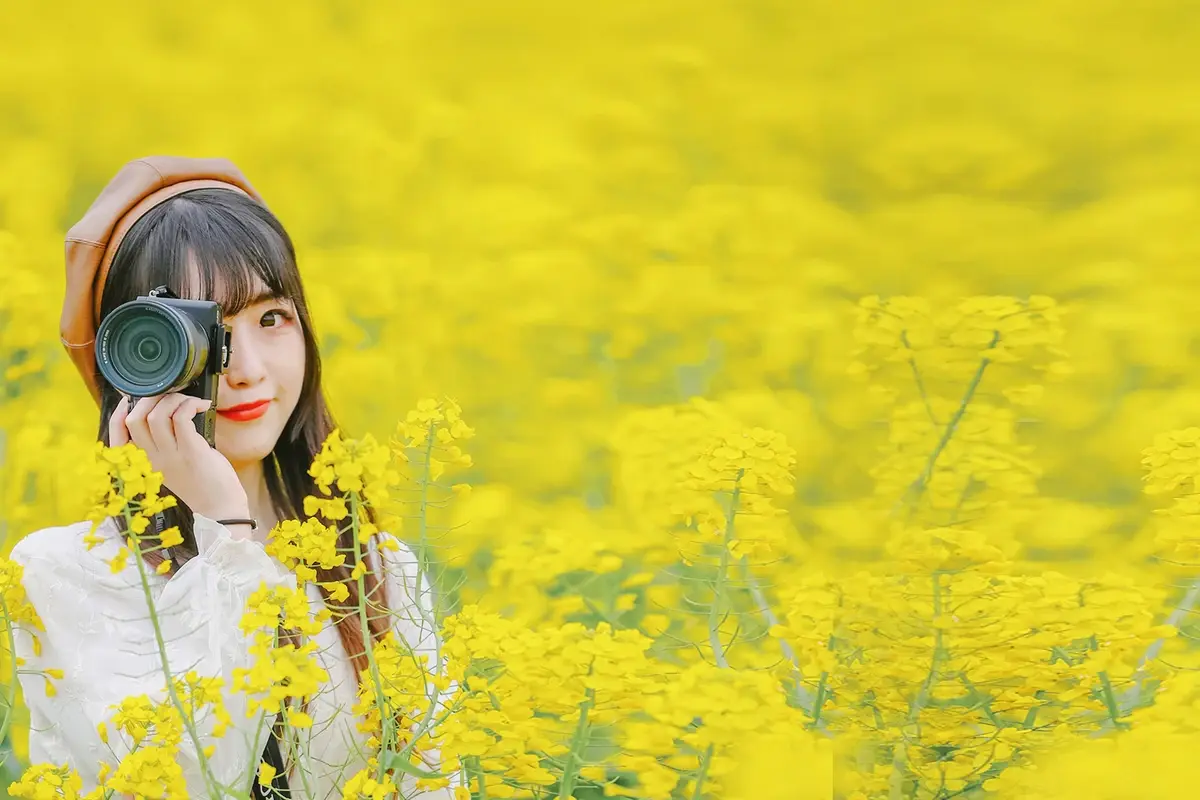
Arriving at the Qianduo Scenic Area, you see a vast ocean of rape flowers in every direction. The clear breeze brings the fragrance of flowers, refreshing the mind. From an aerial view, the rape flowers in the Qianduo Scenic Area cover nearly 10,000 mu (about 667 hectares). The massive scale of the flower fields left us utterly amazed. In the mild spring of March, the scene is full of vitality, with golden rape flowers swaying in the wind. Deep within the flower fields are countless bees and butterflies.
Don't be confused by the intricate duotian layout seen from above. In fact, the Qianduo Scenic Area is well-planned, with field paths providing the best routes for visitors to enjoy the flowers. Many might think it's a maze in such vast flower fields, but besides the multilingual signage, Brother Niu suggests a tip: keep heading toward the octagonal pavilion observation deck, and you won't get lost. The Qianduo Scenic Area is one of the world's 'four major seas of flowers,' renowned alongside the French Provence lavender fields, Dutch tulip fields, and Japanese Kyoto cherry blossoms. This alone fills us with great pride.
Next to the Qianduo Scenic Area, waterways crisscross, and clear rivers flow gently. An ancient poem praises: 'The river has many bends with clear water, and every field is covered with yellow flowers.' In this beautiful land of waterways south of the Yangtze River, visitors are endless. In the early morning, mist envelops the area like a light veil, adding a touch of hazy poetry. Looking closely, dewdrops are distinct on the rape flowers. As sunlight slowly shines, the mist suddenly dissipates.
The dynamic beauty of boats on the water and people among the flowers captivates everyone. The full view of the rape flowers is breathtaking. In this season of bright spring and peaceful scenery, visitors who have stayed indoors for a long time completely relax their bodies and minds.
The best time to view rape flowers is around the Qingming Festival (Tomb-Sweeping Day). At that time, everything is silent in the world. In the hazy night, only the fragrance of thousands of acres of rape flowers wafts over. As the sun slowly rises, tens of thousands of birds in the Qianduo Scenic Area begin to sing. The water surface ripples under the fisher's bamboo poles, and the first batch of visitors arrives punctually. Such beautiful scenery is intoxicating.
Qianduo Scenic Area tips:
(1) Location: Qianduo Scenic Area, East End of Dongwang Village, Ganggutown, Xinghua City, Taizhou City, Jiangsu Province
(2) Transportation: From Xinghua Bus Station, there are buses directly to the scenic area. Fare is 6-7 RMB, and the trip takes about 30-40 minutes.
(3) Opening hours: 08:00-17:00, last entry at 17:00
(4) Ticket price: Regular ticket 100 RMB (including boat ticket)
[Lizhong Water Forest]
After visiting the Qianduo Scenic Area, we also went to the nearby Lizhong Water Forest, which is famous. The water forest is another highlight of Xinghua tourism. The entire area covers 1,050 mu (about 70 hectares), with the water area reaching 950 mu (about 63 hectares). Decades ago, it was a desolate marshland, but through continuous efforts, it was developed into a magnificent water forest.
The water forest is planted with over 100,000 mu (about 6,667 hectares) of metasequoia (dawn redwoods). Approaching it, we were amazed by the thousands of tall, sturdy metasequoia trees. They stand like guards, straight and piercing into the sky. Looking up, the green metasequoia leaves are extremely dense, with umbrella-shaped branches spreading out, looking exceptionally grand.
To be honest, this is not the best season to see the metasequoia forest. The leaves start to grow in May, turning green, and then become golden in autumn. But in this season, the ground is covered with patches of purple flowers, which are February orchids (Orychophragmus violaceus). Also known as Zhuge Cai, these flowers bloom in spring and are excellent ornamental plants.
Sunlight shines through the metasequoia forest, casting shallow shadows. Countless dense light spots decorate the forest beautifully. The metasequoia grows on vast river surfaces. We took a boat tour and enjoyed the scenery along the river. White egrets soared over the water, gentle breezes blew, and ripples appeared on the river. Twilight reflections, blue sky, and moving clouds mirrored in the water, while the metasequoia forest swayed in the wind. The enchanting scenery fascinated everyone, and we were completely mesmerized.
In the autumn season, the metasequoia trees turn entirely golden. At that time, the water forest is dazzling, and the metasequoia leaves slowly fall. Among the trees, on the water surface, on the slopes, everything is so intoxicating.
Lizhong Water Forest Park tips:
(1) Location: Lizhong, Xinghua City, Taizhou City, Jiangsu Province
(2) Transportation: From Xinghua Bus Station, take a bus heading to Lizhong. Fare is 6-7 RMB, and the trip takes about 30-40 minutes.
(3) Opening hours: 08:00-17:00
(4) Ticket price: Regular ticket 90 RMB, including scenic area and bamboo raft
(5) Other: The scenic area is best visited in spring and autumn. From late March to late April, February orchids bloom; from late November to late December, red sequoia trees are beautiful.
[Clear Water Dongluo & Yunduo Homestay]
For this trip, we stayed in a homestay in Dongluo Village. The clear water and beautiful environment create a typical southern Jiangsu village scene. Entering Dongluo Village, we saw the characters 'Clear Water Dongluo.' The calligraphy was vigorous and grand, reflecting the confidence of the local people. Strolling through the village, the characteristic antique-style arrangements were quite appealing. Buildings with white walls and black tiles were everywhere, with carved beams and painted pillars common.
The village history museum of Dongluo Village is built entirely of blue bricks. Inside, the layout is elegant, with an antique charm. Locals introduced that Dongluo Village has a long history. During the Ming and Qing dynasties, it was a favored place for literati south of the Yangtze River. The village square is lively, with locals spontaneously dancing and performing. During special festivals, their unique dances are truly eye-opening.
Of course, the highlight is the homestay in Dongluo Village: Jinglan Yunduo Boutique Homestay. All buildings are built by the water, with a murmuring river just outside. Opening the balcony, cherry blossoms are in bloom outside, and across the river, golden rape flowers are in view.
At dusk, the sun slowly sets. Opening the window, we saw the sunset in the distance. The setting sun dyed the sky and earth red, and the fragrant scent of rape flowers wafted over.
[Xinghua Morning Tea]
Speaking of morning tea, I always thought it was only in cities like Hong Kong, Macau, and Guangzhou in the south. Arriving in Xinghua, I discovered that morning tea is also very popular in Taizhou and Yangzhou in Jiangsu. Morning tea is a social meal where neighbors get up early, gather to drink tea, eat some snacks, and chat. The morning tea in Yangzhou and Taizhou is called Su-style morning tea, which became popular from the early to mid-Qing Dynasty. Su-style morning tea features many bean-based dried tofu shreds and flour-based snacks, such as wontons, fish soup noodles, dry-mixed noodles, fried noodles, and crab roe soup buns, fresh meat and bamboo shoot buns, dried vegetable buns, etc.
The most famous morning tea spot in Xinghua is Zheng's Grand Kitchen. Here, by 7 a.m., visitors have already formed long queues, all loyal patrons of morning tea. Entering the shop, the classical and elegant environment is refreshing, and the seating arranged in small groups is very comfortable.
Zheng's Grand Kitchen incorporates the calligraphy and painting features of Zheng Banqiao, combined with rich Ming and Qing fashion, making the decor appealing. It mainly serves Xinghua local cuisine, and morning tea is its biggest feature. Morning tea emphasizes a balanced and light flavor. Various snacks must be paired well with tea. Huaiyang steamed dumplings have rich soup that leaves a lingering fragrance in the mouth. Large dried tofu shreds are smooth and dry, taste authentic when paired with tea soup. And the special edition siu mai is also a good choice. The comfort and pleasure can only be appreciated through personal experience.
Local people near the Four Archways come in the morning to sit and drink their own tea, and Zheng's Grand Kitchen provides free hot water. Early spring mornings still have a chill, but once the tea is brewed, the shop becomes warm and cozy. The tea steam rises, creating a leisurely and comfortable atmosphere. Gently smelling, the tea fragrance penetrates the heart. Taking a bite of the snacks, such mornings are deeply satisfying.
[Zheng Banqiao's Former Residence]
It is worth mentioning that directly opposite Zheng's Grand Kitchen is Zheng Banqiao's Former Residence. The residence is well-preserved, and the local government attaches great importance to it. Outside, the residence has white walls and black tiles, following the Ming and Qing dynasty relics. Inside, it has been redecorated in an antique style.
Overall, it is simple and elegant, with a quiet environment. Of course, the Zheng Banqiao Memorial Hall is also worth a careful visit. The hall records anecdotes from Zheng Banqiao's life and his personal achievements. The bamboo he painted also has corresponding prototypes. For visitors with children, this place definitely offers great educational value.
[Shangchizhai Pharmacy]
Shangchizhai Pharmacy is the oldest pharmacy in Xinghua. Entering the shop, the antique decoration is delightful. Just like during the Ming and Qing dynasties, Shangchizhai Pharmacy still mainly dispenses herbal medicine and offers medical consultations. In rows of drawers, various Chinese herbs are listed in detail. Unlike old shopkeepers, the doctors in the pharmacy are graduates from professional medical schools. Through their advocacy, the health awareness of Xinghua residents has greatly improved.
[Jindongmen Old Street]
Jindongmen Old Street is located in the southeast of Xinghua. It was a commercial trading area during the Ming and Qing dynasties. The Xinghua government has placed great importance on it and has restored the old street. Walking along the street, on both sides are various ancient buildings, including white-walled, black-tiled structures and simple, dignified wooden towers. At night, Jindongmen Old Street is beautifully decorated, with bright lights along the street and rows of lanterns pushing the lively commercial atmosphere to a climax.
Zhuangyuan Archway is a must-visit place in Xinghua. This was once the residence of Li Chunfang, a Ming and Qing dynasty scholar. Li Chunfang studied poetry and books here as a youth and eventually passed the imperial examinations. Now, the Zhuangyuan Archway is newly decorated and elegantly arranged inside. The high gate made of white marble is impressive.
Dongyue Temple is located in the northern part of Taian urban area. The incense is thriving, and visitors swarm in. The temple enshrines the Great Emperor of Mount Tai. During the Qingming Festival, it attracts visitors from all directions. They eagerly pray to ward off evil and disasters and kowtow before the statue. This is a favorite place for the older generation in Taian and an important carrier of folk culture.
[Xinghua Museum]
The Xinghua Museum is a key cultural project funded and built by the local government. The museum houses a large collection of precious artifacts, including calligraphy and paintings by Zheng Banqiao. The exterior of the museum is like an ordinary residence, with white walls and black tiles, not particularly striking. But once inside, visitors are attracted by artifacts such as pottery, porcelain, bronze, gold, jade, calligraphy, and paintings. The ancient history of Xinghua is truly commendable.
[Shi Nai'an Memorial Hall]
Shi Nai'an is a famous figure from Xinghua, and the Shi Nai'an Memorial Hall is worth seeing. The hall has a strong Water Margin atmosphere, and the exhibits are eye-opening. During the Ming and Qing dynasties, literary creation conditions were relatively simple, but Mr. Shi Nai'an overcame difficulties with tenacious perseverance, which is reflected in the hall. Outside the memorial hall, a statue of Shi Nai'an warmly welcomes visitors, who are all very respectful.
The Song County Government Office completely preserves the government office of the Song Dynasty. Stepping inside, visitors immediately see several vivid statues. They represent the clerks and the county magistrate of the time. Above them hangs a plaque inscribed with 'Mingjing Gaoxuan' (Incorruptible and Clear), just like in films and TV shows. Many visitors take photos and share them on social media.
The Four Archways were built by Xinghua's scholar Zhuangyuan Li Chunfang. After he passed the imperial exams at the top, he built the Four Archways in his hometown to commemorate. The Four Archways were once destroyed by war but were rebuilt by the local government. This is also a landmark of Xinghua, and visitors from other places always take photos. The Four Archways are simple and dignified, and its strong cultural atmosphere is an important representative of Xinghua's city image.
[Fan Zhongyan Memorial Hall]
The Fan Zhongyan Memorial Hall carries significant heritage meaning. The people of Xinghua deeply admire Mr. Fan Zhongyan and established this memorial hall. The statue of Fan Zhongyan is vivid, and his inscriptions are framed. In the room, the simple and old arrangement reflects Fan Zhongyan's noble sentiment of concern for the country and the people. Outside, a large tree stands tall, with leaves covering the path below. Visitors eagerly step inside, and after careful contemplation, they deeply feel the legacy Fan Zhongyan left behind.
The three-day, two-night Xinghua trip ended. Due to the pandemic, we drove to Xinghua this time. Starting from Hangzhou, the entire expressway trip took 5 hours, and the expressway toll was free.