Eight-Day Tour of Low-Risk Regions
I thought this pandemic would finally be over by June, but now it's September, and it's sweeping the globe with no signs of slowing down. Two months before departure, I signed up for the '8-Day Shanghai–Luoyang Luxury Tour' from June 18 to June 25. But things didn't go as planned: the turning point abroad was nowhere in sight, and a new outbreak hit Beijing's Xinfadi market. With a mix of anxiety and hope, on June 18 we set off right on schedule.
June 18, 2020 – Day 1, First Stop: Memorial Hall of Seven Battles and Seven Victories. Also known as the Central Jiangsu Campaign, this series of battles took place from July 13 to August 27, 1946, when the Central China Field Army, under the command of Su Yu and Tan Zhenglin, used 30,000 troops to fend off 120,000 US-equipped Kuomintang soldiers. They fought seven consecutive engagements, winning every one and annihilating 53,000 enemies. The Yan'an headquarters praised the campaign, calling it 'Seven Battles, Seven Victories.'
Due to the pandemic, the memorial hall was closed. I could only take a quick walk around the perimeter – just to say I’d been there.
The World's Largest Bayonet is said to be the biggest 'bayonet' on earth.
June 19, 2020 – Day 2. Zhou Enlai Memorial Hall stands on a man-made peninsula surrounded by water on three sides in Peach Blossom Cove, northeast Huai'an District. The complex is solemn yet elegantly simple, blending traditional ethnic style with modern architectural features. Every element carries deep meaning, reflecting the designer’s ingenuity and the people’s remembrance of Premier Zhou. It consists of a main hall and an auxiliary hall.
Comrade Deng Xiaoping inscribed the name 'Zhou Enlai Memorial Hall.' The main hall's base is a square trapezoid, while the building itself is an octagonal prism, creating a sense of solemn dynamism that alludes to Zhou Enlai’s pivotal role at critical moments for the Party and army.
A loop around the main hall’s roof offers panoramic views.
Echoing the main hall, the auxiliary hall unfolds in the shape of the Chinese character '人' (people), symbolizing Zhou Enlai’s noble personality and subtly conveying that he lives forever in people’s hearts.
The memorial hall is encircled by clear, gentle waters. The whole area consists of two monumental architectural groups, a memorial island, three artificial lakes, and surrounding green spaces.
Yunlong Mountain is a famous peak in northern Jiangsu, offering both natural scenery and cultural landmarks. Rocky outcrops and secluded wooded valleys make it a place of beauty. The mountain has nine ridges running north-south, winding like a dragon, often shrouded in mist – hence its name.
Inside Yunlong Academy are Su Dongpo’s stone bed and the Huangmao Ridge cliff carvings.
When Su Dongpo served as prefect of Xuzhou during the Song Dynasty, he often climbed the mountain to enjoy the views and drunkenly lay on the rocks. He composed and inscribed 'Record of the Crane-Releasing Pavilion,' a stele still found on the mountain today.
June 20, 2020 – Day 3. Dragon Pavilion is built on the ruins of imperial palaces from the Six Dynasties (Later Liang, Later Jin, Later Han, Later Zhou, Northern Song, and Jin). Dominated by the resplendent Dragon Pavilion Hall, the complex includes the Meridian Gate, Jade Belt Bridge, Songhu Gate, Court Gate, Screen Wall, and Court Chambers – structures from the Qing Dynasty’s Longevity Palace.
Tracing its roots: In 1692 (the 31st year of Emperor Kangxi’s reign), a Longevity Pavilion was erected on the former Coal Hill of the Zhou Prince’s mansion, housing the emperor’s longevity tablet. On festivals or the emperor’s birthday, local officials came here to pay remote homage. Coal Hill was renamed Dragon Pavilion Hill, shortened to 'Dragon Pavilion.'
Surrounded by water on three sides and hosting the annual chrysanthemum festival, Dragon Pavilion has become a symbol of Kaifeng.
Songhu Gate lies between the Meridian Gate and Court Gate. Also called Shanhu, it was where Qing officials from Kaifeng performed the 'three shouts of long live' to the distant emperor.
Jade Belt Bridge is a stone arch bridge connecting Pan and Yang Lakes on the east and west. Its graceful curve resembles a jade belt shimmering on the water.
Pan Family Lake and Yang Family Lake flank the main road of Dragon Pavilion Park – Pan to the east, Yang to the west. The lakes stretch wide with meandering shores, peach blossoms, willows, and arched bridges, creating enchanting scenery.
A folk tale about the two lakes: In the Northern Song, General Yang Ye was betrayed by the treacherous Prime Minister Pan Renmei. Wounded and captured at Chenjia Valley, Yang Ye starved himself to death. His wife, She Taijun, enraged, brought the case to court, but Pan was too powerful and received only a token punishment. She Taijun resigned in fury. The Yang and Pan families lived just a street apart. As soon as the Yangs moved away, a fierce storm raged for three days and nights, flooding the area. When it was over, both estates had collapsed, forming two lakes. One family was loyal, the other treacherous – so one lake is clear, the other murky.
'Song Palace Leftover Stones' are one of the 'Three Treasures of Song' still visible on Kaifeng’s surface, alongside the Iron Pagoda and Fan Pagoda.
Earlier, I mentioned that Dragon Pavilion was built on Coal Hill. This wasn't an ordinary artificial hill: it was entirely constructed from rare stones left over from the Northern Song imperial garden 'Genyue' – the famed 'Flower and Rock Network' tribute stones from the late Northern Song. They are mostly Taihu rocks and Lingbi rocks, two of the 'Four Great Stones.' Meticulously chosen and transported at enormous cost over a thousand kilometers, each stone carries nearly a millennium of historical and cultural significance, making their heritage value immeasurable.
On the night of July 15, 1994, the rear wall of Dragon Pavilion’s high base (long bulging) collapsed due to neglect and days of continuous rain. The entire hall tilted northward, and pillar bases shifted. During emergency repairs, workers uncovered Ming Dynasty Coal Hill beneath the foundation, revealing a wealth of Taihu and Lingbi rocks. A crane tried to lift some out but failed. They finally retrieved two smaller stones from the peak as evidence, later placing them on either side of the restored hall.
Exploring the Past Garden is on East Lake Island within Pan Family Lake, themed on historical legends and stories from the Dragon Pavilion area. It has three exhibition halls – North, East, and West – displaying five sets of tales. Closed due to the pandemic, so no visit.
Imperial Street of the Song Capital. During the Northern Song, the Imperial Street in the eastern capital ran from the palace’s Xuande Gate in the north through Zhou Bridge and Vermilion Bird Gate, straight to the outer city’s Nanxun Gate. Over five kilometers long and 200 paces wide, it was the grand thoroughfare for imperial processions, displaying majesty. The new Imperial Street was rebuilt on the original site.
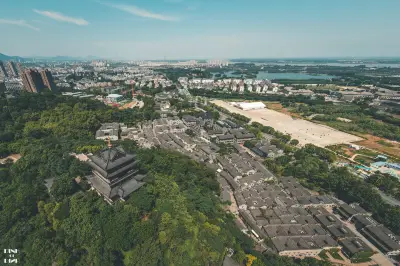
June 21, 2020 – Day 4. Tiantang and Mingtang are the most important landmarks of the Sui-Tang Luoyang City project. They were where Empress Wu Zetian governed, worshipped Buddha, and lived over 1,300 years ago. The only female emperor in Chinese history, she ascended the throne in Luoyang, changed Tang to Zhou, and established the Wu Zhou dynasty, styling herself 'Holy and Divine Emperor.' Luoyang became the 'Divine Capital.' On the north-south axis, she built Mingtang, Tiantang, Tianshu, and other structures, creating a magnificent skyline.
Mingtang was the main hall of Luoyang’s Ziwei Palace in the Tang Dynasty, known as the 'Hall of the Universe.' It hosted grand state ceremonies; Wu Zetian personally conducted rituals here, offering sacrifices to heaven and earth.
The Hall of the Universe recreates the awe-inspiring scene of the empress’s authority, her vision of ruling all under heaven, issuing decrees, expanding territory, and ushering in an era of prosperity. This is the centerpiece of the new Mingtang and the first sight visitors see. It is a building that transcends history and rises over ancient ruins, dominating the city.
A wall of twenty Chinese characters – Empress Wu’s character creations. As the only legitimate female emperor, she boldly reformed writing, adding or subtracting strokes. Among the twenty characters she invented and widely used, you can glimpse her talent and extraordinary wisdom. One is 曌 (zhào), which she adopted as her personal name: the characters for sun and moon hanging in the sky, illuminating the earth.
At the heart of the Mingtang site lies a giant circular pillar pit, its base formed by four huge bluestone blocks that served as the pillar foundation.
Tiantang’s gleaming golden spire is visible from afar, signaling a Buddhist connection. The structure appears five stories tall outside but houses nine floors inside, interplaying light and shadow, symbolizing the supreme imperial power and the turbulent political landscape.
On the second floor of the lobby hangs a 22-meter-long mural, 'All Nations Coming to Court,' jointly created by contemporary mural masters such as Professors Wang Yingsheng and Sun Jingbo from the Central Academy of Fine Arts.
The lighting design in the main hall features a phoenix theme.
'The Imperial Music and Dance of Empress Wu’s Court' has been inscribed as China’s intangible cultural heritage.
Luoyi Ancient City, hailed as the 'Ferry of the Central Plains,' is in the old town of Luoyang, Henan. The first phase occupies its southeast corner. The project is divided into four phases, spanning about a decade.
The whole park is a series of picturesque scenes, rich in cultural atmosphere. It preserves and carries forward the original cultural landscapes and heritage, making it a highlight of Luoyang’s old city conservation and revival.
Luoyang Old Town Historical and Cultural Street, also known as 'Cross Street,' divides the old city into East and West Avenues. Along the bluestone road, houses of varying heights exude old-world charm, their signs hanging high, forming a lively historical area full of everyday life. Midway along East Avenue stands Luoyang Drum Tower, modest but authentic and unadorned, echoing Lijing Gate at the other end of the street, as if guarding the old town’s people.
The old city was rebuilt in 1224 (first year of Jin Aizong’s reign) on the foundations of a city originally built when Wang Zeng was governor of Henan in the early Northern Song. The west wall reused part of the old Tang East City wall. The west and north walls were built on the old foundations of the Tang Dongcheng northwest walls. The old city perimeter is nearly nine li, with a gate on each side: Jianchun Gate (east), Lijing Gate (west), Changxia Gate (south), and Anxi Gate (north), all featuring multi-story gate towers.
Lijing Gate is Luoyang’s formal west gate and a symbol of the ancient city. Dating back to the Sui Dynasty, its 'wengcheng' (barbican) design reflects the earliest defensive-offensive fortification concept. Thick, towering walls, a spacious outer courtyard, layered gateways, and floating clouds create a majestic presence, making it the prime landmark of Luoyang’s historical and cultural old town.
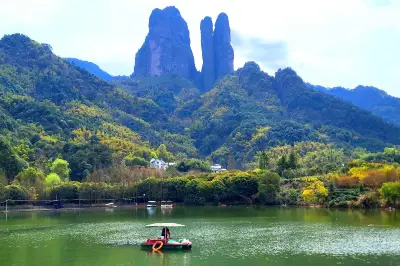
June 22, 2020 – Day 5. Peach Blossom Island. We took a cable car to the hilltop gallery, enjoying the magnificent scenery of the island caught between Gushan Gorge and Bali Gorge, with mountains and water embracing each other. This is the perfect spot along the Yellow River to admire high gorges, placid lakes, and nature’s grand potted landscapes.
Mengliang Fort stands with rugged heights to the east and sheer cliffs to the west, a path passing through the stronghold. The terrain is perilous, the fort sturdy, higher at the back and lower at the front – easy to defend, hard to attack. Legend says Song Dynasty General Meng Liang guarded the pass and built the fort here, hence its name.
Mengliang Fort is a natural fortress. The peak is high, with three sides of vertical rock faces so smooth that even monkeys struggle to climb. Only one steep slope allows for ascent and descent. The terrain alone is a defense, but Meng Liang also set three checkpoints at the most treacherous spots. The first gate permitted only ordinary fort residents to pass; the second, only squad leaders and above; the third, only a few key leaders and close associates. Not far away, on another hilltop, Jiao Zan could exchange messages and signals, making both strongholds virtually impregnable. Despite years of robbing the rich to aid the poor along the Yellow River, official forces repeatedly tried to wipe them out, always in vain.
What Meng Liang and Jiao Zan did was robbery, but they only targeted the wealthy, never harming common folk, earning a good reputation. When Yang Liulang passed through with his troops and heard their stories, he wanted to recruit them for the court. He surrounded the fort without attacking, waiting for supplies to run out. After a whole month, there was still no sign of starvation. When he asked the locals, they said: 'Up on Mengliang Fort, there’s a strip of “revolving alive field” about a foot wide – they sow wheat on one end and harvest it right behind. It goes on endlessly.' So Yang Liulang realized why, even in October, chaff could be seen floating down from the peak. He pretended to retreat, pulling his troops miles away, but left dozens of elite soldiers disguised as villagers around the fort.
After being cooped up for a month, Meng Liang grew restless. Seeing Yang Liulang’s troops withdraw, he was suspicious at first but, after scouts confirmed no trace of them, he swaggered down to loot again. On their return, they were ambushed; Yang Liulang and his men captured the king first, seizing Meng Liang and his chiefs. Meng Liang initially refused to submit, accusing them of trickery, but upon learning it was Yang Liulang, he immediately yielded and even persuaded Jiao Zan to join. Together they headed north with Yang Liulang and earned eternal glory in the war against the Liao.
Coming down, drenched in sweat, I must clarify that we are at Peach Blossom Island.
Yellow River Three Gorges. Each gorge is unique: Gushan Gorge showcases uncanny rock formations and scenic peaks; Longfeng Gorge twists and turns with deep, secluded valleys; Bali Gorge features sheer cliffs and magnificent grandeur – touted as the 'Number One Gorge on the Ten-Thousand-Li Yellow River.'
The scenic area lies in southwestern Jiyuan, Henan, 20 kilometers upstream from the Xiaolangdi Dam, at the junction of the South Taihang Tourism Belt and the 'Three Points, One Line' tourism artery. It is the core zone of the Wangwu Mountain World Geopark.
We boarded the 'Number One Boat on the Yellow River,' slicing through surging waves and welcoming the rushing breeze.
Here, mountains and water intertwine, coves crisscross, high gorges meet calm lakes, and exotic peaks stand like forests – a rare northern landscape with the grace and beauty of the Jiangnan water towns, a magnificent scroll comparable to the Yangtze River’s Three Gorges.
It possesses both the softness and subtlety of southern scenery and the rugged masculinity of the north.
June 23, 2020 – Day 6. Mount Mangdang is famous for Emperor Gaozu of Han slaying the white serpent and launching his uprising. Chen Sheng, China’s first peasant rebel leader, is also buried here. Confucius once sought shelter from rain and gave lectures here, leaving behind sites like Fuzi Cliff and Fuzi Mountain. The imperial tomb complex of the Han Liang Princes – the largest Han tomb group in China – dots the landscape.
The largest Han tomb group in China: tombs of the Liang princes.
Mount Mangdang is not only where Liu Bang revolted but also a dragon vein of the Han dynasty. Generations of Prince Xiao of Liang, grandson of Liu Bang and second son of Emperor Wen, guarded and were buried here.
The Emperor Gaozu’s Serpent-Slaying Stele was erected to commemorate Liu Bang’s serpent-slaying uprising.
At night, when light hits the stele, a tall, majestic phantom of Liu Bang appears – a remarkable sight.
Myth and legend: The Serpent-Slaying Uprising.
Liu Bang, a native of Pei County in the late Qin, was once a village head in Sishui. He was ordered to escort laborers to Mount Li for the First Emperor’s mausoleum, but many escaped along the way. Realizing that even if he reached Mount Li, all would have fled, he paused near Mount Mangdang to rest and eat. That night, he released the remaining laborers, saying, 'Go and save yourselves! I’m going on the run too.' A dozen strong men, admiring his magnanimity and righteousness, volunteered to follow him.
That night, emboldened by wine, Liu Bang continued forward in the moonlight along a winding path. Suddenly, someone ahead screamed and reported, 'A huge snake blocks the way – let’s take another path!' Tipsy and bold, Liu Bang laughed, 'A hero’s spirit sweeps all before it. Why should a mere snake stop me?' He pushed through, sword in hand, and indeed saw a giant serpent sprawled across the road. As he raised his sword, the white snake spoke: 'I am a Son of Heaven, roaming the world, come to divide the realm of Qin.' Liu Bang refused to yield. The snake said, 'So be it. If you cut my head, I will disrupt your beginning; cut my tail, I will disrupt your end.' Fuelled by wine and courage, Liu Bang declared, 'I’ll cut neither head nor tail, but slice you in two through the middle!' With one stroke, he cleaved the snake in half. Blood splattered, staining the earth, and to this day, the grass there grows red. The snake’s spirit rose into the air, crying, 'Liu Bang, return my life!' Liu Bang replied, 'Here in the deep mountains, how can I? Wait till we reach level ground, and I will repay you.' As emperor, his words were golden. Later, Wang Mang usurped the throne and divided the Han dynasty after four centuries – legend says Wang Mang was the white snake reborn, thus fulfilling Liu Bang’s promise. But that is another story.
After slaying the snake, Liu Bang walked on, but the wine took effect, and he fell asleep by the road.
The next morning, a passerby at the spot saw an old woman weeping bitterly and asked why. She said, 'My son has been killed.' 'Who killed him?' 'My son was the White Emperor’s son. He took the form of a snake here to await a title from the Red Emperor, but the Red Emperor slew him.' With that, she vanished. When the man caught up with Liu Bang and told what he’d seen, Liu Bang was secretly overjoyed, believing himself to be the Red Emperor, and his resolve to rebel grew stronger. When the locals of Pei County heard this, they all wanted to follow him. Liu Bang first hid in the marshes of Mangdang, then returned to Pei County, killed the magistrate, and was hailed as Duke of Pei, launching the uprising. Through the Chu–Han Contention, he finally ascended the imperial throne.
June 24, 2020 – Day 7. Fengcheng River, in the heart of Taizhou city, Jiangsu, merges natural scenery with cultural flair. The scenic area is surrounded by water, which creates its charm, vividly displaying the Jiangnan water town essence.
Centered on Wangjiang Tower, the area radiates outward to Peach Garden and Old Street, each echoing the other.
Drifting on the water, listening to a melodious opera, you feel the ancient city soothe and cleanse the soul, while savoring the grace and allure of a water town.
Wangjiang Tower was first built in the Song Dynasty and has inspired countless literati to leave precious calligraphic treasures.
The Stele Garden nestles in a lush bamboo grove by the picturesque Fengcheng River. Unusual boulders, each carved with famous poems about Taizhou from the Five Dynasties right up to the present, stand there.
Taizhou Old Street isn’t truly an ancient street; the area, including adjoining Peach Garden, was once farmland and village houses of Dongjiao Bòbà Village. With the planning and development of the Dongcheng River Scenic Area, construction began in 2007, and after two years, it reached its current scale.
Passing under an old archway, you step onto a lane paved with granite slabs. On both sides, old-style shops line the way, strings of red lanterns hanging from arcade corridors. Shop signs, horizontal inscribed boards, and flags create a delightful scene.
At a bend in the street lies a small square, with an ancient opera stage at its south end, featuring upturned eaves and painted beams. A winding brook hugs the square to the west. A waterwheel, as tall as a three-story building, stands in the stream; rushing water drives its buckets, lifting water high into the air like mist, creating a hazy, enchanting water-town atmosphere. At night, with lights, the view becomes even more captivating.
June 25, 2020 – Final Day. Mei Garden, formed by merging the former Mei Lanfang Historical Materials Exhibition Hall and Mei Lanfang Park, is perched on Phoenix Mound in downtown Taizhou. Surrounded by water on three sides, shaded by green trees, the scenery is elegant.
'Righteous integrity illuminates millennia; the foremost master of the qingyi role.'
A poetic couplet: 'His art early amazed the world with song and dance; in later years, his disciples spread his fragrance.' Horizontal inscription: 'A Paragon of His Generation.'