Impression 15 - A Trip Across the Jiangyin Yangtze River Bridge in the Past
When driving from Suzhou to the north across the Yangtze River, one often passes through the Jiangyin Yangtze River Bridge. This bridge is China's first super-large bridge with a span exceeding one kilometer. The two sides of the bridge are Jingjiang City and Jiangyin City.
It takes just over an hour to drive from Suzhou to the Jiangyin Yangtze River Bridge, making transportation very convenient. I recall one time, on a Sunday, a few friends and I arranged a day trip around the Jiangyin Yangtze River Bridge.
In the morning, after driving for over an hour across the Jiangyin Yangtze River Bridge, we arrived in Jingjiang, specifically to taste the famous Jingjiang crab roe soup dumplings, which have a history of nearly two hundred years.
After enjoying the specialty flavors of Jingjiang, we drove about 80 kilometers northwest to Taizhou.
Taizhou borders the Yangtze River to the south, Yancheng to the north, Nantong to the east, and Yangzhou to the west. It is a crucial water and land hub connecting the south and north, serving as the gateway to central Jiangsu. Since ancient times, it has been known as "a vital water and land passage, a strategic throat holding the prefecture."
Taizhou is a famous historical and cultural city in China, with numerous cultural relics and historic sites. Qinhu National Wetland Park, Fengcheng River Scenic Area, and so on...
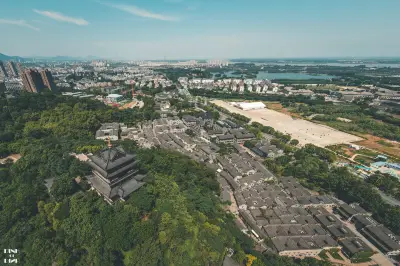
Fengcheng River Scenic Area: Boating on the river, one can fully appreciate the historical depth of "the prefecture established in the Southern Tang Dynasty." Along the Fengcheng River, the Wanghai Tower and the Peach Garden Scenic Area feature over 30 attractions that gather the four major characteristics of Taizhou's culture: history, opera, folk customs, and commerce.
Mei Garden: The Mei Garden in Taizhou does not grow plum trees; it is a memorial hall for celebrities. It is a memorial site for the Peking Opera master Mei Lanfang, so it is also called Mei Lanfang Park.
We had lunch at Taizhou Old Street in the Peach Garden by the Fengcheng River and bought local specialties, including Huangqiao sesame seed cakes.
In the afternoon, we crossed the Jiangyin Yangtze River Bridge again to return to the south bank of the Yangtze River—Jiangyin.
Jiangyin is located at the tail of the Yangtze River and the head of the sea, a strategic throat of the Yangtze, historically a key defense point along the river, and an important transportation hub between the north and south of the Yangtze.
Zhongshan Park was first built in the early Northern Song Dynasty, originally named Wanchun Garden. It was renamed Qingji Garden in the Ming Dynasty, then reduced to ruins when the Qing army entered the city. After reconstruction, it was named Ji Garden. It was destroyed again in 1860 during the Taiping Rebellion, rebuilt in 1885 as Ji Garden, renamed Shoushan Park in 1906, and finally renamed Zhongshan Park in 1930.
Jiangsu Education Commissioner's Office: The venue for Jiangsu Province's imperial examinations during the Qing Dynasty, spanning 292 years. Officials such as Liu Yong once presided over Jiangsu's education here. It is hailed as "the crown of Jiangnan official offices" and "the number one government office in Jiangnan."
Huangshan Fort: A national key cultural relics protection unit.
Zan Garden: The former residence and memorial hall of Master Ju Zan, a Buddhist cultural theme park.
In the evening, on the way back, we arrived at Dangkou Town in Wuxi.
Dangkou Ancient Town, located at the junction of Wuxi, Suzhou, and Changshu, is known as "Little Suzhou" and "Silver Dangkou," and is a national AAAA-level tourist attraction.
At Qinyuan Xiaolong, you can taste authentic Wuxi-style fresh meat xiaolongbao.
Strolling in Dangkou in the evening.
Driving home in the hazy night.