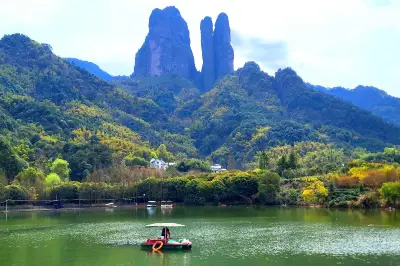
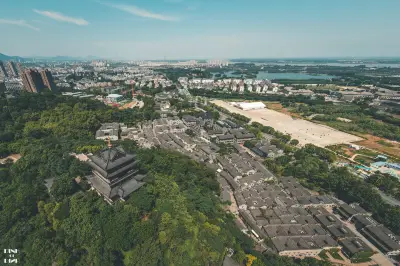
Lesser-Known Tourist Attractions in Jiangnan: Qiandao Lake, Qianduo Scenic Area, Lizhong Water Forest, Huaxi Village, Lingering Garden, Qili Shantang, Wuzhen
2020~an unusual year. Besides the changes brought by COVID-19, the Mid-Autumn Festival and National Day also conspired to fall on the same day (reportedly once every 19 years).
With the virus still not eliminated and many unknowns about it, we chose to avoid the free high-speed travel during the holiday peak to stay safe. Since there had been a lot of rain, many routes we were interested in had bad weather. Only the Jiangsu-Zhejiang area had clear skies, so heading south of the Yangtze River became our only choice.
We had visited Jiangnan many times and already seen all the major attractions. Lesser-known spots were our goal. This trip was the farthest we had traveled during the post-pandemic period. To effectively protect ourselves, we combined air travel with self-driving. We booked round-trip flights and arranged car rental online beforehand.
Itinerary: September 24–September 28
Day 1: Xi'an–Hangzhou, visit Qiandao Lake, stay at Qiandao Lake.
Day 2: Morning tour of Qiandao Lake; noon drive from Qiandao Lake to Xinghua, stay in Xinghua.
Day 3: Xinghua–Suzhou: morning visit Qianduo Scenic Area and Water Forest; afternoon visit Huaxi Village; evening visit Lingering Garden in Suzhou; stay in Suzhou.
Day 4: Suzhou–Wuzhen: visit Wuzhen East Gate, World Internet Conference venue, West Gate; stay in Wuzhen West Gate.
Day 5: Wuzhen–Hangzhou–Xi'an.
Route: Chun'an Qiandao Lake–Xinghua Qianduo Scenic Area–Xinghua Lizhong Water Forest–Wuxi Huaxi Village–Suzhou Lingering Garden–Wuzhen, covering 6 attractions, about 1,200 km.
Day 1: Xi'an–Hangzhou–Chun'an
Flight: Xi'an–Hangzhou 09:25–11:50
Drive: Hangzhou Xiaoshan International Airport–Chun'an Qiandao Lake Scenic Area, 3h14min, 196.4 km, via Changshen Expressway and Baixiao Road.
Attraction: Qiandao Lake
********************
At 11:40 (ten minutes early), the plane landed on time. We picked up the car at the airport branch of Shenzhou Rental.
We had lunch at the Hangzhou Jiande Expressway service area (five-star).
In the service area square, a suspended kettle poured down blessings for people.
At 4:30 p.m., we arrived at Qiandao Lake Scenic Area.
There are many hotels along the lake. On Pailing Peninsula, we found a nice-looking one: Qiandao Lake Meidiya Junlan Resort Hotel. The hotel is built by the lake, adjacent to the Qiandao Lake tourist pier, facing the central lake area, with Menggutang Cultural Park and Xiushui Street theme park to the east. Without leaving the hotel, you can enjoy the beautiful scenery of the central lake area. We booked a garden-view room (lake-view rooms were already poorly positioned). The hotel gave us two vouchers for cycling around the lake.
After checking in, it was almost dusk. Looking at the tourist map, we planned to drive counterclockwise along the lake from the hotel that evening, and the next day to cycle clockwise along the lakeside bike trail.
We passed Xiushui Street, tourist pier, Menggutang Cultural Park, Natural History Museum, Qiandao Lake Food Stalls, Fish Street, Night Cruise Pier, Jiangbin Park, Hubin Park, Xiushui Square, Xiushui Fang, Qiandao Lake Bridge, Yuantou Service Station, Red Leaf Bay Scenic Area. When we reached Xiaojinshan Viewing Platform, night fell, so we had to turn back (it gets dark very early here; visibility is poor after 6 p.m.).
We had dinner at the hotel. It is said that Qiandao Lake fish is the top freshwater fish brand in China, and fish head meal is a specialty. But the fish here is huge—one serving is as big as a washbasin, suitable for four or more people; two people can't finish it. So we just had Qiandao tofu and Qiandao bamboo shoots.
Day 2: Chun'an–Xinghua
Drive: Qiandao Lake Meidiya Junlan Resort Hotel–Xinghua Jinjiang Inn (Yingwu Bridge Branch), 6h56min, 518.2 km, via Changshen Expressway and Fuli Expressway.
Attraction: Qiandao Lake
*******************
At dawn, we wanted to photograph the sunrise, but the weather was not cooperating. We had to settle for a walk near the hotel by the lake.
Breakfast was abundant.
After breakfast, we picked up the mountain bikes and rode along the 15-km lakeside bike trail, embracing the natural beauty of Qiandao Lake through cycling.
The bike trail was just the right length. Riders could feel the scenery unfolding as they moved.
After more than an hour, the weather seemed to clear up a bit, and the best photo opportunity arrived.
Since we had to set off for our next destination at noon, which would take about 7 hours, we needed to spare an hour before leaving for aerial photography to get a bird's-eye view of Qiandao Lake. Time was tight, so we couldn't ride all the way to the end—the Qiandao Lake Cycling Bridge. Reluctantly, we returned to the hotel.
After finishing the aerial photography, we checked out at the front desk and set off for Xinghua.
Special praise goes to the expressway service areas in Jiangsu. We encountered two service areas along the way, both marked as "five-star." They truly lived up to the name: high quality and clean. Not only did we eat delicious food from the land of fish and rice, but we also tasted authentic ancient traditional snacks—Huangqiao sesame cakes and Jiaxing zongzi.
The journey was tiring. We arrived in Xinghua at 8 p.m.
Day 3: Xinghua–Suzhou
Drive: Xinghua Jinjiang Inn (Yingwu Bridge Branch)–Suzhou Jinjiang Inn (Suzhou Railway Station Lingering Garden Branch), 4h16min, 212.0 km, via Yanjing Expressway and Beijing-Shanghai Expressway.
Attractions: Xinghua Qianduo Scenic Area–Xinghua Lizhong Water Forest–Wuxi Huaxi Village–Suzhou Lingering Garden
**********************
In the early morning, while walking around the hotel, we saw residents washing clothes and scrubbing mops in the river.
After breakfast, we checked out and drove to start today's sightseeing.
Leaving Xinghua city, we soon entered the water town landscape avenue opened last year—"Qianduo Beautiful Road." It connects attractions such as Qianduo Rape Flower, Lizhong Water Forest, and Wujin Wetland, as well as several administrative villages, with a total length of 66 km. Along the way, we not only enjoyed pleasing views but also witnessed scenes of fishing, crab farming, and sesame harvesting. "Qianduo Beautiful Road" was successfully selected for the 2019 "Top Ten Most Beautiful Rural Roads" and was also rated by the Ministry of Transport as "the road with the most nostalgia and the most popular road."
Wujin is the starting section of "Qianduo Beautiful Road." On the Wujin Bridge, the majestic statues of Yue Fei's army and the nearby ancient Song Dynasty warship named "Desheng" tell the historical legend of Wujin, also showcasing the nationally renowned Zhuhong wooden boat building technique and industry.
Driving on "Qianduo Beautiful Road," various sculptures and installations kept catching our eyes, telling wonderful stories of Xinghua to passersby.
A large bronze crab wrapped in stainless steel fishing net symbolizes "crabs make the world rich," vividly showing that Xinghua crabs are big, delicious, with red roe and full meat.
Along the road, there are also farming sculptures, lotus sculptures, water town windmills, and other characteristic landscapes, highlighting Xinghua's long culture and fine ecology.
For the first time in our lives, we encountered sesame plants in the fruiting stage, appearing as herbaceous plants before our eyes.
Such small and fragrant sesame grows like this! Surprised, we asked a local for a sickle and harvested some.
Xinghua has dense rivers and lakes, producing various aquatic products. During the fishing and crab season, busy fishermen can be seen everywhere.
After driving a dozen kilometers, we arrived at Qianduo Scenic Area. The natural landscape of Qiaotian (raised fields) was formed 750 years ago. In this swampy land lacking soil, ancestors took mud from underwater and piled it up into elevated plots, creating thousands of raised fields. The most beautiful season is March–April when rapeseed flowers bloom. Autumn should also be the time when marigolds cover the raised fields, "see rapeseed flowers in spring, appreciate chrysanthemums in autumn." This year's rapeseed flowering period coincided with the critical period of epidemic prevention and control. The scenic area mainly received individual tourists from the province and surrounding areas. Since not many flower viewers came, the farmers did not plant lotus or marigolds. Although the scenic area was not operating, the gate was not closed. We entered through the gate and seemed to be in a no-man's land. The once bustling huge scenic area became our exclusive venue. A scene of desolation appeared before us, which we had anticipated. No regrets—the important thing about visiting Qianduo was to see a special form of farmland: the "raised field" characteristic landform. Of course, it would have been better with flower decoration.
Entering the scenic area gate, we crossed the bridge over "Qianduo Beautiful Road" and arrived at the viewing platform.
Looking around, on one side were prosperous villages and towns, on the other side were the world-famous Qianduo fields.
Coming down from the platform, we strolled among the raised fields, stepping on the artificially built earth.
Along "Qianduo Beautiful Road," it is less than ten kilometers from Qianduo Scenic Area to Lizhong Water Forest.
The Water Forest Scenic Area has Jiangsu's largest artificial wetland ecological forest, mainly metasequoia, covering 2,000 mu (about 133 hectares). It adopts a three-dimensional mode of forest, raised fields, ditches, and fish, forming a water town landscape of "forest with water, forest with birds." It is indeed unique.
Not far away is the water inlet of the circulating water system in the water forest.
Workers were busy.
Wooden plank roads, wooden tables and chairs, stone bridges, pavilions... various structures dotted among green trees and clear water.
Crisscrossing waterways divided the raised fields into a chessboard pattern, with rivers along the latitudinal and longitudinal lines forming "water alleys in the forest" shaded by trees.
Every waterway had various small bridges.
The roots (called "aerial roots") of pond cypress growing along the river protruded from the water, in strange and varied shapes.
Green algae growing naturally on the water dyed the river emerald green.
The boundary between the algae-covered water and clear water was visible.
Stepping into the "Little Jiuzhaigou of Jiangsu," we felt as if we had entered a fantasy world: rows of pond cypress growing in clear water, the cypress and water merging together, reflections dancing, light and shadow drifting. Wooden plank roads wound their way into secluded spots.
Pond cypress in various poses.
Photography enthusiasts also struck various poses to capture precious scenes.
After leaving the "Little Jiuzhaigou of Jiangsu," we arrived at the "Lotus Pond."
In just two hours, we absorbed plenty of negative oxygen ions, fully enjoyed the beauty of the water forest, and truly experienced the leisurely pleasure of "wild ducks sleep on the shore with idle charm, old trees blossom without ugly branches." Then we drove toward Suzhou, taking a detour to catch a glimpse of the nationally renowned "No. 1 Village under Heaven"—Huaxi Village.
After driving 176 km, we arrived at this mysterious village that we "especially wanted to see with our own eyes" at 2 p.m.
It is said that in 2001, Huaxi adopted the "one division, five unifications" method to help 20 surrounding villages develop together, building a large Huaxi with an area of 35 square kilometers and a population of 30,340. They created a village with "green hills, lakes, expressways, waterways, a heliport, and a five-star luxury hotel." In 2012, the village achieved an annual economic income of 52.5 billion yuan, with each household's minimum savings between 6 million and 20 million yuan, and every family lived in a villa—truly eye-catching!
Landmark buildings: Huaxi Golden Tower complex.
Huaxi Longxi International Hotel.
Huaxi Happiness Garden villa area.
After a cursory glance, we drove onto the expressway to Suzhou. An hour or so later, we arrived in Suzhou. Originally we wanted to visit the Humble Administrator's Garden. We searched for nearly an hour but couldn't find the entrance because the surrounding area was under renovation. It was already after 4 p.m., so we thought of Lingering Garden. Lingering Garden closes at 5:30 p.m. Fortunately, it is not large, so we had enough time to appreciate it slowly.
Lingering Garden is a large classical private garden in China, known for its exquisite architecture and numerous rare stones. Together with Suzhou's Humble Administrator's Garden, Beijing's Summer Palace, and Chengde's Mountain Resort, it is known as one of China's four famous gardens.
When the closing bell rang, we had already circled the garden one and a half times, not missing any notable spots.
All day on the road, non-stop from Xinghua through Wuxi to Suzhou. Although the distance was not long, we crossed three cities and visited many attractions (lunch at a five-star expressway service area, delicious and clean). At the end, we longed to immediately check into a comfortable hotel. We found the Jinjiang Inn Lingering Garden branch on the spot. Its location was convenient—just a few minutes' walk to Lingering Garden.
Day 4: Suzhou–Tongxiang
Drive: Suzhou Jinjiang Inn (Suzhou Railway Station Lingering Garden Branch)–Wuzhen Scenic Area, 1h30min, 76.1 km.
Attractions: Suzhou Qili Shantang–Wuzhen East Gate–World Internet Conference venue–Wuzhen West Gate
********************
On an early morning walk, we accidentally discovered the nearby China Historical and Cultural Street—Qili Shantang. We were lucky to add another attraction, and sunrise was a perfect time for photography. Since it was still early, we could enter the scenic area freely without buying tickets.
When the poet Bai Juyi served as the prefect of Suzhou, to facilitate water and land transportation, he dug a canal starting from Tiger Hill in the west to Changmen in the east. The ancient street built along the canal is called Shantang Street, also known as "Baigong Causeway," about seven li long, hence "Qili Shantang." Since ancient times, Shantang Street has been known as "the first street in Gusu." A folk song goes: "Up above there is heaven, down below there is Suzhou and Hangzhou. Hangzhou has West Lake, Suzhou has Shantang."
On the way back from Shantang Street to the hotel, we passed the "Suzhou Legal Park." The outer "Chinese Legal History Wall" was particularly eye-catching. A series of display boards embedded in the wall systematically introduced Chinese laws throughout the dynasties, attracting tourists and passersby to stop and read.
We set off from Suzhou at 9 a.m. and arrived at Wuzhen Scenic Area around 10 a.m. It is said that you must stay one night in West Gate to enjoy the night view. So at the West Gate service center, we chose a guesthouse and bought a "combined ticket with accommodation discount for East Gate and West Gate" (this ticket allowed entry to East Gate and West Gate before 3 p.m. the next day). We allocated our time reasonably: East Gate first, then the World Internet Conference venue, and finally West Gate.
Wuzhen, a famous historical and cultural town in China, has a civilization history of over 7,000 years and a town history of 1,300 years. It lies at the junction of two provinces, three prefectures, and seven counties. The town has a dense network of rivers, belonging to the Taihu Lake basin. It is a typical ancient water town in Jiangnan, known as "the land of fish and rice, the home of silk" and "the last water town where people live by the water."
The feature of Wuzhen East Gate is showing its unique charm with an original, unadulterated water town appearance and profound cultural heritage.
Here, ancient residential houses spread along the riverbanks, with quaint white walls and black tiles. Bustling shops and inns line the streets, one after another, lively and prosperous. Many local residents still live there, giving the water town a relaxed and tranquil atmosphere. Most scenes of the TV drama "The Story of a Discharged Prisoner" (Note: Should be "The Story of a Floating Life" or similar? Actually "似水年华" is "The Story of a Watery Youth") were filmed in Wuzhen East Gate. There are also many cultural relics preserved in the scenic area.
During the Southern Song Dynasty, to strengthen the body and protect the local area, people practiced martial arts on boats, giving rise to "fist boats."
Can you tell that the little shop assistant wearing a mask and grinding medicine at the door is a robot?
Walking on the ancient water lanes and streets of Wuzhen West Gate felt like traveling through dynasties.
Lizhi Academy was the primary school where Mao Dun studied in his childhood.
The high pole boat, also called the standard pole boat or "silkworm flower boat." Every Qingming Festival, in the silkworm-raising areas around Wuzhen, a traditional cultural activity is held to pray for a good silkworm harvest: a large ship places a giant stone mortar in the center, with a carefully selected large flexible bamboo pole (called "silkworm flower bamboo") inserted. Farmers dressed in white climb to the top of the bamboo, symbolizing silkworms, performing various thrilling moves.
We had lunch at "Hanlin Mansion" in East Gate, tasting local specialties.
Steamed Taihu Lake white fish: This dish uses wild white fish from Taihu Lake, with tender and smooth meat and delicious broth. Dingsheng cake: Wuzhen has always valued education. In ancient times, when scholars went to take the imperial exams, relatives and friends would make several baskets of sweet, soft, and glutinous Dingsheng cakes to send them off, wishing them success in the exams.
After enjoying the sights and tastes in East Gate, we drove to the "World Internet Conference site."
Unfortunately, the venue was under renovation and upgrade, and the entire area was closed to the public. We could only quickly take a few photos behind the venue.
We had traveled a long way to Wuzhen specifically to see this international platform where China connects with the world. Feeling regretful and unwilling, we drove around the venue and found a good spot to launch the drone and fly over the fence for aerial photos. The closure did not block our view; from the air, we got a panoramic view.
At 2 p.m., we arrived at West Gate Scenic Area.
Wuzhen West Gate is adjacent to the Beijing-Hangzhou Grand Canal. The density of waterways and stone bridges is among the highest in China's ancient towns.
West Gate is mainly oriented toward tourism and vacation, so the tourism service is very mature, with seamless one-stop service.
We parked the car in the external parking lot and left our luggage at the baggage service. The staff would deliver it directly to the hotel or guesthouse we were staying at. We could tour the scenic area light, walking, taking a shuttle bus, or swaying in a wupeng boat.
Among the many national flags, we found the Chinese flag.
The first thing we saw upon entering the scenic area was the high-end cultural landmark—Wuzhen Grand Theatre, showcasing the modern Jiangnan water town side of West Gate.
Muxin Art Museum houses the lifelong works of Mr. Muxin.
In stark contrast to modernization, West Gate retains the ancient water town style of "clear water passes through the city, homes rest by the river, houses float on water, water flows under houses."
Cao Mu Ben Se Dyeing Workshop.
Rivers crisscross, bridges are dense, streets cling to the water.
Old houses arranged in picturesque disorder.
High walls and narrow alleys, old stone-paved roads.
The quaint Zhaoming Academy—the place where Crown Prince Zhaoming of the Southern Liang Dynasty studied.
Leaning on the railing, we let our carefree hearts savor the tranquility that seeks nothing from the world.
Secluded water lanes, ancient wupeng boats.
Xi Qing Tang (Wedding Hall)—traditional wedding hall of Wuzhen.
San Cun Jin Lian Museum (Three-inch Golden Lotus)—a museum of foot-binding history, showing the world a rare aesthetic and cruel custom, telling the painful physical and mental distortion of ancient women.
Yue Lao Temple—a place for lovers to make wishes in Wuzhen.
White Lotus Pagoda—the tallest building in Wuzhen, standing by the ancient Grand Canal.
Climbing the White Lotus Pagoda (only three floors open) to overlook Wuzhen.
Bridge within Bridge—Tongji Bridge: Composed of two stone arch bridges at right angles leaning against each other. It gets its name because you can see the other bridge through one bridge's arch. It is one of the most beautiful ancient bridges in Wuzhen.
Wenchang Pavilion—a place where Wuzhen locals worship Emperor Wenchang. In old days, every exam season, scholars would come to pray for success in the imperial exams.
General Wu Temple—after the An Lushan Rebellion in the Tang Dynasty, General Wu Zan died defending Wuzhen, and locals enshrined him as a "guardian god."
A themed restaurant with strong Republic of China style.
Morning tea house and water stage.
Ornamental red koi.
After touring a large area of Wuzhen and finishing the daytime sightseeing, we arrived at our designated guesthouse. Our luggage had already been delivered to our room. It was a clean, tidy, warm, and down-to-earth guesthouse right by the water.
We could see many guest comments. Apparently this guesthouse had a good reputation.
After a short rest, before it was completely dark, we went to a nearby restaurant for dinner, tasting local specialties.
After dinner, the houses on the water began to light up sporadically. As the lights came on and the sky turned deep blue, we sat by the window in the restaurant, quietly waiting for nightfall, casually taking a few photos of the dusk scene.
Night slowly drew its curtain, everything changing silently. The daytime bustle gave way to a world of light and shadow: hazy lights, gentle ripples, swaying reflections, intertwining light and shadow.
Strolling through West Gate at night, the streets, alleys, bridge arches, houses on the water... countless lamps glowed, low-key yet splendid. Hanging red lanterns, slowly moving wupeng boats, reflections of lights on the water... every scene was worth stopping to admire.
After feasting our eyes, we returned to the waterside guesthouse and quietly fell asleep by the water.
Day 5: Tongxiang–Hangzhou–Xi'an
Drive: Wuzhen Scenic Area–Hangzhou Xiaoshan International Airport, 2h9min, 86.3 km, via Huru Line and Donghu Elevated Road (since we had plenty of time, we chose not to take the expressway).
Attraction: Wuzhen West Gate
Flight: Hangzhou–Xinyang–Xi'an 11:40 – 15:55
*********************
Early in the morning, before people woke up, we walked along Wuzhen's water lanes, waiting for the sunrise, breathing in the fresh, slightly humid air, enjoying the quiet scenery, and absorbing a different feeling.
Guesthouse breakfast: the landlady personally made us shredded pork with pickled vegetable noodles, fried eggs, and rice cakes. Tasty, clean, and delicious.
Coming to Wuzhen West Gate, finding a guesthouse, tasting a table of Jiangnan home-style dishes, enjoying a night of sleep by the water, admiring the twinkling night scene, breathing the morning air of the water town, and catching a glimpse of the morning market on the water—truly a wonderful experience.
After breakfast, we took the reservation shuttle at exactly 8 a.m., left West Gate Scenic Area, picked up the car, refueled, drove, returned the car, boarded the plane... everything went smoothly. Thus ended our five-day self-driving tour of Jiangsu and Zhejiang at a fast pace. We tasted the benefits of combining flights and self-driving in limited time, enjoying the freedom to go wherever we wanted and change routes at will.