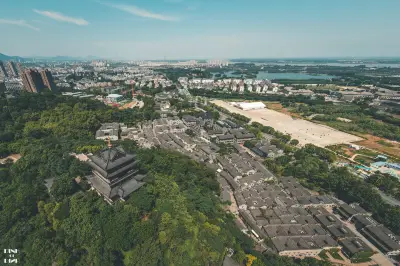
Taizhou Peach Garden: Former Residence of Kong Shangren
Poetry and the distance are not far. On the clear autumn morning of October 6, I entered Taizhou Peach Garden. Peach Garden is a poem, and the former residence of Kong Shangren inside the garden is the most brilliant verse in the poem.
East of the Peach Garden's gate lies Taizhou Old Street; to the west, it faces Wanghai Tower across the water; to the north, it is separated only by one street from the Mei Lanfang Memorial Hall (Plum Garden). Standing here, I deeply feel: this is a place blessed with outstanding people and a remarkable spirit!
Kong Shangren, the 64th generation descendant of Confucius, was ordered by the emperor to supervise water control projects in Taizhou in the early Qing Dynasty. He once lived in Chen Nunnery in the southern part of the city. This explains why behind the plaque reading "Former Residence of Kong Shangren" there hangs another plaque that says "Chen Nunnery."
The Peach Blossom Fan is a historical drama reflecting the pain of the Ming Dynasty's fall. It interweaves the love story of Hou Fangyu, a talented scholar of the late Ming, and Li Xiangjun, a Qinhuai courtesan, with the rise and fall of the Southern Ming Hongguang reign, creating a series of vivid characters. The tragic ending breaks away from the traditional reunion of talented scholars and beauties, organically combining and elevating the love affair with the rise and fall of the nation.
Among ancient literati who became officials, how many had a smooth journey? From Li Bai and Du Fu to Zheng Banqiao... Kong Shangren was no exception. When he first arrived in Taizhou, his heart burned with patriotic zeal, eager to save the people from floods, and he endured great hardships. However, his superiors were dissatisfied with his flood control plan, and he was demoted. From then on, as an imperial envoy, he was left idle! Within two or three years, local officials' attitudes toward him changed dramatically: respect → indifference → aversion → disgust. In the end, he took shelter in the dilapidated Chen Nunnery, with no carriage to travel, no fish to eat, unable to maintain three meals a day, cutting lunch and even eating only one meal a day. He had to beg others for money and rice. When a scholar reaches such a state, he can only make friends through writing and find joy in books. Thus came the idea of creating The Peach Blossom Fan. The Peach Blossom Fan made Kong Shangren's name eternal in history, but the good times did not last. Eventually, he was dismissed from office and returned home because of The Peach Blossom Fan. He died in Qufu in the 57th year of Kangxi (1718) and was buried in the Confucian Cemetery.
Today, stepping into the former residence of Kong Shangren, I find it has not been "restored to its original state"; everything looks new. The former residence is a garden within a garden, quite spacious: small bridges, flowing water, small pavilions, fish ponds, and waterside pavilions—everything one could wish for. Bathed in autumn sunlight, the greenery is lush, full of vitality. Passing through Kong Shangren's bedroom, I see a carved wooden bed with a snow-white mosquito net. Next door, I see a wax figure of Kong Shangren, sitting upright in a tidy study, quietly writing The Peach Blossom Fan.
Such an environment is a stark contrast to the Chen Nunnery where Kong Shangren once lived!
If Kong Shangren knows in the afterlife, what kind of sigh would he heave? Who knows!
Alas! History, with its rises and falls, constructions and destructions, seems ordinary yet extraordinary. Perhaps it is through this that history advances and culture is transmitted.