Hailing and Pi Bao Shui (Skin Wraps Water)
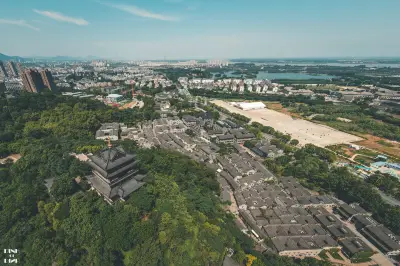
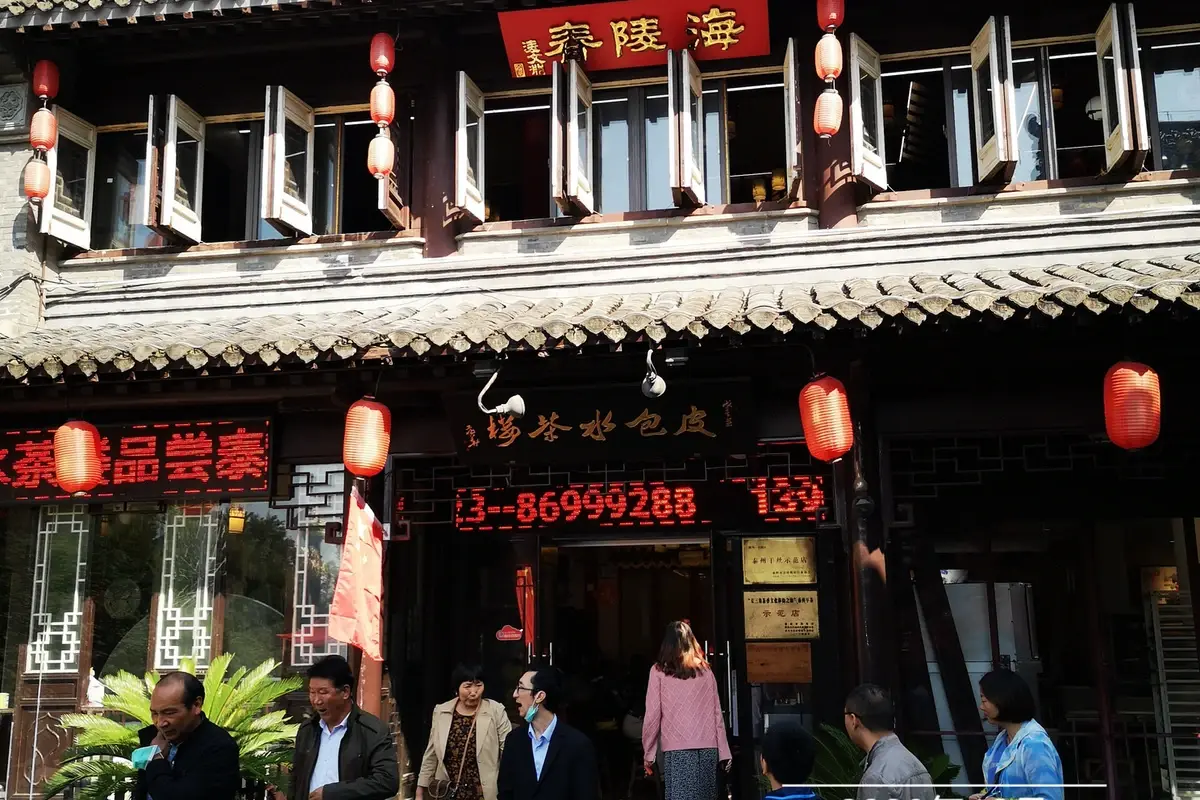
At 9 a.m. on October 6, exiting the west gate of Taizhou Peach Garden, Guide Wang was indeed waiting for us outside the gate. A tall archway with double eaves and a hip-and-gable roof stood facing south at the intersection, with the lintel bearing the characters "Old Street." On the archway pillars hung a couplet: The inscription by Zhao Puchu says, "The prefecture was founded in the Southern Tang, and culture flourished in the Northern Song"; The calligraphy by Lin Sanzhi reads, "An ancient commandery of the Han and Tang dynasties, a renowned region of the Huaihai area." The couplet is distinctive: it highlights Taizhou's long history and geographical location. Looking around, the rows of shops on the old street were newly built, but their design and architecture exude a classical elegance. The streets of the old lane are paved with either stone or brick, flat and clean. From the road conditions, it's clear this street is newly constructed. During the National Day holiday, the streets are decorated with national flags and red lanterns, creating a festive atmosphere. The old street features an ancient stage, bronze sculptures, a waterwheel, a stone mill... The holiday spirit enhances the joy of sightseeing. Looking around, I feel deeply: Taizhou's prosperity is no less than that of Jiangnan! On the first floor of an old building, the upper part reads "Hailing Spring" and the lower part reads "Pi Bao Shui Tea House." The term "Hailing" must have a special significance. I asked Guide Wang. He replied: "In the pre-Qin era, a granary called Hailing was built along the Yellow Sea, and taking advantage of the coastal access, salt fields were established to boil seawater for salt. Thus, the name Hailing came about." -- So that's it! As I strolled along the old street, I saw another shop sign -- "Pi Bao Shui Taixiang." I know: 'In the morning, skin wraps water; in the evening, water wraps skin' is a Yangzhou lifestyle. Water wrapping skin means bathing at night, while skin wrapping water means drinking tea in the morning. That's a Yangzhou specialty. How did it end up in Taizhou? -- At the time, Taizhou was bordered by the Yangtze River to the south and the Yellow Sea to the east. Yangzhou's wealth came from salt production, and so did Taizhou's. In the early days of the Southern Tang dynasty, both Taizhou and Yangzhou were major contributors of salt tax to the state, ranking among the top ten salt tax collection sites nationwide. Taizhou, adjacent to Yangzhou, was equally prosperous and shared very similar living customs. (Guided Wang explained.) Taizhou Old Street is like a carrying pole, with Peach Garden at one end and Plum Garden at the other. It's the golden route for visiting Taizhou! Even more delightful: Despite the continuous shops along Taizhou Old Street, there is none of the oppressive commercial atmosphere that often annoys visitors. Compared to several ancient towns in Jiangnan, it has a bit more antique charm and a bit more of an ancient commandery ambiance.