Taizhou | A Slow Autumn Encounter in the Water City
Do you spend each day darting through the clamorous city?
Do you long to leave behind the hubbub of the mundane world?
Do you yearn to find a tranquil haven where you can settle your heart and savor a slower pace?
Do you also dream of Tao Yuanming’s leisurely life, plucking chrysanthemums by the eastern fence?
If so, then slow your steps and savor the unhurried life of the water city, Taizhou. Over 700 years ago, Marco Polo traveled here and praised it, saying, “The city is not large, but it abounds in all kinds of earthly happiness.”
Taizhou is a small city free from hurried gaits and tense, rapid rhythms. Elegant and leisurely, it is as serene as its name suggests. Here, there are countless ways to enjoy a cozy weekend: drift on a boat along the Fengcheng River, or stroll through old lanes and gardens, relax your soul, and discover the joy of nature.
DAY 1: Xinghua, Taizhou: Lizhong Water Forest Park – Bishui Dongluo pastoral scenery. After dinner, a night cruise on the Fengcheng River. Stay overnight at Daohu Shuxiangshijia Hotel.
DAY 2: Taizhou morning tea, Mei Garden – Qiao Garden – Wanghai Tower – Salt Tax Museum – Naval Birthplace Memorial Hall – Diaohua Lou. Stay overnight at Daohu Shuxiangshijia Hotel.
DAY 3: Daohu Ancient Street Area – Qin Lake – Qintong Ancient Town. Head home.
A memorable trip naturally calls for accommodation that complements the experience. On our Taizhou journey, we stayed at the Daohu Shuxiangshijia Hotel, nestled within the Daohu Ancient Street Area. Though removed from the city’s noise, it remains sheltered within the urban fabric, offering an enviable location.
The hotel blends seamlessly with the area’s traditional plank bridge culture, merging the Jiangnan water town atmosphere with a literary flair. Antique-style furniture exudes a sense of history, while the space embraces both humanistic city culture and modern smart hotel technology—allowing you to dwell in the present while savoring tradition.
Willows brush the fresh breeze, and purple light shines on the lovely garden. The Daohu Shijia Hotel’s unique design is strikingly novel; the decor is elegant yet rooted in Chinese tradition. Guest rooms are furnished with high-end amenities: fully automatic water dispensers and small robot assistants cater to your every need. The meticulous, thoughtful service feels deeply personal.
The hotel is built around a Ming-Qing courtyard complex, with five residences and four yards containing 72 guest rooms: Songhua Xuan, Baiyun Xuan, Youzhen Xuan, Linglong Xuan, and Xiyu Xuan—each with its own character. There’s also a private rear garden, with black bricks and dark tiles, little bridges over flowing water, and timeless charm everywhere. Every snapshot becomes a scenic postcard.
Address: No. 118 Haibei North Road, Taizhou (inside Daohu Bay Ancient Street Area)
Taizhou, a city living on water, was born of water and thrives because of it. It is no grand capital or prefecture, nor does it boast towering mountains or vast rivers, but the lowlands carved by the Lixiahe region bless Taizhou with an unsurpassable beauty of water villages. Known as the Phoenix City, it carries a history of over 2,100 years. Once called Haiyang or Hailing, a county was established here in the early Han Dynasty, a prefecture in the Eastern Jin, and a sub-prefecture in the Southern Tang. The ancients prayed for “a peaceful country and prosperous people, with dragons and phoenixes bringing good fortune,” and thus the name Taizhou was born.
On the first day in Taizhou, we headed to a real-life version of the Wizard of Oz: Lizhong Water Forest Park. Far from the city’s noise and clamor, this is nature’s oxygen bar. The park is dominated by pond bald cypress trees and features scenic spots such as Forest Waterways, Plank Bridge Walkway, the Grove of Happy Ignorance, and Misty Forest. Stroll along winding cypress footbridges, pause at quaint forest pavilions, and immerse yourself in this serene, natural wonderland of water and woods.
Lizhong Water Forest is actually a man-made ecological forest base, first planted in the early 1980s. Covering 1,050 mu of woodland, it’s planted with many dawn redwood, pond bald cypress, and other trees. Unlike ordinary planting methods, it employs a unique three-dimensional model of forest mounds with fish ponds, creating a distinctive water village scene where “water flows through the forest, fish swim in the water, and birds dwell among the trees.”
Once inside, everything your eyes meet is green. Bald cypress rises from the water, duckweed stretches to meet the sky—every sight intoxicating. Now and then an egret glides freely. Because of the season, many migratory birds have already flown south, so spotting even one is a treat!
For an even more beautiful forest view, you must try a bamboo raft drift. Board a raft and weave through the emerald waterways. Warm sunlight spills through gaps in the forest, painting iridescent patterns on the duckweed below. Face the refreshing breeze, breathe the freshest air, and let contentment wash over you.
Wooden walkways wind through secluded paths, stone bridges arch over rippling water, and pavilions rise among the clouds—various structures dot the greenery and turquoise waters. Deep within the bald cypress forest hides a Misty Forest, the best spot for photos. At timed intervals, it releases an ethereal white mist, making you feel as if you’ve stepped into a dream—perfect for ethereal, forest-themed portraits.
The poet Li Botong once wrote in his long poem “Rain Passes over Luyang Lake”: “The scroll of lake light sweeps through misty trees.” Here, green canopies block the sky, slender and gracefully spaced; birds chirp overhead, and crystal-clear water ripples below—truly a green sea. Walking within it is like traversing a painting.
A bend of emerald water, a few cottages—return to nature and savor the idyllic life!
Bishui Dongluo hides among the watery fields of Xinghua, Taizhou. Walking the country lanes, the autumn breeze carries a pastoral fragrance that sweeps away worldly noise and impatience.
Rippling water, leisurely homes lining both shores, and the natural gifts of the Duotian water village make Dongluo Village a wonderful travel destination. The scenes unfold like a distinctive rustic landscape painting, testifying to the colorful slow life of Bishui Dongluo.
Dongluo Village lies in Ganggu Township, Xinghua, Jiangsu, embraced by two rivers and two lakes, with an excellent location. It’s also a pivot point for rural tourism in Xinghua. About 2.2 kilometers to the east is the famous Qianduo rapeseed flower scenic area, and 6 kilometers to the west is Lizhong Water Forest Park. If you’d like to linger for a couple of days, you can stay at a guesthouse in Dongluo.
Dongluo Village’s Grand Auditorium was converted from an old temple, originally built in 1953. Above its entrance are carved a five-starred red flag, sun rays, and three red flags, full of historical resonance. This gray-brick, small-tile building holds the weight and authenticity of an era. It’s said such relics once existed in every village, but few remain as intact as here.
Yunduo Guesthouse—beautiful and serene, just like its name. Nestled among the Duotian fields, sleeping by the water.
Yunduo Guesthouse hides on a small island by Pingwang Lake. Two stone arch bridges serve as time’s ribbons connecting the village. To the south, vast emerald waters stretch, soft as a long melody. Each courtyard here has its own sky, and the architecture harmonizes with local village charm.
In quiet moments, face the lake breeze, enjoy afternoon tea alone, or share wine and laughter with a few friends. In the distance, water glimmers; time drifts leisurely.
Address: Dongluo Village, Qianduo Town, Xinghua, Taizhou, Jiangsu Province
As dusk lights up, to fully appreciate Taizhou’s nocturnal beauty, you must “Night Cruise the Fengcheng River.” This ancient city moat, nearly a thousand years old, stretches 6.7 kilometers and encircles Taizhou like a necklace, linking over 30 attractions. These sites showcase Taizhou’s four hallmark cultures: history, opera, folk customs, and merchant tradition, and record the city’s glory from “the Southern Tang and the Northern Song cultural renaissance.”
Drifting along the river, famous towers and gardens on the banks unfurl their splendid panorama. Aboard a painted boat, you can admire the nighttime majesty of Wanghai Tower, the greatest tower on the Jianghuai Plain, and enjoy the timeless songs of the Kunqu opera “The Peach Blossom Fan”—a truly extraordinary experience.
A single word, “slow,” captures the essence of Taizhou’s two-thousand-year charm. Someone once said, “If you haven’t night-cruised past the cultural relics along the Fengcheng River, you haven’t truly visited Taizhou.” This shows just how deep the river’s history runs. Board a boat, sip a cup of fragrant, high-quality tea, listen to a long, melodious Kunqu aria, and enjoy the riverside night views—could there be a finer pleasure?
In Taizhou, one simple pleasure is “eating morning tea”!
The right way to experience Taizhou’s slow life is to calm your mind and slow your pace, starting with a Taizhou-style morning tea.
A plate of appetizing blanched shredded bean curd, a juicy crab-roe soup dumpling, a bowl of rich fish broth noodles… they awaken your spirits for the day ahead.
The tradition of Taizhou morning tea follows “one tea, three snacks, one noodle.” First to arrive is a cup of lidded tea and a plate of blanched shredded bean curd. “Fuxiang Tea” blends the color of Kuizhen, the fragrance of zhulan flowers, and the taste of Longjing. One gentle sip banishes the cobwebs of fatigue, paired with silky, refreshing shredded bean curd—a leisurely mood naturally takes hold.
The “three snacks” are steamed buns, steamed dumplings, and siu mai. Steaming baskets arrive amid kitchen warmth: the aroma of crab-roe buns, the fresh succulence of shrimp dumplings, the delicate lightness of vegetable siu mai. Purity and subtlety in every bite, lingering flavors in every strand—such is the magic of Taizhou morning tea.
A genuine local morning tea, a stretch of unhurried life, a space to settle your soul. This is Taizhou’s inclusiveness: refined and deliberate, or down-to-earth and lively. Every flavor of morning tea is Taizhou’s most sincere confession of love for life and happiness.
Taizhou, this water city, has deep opera roots in its history and culture. “After lunch, listen to storytelling; at night, enjoy casual operas.” Hear a Yangzhou pinghua tale, watch a scene from “The Drunken Concubine”—opera has long been woven into daily life here. The “Three Villages of Opera Culture” formed by Mei Garden, Tao Garden, and Liu Garden are memorial halls dedicated to opera masters Mei Lanfang, Kong Shangren, and Liu Jingting.
Taizhou’s Mei Garden is a memorial hall for Mei Lanfang, built primarily in Ming and Qing architectural styles, located on Fenghuangdun in central Taizhou. Surrounded by water on three sides, it is quiet and elegant. Compared to the bustle of the old street, it offers more peace and serenity.
Entering through the main gate and crossing a small bridge, you’re greeted by a white marble statue of Mei Lanfang. Mei Lanfang (October 22, 1894 – August 8, 1961), a native of Taizhou, Jiangsu, was born into a Peking opera family in Beijing. He was an outstanding modern Peking and Kunqu opera performer of female roles and a world-renowned master of Chinese opera.
Stroll along the stone pathways and enjoy Mei Garden’s Jiangnan garden scenery. Deeper inside, a subtle, elegant, and delicate fragrance lures you to explore. It turns out countless plum (mei) trees are planted here. Though peak bloom is past, the lingering plum scent still perfumes the air. The Mei Pavilion in the northwest corner is worth a closer look. Its five-sided plum-blossom shape is echoed in its upturned eaves, columns, and seat boards—all plum-themed. Under the eaves, wooden carvings depict scenes from Mei’s five representative plays, such as “The Drunken Concubine.”
Don’t miss the Mei Lanfang Historical Archive inside the garden. It displays many photos and objects from the master’s life. In front of the hall is a semi-circular square, and above the entrance hangs a plaque inscribed by Li Xiannian.
Mei Lanfang is universally acclaimed as the greatest actor and embodiment of beauty. He devoted his entire energy to the art of Peking opera. Over more than half a century on stage, he inherited tradition while bravely innovating, always meticulous and striving for perfection. He integrated the finest elements of Chinese opera, created numerous beautiful and unforgettable artistic images, amassed a rich trove of outstanding plays, and established a distinctive artistic school—the Mei School.
Admission: 15 RMB | Opening hours: 8:00–17:30
Transport: No.90 East Yingchun Road. Take buses 7, 10, 19, 22, or 36.
Qiao Garden, located in Taizhou’s old city, was first built during the Wanli years of the Ming Dynasty and later belonged to Qiao Songnian, the salt commissioner of the Lianghuai region in the Qing Dynasty. It connects to Haibei North Road in the west (formerly called Bazi Bridge Straight Street) and leans against Bazi Bridge East Street in the south. Though small in size, the garden is ingeniously designed and steeped in history, known as the “First Garden West of the Huai River” and the oldest surviving classical private garden in northern Jiangsu.
The garden centers on the Mountain Echo Thatched Hall. To the south are rockeries and ponds, and to the north is a courtyard garden. Its long history dates back to the Rishè Garden of the Wanli era. Over 400 years, ownership changed many times, waxing and waning, and the garden’s name varied. According to local records: “The Three Peaks Thatched Hall is the former site of Rishè Garden, where Chen Lantai retired.”
The scenery captures the essence of Jiangnan gardens: rock valleys and forest springs harmonize playfully, towers and pavilions complement each other, and flowers, grasses, pines, and bamboo adorn the spaces with clear layers. “A hall to the north, a pond across the middle, artificial hills facing each other, winding caves hiding rocks, stone bridges over water”—all assembled from a few simple elements with great cleverness. Without leaving town, you can enjoy the pleasure of mountains and waters; amid the bustling city, you find the delight of forests and springs.
When warm spring brings flowers into bloom, bamboo shadows rustle outside the window, magnolias and camellias vie in splendor. Lingering in the mountain house, brewing a pot of fragrant tea, inviting a few close friends to admire the view, compose poetry, paint, and express one’s heart—this was the ancients’ idyllic ideal. It’s said that whenever Mei Lanfang returned to his ancestral home to pay respects, he stayed here, and the garden still preserves “Mei Lanfang’s lodgings.”
In front of the thatched hall, the pond water meanders, embraced by rocks. The Wengui Fang, an antique boat-shaped structure, is anchored in the Yixin Pond. From its bow and cabin, you can admire the pond view: opposite, a waterfall cascades down a rock face; in the pond, fish frolic among lotus leaves. The beauty evokes the natural charm of lakes and mountains.
Address: No. 68 Haibei North Road, Taizhou, Jiangsu | Opening hours: 9:00–17:00
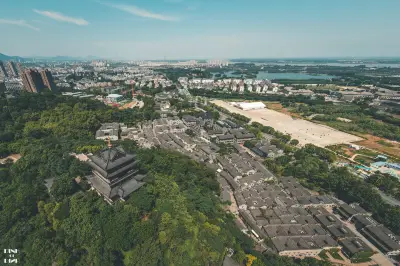
Standing by the Fengcheng River, the first thing you’ll see is Wanghai Tower, the landmark of Taizhou. First built in the second year of the Shaoding era of the Southern Song Dynasty (1229), it’s praised as the greatest tower on the Jianghuai Plain. Wanghai Tower—what a distant, vague name—owes its name to the character “hai” (sea). This land of Taizhou was once a vast sea 8,000 years ago. Around a thousand years ago, the sea gradually receded.
To commemorate the fading sound of the tides, this towering thousand-year edifice was erected at an ideal fengshui spot southeast of the city in 1229. It still stands by the city moat, enduring the vicissitudes of time.
In late autumn, the vegetation is lush. The lofty, ancient Wanghai Tower may not rival China’s four great towers, but it possesses its own unique cultural allure. The Yangtze River, the Yellow Sea, and the Huai River once converged here, as did the ancient Salt Canal, Nanguan River, and Lixia River. Thus, it has always been regarded as the cultural thread of Taizhou.
“At sunset, I lean on the rail and gaze afar. Boundless misty air meets Penglai Isle. A thousand houses and wells encircle the solitary city; ten thousand miles of sails return on one waterway. No trace of the Qin whip driving stones away; only tales of Han crossbows shooting giant waves. Since then, countless travelers have passed—is there any talent to match Yuanxu?” (“Climbing Wanghai Tower”) The third floor also houses an exhibition of classical poetry, splendid verses left by renowned scholars through the ages.
Ascend the 30-meter-high tower for a panoramic view. To the east are Mei Garden and Tao Garden; to the south, San Shui Wan and Liu Garden; to the west, Wenchang Pavilion, Wenfeng Pagoda, and Nanshan Temple. The towering ancient Wanghai Tower stands as an indispensable brilliant scenery in the hearts of Taizhou’s literati.
Taizhou has been an important sea salt production area since ancient times. Liu Bi, King of Wu and nephew of Liu Bang (Han Dynasty’s founder), pioneered the ancient salt fields. The Han had a salt transport river; the Tang, the Hailing salt administration; the Song, salt tax seals; the Yuan, a salt transport bureau; the Ming, the Guangying Granary; the Qing, tax steles and the Taiba Salt Control Office. In the Tang Dynasty, six major salt regions existed nationwide, with Taizhou heading the Lianghuai area. “Of the empire’s salt revenue, Lianghuai contributes half; of Lianghuai’s salt tax, Taizhou contributes half.”
Salt tax revenue long held a significant place in China’s fiscal income. As early as the Spring and Autumn and Warring States periods, a salt monopoly was instituted. After the An Lushan Rebellion in the Tang Dynasty, reforms in the salt monopoly led to a surge in tax revenue. History records: “Of all the empire’s taxes, salt profits contribute half.”
The Jiangsu Salt Tax Museum stands on the north bank of the city moat, southwest of the old Taiba Salt Administration, at the site of the ancient dock where salt from upper Taizhou was loaded onto boats. It covers 2,007 square meters. This was the location of the historic Taiba Supervision Office, and Taizhou, a historic cultural city born of salt and prospered by tax, renowned for its “rich red millet and profits from salt”, is an important birthplace of China’s salt tax culture.
The museum’s exhibition is divided into “The Origins of Salt Tax,” “The Evolution of Salt Tax,” “The Contribution of Salt Tax,” and “Salt Tax and Jiangsu,” revealing the development from agricultural tax to salt tax and industrial/commercial tax in this ancient agricultural giant. Among over 2,000 cultural relics and historical materials on display are Tang Dynasty “stone lotus seeds” used to test brine concentration, Northern Song iron pans for boiling salt, Yuan Dynasty silver ingots, oxcarts used by Huainan salt workers to transport salt and grass, Qing Dynasty “Salt Transport Licenses,” and Republican-era household salt purchase certificates—salt tax records spanning the ages.
The museum incorporates the local Qing Dynasty residential style: gray brick exterior walls, black tiles, and a traditional interior, supplemented by modern technology such as multimedia, smart and digital displays, and sound, light, electricity, sculpture, and simulation techniques to vividly present salt tax artifacts and history.
Outside in the lane, you’ll see a replica of the Northern Song Dynasty iron pan for boiling salt. Even as a replica, its massive size evokes the prosperity and splendor of that bygone era.
Jiangsu has two ancient carved buildings: one in Dongshan, Suzhou, and one in Gaogang, Taizhou. The Gaogang Diaohua Lou was built in the mid-18th century by the Yao family, who came from Jiangnan and dealt in timber. Construction took over two years, and it was completed in the fourth year of Qianlong’s reign (1740). At the time, this Yao family mansion was preeminent and prominent in Gaogang.
The Diaohua Lou faces east and forms a square, consisting of two five-bay, two-story main buildings at front and rear, flanked by three-bay wing buildings on each side, with a central courtyard enclosed by buildings. Walking through, you pass Jiangnan garden scenery only to fall into another distant historical vista. From one end of the lane to the other, you’re not sure whether you’re admiring the scenery or the scenery is admiring you.
The blue-brick walls and gray-tiled roof appear no different from an ordinary ancient building. Even up close, it seems unremarkable. But once inside, standing behind the front building’s screen door and gazing up into the courtyard, from top to bottom, front to back, left to right—everywhere you look, all are intricate carvings. Bathed in the light streaming down from the courtyard, the profusion of carved elements is so dazzling it takes your breath away!
Stroll the ground-floor corridors or climb to the Guanlan Pavilion, the commanding vantage point. This three-story pavilion fronts a street, with water behind, edged with lake rocks. Inside the garden, the pavilion seems to rise naturally atop the rockery. The second-floor veranda is surrounded by white stone balustrades from Zhenjiang, each panel carved with dragon motifs. Inside the pavilion, the entire ceiling is carved with dragon patterns—a mass of writhing dragons.
Late autumn colors shine brilliantly here. The garden is richly planted with a variety of lush old trees: boxwood, camphor, osmanthus, yew, fruit trees, and more. One overhead tree is laden with golden fruit, a happy sight.
As the birthplace of the People’s Liberation Army Navy, Taizhou is known as the “Mother City of Sailors.” The site of the Naval Birthplace Memorial Hall was originally a landlord’s manor named Wang, dating to the late Ming and early Qing. In early April 1949, the command headquarters for the Yangtze River Crossing Campaign was set up in this Baima Temple landlord manor, which later became the Naval Birthplace Memorial Hall.
The old site preserves a two-story Qing-style building and several single-story rooms. Upstairs was the command center for the Third Field Army’s river-crossing operation, restored to its original conference setting, with displays such as a radio transmitter, magnifying glass, lantern, and marching mugs. Downstairs were bedrooms and offices of Generals Su Yu, Zhang Zhen, and Zhang Aiping.
The exhibition hall displays over 50 artifacts, including the carved wooden bed Su Yu slept in, a chest, tea table, Chinese-style armchair, lantern, lamp cabinet, and copper basin. The gate and foyer have been restored to their original appearance, recreating the landlord estate as it was then. Today the site has four exhibition areas and six rooms, recreating the strategic planning and decisive battle across the Yangtze.
The memorial hall covers five major themes: “Modern Vicissitudes,” “The Founding of the Navy at Baima,” “Might Over the Seas,” “Growth and Expansion,” and “Deep Ties with the People,” comprehensively showing the glorious journey of the PLA Navy from its founding at Baima to its growth into a powerful force. The square and indoor displays feature a retired Super Frelon helicopter, ship and vessel models, naval uniforms, and other equipment, truly integrating education, sightseeing, and tourism.
Meeting Qin Lake in autumn is perfect for gathering a few friends and taking a sculling boat ride—it gives you all the autumn’s beauty and romance.
Known as the Pearl of Water Villages, Qin Lake National Wetland Park lies in the Lixiahe area of central Jiangsu, northwest of Jiangyan City, and is a 4A-level scenic spot.
Contemporary poet Liu Zhen once wrote: “The beauty of Magpie Lake never fades with the changing seasons, nor dims with the fall of night. Under clear skies, the shimmering waves and passing clouds enchant the soul. In drizzling rain, bright moonlight, or the rustling autumn wind, the reed flowers always stir a haunting mood!” The “Magpie Lake” that captivates in all weather is precisely Qin Lake.
In golden October, looking out, you see endless blue water and sky, and vast expanses of white wild reed flowers. Such a beautiful season cannot be missed. Slow-tour Qin Lake and savor the poetic charm of the “Eight Scenes of Qin Lake.” As the boatwoman told us, in ancient times this was the paradise where the rare milu deer lived in herds. Despite the vicissitudes of time, it still maintains clean waters and pristine wetland ecology, enhanced by rare geothermal hot springs—even more precious. Heheng Village, east of the lake, was named by the UN Environment Programme as one of the “Global 500 Best” ecological environments.
The azure lakes, interlaced river networks, and scattered islands and shoals lend this wetland a rich poetic atmosphere that captivates visitors. The scenic area is divided into nine zones including an adventure park, rural experience center, science and technology exhibition hall, and milu deer park, with nine rivers naturally forming the spectacular “Nine Dragons Paying Homage.”
Only by boarding a sculling boat can you truly appreciate the enchanting scenery deep within the reed marshes. The boatwoman rows while singing northern Jiangsu folk tunes. A cool breeze passes, and the reed plumes surge like ocean waves, rustling the leaves with a magnificent sound.
Unlike the green tiles and white walls of Jiangnan water towns, here you can sit in a tea house over the water, sip fragrant tea brewed with Qin Lake water, and nibble local snacks. Whether you’re daydreaming or simply admiring the wetland’s charm, it’s utterly comfortable and relaxing.
Legend has it that during the Southern Song Dynasty, Yue Fei’s loyalist army fought the Jin troops fiercely at Qin Lake. Local people came each Qingming Festival to mourn. Over time, this evolved into the annual water town folk festival—the Jiangyan Qintong Boat Festival. Every Qingming, hundreds of boats and thousands of boatmen from nearby towns gather on Qin Lake—a magnificent spectacle, a grand showcase of folk culture.
Here, the sunlight is abundant, the climate mild and humid. A wide variety of wild animals live here, including three first-class nationally protected species: milu deer, red-crowned cranes, and Chinese alligators. With a bit of luck, you might spot milu deer grazing or strolling leisurely by the water’s edge, on the grass, or among the trees.
After touring Qin Lake, don’t miss Qintong Ancient Town on the lake’s north shore. Qintong has been near the sea since ancient times, with lush water and grass. The village on the east bank is still called “Haibin Village.”
Like other ancient towns, the streets are lined with local snacks: Huangqiao sesame cakes, Zhongzhuang drunken crabs, blanched shredded bean curd, Qintong fish cakes, deep-fried stinky tofu, five-flavor shredded bean curd, fish broth noodles, Jiangyan flaky pastries, farmhouse buckwheat soup cakes, Chaixu cicada-wing cakes, and more—all incredibly authentic. The locals are warm and friendly.
Qintong Ancient Town is a renowned historic and cultural town, located in the northeastern corner of Jiangyan City, at the junction of Taizhou, Yancheng, and Nantong. Since ancient times, it’s been said that “a dog’s bark can be heard across three counties.” The nourishing waters of Qin Lake have nurtured brilliant and diligent Qintong scholars, creating a unique atmosphere of learning.
The Former Residence of Academicians: Qintong is a place of outstanding people. In the past, the Liu brothers achieved three top imperial exam laureates; today, the Li Dequn brothers boast five academicians. This is an ancient residence built during the Qianlong period of the Qing Dynasty, over 200 years old.
The centuries-old house, weathered yet rich in cultural depth. From the civil service examination champion Li Chenglin in the Daoguang era to the present-day Li Deren, Li Deyi, Li Dequn—three brothers and five academicians—all walked out of this home’s gate, stepping into the century’s storms and creating brilliant careers.
The Li family’s private garden is called “Rui Garden.” “Rui” means wisdom and intelligence, as Wang Anshi said: “A wise mind comprehends everything.” With supreme wisdom, one achieves great deeds, which is why so many talents emerged from here!
Walking around, you’ll find the ancient town surrounded by water on all sides, with every household living by the water. The dwellings are exquisite and compact, with deep lanes, stone-paved streets, and courtyard wells. The alleys twist and turn; the narrowest passages allow only one person. Houses are interconnected—if no one guides you, you might get lost.
A city’s depth often reveals itself in casual moments. Strolling the old streets, greenish-gray bricks and dark tiles, former salt merchants’ mansions have become ordinary homes, yet still retain a whiff of bygone days. Northern Song culture, the Five Chancellors culture, salt tax culture, water culture, Taizhou-style residences… these threads string together Taizhou’s 2,000-plus years of history and form our deepest memories.
Along Fengcheng River Old Street, shops line up side by side. Near the south end, a storefront displays a gold-on-green plaque: “Taizhou Cao Lu Sesame Cakes.” The shop is small but always bustling. They say this charcoal-hearth cake has a century-old tradition—the most authentic version. Not expensive, it’s worth a taste when you’re in Taizhou.
Taizhou cuisine belongs to the Huaiyang school, emphasizing original flavors, freshness, and balance. “Drunken crabs not beyond the Lantern Festival, air-dried chicken not past the Lantern Festival, anchovies not beyond Qingming, sturgeon not past Dragon Boat Festival”—this seasonal rule ensures that every ingredient is at its peak, letting you savor the exquisite Huaiyang experience anytime.
1. Clothing: jacket, sun hat, sunglasses
2. Skincare: hand cream, anti-chap lip balm, moisturizing spray, sunscreen, facial masks
3. Tech: batteries, film, memory card, charger
4. Daily items: personal toiletries (shampoo, conditioner, shower gel, etc.), small blanket
5. Medicines: motion sickness pills, diarrhea medicine, cold medicine, band-aids, etc.
6. Documents: student ID, ID card, etc.
Travelogue Contents
1. Preface
2. About the Itinerary
3. Daohu Shuxiangshijia Hotel
4. Lizhong Water Forest, a Real-life Wizard of Oz
5. Bishui Dongluo, Slow Pastoral Life
6. Night Cruise on Fengcheng River, Millennia of Water Culture
7. Taizhou Morning Tea, Awakening the Taste Buds
8. Mei Garden, Exploring Peking Opera Master Mei Lanfang
9. Qiao Garden, Admiring a Classical Private Garden
10. Wanghai Tower, First Tower on the Jianghuai
11. The Past and Present of the Salt Tax Museum
12. Diaohua Lou, Chaixu Ancient Town
13. Naval Birthplace Memorial Hall
14. Qin Lake National Wetland Park
15. Qintong Ancient Town
16. Local Specialties and Cuisine
17. Travel Tips
Travel Information
Hotel Index
Travel Guide Index
Flight Ticket Index
Website Navigation
Tour Index
Cruise Index
Corporate Travel Index
Join Us and Cooperate
Distribution Alliance
Partnerships
Corporate Gift Card Purchase
Insurance Agent
Agent Cooperation
Hotel Partnership
Destination and Scenic Spot Cooperation
More Partnership Opportunities
About Ctrip
About Ctrip
Ctrip Hotspots
Contact Us
Careers
User Agreement
Privacy Policy
Business License
Safety Center
Ctrip Content Center
Intellectual Property
Trip.com Group
Algorithm Disclosure