Entering Ancient Alleys in the Morning, Savoring Daohe
October 7, the last day of the three-day trip to Taizhou. After breakfast, we boarded the bus. Guide Wang gave an introduction, and everyone listened quietly:
Taizhou is an ancient city in the Jianghuai region. Now we are going to Daohe Ancient Street, which emerged in the late Yuan and early Ming dynasties. It is a calling card of Taizhou, with a scale of Ming and Qing residential buildings that cannot be compared with those in Jiangnan ancient towns..... A few simple words, and our travel interest was rekindled.
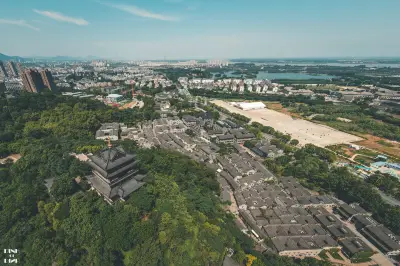
Getting off the bus, we entered Daohe Ancient Street. The Daohe neighborhood has a large area of restored Ming and Qing residential buildings. There are also many old Ming and Qing houses, some in disrepair. Taizhou escaped the destructive wars of successive dynasties, so these old houses have been preserved.
On a clear autumn morning, in this cluster of ancient buildings, almost no residents were seen outside. But by the riverside pavilions, elderly men gathered to play music and sing. On the square, a group of women in bright red were dancing Xinjiang dance. The rafters and upturned eaves still retain the texture of old times; the pavilions and towers exude the elegance of bygone days. The ground was paved with stone and brick, clean and tidy. It is said there are 11 cultural heritage protection units and over 30 historical buildings here.
Under Guide Wang's leadership, we walked outside the deep courtyards of old residences and through long, elegant alleys. Just as we felt a sense of stepping into another era, it was shattered: coming towards us were cafés, tea restaurants, Haidilao hotpot......
Hu Jintao's former residence: a compound with several courtyards, surrounded by walls. The main door with Spring Festival couplets was locked. We took photos at the entrance. There was no text explanation outside; if Guide Wang hadn't mentioned it, we would have passed by!
Walking along the ancient street for a few minutes, we saw a school sign: Taizhou Wuxiang Primary School. The school had only one row of single-story buildings, with four or five classrooms. Inside the courtyard, there was an ancient ginkgo tree, 110 years old.
The primary school is now vacant, so quiet that one could almost hear the sound of reading aloud. A sign stood at the corner. It read: Wuxiang Primary School was founded in the first year of Xuantong of the Qing Dynasty (1919). Former President Hu Jintao lived in Duo'er Alley as a child, just a few minutes' walk from Wuxiang Primary School. He attended this school and transferred to Dapu Primary School in the third grade, graduating from the lower primary school at Dapu in 1951.
Outside a classroom, a group member peered inside, trying to find the seat Hu Jintao once occupied.
The five alleys are interconnected, where the Yangtze and Huai rivers converge. Entering the five alleys is like entering a maze, because each alley looks almost the same. Locals say: 'Entering the five alleys is like drinking a disorienting soup.' Our group of 50, closely following Guide Wang, no one dared to fall behind.