"Water City Taizhou": An Abundance of Happiness Here (A Complete Guide to Eating, Staying, and Traveling)
Since ancient times, Jiangsu Province has been a land of fish and rice. With economic development and urban construction, Jiangsu has long been a major tourism province. There is a saying: 'Above there is heaven, below there are Suzhou and Hangzhou,' referring to the Jiangsu and Zhejiang regions. Among these cities in Jiangsu, there is a key water and land hub connecting the north and south, serving as the gateway to central Jiangsu. Historically known as 'the throat of water and land routes,' as early as over 700 years ago, Marco Polo visited this place and praised, 'This city is not large, but it abounds in all kinds of earthly happiness.' It is the prefecture-level city of Taizhou in Jiangsu Province.
The Taizhou School—the only school named after a place in Chinese history—originated here. Taizhou has produced many literati, including Shi Nai'an, author of one of the Four Great Classical Novels, "Water Margin," and Zheng Banqiao, author of "Bamboo and Stone." Talents have emerged in succession.
Speaking of Taizhou, I think of the filming location of "A Bite of China"—Xinghua, described as a land forgotten by time. Over a thousand years ago, to prevent floods, the people of Xinghua piled up thousands of mu of raised fields (duotian) on low-lying swamps and barren beaches. Today, these have formed the large-scale Qanduo Rape Flower Scenic Area, one of the world's four most beautiful seas of flowers. Besides this, Taizhou boasts many natural and cultural landscapes.
On this trip to Taizhou, I visited the natural oxygen bar Lizhong Water Forest, took a night boat ride on Fengcheng River, strolled through the antique Daohe Ancient Street, climbed Wanghai Tower for a panoramic view of the old and new city, explored Qiao Garden, Mei Garden, and Carved Flower Building to experience the charm of Jiangnan gardens, and went to Qintong to cruise Qin Lake and taste local hairy crabs. Of course, I couldn't miss the Taizhou morning tea and grass-oven sesame cakes.
Day 1: High-speed rail station → Xinghua Lizhong Water Forest → Bishui Dongluo → Night cruise on Fengcheng River → Stay at Daohe Shuxiang Shijia.
Day 2: Savor Taizhou morning tea → Eat grass-oven sesame cakes at Taizhou Old Street → Visit Mei Garden → Qiao Garden → Wanghai Tower → Salt Tax Museum → Carved Flower Building → Stay at Daohe Shuxiang Shijia.
Day 3: Daohe Ancient Street → Qintong Ancient Town → Qin Lake → Return trip.
Taizhou High-Speed Rail Station is located at No.1 Jingtai Road, Hailing District, Taizhou City, Jiangsu Province. It is the only railway station in Taizhou, not very large. For travelers from other provinces such as Beijing, Tianjin, or Chongqing, there are several trains daily. If there is no direct train, you can transfer at nearby cities like Hefei or Xuzhou, where more trains are available.
To the right of Taizhou High-Speed Rail Station is Taizhou Bus Station. If you want to visit surrounding areas such as Xinghua, Taixing, or Jingjiang, or other cities in the province, you can take a bus from here.
Taizhou/Yangzhou Airport
Taizhou Airport, also known as Yangzhou Airport, is relatively far from downtown Taizhou. It currently operates 45 routes connecting to 36 cities. Though not large, it saves you from long queues. It is advisable to take a taxi to the airport, especially if you are coming from the Qin Lake area, which is more convenient.
Taizhou Bus Station has buses to Xinghua:
1. Xinghua – Lizhong: Xinghua: 6:00–17:30, Lizhong: 6:00–17:00
2. Xinghua – Shagou: Xinghua: 6:00–17:30, Shagou: 6:00–17:00
!! Friendly Reminder !!
During the rape flower season, there is a tourist shuttle (Route 801): Xinghua → Qanduo Rape Flowers → Bishui Dongluo → Water Forest.
Departure times: Xinghua: 7:00–15:00, Water Forest: 8:30–17:00.
1. Lizhong Water Forest
Location: Shunchuan Road East, Qanduo Town, Xinghua City, Taizhou
Ticket: Adult ticket 45 yuan, Bamboo raft + ticket 82 yuan
Opening hours: All year 08:30–16:30 (last entry 16:00)
Tips: Lizhong Water Forest has a parking lot (10 yuan per visit). Luggage can be stored for free at the visitor center. To take a bamboo raft, go to the East Pier; operating hours 08:30–16:30.
2. Fengcheng River Painted Boat Tour
Address: Fengcheng River Painted Boat Tour Visitor Center (at the entrance of Old Street), Hailing District, Taizhou
Day tour: 50 yuan, schedule: 08:00–17:00
Night tour: 60 yuan, schedule: 19:30, 20:30, 21:30
Tips: The boat departs when there are at least 5 passengers. Onboard, you can enjoy Taizhou specialty snacks and hot tea. The cruise lasts about 40 minutes.
3. Daohe Ancient Street
Address: Qingnian North Road, Jiangsu Province, Taizhou
Tips: The night view is beautiful with charming lights. There are night markets and bazaars to explore, and plenty of food. The street has morning tea shops, crowded with people coming for Taizhou morning tea.
Address: No. 90 Yingchun East Road, Eastern Suburb, Taizhou City, Jiangsu Province
Ticket: 15 yuan
Opening hours: 8:00–17:30
Tips: You can take buses 7, 10, 19, 22, or 36 to Mei Garden.
Address: No. 68 Hailing North Road, Taizhou
Ticket: 40 yuan
Opening hours: 08:30 (ticket sales stop at 16:30)
Address: South side of Wuyi Bridge, Jingang South Road, Gaogang District, Taizhou
Ticket: 40 yuan
Opening hours: 09:00 (last entry 16:30)
Address: Southeast Garden, Hailing District, Taizhou
Ticket: 40 yuan
Opening hours: 08:30
8. Qintong Ancient Town
Address: Qintong Town, Jiangyan District, Taizhou
Ticket: 40 yuan
Opening hours: 08:10 (last entry 16:00)
9. Qin Lake National Wetland Park
Address: No. 1 Qinhu Avenue, Qintong Town, Jiangyan District, Taizhou
Ticket: 80 yuan (includes round-trip ferry ticket)
Opening hours: 08:10 (last entry 15:00)
1. Daohe Shuxiang Shijia
Address: No. 118 Hailing North Road, Hailing District, Taizhou (inside Daohe Bay Ancient Street)
A Chinese-style Jiangnan courtyard B&B with antique charm, especially suitable for families, couples, friends, and groups. I stayed in a three-bedroom, one-living-room unit with independent master bedrooms and a shared living space with a TV, sofa, and coffee table—perfect for chatting at night. The room also has a small garden, very elegant. There are also suites with kitchens. Various room types are available. Breakfast buffet is provided in the morning, and across the street is Daohe Ancient Street.
2. Dongluo Village Yunduo B&B
Address: Dongluo Village, Qanduo Town, Xinghua, Taizhou, Jiangsu (inside Bishui Dongluo)
Yunduo is like a hidden paradise away from the world. Open the window and you have a panoramic view of the lake. The natural scenery is beautiful, the air is fresh, and it's only 6 km from Lizhong Water Forest. You can also barbecue and play cards, suitable for family and parent-child trips. There are 10 villas, including detached houses for 2–6 people and lakeside suites and standard rooms, which can also host team building, meetings, and dining—a comprehensive resort.
Taizhou has a wide variety of cuisine. Here, you'll find that like Yangzhou, locals enjoy 'skin wrapped in water' (eating soup-filled dumplings) in the morning and 'water wrapped in skin' (bathing) in the evening. A hearty Taizhou morning tea is essential to start a vibrant day. In autumn, after National Day, it's the season for plump river crabs. Be sure to taste the large, fatty Qin Lake duan crabs.
There are many snacks: Huangqiao sesame cakes, Caoqiao sesame cakes, osmanthus cakes, fish balls—fish balls are a must-have ingredient in local dishes. When eating Taizhou cuisine, you'll notice that locals love soupy dishes. Nearly half the dishes on a table are soups. My companions joked that we were already 'full from drinking' just from these soup dishes. From Dazhu Gansi (shredded bean curd with sauce) to Qinhu Eight Delicacies, the focus is on the original flavor of the ingredients, fresh and light, rich but not greasy.
------ I am the body text separator ------
My first stop in Taizhou was 'Lizhong Water Forest.' I came in spring last time, and this time in autumn. Actually, the scenery changes with the seasons: spring is a sea of flowers, summer offers cool retreats, autumn sees leaves turn yellow and colorful, and even in deep winter, the negative oxygen ion content here is ten times that of the city. Far from urban areas, it's a great choice just to come for some oxygen.
Lizhong Water Forest covers an area of 1,050 mu. In the early 1980s, local people rationally developed the wasteland resources, turning the barren land into rows of raised fields and planting tree species adapted to water, such as pond cypress and metasequoia. After decades of planting and protection, the trees have grown into a forest. Whether by boat or on wooden boardwalks, you can clearly see the crisscrossing roots emerging from the water, intertwined in various shapes—some like humans, some like animals, some like immortals, lifelike. These magical roots seem to have a life of their own.
Walking on the wooden boardwalk, you unknowingly step into a fairyland. Man-made mist turns the place into a wonderland in an instant. You might not know that this mist uses internationally advanced music therapy and aromatherapy, combining herbal fragrances in the air with gentle, soothing music to relax both body and mind—a natural way to nurture health.
This mist not only creates scenery and relaxes you but also lowers the temperature during hot summers. The mist experience area covers 3,500 square meters, with nearly a thousand spray heads that can create a two-meter-high mist layer in the forest in just five minutes, reducing the temperature by 6–8°C.
Another way to explore Lizhong Water Forest is by bamboo raft. Each raft can carry about 10 people. The raft slowly drifts along the river channel, passing through tall pond cypress trees. Looking up at these towering trees, you feel as if you've entered the Emerald City. From wasteland to raised fields, nearly 100,000 trees of pond cypress and metasequoia crisscross. In spring, rapeseed and taro are planted here, making it not only a natural oxygen bar for self-cultivation but also a source of considerable economic income for locals.
In the south, there is Jiuzhaigou; in central Jiangsu, Lizhong Water Forest also hides a 'Little Jiuzhaigou.' Calm pool water, dense and tall pond cypress reflected in the water, the surface barely rippling. Occasionally fish swim in the clear water, and you can see swaying aquatic plants at a glance. As the season and sunlight change, they display different colors, quite reminiscent of Jiuzhaigou.
It was late afternoon when I arrived at Dongluo Village, Ganggu Township, Xinghua, Taizhou. The Xiaguan River and Daxi River tightly embrace this village. The water and soil nurture its people. Walking into Bishui Dongluo, a distinctive rural village, you feel both the softness of Jiangnan water towns and the vastness of big rivers and lakes, making you sigh with admiration for the happiness of the people living here.
At sunset, the village history museum with its antique style of blue bricks and small tiles has a beautiful name: Dongluo Qiushi. Its outer wall is made of small blue bricks stacked in a hollow pattern. Deep in the village, the Dongluo Auditorium has a sense of history but is equipped with modern projectors, conference tables, central air conditioning, etc.—a blend of Chinese and Western elements. Built in 1953, it was originally an old temple; after renovation, it has become an important venue for village lectures, local cultural performances, and gatherings.
Less than 10 kilometers from the Water Forest, many tourists now prefer to stay in Dongluo Village. The village has developed many B&Bs, such as Yunduo, with its courtyard-style architecture and charming lakeside views. The fruit trees in the courtyard are ripe: oranges, apples, pomelos. If you like picking, you can also visit the nearby orchards for fun.
Fengcheng River is the rectangular moat surrounding ancient Taizhou City. The best way to enjoy a night tour of Fengcheng River is by boat. We deliberately chose to visit at night. The charming lights seemed to recreate the beautiful scenery of the Qinhuai River.
Along the way, we saw historical and cultural attractions like Wanghai Tower, Peach Garden, Qiao Garden, Stone Boat, and Old Street. On the water stage, there were delicate and gentle Yue opera on one side and powerful Peking opera on the other, echoing each other across the Fengcheng River. Listening to opera while boating was a completely new experience.
After getting off the boat, we arrived at our B&B for the night: Daohe Shuxiang Shijia, just a step away from Daohe Ancient Street. It perfectly blends Taizhou folk customs with modern freehand style. Pavilions, rockeries, ponds, and classical Chinese courtyards make you feel as if time has reversed, allowing guests to experience the elegant charm of Wu, Chu, and Yue cultures.
From the outside, it looks classical, but the interior facilities are modern, even more comfortable than many hotels. Natural latex pillows and mattresses ensure a peaceful night's sleep. Smart robots, water heaters, toilets, and even mobile phone connectivity allow you to control the door, air conditioning, and lights via a smart system.
I particularly loved the courtyard-style rooms. There are three-bedroom, one-living-room Ming and Qing dynasty courtyards, double-bed chess rooms, and family rooms for two adults and one child, some with kitchens. Traveling away from home, you can still feel at home. It's the top choice for family trips.
In the quiet and elegant Shuxiang Shijia, waking up to the chirping of birds, opening the antique wooden doors and windows, basking in the warm sunlight, enjoying the small back garden—this is a long-lost, long-sought pace of life.
Daohe Ancient Street, with its crisscrossing lanes, was built in the late Yuan and early Ming dynasties, over 600 years ago. The Daohe River runs through the city. During the Ming and Qing dynasties, the banks of the Daohe River were famous agricultural product distribution centers, with grain shops, oil mills, and warehouses mostly set up along the river. The renovated ancient street restores the architectural features of the Ming and Qing dynasties. The deep ancient alleys seem to tell stories of history.
Walking from Shuxiang Shijia to Daohe Ancient Street, similar to most ancient towns in Jiangnan, there are plain bluestone slabs, and the moat flows quietly on one side. Since we arrived early, most shops on the street hadn't opened yet, only a few breakfast shops were crowded.
Blue bricks, black tiles, red lanterns, Zhou's Residence, Sun Longfu Memorial Hall, China Ancient Well Museum, Cao Jun Art Museum, and Scientific Development Concept Exhibition Hall offer an up-close understanding of Taizhou's intangible cultural heritage: Zhao's micro-carving, Hailing Twin Mound Temple Fair, Hailing crochet technique, Hailing pyrography, Hailing block printing, Taizhou crab oil production, traditional child porridge making, and Hailing crispy cake making.
There are many ancient wells on Daohe Ancient Street, some from the Qing Dynasty, some from the Song Dynasty. This octagonal well, with an octagonal well curb made of volcanic rock, is a relic from before the Song Dynasty, nearly 800 years old. Such wells are common in Taizhou city but rare in the five lanes north of the city gate, indicating that people lived here before the Song Dynasty. Along with the nearby newly discovered wells from the Han, Tang, Song, Ming, and Qing dynasties, it is one of the testimonies to the history of the Daohe area in the north of the city, evoking the past life of Daohe Street residents.
Like Yangzhou, Taizhou people still maintain the custom of morning tea. Traditional Taizhou morning tea includes 'one tea, three snacks, one noodle': one tea is a cup of tea and a serving of shredded dried bean curd (called a tea head); three snacks are the three famous Taizhou breakfast items: steamed buns, steamed dumplings, and shaomai; one noodle is fish soup noodles.
We went to the Taizhou time-honored brand Guyue Lou. Even at 9 a.m., there were still many people queuing for seats. Many lingered even after finishing breakfast, chatting with friends over tea. This is the slow pace of Taizhou.
The Taizhou School, the only school named after a place in Chinese history, originated here. Taizhou has produced many literati, including Shi Nai'an, author of 'Water Margin,' Zheng Banqiao, author of 'Bamboo and Stone,' and the ancestral home of Peking opera master Mei Lanfang. In Mei Garden on the east outskirts of Taizhou, there is a Mei Lanfang Memorial Hall.
The half-length white marble statue of Mei Lanfang at the entrance is particularly striking, surrounded by displays of his life story. Entering the garden, you see a typical Jiangnan garden landscape. The image of a woman in the pond is the artistic image of Yang Taizhen created by Mei Lanfang in 'The Story of Taizhen.' With its soft beauty, set among rockeries, ponds, and corridors of the Jiangnan garden, it seems like a fairy descending to earth, filling the entire Mei Garden with a strong artistic atmosphere.
The entire Mei Garden was rebuilt in 2007. Besides the Jiangnan garden scenery, the indoor part is divided into five sections: 'Mei Blossoms in China,' 'Mei Fragrance Across the Seas,' 'Mei's Unyielding Spirit,' 'Mei's Virtue Like Jade,' and 'Mei's Roots in Taizhou,' introducing visitors from all over to Mei Lanfang's noble personality and artistic achievements, while also expressing the deep bond between Taizhou and Mei Lanfang.
Since ancient times, Taizhou has been inextricably linked to the sea. It was anciently called 'Hailing,' meaning a highland in the sea. From the Han Dynasty when the county was established, Hailing governed all the way to the seashore. Now the sea has receded. To express Taizhou people's nostalgia for the sea, the name was changed to 'Wanghai Tower' (Sea-Viewing Tower).
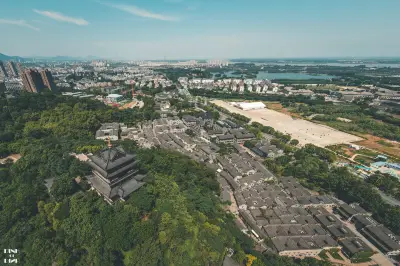
Last night on the Fengcheng River boat tour, we saw Wanghai Tower. Now it has become a landmark of Taizhou. At 32 meters high, it is known as 'the first tower in Jianghuai.' From above, the building is elegant and magnificent. Climbing Wanghai Tower, you see rows of tall buildings in the distance, and below flows the moat of Taizhou. Taizhou ancient city was built in the Southern Song Dynasty, about 1,800 meters from north to south and 2,500 meters from east to west, with four gates in the four directions, and outer barbicans for a complete defense system.
Born from water, Taizhou is closely related to water and the sea. The rectangular moat circles the ancient city. Looking around, both banks are lined with green trees. The new city across the river is full of vitality. Even today, you can find the remains of the Song Dynasty city wall's rammed earth on the small slope below Wanghai Tower. However, only 81 meters of the ancient city wall remain, and the culvert made of blue bricks under the old city wall is still intact, preserving the Song Dynasty drainage system.
Qiao Garden is located in the old town of Hailing District, Taizhou City, Jiangsu Province, bordering Hailing North Road to the west and Baziqiao East Street to the south. The existing garden is small, but cleverly conceived and rich in history, known as 'the first garden in Huaihe region.' Its history can be traced back to the Rishe Garden of the Wanli period of the Ming Dynasty. It is one of the oldest existing gardens in northern Jiangsu. Over the past 400 years, it changed hands many times, rose and fell, and had different names in different periods. According to local records, 'The Sanfeng Thatched Cottage was the site of the Rishe Garden, the retreat of Chen Lantai. It was later acquired by Prefect Gao Lu'an Fengzhu, who renamed it Sanfeng Garden because there were three stone peaks. When Wu Lianfen rented it, he inscribed the name Sanfeng Thatched Cottage on the hall.'
One of the garden's features is its emphasis on the arrangement of flowers and trees, which is also reflected in the naming of buildings, such as Erfen Bamboo House, Jielü Green Room, Songchui Pavilion, Yinchao Pavilion, Jiaoyu Xuan, and Wengui Fang. The core area features tall trees, with ancient cypress on the rockery as the highlight. Songchui Pavilion and Yinchao Pavilion are surrounded by tall pines and plum groves; bamboo and houses are hidden in the hills; wintersweet and osmanthus are planted in front and behind the courtyard; peonies and plantains surround the veranda, adapting to seasonal changes.
In 2020, the first museum in China themed on salt tax culture opened in Taizhou, Jiangsu, located on the ancient Salt Transport River.
From the origin of salt tax, its reforms, contributions, and the four major sectors in Jiangsu, the museum reveals the historical evolution of taxation in this agricultural country from agricultural tax to salt tax and industrial and commercial tax. Taizhou has been 'born from water and born from salt' since ancient times. Salt has played a vital role in Taizhou's origin, development, and even daily life.
In the south of Gaogang urban area, there is a 4A scenic spot called 'Carved Flower Building.' This mansion was originally built by Yao, a timber merchant from Jiangnan, as a flower building (now East Building). Later, the West Building and wing buildings were added in the same style, and the garden outside was expanded. The wood carvings, brick carvings, and stone carvings in the garden are exquisite, representing the pinnacle of carving art at that time, earning it the reputation of 'the first building east of the Yangtze River.'
Covering an area of 88,000 square meters, the location has a profound thousand-year-old ancient town heritage, with numerous historical relics. Visiting the Carved Flower Building, you can admire the exquisite carvings on doors, windows, beams, plaques, and furniture. Brick carvings with auspicious meanings like 'Blessings as Vast as the Eastern Sea,' 'Five Blessings Arrive at the Door,' and 'Five Blessings Celebrate Longevity' are vivid.
The Carved Flower Building faces east, square in shape, consisting of two five-bay two-story main buildings and three-bay wing buildings on each side, with a courtyard in the middle surrounded by buildings. In the past, few people entered, and most townspeople didn't know its true appearance, commonly calling it 'Square Building.'
On the roof at the top, each main ridge has gray plaster patterns at the center and ends. Skilled tile workers used a mixture of glutinous rice paste, slaked lime, and plant ash to shape patterns such as the Three Stars of Fortune, Prosperity, and Longevity, the Kylin Sending Sons, Phoenix and Peony, and the Eight Immortals' Emblems. Along the eaves, besides pressed patterned tiles and dripstones, there are carved scroll-patterned eaves boards on the inside. For the Carved Flower Building, the roof decoration is just the prelude; the wooden carvings in the courtyard are the highlight.
Entering the building, standing behind the screen door of the front building, look up at the courtyard around you. From top to bottom, front to back, left to right, wherever your eyes can reach, there are all kinds of carvings. Under the light from the courtyard above, the dazzling array of carved components is breathtaking!
Qintong Ancient Town, with a thousand-year history, first welcomes you with plump river crabs, fish balls in oil, and steaming osmanthus rice cakes. Located over 40 km from downtown Taizhou, Qintong Ancient Town has long streets full of a lively atmosphere. Surrounded by water, Qintong was known as 'Little Shanghai' in ancient times. During the Han and Tang dynasties, it was a fertile land with abundant water and grass. People made a living by fishing and weaving rushes, and farmers could almost 'farm without plowing.'
At the junction of Nantong, Yancheng, and Taizhou, Qintong Ancient Town became a distribution center for cargo boats. People from all over gathered here, vendors lined the streets, and the town formed a urban pattern shaped by the waterways.
Don't think Qintong Ancient Town is just this one lively old street. Entering the former residence of an academician, you begin a thousand-year time travel. Qintong Ancient Town was built along the river, and the Salt Transport River runs east-west, so the buildings follow the river. Today, Qintong still preserves over 60,000 square meters of ancient buildings, making it a living museum for understanding Chinese history.
In traditional Chinese architecture, every brick carving and door decoration carries auspicious meanings. In ancient times, such ornaments were both beautiful and expressive of a longing for a good life. Entering this 'cat-shaped' ceremonial gate, we continued through the alleys.
China has always been a land of etiquette. In Chinese culture, hosting guests requires attention to decorum, so ancient people often adorned ceremonial gates with exquisite decorations, poems, and plaques, reflecting the owner's aesthetic taste and moral cultivation. On the gate we saw, the porch was carved with patterns of 'Fortune, Prosperity, Longevity,' 'Five Bats Surrounding Longevity,' and 'Returning Home in Splendor.' Despite a hundred years, they remain vivid.
Economic development promoted local humanistic education. In Qintong, nearly every family's children studied hard. The ancient town produced over a hundred juren (successful candidates in provincial exams) and jinshi (successful candidates in palace exams), and two martial arts champions in the Qing Dynasty. The water and soil nurture the people. Most families in the ancient town preserve family rules and teachings—a few lines of earnest advice from their ancestors.
Located in central Taizhou, the Jiangyan District is known as 'the water town of central Jiangsu.' Jiangyan lies in the lowlands on the north bank of the Yangtze River, in the Lixiahe region. The terrain of Lixiahe is higher on the edges and lower in the middle, like a large pot, so water from all directions converges here, creating a dense network of rivers and waterways. Nourished by the Yangtze and Huaihe river systems, it has become a true 'water town of central Jiangsu.'
Qin Lake National Wetland Park, located in the northern part of Jiangyan District, is bounded by the Jiangqin River to the east, the Magpie Lake west bank to the west, the Jiangqin Highway to the north, and the West Jiangqin River to the south, covering an area of about 8 square kilometers. Due to years of protection, the natural ecological environment here is very beautiful.
Qin Lake is a place where three waters converge: river water, seawater, and Huaihe water. Since the sea retreated eastward, the seawater source has been cut off. Currently, it is mainly fed by the Yangtze and Huaihe river systems. The total area of Qin Lake is 6,300 mu, with most visitors concentrated in the 2.4-square-kilometer rational utilization area. After years of environmental management, it has become not only the best habitat for birds and waterfowl but also an important part of maintaining the ecological environment of the Lixiahe region.
Strolling through the wetland park, breathing fresh air, and admiring the beautiful natural scenery, you can't help but be immersed. When you come to Qin Lake, you must experience the local rowing boats. These small farm boats originally used for fishing are very interesting. Living in a water town, boating on the lake, you can lose yourself in it.
Listening to the boat women rowing and singing local folk songs, the melodious tunes infect everyone on board. This carefree mood is a unique joy of the water town people, making you reluctant to leave.
Travelogue Table of Contents
1. So This Is Taizhou
2. About the Itinerary
3. About Transportation
4. About Attractions
5. About Accommodation
6. About Food
7. Lizhong Water Forest: Little Jiuzhaigou in Central Jiangsu, Stumbling into the Emerald City
8. Bishui Dongluo: Away from the City's Hustle, into a Charming Rural Village
9. Night Cruise on Fengcheng River: Listening to Yue Opera on the Boat
10. Strolling through Daohe Ancient Street, Savoring the Scholar's Home
11. At the Old Street, Eat an Authentic Taizhou Morning Tea
12. Mei Garden: Entering the Artistic World of a Peking Opera Master
13. Wanghai Tower: Landmark of Taizhou, Known as 'First Tower in Jianghuai'
14. Qiao Garden: The 'First Garden in Huaihe Region'
15. Salt Tax Museum: The Only Museum in China Themed on Salt Tax Culture
16. Carved Flower Building: Enter the 'First Building East of the Yangtze River'
17. Qintong Ancient Town with a Thousand-Year History
18. Qin Lake National Wetland Park
Travel Information
Hotel Index
Attraction Index
Flight Index
Website Navigation
Travel Index
Cruise Index
Corporate Travel Index
Franchise Cooperation
Distribution Alliance
Friendship Links
Corporate Gift Card Purchase
Insurance Agency
Agent Cooperation
Hotel Franchise
Destination and Scenic Area Cooperation
More Cooperation
About Ctrip
About Ctrip
Ctrip Hotspots
Contact Us
Careers
User Agreement
Privacy Policy
Business License
Safety Center
Ctrip Content Center
Intellectual Property
Trip.com Group Algorithm Disclosure