Savoring Taizhou: The Slow Life of a Water City
Taizhou is a water city, where people live by the water and make a living from it.
At Qin Lake, rivers crisscross and ponds dot the landscape like a chessboard.
Climb Wanghai Tower to savor the past and present.
With the new high-speed rail line now open, getting to Taizhou from Shanghai has become increasingly convenient.
So this time, we traveled to Taizhou by high-speed train.
Savoring Taizhou, the happy water city.
Savoring is not just about seeking out delicious food, but also about tasting a city's cultural atmosphere and lifestyle.
First visit to Li Zhong Water Forest Park: within the forest there is water, in the water there are fish, and the fish are accompanied by birds. This used to be just a barren shoal, but thanks to the efforts of the people of Xinghua, it has been transformed into a green oasis, planted with water-adapted tree species like pond cypress and metasequoia, covering over 1,000 mu (about 165 acres), like a green sea.
More than 100,000 metasequoias, pond cypresses, and other trees have grown into a tall, dense, and vibrant water garden. It has become a well-known national 4A-level scenic spot in Taizhou and even East China, attracting countless visitors every day. In spring, you can enjoy flowers; in summer, escape the heat and watch birds; in late autumn, see the cypresses turn yellow and red—each season offers a different landscape.
The cypresses on both sides intertwine, forming a green ecological tunnel in the middle—so pleasing to the eyes. Indeed, in Li Zhong Water Forest Park, the negative oxygen ion content is much higher than in the city and surrounding areas, making it a genuine forest oxygen bar. In summer, the average temperature here is 5–7°C lower than in the city, so it's quite cool overall.
The whole area presents a unique waterside landscape of 'water within the forest, fish in the water, and birds in the woods.'
Here, there are many plants and animals, including owls, wild ducks, egrets, black cuckoos, grass parrots, magpies, and more. Of course, the most numerous and popular are the egrets. In summer, many photography enthusiasts come early in the morning to wait and take pictures.
There are two ways to explore Li Zhong Water Forest Park: one is to walk around slowly, strolling and soaking in the lush greenery of nature; the other is to take a bamboo raft. The raft follows the river into the cypress tunnel and loops around in about 20 minutes, offering different perspectives of the water forest—truly beautiful.
After landing, you'll still walk along a willow-lined path, with a lotus pond on one side and the river on the other. Reflections of the cypresses dance on the water, embellished by various flowers—a great spot for photos.
Come December in late autumn, it becomes even more beautiful when all the cypresses turn golden-red, rich with autumn atmosphere—one of the best places to enjoy the fall.
Between the Water Forest Park and the Qianduo Scenic Area lies Dongluo Village, a well-known new countryside in Xinghua. Unlike other villages, it's a representative of rural tourism with great environment, high-end guesthouses, far from the city, quiet, with lakes and water. It's a leisurely escape to stay a couple of days.
Whenever the weather is fine, it's very beautiful here: clear water, blue sky, and villages along the riverbanks that are quaint and natural, without excessive artificial alterations.
There's an old house here that's decades old, now converted into a chapel. The village holds events here from time to time, and it's also used for weddings. You can tell from the exterior walls that it's quite aged, with a long history.
Mainly the interior has been renovated and refreshed, and the overall effect is quite nice. On the walls on both sides, there are introductions to Dongluo Village and the surrounding tourism.
There are also wall paintings depicting the 24 solar terms. The village has a small river with reeds growing on both sides, making it a lovely spot for girls who enjoy taking photos.
The real highlight here is the Bishui Dongluo guesthouse, entirely designed by a team of university professors, so the architecture itself is highly design-oriented. It's divided into several buildings connected by paths, with fruit trees and banana plants planted around. Even vegetables are grown at the guesthouse doorstep, brimming with rustic charm.
Despite the strong rural flavor, the comfort is not compromised at all. The overall ambiance feels very cozy, with bathtubs, balconies, and floor-to-ceiling windows facing a courtyard that looks directly onto the lake. On a clear day, you can catch the sunset from here. Prices are normally around 500–600 yuan, rising a bit during holidays.
Fengcheng River was the ancient moat of Taizhou, encircling the old city in a square shape like the character '口'. The area inside the moat was the ancient Hailing city district. Looking at a map, it's obviously not large. Today's Taizhou urban area has expanded many times over, making one marvel at the magic of time.
Along the banks of Fengcheng River, many of Taizhou's scenic spots and historical sites are gathered, such as Wanghai Tower and the 30-plus attractions in the Peach Garden Scenic Area. It also brings together the city's distinctive cultures: opera, folk customs, and merchant traditions.
A night cruise on Fengcheng River lasts about 40–50 minutes. The most spectacular view up close is Wanghai Tower. It was first built in the Song Dynasty, repeatedly destroyed by war, and rebuilt in the Ming and Qing dynasties. The renowned scholar Wen Huaisha called it 'the finest tower in the Jianghuai region.' To its west is the Wenhui Hall, which historical records say was first built by Teng Zijing of the Northern Song Dynasty.
Apart from enjoying the night scenery on both banks, the night cruise offers many special features. For instance, when passing a certain section, operatic singing rings out from the pavilions and towers, making you feel as if you've traveled back in time—very immersive.
Although Fengcheng River was artificially built, it's very wide, with most parts exceeding 100 meters in width. So even residents living a kilometer away can gaze out at the Fengcheng River scenery. It feels like the people living here are truly blessed.
Sitting in the tour boat, following the waves of history, listening to a mellifluous opera tune, and feeling the ancient charm and unique allure of the old city and river—this is perhaps the most important part of Taizhou's slow life and something you must experience.
Taizhou morning tea: the beginning of a day's slow living.
Guyue Lou is probably Taizhou's most famous morning tea house, situated on the edge of the old street in a very prominent spot. As a visitor, you must of course go and have a taste.
Taizhou has a custom of eating morning tea. Although many years have passed, the tradition has been stubbornly preserved, deeply rooted in local life, and integrated into daily routines. With each unique culinary art, it makes the diet of Taizhou people flavorful and interesting. Taizhou morning tea is not just about the food, but also about the gentle sentiment.
Dried tofu strips, crab roe buns, siu mai—one tea, three dim sum, and a bowl of noodles, and the slow day begins. The pace of life here is very leisurely, giving people time to enjoy life, which is probably what many big-city dwellers yearn for.
Mei Garden: The Story of Mei Lanfang
Mei Garden is located on the Phoenix Mound, which has a beautiful legend. The Mei Lanfang Memorial Park has 'Four Wonders' that are a must-see for visitors. The first wonder is the Mei Pavilion; the second is a large white marble bust of Mei Lanfang; the third is the white marble statue of Mei Lanfang in the role of Yang Taizhen from 'The Unofficial Biography of Taizhen' standing in the pond outside the exhibition hall; and the fourth is a giant stele inscribed with a poem 'Ta Suo Xing' composed by Mr. Zhao Puchu when he visited Taizhou.
Mei Garden depicts the life of Mei Lanfang from different angles. This famous Peking opera master was originally from Taizhou. His artistic achievements have long transcended national borders, ranking alongside world masters Stanislavsky and Brecht; together they are known as the three great performance systems of the world. His signature operas include 'The Drunken Beauty' and 'Farewell My Concubine.' He performed abroad many times and received international recognition and acclaim.
After a renovation in 2007, the current exhibition area is divided into five parts: 'Mei Blossoms in China,' 'Mei's Fragrance All Around,' 'Mei's Unyielding Integrity,' 'Mei's Jade-like Virtue,' and 'Mei's Roots in Taizhou.' These five sections condense and highlight Mei Lanfang's glorious life—belonging to China, to the world, and to Taizhou—reflecting his noble character, patriotism, and deep blood ties with his hometown.
In the exhibition hall, you can also see the female characters portrayed by Mei Lanfang. For those of us born in the 90s, they may still ring a bell, but younger generations might not be as familiar with his Peking opera. In the backyard woods, there is still a stage where live Peking opera is performed daily. This national-treasure-level art and culture attract visitors from all over the world.
Wanghai Tower: Though you can't see the sea, you can overlook Taizhou.
As its name suggests (Wanghai means 'sea-watching'), this tower indeed used to overlook the sea in ancient times. It's one of Taizhou's landmarks, but now, instead of the sea, it offers a panoramic view of Taizhou.
Wanghai Tower is located by the Fengcheng River in Taizhou. First built in the second year of the Shaoding reign of the Southern Song Dynasty, it is hailed as the 'First Tower of Jianghuai.' The tower has been destroyed and rebuilt many times, mostly ruined by war and resurrected in times of prosperity.
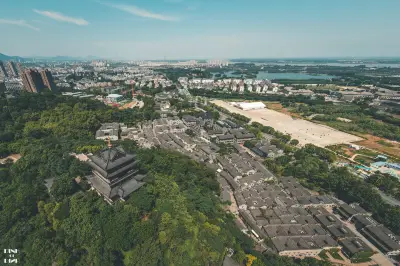
The Wanghai Tower we see today is also a reconstruction. It's not very tall, but it offers unobstructed views of the old Taizhou cityscape—a sweeping vista from on high.
You can see that the scenery around Wanghai Tower is quite lovely. Within the old town, there are few high-rise buildings, but the greenery is excellent, with water and trees—a very pleasant environment.
One can imagine ancient poets climbing up, gazing into the distance, and composing a poem. Taizhou's beauty is hidden in every corner of the city; we need to slowly seek it out. The slow life of Taizhou is worth savoring.
Taizhou Gardens Rivaling Suzhou's
It's often said that Suzhou gardens are the best under heaven, but in other cities of Jiangsu and Zhejiang, there are many exquisite and compact gardens. In Taizhou, just an hour's drive from Nanjing, there are several ancient mansion gardens, and Qiao Garden is the most representative.
Like most Suzhou gardens, Qiao Garden is not huge, covering only 12,000 square meters. But thanks to its ingenious design and long history, it is known as the finest garden in the Huai-Zuo region. It remains one of Taizhou's most beautiful scenic spots. Compared to the popular Suzhou gardens, Qiao Garden is much more affordable—only 40 yuan for admission, a real bargain.
With a history of over 400 years, Qiao Garden is one of the oldest mansion gardens in Taizhou and even Jiangsu, with dense woods, slender bamboo, and delicate beauty. Over the centuries, it has changed hands many times and experienced rises and falls; it's quite an achievement that it remains so well-preserved.
Like other gardens, Qiao Garden features rock valleys, woods, springs, pavilions, terraces, and open halls, dotted with flowers, plants, pines, and bamboo, along with rockeries and ponds—all very tastefully arranged. Especially on ordinary days when there are fewer visitors, it has a special charm even surpassing that of Suzhou gardens. It's perfect for photography, so girls who love taking pictures shouldn't miss it.
As early autumn arrives, the maple leaves inside gradually turn yellow and red, making the whole courtyard more colorful.
It must be said that merchants in ancient Jiangnan were really wealthy, able to build such a fine courtyard as their private residence, living lives that even surpassed those of emperors.
Compared to the tourist-packed Suzhou gardens, I prefer Taizhou's Qiao Garden—small, exquisite, and full of antique charm.
Although Taizhou is not geographically part of Jiangnan, it shares the same modest elegance. So exquisite! From corner to hall, you can see how generations of owners cherished life and pursued quality. Even by today's standards, this is a garden residence of ultimate beauty.
Kou'an Diaohua Lou: An Outstanding Example of Ancient Carving
Jiangsu, with its profound cultural heritage, is dotted with historical relics across the province. There are two ancient carved buildings: one in Dongshan by Lake Tai in Suzhou, and the other in Gaogang by the Yangtze River in Taizhou. These two carved buildings, north and south, are like sisters, both being key provincial cultural relic protection units.
The Dongshan Carved Building in Suzhou is familiar to many tourists, but the Gaogang Carved Building in Taizhou has remained hidden away and little known for many years.
It's about a 40-minute drive from downtown Taizhou. It's slightly farther out, so there are fewer tourists. Maybe it was also because we went a bit late. This scenic spot closes at 5 p.m., so you can go around 3 p.m.—good lighting for photos, and by then most visitors have left, making it even more pleasant to explore.
As early as the mid-18th century, the Yao family from Jiangnan built the Yao Family Mansion in Gaogang while running a timber business.
It was officially completed in the fourth year of the Qianlong reign of the Qing Dynasty. However, after more than 160 years of glory, the Yao family declined due to mismanagement and sold it to Li Songru, who was engaged in Yangtze River shipping, in the early years of the Republic of China. After acquiring the mansion, Li spent a fortune on a large-scale expansion.
Inside the carved building, like many private gardens, there are rockeries, ponds, pavilions, corridors, and tall camphor trees. The pond is stocked with many fish, and the environment is excellent. Living here must be so comfortable.
Here you'll find all kinds of carvings: stone, brick, wood, and more—each with carefully chosen names and auspicious meanings.
For example, 'Five Blessings Arriving at the Door' and 'Blessings as Vast as the Eastern Sea' represent the ancients' aspirations for good fortune. Beyond blessings, the wood carvings also conceal the idea of 'prosperity.' On the left, there's a set of patterns with many sika deer in various poses—carved delightfully: some are concentrating, some looking back, a fawn cuddled in its mother's arms, a loving male-female pair, and a little deer at the tree hollow on the far right, half in and half out—charmingly lifelike. There are exactly ten deer. 'Ten deer' (shi lu) sounds like 'eating salary' (shi lu), implying 'enjoying the emperor's salary.'
Although it excels in carved decorations, the garden is also very well done, with small bridges over flowing water, rockeries and ponds, pavilions and corridors, and various bamboo plants embellishing the grounds—it's not inferior to any of Suzhou's famous garden areas.
Even a small stone bridge is carved with many patterns—lotuses, swimming fish, plum blossoms, etc.—each stroke hand-carved by artisans. It's no small feat, so whether ancient or modern, they are presented as works of art, typically only found in wealthy households.
Daohe River: Taizhou's Everyday Life Atmosphere
Many tourists go to Taizhou Old Street but overlook Daohe. In fact, this is where the real flavor of local life is. On one side is a residential area, and along the riverbanks are quaint old buildings. When the lights come on at night, it looks even livelier.
After meals, people take a stroll, walk their dogs, chat with a few neighbors and friends, and sip tea—so relaxed and at ease.
Taizhou people's life is just like that: very leisurely, unhurried.
When the lights are on at night, it's also very pretty. There are bars, hot pot places, barbecue joints, and so on, so it's quite bustling. Walk along the river in the evening, and you can hear folk singers from the bars, have a drink and enjoy the music—so comfortable, hahaha.
We stayed at a hotel right next to it, called Shuxiang Shijia Hotel. As the name suggests, it has something to do with the Four Treasures of the Study. It's a quaint, old-style courtyard. We stayed in a house with three rooms and a living room in the middle.
The rooms overall were clean and tidy. This season, it was very affordable, only 200–300 yuan per night. In peak season it would be over 400–500. There was a foot care shop right outside the door. Everyone knows Yangzhou and Taizhou are famous for foot massage, so we tried it—very comfortable and reasonably priced.
At the Salt Tax Museum, you can learn a lot about the salt tax history of Jiangsu and even the whole country.
In ancient times, salt tax was one of the most fundamental sources of state revenue, accounting for about half of tax income in many dynasties. That's why many wealthy merchants in Jiangnan made their fortunes selling salt, known as salt merchants.
The museum also displays the process of salt making throughout the ages and some of the instruments and containers used. From the illustrations, it seems the process was not as simple as we might think.
In ancient salt production, Jiangsu accounted for about half of the output, so Jiangnan had the most salt merchants in the country. Many of the famous Jiangnan gardens were built by salt merchants, some of whom were wealthier than states.
Inside the museum, some ancient memorials and reports are displayed. The content is lengthy, but the imperial comments are surprisingly brief—usually just two or four characters: 'Acknowledged,' 'Understood'—quite similar to today's 'Noted.'
Another memorial worth visiting in Taizhou is the Memorial Hall of the Birthplace of the People's Liberation Army Navy.
The memorial is very close to the city center, about a ten-minute drive. It consists of two parts: the former site of the command post for the Third Field Army's Yangtze River Crossing Campaign and the new Navy Birthplace Museum.
In the grounds, you can see some equipment, which is pretty cool, since it's not something you normally get to see.
It involves a lot of military-related things, which are best explored in person, so I won't say much more here, hahaha.
Qin Lake: Taizhou's Most Beautiful Wetland Park
Qin Lake National Wetland Park is located north of Taizhou city, about 40 minutes by car from downtown. The whole area is quite large, with a planned total area of 26 square kilometers. It's rich in aquatic resources and diverse wildlife. In the 7 square kilometers open to visitors, you can see red-crowned cranes, milu deer, white swans, white-naped cranes, silver pheasants, and more. If exploring on foot, it'll take about half a day.
Qin Lake is vast, and upon entering, you need to take a boat—this is required for all visitors, about a 6–10 minute ride. Then there's a one-way path about 6–7 kilometers long, with no turning back. If you don't want to walk the whole way, you can buy an extra ticket for a rowing boat, a very Taizhou-style experience.
In early autumn, the lotus leaves and reeds here start turning golden, looking beautiful against the blue sky and white clouds. Wetland parks are the kidneys of the earth, purifying the air, so you can clearly feel the excellent air quality here, breathing freely.
The park has dense trees, crisscrossing rivers, and countless stone bridges. Though large, it feels compact and delicate at every turn.
With lakes, rivers, animals, and boats, although not as flower-filled as spring, it's still a great place for an autumn outing.
Because we wanted to fully experience Taizhou's character, we took the rowing boat twice inside the park, reducing the walking distance considerably. We probably only walked about a kilometer.
You buy a separate ticket, charged per person. The rowers are local grannies and grandpas; it's said they've been doing this for at least a decade. As Taizhou people who grew up by rivers and lakes, they sing beautifully to pass the time. While on the boat, you can see animals along the banks, like peacocks, swans, and red-crowned cranes.
Inside the park, there's a designated animal zone, similar to a wildlife park, which kids usually love.
If you go a fortnight later, the autumn colors would probably be even more stunning, with richer hues.
Qin Lake Wetland Park, compared to typical scenic spots, has less artificial intervention and retains more of its original appearance. So it may not look as manicured, but it's closer to nature's primal look—with rivers, bridges, and boats. Aerial footage looks very beautiful.
We left Qin Lake around 5 p.m., took a taxi to the high-speed rail station, and caught our train home just in time. Compared to my first visit to Taizhou when I had to take a coach, it's so much more convenient now.
Three days and two nights of Taizhou's slow life truly made me envious. Next spring, when the flowers bloom, I'll find another weekend to come and see Taizhou in springtime.