Is This Oriental Venice the Watery Taizhou You Love?
Some things are always beautiful because we've longed for them for so long. Watching birds fly by, you still take off your hat and wave to them, and I think the birds will look back at you with encouragement. You see people coming and going around you, yet you remain in your own place, still longing for what lies ahead.
This autumn, driven by such longing, I came with a few friends to Jiangsu's Taizhou, a watery town known as the "Oriental Venice."
1. Xinghua: A True "Land of Fish and Rice"
Xinghua is an ancient county with over 2,000 years of history, located in the hinterland of the Lixia River region in central Jiangsu. Its rivers, lakes, and waterways crisscross like a spiderweb. Surrounded by water on all sides, it has long been known as a place where "since ancient times, Zhaoyang has been a good refuge from war." Artifacts from the Nandang Site prove that people lived in Xinghua as early as the Neolithic Age over 4,000 years ago.
Our first stop was the Lizhong Water Forest Park, a real-life Emerald City. Actually, I had just been here not long ago—fate brought us together again, and I really love this place.
This scene of the Emerald City I had only seen in movies before, and I never imagined I would find it at the Lizhong Water Forest Park in Xinghua. Not only is the scenery beautiful, but the air is especially fresh. It's perfect for walking and rowing boats.
You might not imagine that this was once a barren floodplain, later developed into rows of raised platforms planted with water-tolerant trees like pond cypress and metasequoia, with cash crops like taro and rapeseed planted between the rows. Now, over 100,000 trees of these species have grown into a tall, dense, and vibrant water forest.
The unique watery landscape of "forest in water, fish in water, birds in forest" makes the Lizhong Water Forest feel like stepping into a fairy-tale forest. The trees are tall, dense, and full of life. It's also a paradise for wildlife—owls, wild ducks, egrets, black cuckoos, grass parrots, and magpies nest and thrive here.
We hopped onto a wooden raft, sat on wooden benches, put on bamboo hats and life jackets, and set off to drift along the periphery of the Lizhong Water Forest. The lake before us was as smooth as a mirror, with blue sky, white clouds, green trees, and flying birds reflected in shimmering ripples of light and shadow...
The water forest scenic area is a natural oxygen bar, an ideal place for city dwellers to return to nature and relax. Mist lingers throughout the park—it's truly a fairyland...
Keeping watch with the Lizhong Water Forest is Bishui Dongluo (Clear Water East Luo). The heart, long confined to the city, stirs restlessly here.
The days of damp cold had made my mood gloomy as well. Fortunately, today, under the mild sunlight of Bishui Dongluo, the golden reed marshes on the watery terraced fields eagerly "release" their beauty, lifting my spirits.
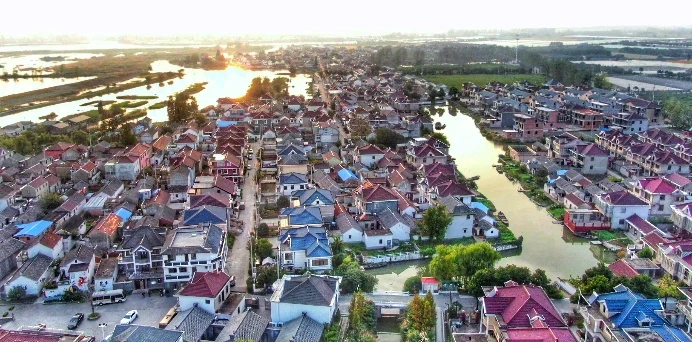
In the early morning distance, rows of individual courtyard houses seem to float on the mist above the water, so light and beautiful. Outside the window, on the private terraced fields across the shore, the fragrance of tea wafts; fishing and resting are both scenery and the beautiful daily life of Dongluo's terraced fields. Before my eyes, the rustic courtyard is simple and elegant, as if it has deleted the trivialities and vulgarities of life.
In every cup of tea, the primal aroma of life is stirred; in every step, the original form of life is imprinted; between dreams and waking, the initial longing for life is called forth. The "cloud above" life in Bishui Dongluo cultivates a splendid existence.
This is Xinghua's Bishui Dongluo Village, known as "China's Most Beautiful Township." The Jiangsu episode of the documentary "Aerial China" once filmed here, making countless people yearn for it. The homestays here are each a scene in themselves, a hot topic on social media.
The development of leisure agricultural tourism has become a distinctive feature of Dongluo Village's rural construction, fully showcasing the characteristics of the water town. Strolling through Bishui Dongluo, spending a leisurely weekend with friends or loved ones—how enjoyable!
In the evening, we took a night tour to carefully observe this city on the water and experience all its beauty.
When night falls, the night cruise on Fengcheng River is the most anticipated activity. Boarding a painted boat to enjoy the night scenery of Fengcheng River, colorful lights outline magnificent bridges and the shimmering river surface; layers of light ripple on the water, romantic and graceful.
The Fengcheng River Scenic Area is surrounded by water, creating charm through water, fully displaying the features of the Jiangnan water town. On the banks of Fengcheng River, the "First Tower of Jianghuai"—Wanghai Tower—along with its unique opera, further highlight the city's cultural heritage. The scenic area centers on Wanghai Tower, radiating in all directions, with the Peach Garden and Old Street complementing each other. Wanghai Tower was first built in the Song Dynasty, and countless literati have left precious calligraphy and poetry for it.
We'll come again tomorrow!
2. From Wanghai Tower to Diaohua Tower: Gardens That Captivate
Before visiting Wanghai Tower again, we first went to Mei Garden and Qiao Garden.
"Character like plum blossom fragrance in bone, person like autumn water jade as spirit." Taizhou is the ancestral home of Mei Lanfang, the master of Peking Opera. In 1984, Mei Garden was built to commemorate the 90th anniversary of Mei Lanfang's birth.
Mei Garden has "four wonders" worth seeing. The first wonder is the Mei Pavilion; the second is the large half-length white marble statue of Mei Lanfang; the third is a large white marble statue in the middle of the pool outside the exhibition hall (the artistic image of Yang Taizhen played by Mei Lanfang in the opera "The Story of Yang Taizhen"); the fourth wonder is a giant stone stele inscribed with a poem by Zhao Puchu composed during his visit to Taizhou.
In 1984, on the 90th anniversary of Mei Lanfang's birth, Mei Lanfang Park (hereafter referred to as "Mei Garden") was built. This master artist, renowned at home and abroad, traced his ancestral home to the fourth generation of his forebears during his stay in Taizhou, located at Bao Ba Village, the current site of Mei Garden.
Entering Mei Garden, along the stone path, you can first visit the Mei Lanfang Historical Materials Exhibition Hall, which displays a large number of photos and artifacts from the master's life. In front of the hall is a semi-circular square; under the eaves of the entrance hangs a plaque with the inscription of the hall's name by former President Li Xiannian. Many buildings inside the park were relocated from Ming and Qing dynasty structures in the urban area.
The deeper you go into the park, a refined and elegant fragrance tempts visitors to search for its source. If you deliberately take a deep breath to smell it, you can't catch it; but when you don't sniff, it fills your nose, instantly refreshing your lungs. It turns out that countless plum trees are densely planted here. Although the peak blooming season has passed, the lingering fragrance in the air does not dissipate...
Qiao Garden, not far from Mei Garden, is also a garden with strong water-town characteristics.
Qiao Garden is located in the old urban area of Taizhou, west of Hailing North Road (formerly called Baziqiao Straight Street) and south of Baziqiao East Street. The existing garden is not large, but it is cleverly designed and has a long history. It is known as the "First Garden of Huai East" and is now a provincial-level cultural relic protection unit in Jiangsu.
The history of Qiao Garden can be traced back to the Rishe Garden of the Wanli period of the Ming Dynasty. It is one of the oldest existing gardens in northern Jiangsu. Over the past 400 years, it has changed owners many times, experienced several rises and falls, and its name has changed in different periods. According to local records: "The Sanfeng Thatched Cottage was the former site of Rishe Garden, the retirement home of Chen Lantai. The garden was later acquired by Gao Lu'an, the prefect, and because there were three stone stalagmites, it was renamed Sanfeng Garden."
After the founding of the People's Republic of China, Qiao Garden was nationalized and converted into a government guesthouse using the garden and its residences, hence called Qiao Garden Guesthouse, later Qiao Garden Hotel. Liu Shaoqi once stayed here during his inspection tour of northern Jiangsu, and in 1956, Mei Lanfang also stayed here during his return hometown visit, making Qiao Garden one of Taizhou's famous attractions.
Last night's night cruise on the Fengcheng River Scenic Area made me crave Wanghai Tower. Today, Wanghai Tower, which I had been longing for, was coming.
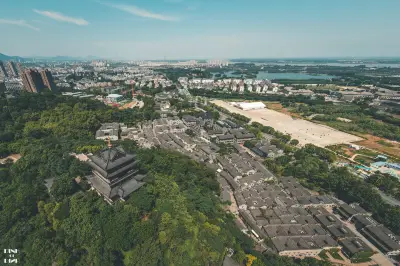
Wanghai Tower is a famous scenic spot in Taizhou, Jiangsu, and a landmark of the city. First built in the second year of the Shaoding reign of the Southern Song Dynasty, it is known as the "First Tower of Jianghuai." The tower has been repeatedly destroyed and rebuilt, most often by war and then restored during prosperous times. Climbing Wanghai Tower, you can overlook the entire city of Taizhou and observe the city's rivers.
Entering the garden, the pavilions, terraces, and towers are charming and delicate; the corridors, kiosks, and winding waterways flow elegantly. Entering the side building, you can see many architectural decorative motifs such as wood carvings, reliefs, and brick carvings. When the lights come on, the ancient buildings with blue bricks and black tiles, mottled walls, and winding deep ancient paths create a dreamlike atmosphere under the illumination.
Taizhou's Wanghai Tower exists because local scholars, though living in villages, had lofty aspirations; though walking on muddy paths, their hearts were on the vast sea. Building this tower allowed them to climb high, look far and near, and broaden their horizons. Throughout history, those who climbed the tower included local figures such as Shi Nai'an, Wang Gen, Zheng Banqiao, Liu Jingting, and Mei Lanfang, as well as outsiders such as Lu You, Fan Zhongyan, Ouyang Xiu, Yue Fei, and Kong Shangren. Monks in cassocks filled the paths with Buddhist chants; eminent monks and great scholars passed continuously. With pairs of cloth shoes and layers of stone steps, the sky grew higher and the earth wider. What place is this? It is an important high platform of Chinese culture.
The design of Wanghai Tower continues the historical architectural style, but its specific form is taller and more magnificent than historical records, with smooth and graceful lines, elegant and refined expression, maintaining a harmonious and consistent style with Taizhou's existing ancient buildings. The city wall ruins will be restored to their original appearance, rebuilt at the original location of the ancient Taizhou city wall. The reconstruction plan of Wanghai Tower was designed by Professor Du Baoshun of Southeast University, who also designed the Yuejiang Tower in Nanjing, one of China's four famous towers. It took him half a year and three drafts to complete.
"Of the world's salt tax, two Huai regions account for half; of the salt tax from the two Huai regions, Taizhou accounts for half." This trip also gave me the opportunity to visit the Jiangsu Salt Tax Museum, where I could vaguely see the prosperous days of Taizhou's salt tax culture.
The Jiangsu Salt Tax Museum's rich historical materials and physical objects comprehensively display the origin, status, and role of salt tax in Chinese history. Each exhibit here has its own story, representing and witnessing the glorious years of Taizhou's salt tax culture.
The museum's exhibition is divided into four sections: the origin of salt tax, the changes in salt tax, the contribution of salt tax, and salt tax and Jiangsu. It reveals the evolution of tax revenue in China, an agricultural country, from agricultural tax to salt tax and industrial-commercial tax. I gained a lot here!
Taizhou not only has elegant Jiangnan gardens but also ancient culture waiting to be explored. Entering the Diaohua Tower, built during the Qianlong reign of the Qing Dynasty, feels like traveling back to ancient times.
Jiangsu is dotted with cultural relics and ancient sites; there are two ancient carved towers, one at Dongshan by Taihu Lake in Suzhou, and the other at Gaogang by the Yangtze River in Taizhou. One in the south, one in the north, like sisters—both are provincial cultural relic protection units in Jiangsu. Suzhou's Dongshan Diaohua Tower is well known to many tourists, while Taizhou's Gaogang Diaohua Tower has long been hidden away, unknown to many.
In the mid-18th century, the Yao family from Jiangnan operated timber sales in Gaogang and built the Yao Family Compound, which was officially completed in the fourth year of the Qianlong reign of the Qing Dynasty. The Yao family prospered for over 160 years, but due to the mismanagement of the owner, it was sold to Li Songru, who was engaged in Yangtze River shipping, in the early years of the Republic of China. After purchasing the Yao Family Compound, Li Songru spent a large sum of money on a massive expansion. Nearly a hundred years have passed since Li's expansion. During this time, it suffered artillery attacks by the Japanese, destruction by the Nationalist army, and vandalism by the Red Guards. Fortunately, the main building, Diaohua Tower, remained largely intact. After careful planning by the Gaogang Construction Bureau and meticulous restoration by the Changshu Ancient Architecture Taizhou Branch, it has been restored to its original appearance, regaining its former glory.
The thousand-year-old ancient town Chaiqu, where Diaohua Tower is located, has a profound heritage and is well known; it has many historical and cultural relics and many traditional-style buildings. Here, you can stroll along ancient streets, select exquisite traditional handicrafts—all these link together the enduring story of Diaohua Tower.
Reluctantly leaving Diaohua Tower, we headed to the Daohe Ancient Block.
Built at the end of the Yuan Dynasty and the beginning of the Ming Dynasty, the Daohe Ancient Block is the largest ancient architectural complex in Taizhou. Its spatial layout is orderly; the Yangtze River water and Huai River water converge here; Hanxi and Wuxiang are located east and west, while Daohe and Caohe run north and south.
The Taizhou Scientific Development Concept Exhibition Hall, designed by Academician He Jingtang, cleverly blends classical elements with modern style—a masterpiece that adds the finishing touch to the block.
Today, I ate the long-famous Taizhou Grass-kiln Sesame Cake, which was very satisfying!
This "grass-kiln sesame cake" has a history of several hundred years. Its deliciousness lies in being baked over a grass fire. Compared to electric baking nowadays, cakes baked over grass are much more flavorful, with a strong smoky taste that common people love. Because the kiln is quite deep, putting the cakes into the fire is a technical skill.
Now, a middle-aged man has been insisting on preserving this craft—very touching. Everyone is also very happy to still be able to eat such delicious "grass-kiln sesame cakes."
3. The Birthplace of the Chinese Navy is Also in Taizhou, and There's the Most Beautiful Qinhu Lake
In early April 1949, the command headquarters of the East China Field Army (Third Field Army) of the People's Liberation Army for the Yangtze River Crossing Campaign was set up in Taizhou. On April 23 of the same year, by order of the Central Military Commission, the first naval force of the People's Liberation Army—the East China Military Region Navy—was declared established here.
The former site of the Navy's birthplace now contains a two-story building in Qing style and a few bungalows. The upper floor was the meeting room of the Third Field Army's Yangtze River Crossing Campaign command center; the lower floor served as the bedrooms and offices of Generals Su Yu, Zhang Zhen, and Zhang Aiping.
The new museum building is novel and unique, with a strong modern atmosphere while containing the thematic features of a memorial hall. The main building's shape resembles a warship. On the left side of the outdoor square stands a high mast symbolizing naval vessels. The square displays a number of decommissioned naval equipment, including bombers, fighters, Super Frelon helicopters, naval guns, torpedoes, and missiles. The indoor exhibition uses various forms such as physical objects, pictures, and models, as well as sound, light, and electrical technology like holographic imaging, audio-visual recordings, and scene creation, to restore multiple historical scenes such as the "Yangtze River Crossing Battle" and "Liberation of Yijiangshan Island," giving visitors a strong visual impact and achieving an organic unity of ideology, artistry, and appreciation.
The Navy Birthplace Memorial Hall has established cooperative relations with dozens of schools and has become an important patriotic education base, the preferred venue for student military training, oath-taking of new Party members and league members, and activities supporting the army and honoring military families. It has become a preaching point for patriotic and national defense education, an important window for the construction of socialist spiritual civilization, and a showcase of Taizhou spirit.
Have you ever appreciated the beautiful scene outlined by water plants and reeds? At Qinhu Lake in Taizhou, we can achieve it.
Every time I open my eyes and see sunshine and scenery together, it's probably one of the happiest things. Qinhu Lake Wetland is known as the "Pearl of Water Towns." Its blue lakes, intertwined river networks, scattered islands and shoals, and unique wetland ecological environment, along with the rural folk culture of the Lixia River region, are its distinctive landscape features.
After long-term accumulation and development, the park has formed a water environment scenic area centered on Qinhu Lake, a wetland ecological scenic area under the brand "Milu Hometown," an ecological agricultural park based on "Global Top 500 Ecology," a hot spring resort area formed by comprehensive development and utilization of Qinhu Lake geothermal resources, and cultural landscapes represented by Qintong Ancient Town and the China Jiangyan Qintong Boat Festival.
Qinhu Lake Wetland lies on the East Asia–Australia migratory flyway for global migratory birds. With abundant sunlight, lush aquatic plants, and rich aquatic resources, it has always been an ideal wintering ground for migratory waterfowl. The Qinhu Lake Waterfowl Park draws on the concept of the London Wetland Park. By dredging the waterways within the park and combining with terrain modification, it creates small spaces centered on water, constructing a diverse wetland ecological environment to provide the best bird habitat for different species and habits of flying birds and waterfowl.
Qinhu Lake remains as smooth as a mirror all year round, with clear water. It is rich in pollution-free green products such as fish, shrimp, water chestnuts, and water caltrops. The islands in the lake are dotted with lush cattails. During the day, sailing boats drift; at night, fishing lights twinkle—pleasant for both people and travel.
Qinhu Lake has a long history and rich folk legends. During the Southern Song Dynasty, Yue Fei's volunteer army fought fiercely with Jin soldiers at Qinhu Lake. The local people came here every Qingming Festival to pay homage. Over time, this evolved into an annual water town folk event—the China Jiangyan Qintong Boat Festival.
The nearby ancient town—Qintong Ancient Town—is also a particularly charming place. Located at the junction of Yancheng, Nantong, and Taizhou, where the Yangtze River system and the Huai River system meet, it is a famous historical and cultural town in China. Surrounded by water, the town has a pleasant environment.
Qintong Ancient Town is well preserved. A large number of Ming and Qing dynasty architectural complexes, such as Xiaojinhua Lane and Baxianqiao Lane, retain their original style and antique charm. The "China Camellia King" in the ancient Camellia Courtyard is 11 meters tall and hundreds of years old. Every year around Qingming Festival, tens of thousands of camellia flowers bloom, astonishing visitors.
Of course, when traveling in Taizhou, you must not miss Taizhou morning tea—it can take you back to the old days.
Wake up naturally, no need for a morning call. Taizhou people live at a very slow pace and know how to enjoy time. There is a saying in Taizhou: "In the morning, skin wraps water; in the evening, water wraps skin," referring to the habit of drinking tea in the morning.
At Guyue Restaurant, we enjoyed a breakfast full of color, aroma, and taste: a pot of good tea, plus crab roe buns, fish soup noodles, and shredded dried tofu—the three most commonly ordered foods by Taizhou locals.
Water shimmering, rivers and seas melodious...
Even the busiest life can be healed by Taizhou like this!
Is this Oriental Venice the watery Taizhou you love?!